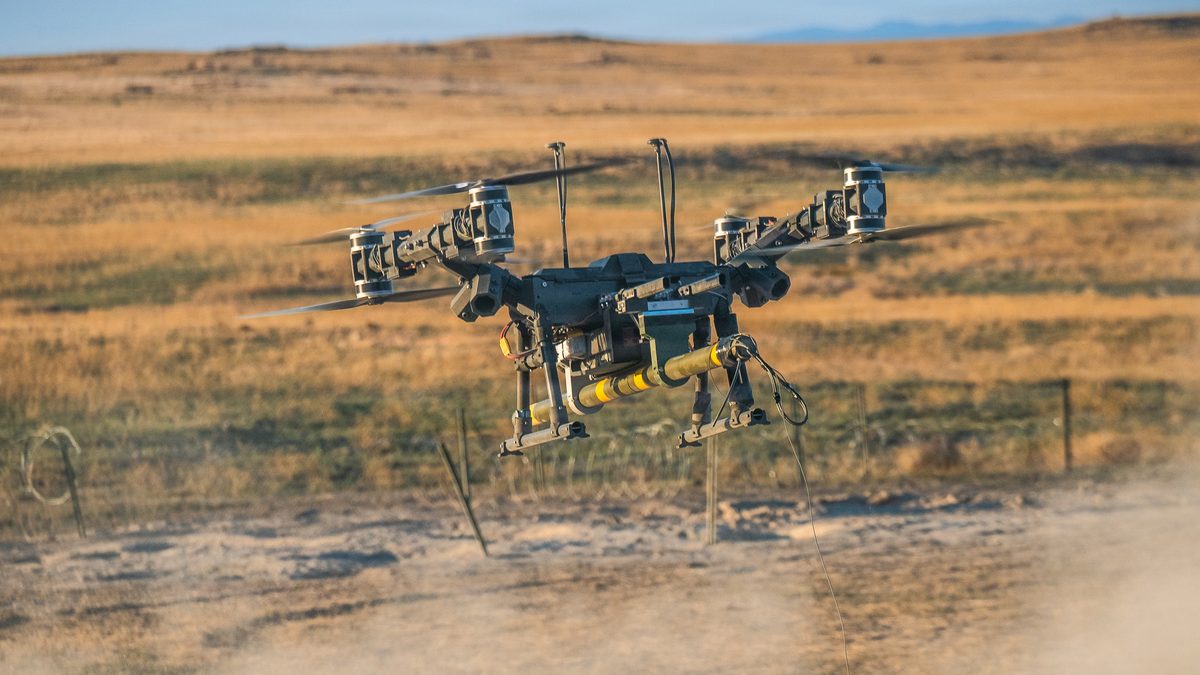
Illustrative of the mission set, not the Coriolis: a Lorica Technologies Mule 28 unmanned aerial system carries a live, primed M1A3 Bangalore torpedo toward a concertina wire obstacle during a proof-of-concept drone-delivered breach by Bravo Company, 741st Brigade Engineer Battalion, 41st Infantry Brigade Combat Team, Range 22, Orchard Combat Training Center, Idaho, 22 June 2026. Photo: Maj. Wayne Clyne, Oregon National Guard Public Affairs Office, U.S. Department of War, public domain, via DVIDS. Use does not imply endorsement.
Dragoon Technology Wins $9.9 Million to Integrate Energetics into the Coriolis Unmanned Aerial System
On 6 August 2026 Dragoon Technology of Tucson, Arizona was awarded a $9,879,151 firm-fixed-price contract for non-recurring engineering to integrate energetics into its internally developed Coriolis unmanned aerial system. The work sits under Small Business Innovation Research Phase II topic A234-P017, Engineer Operations, and runs to August 2028. Naval Air Warfare Center Aircraft Division, Lakehurst, New Jersey is the contracting activity.
Technical Summary
The announcement is short but every clause in it carries weight. Dragoon Technology LLC, a small business at Tucson, Arizona, receives $9,879,151 firm-fixed-price for non-recurring engineering (NRE) to integrate energetics into the Coriolis unmanned aerial system (UAS), and to support test and evaluation events assessing the operational suitability and performance of Coriolis with onboard collaborative autonomy across multiple systems. Funding is $8,999,945 of fiscal 2025 research, development, test and evaluation money, Defense Wide. The route is Small Business Innovation Research (SBIR) Phase II topic A234-P017, Engineer Operations, transitioned through the Office of the Secretary of War Accelerated Research for Transition programme. The action was competed other than full and open, with one firm solicited and one offer received. Work is 97 per cent at Tucson and 3 per cent at Tampa, Florida, completing in August 2028.
The phrase that matters to ordnance staff is integrate energetics. Coriolis is described as an internally developed air vehicle, which means this award does not buy a munition. It buys the engineering that converts an existing unarmed airframe into one that carries energetic material, and the qualification evidence that goes with it. The topic coding is the strongest available clue to what that material is. Engineer Operations covers breaching, obstacle reduction, route clearance and demolition, so a bulk demolition or breaching charge is at least as plausible a payload as a shaped-charge anti-armour warhead. Neither reading is confirmed in the announcement, and ISC treats the payload nature as an open question rather than an inference.
Two open-source records narrow the picture. Dragoon describes Coriolis as a long-endurance hybrid-electric fixed-wing air vehicle under 30 lb (about 13.6 kg), combining an internal-combustion cruise element with battery power, and in January 2026 the company reported a continuous flight of 14.7 hours covering more than 916 miles (1,474 km). The type has flown beyond-visual-line-of-sight weather-sounding sorties with the National Oceanic and Atmospheric Administration. A sub-30 lb airframe constrains what can be carried: on ISC assessment any energetic payload will be a modest net explosive quantity in a modular form rather than a heavy warhead, which again points toward a delivered charge rather than an integral anti-armour shaped charge.
The second record is the predecessor. The same topic code, A234-P017, funded an Army Small Business Innovation Research Phase II with Dragoon, contract W51701-25-C-A009, worth $1,899,913 and titled Low-cost UAS Platform for Edge Computing Applications. Its period of performance ran from 23 January 2025 to 3 August 2026. The published abstract states that the Phase II effort would optimise a low-cost onboard sensor package, implement government-owned autonomy software, and demonstrate collaborative teaming, producing an optionally disposable, highly autonomous system deployable in mass. That contract ended on 3 August 2026. The energetics award was announced three days later. The sequence reads as a deliberate hand-off rather than a coincidence: the autonomy and sensing work finished, and the payload work started immediately.
One structural detail deserves noting. A234 is an Army topic series and the predecessor was an Army contract, yet the contracting activity for this award is Naval Air Warfare Center Aircraft Division, Lakehurst, and the money is Defense Wide rather than Army. The transition has moved across service boundaries. Lakehurst carries deep institutional weight in air-vehicle and store-carriage engineering, which is consistent with an award about integrating a store onto an airframe, but the announcement does not explain the routing and ISC does not infer a sponsor from it.
The award buys non-recurring engineering, not munitions. It funds the step at which an unarmed air vehicle acquires an energetic payload, and that step is where fuzing safety, hazard classification and storage licensing all begin. ISC assessment, 9 August 2026
Analysis of Effects
Adding energetics to an air vehicle is a certification event, not a bolt-on. Once an energetic payload and its initiation train are present, the system acquires an explosive safety case it did not previously need. Fuze design safety criteria for United States systems sit under MIL-STD-1316, which drives requirements such as independent safety features and an out-of-line explosive train until arming conditions are met. System safety analysis sits under MIL-STD-882E. Hazard assessment and insensitive munitions (IM) response testing sit under MIL-STD-2105E. Explosives safety siting for whatever quantity is eventually stored follows DESR 6055.09 Edition 1 Change 2. None of those obligations attach to a sensing UAS. All of them attach the moment the payload is energetic, and the cost and schedule of meeting them routinely exceed the cost of the airframe.
The second clause, collaborative autonomy across multiple systems, compounds the safety problem rather than sitting beside it. A single armed air vehicle under positive control presents a bounded arming and release case. Several armed vehicles cooperating, sharing target data and reallocating tasks between themselves present a case where arming state, geographic release constraints and abort authority have to hold across a distributed system whose internal decisions are not individually commanded. The relevant question for a safety board is not whether each vehicle can be armed safely but whether the ensemble can be guaranteed to disarm. That is a harder assurance argument and it is one the standards above were not originally written to answer.
Personnel and Safety Considerations
For practitioners the immediate handling consequence is that Coriolis test articles will move through the ranges, magazines and transport chain as explosive stores once the payload is fitted, and will need a hazard division (HD) and compatibility group (CG) assignment and a stated net explosive quantity (NEQ) in kilograms of trinitrotoluene equivalent for each packaging configuration before that happens. Storage compatibility is not automatic: an air vehicle containing a lithium battery, an energetic payload and an initiation device may not share a compatibility group with either a bare charge or an inert airframe. Test and evaluation events named in the award are the point at which those assignments become real rather than provisional, and the interim classification used for the trials should not be carried forward into service storage without a fresh assessment.
Data Gaps
Six gaps are material. First, the nature of the energetic payload is unstated: bulk demolition explosive, shaped charge and fragmentation cannot be distinguished from the announcement. Second, no NEQ is given, so no siting or transport implication can be calculated. Third, the initiation and safety and arming architecture is unstated, including whether an electronic safety and arming device to MIL-STD-1316 is in the design. Fourth, no HD or CG assignment is published. Fifth, the Coriolis air vehicle is only partly documented: mass class and endurance are published by the manufacturer, but payload fraction, recovery mode and the armed configuration are not, and no specification exists in open sources for a Coriolis carrying energetics. Sixth, the 3 per cent work share at Tampa, Florida is unexplained in the announcement, and ISC has found no open-source basis for attributing it to a named facility or subcontractor.
Key Questions
What does integrating energetics into a UAS actually involve?
It means designing the payload bay, mounting, initiation train and safety and arming provisions so an air vehicle can carry and function an explosive charge, then generating the qualification evidence. In United States practice that pulls in MIL-STD-1316 fuze safety criteria, MIL-STD-882E system safety and MIL-STD-2105E hazard and insensitive munitions testing. It is an engineering and certification programme, not an installation.
Is the Coriolis a loitering munition?
The announcement does not say so. It describes an internally developed unmanned aerial system receiving an energetic payload under Small Business Innovation Research topic A234-P017, Engineer Operations. That topic covers breaching, obstacle reduction and demolition, so a delivered demolition charge is as consistent with the wording as an anti-armour warhead. ISC treats the classification as unresolved.
Why is a $9.9 million small business award worth attention?
Because it funds a transition, not a study. Small Business Innovation Research Phase II money moving through the Accelerated Research for Transition programme, with $8,999,945 obligated at award and test events written into the scope, indicates a path toward fielding. Armed autonomous air vehicles reaching that stage set precedents for explosive safety certification that outlast the individual programme.
References
Source-evaluated under NATO STANAG 2022 (Reliability A–F / Accuracy 1–6). Tier 1 = government primary source; Tier 2 = quality news / specialist defence media; Tier 3 = authoritative aggregator / encyclopaedia.
- T1U.S. Department of War – Contracts for Aug. 6, 2026, 6 August 2026. (Reliability A / Accuracy 1)
- T1U.S. Department of Defense, Defense Standardization Program – MIL-STD-1316, Safety Criteria for Fuze Design, accessed 9 August 2026. (Reliability A / Accuracy 1)
- T1U.S. Department of Defense – DESR 6055.09 Edition 1 Change 2, Defense Explosives Safety Regulation, accessed 9 August 2026. (Reliability A / Accuracy 1)
- T2Small Business Innovation Research programme – SBIR Phase II topic structure and transition pathways, accessed 9 August 2026. (Reliability B / Accuracy 2)
- T2Naval Air Warfare Center Aircraft Division – Naval Air Warfare Center Aircraft Division, Lakehurst, contracting activity, accessed 9 August 2026. (Reliability B / Accuracy 2)
- T1U.S. Small Business Administration, SBIR – Award 215361, Dragoon Technology LLC, contract W51701-25-C-A009, topic A234-P017, $1,899,913, 23 January 2025 to 3 August 2026, accessed 9 August 2026. (Reliability A / Accuracy 1)
- T2NOAA Technology Partnerships Office – SBIR success story: single-flight drones and the Dragoon Coriolis hybrid-electric platform, accessed 9 August 2026. (Reliability B / Accuracy 2)
- T1U.S. Department of War / DVIDS – Oregon engineers breach wire obstacle with drone-delivered Bangalore, Orchard Combat Training Center, Idaho, 22 June 2026. (Reliability A / Accuracy 1)
Corrections & updates welcome. If you hold open-source data that refines or corrects any parameter in this article, please contact [email protected] citing the specific claim and your source. Verified corrections will be incorporated and credited in the revision history. AI-assisted technical assessment based on open-source material. Not a formal intelligence product.