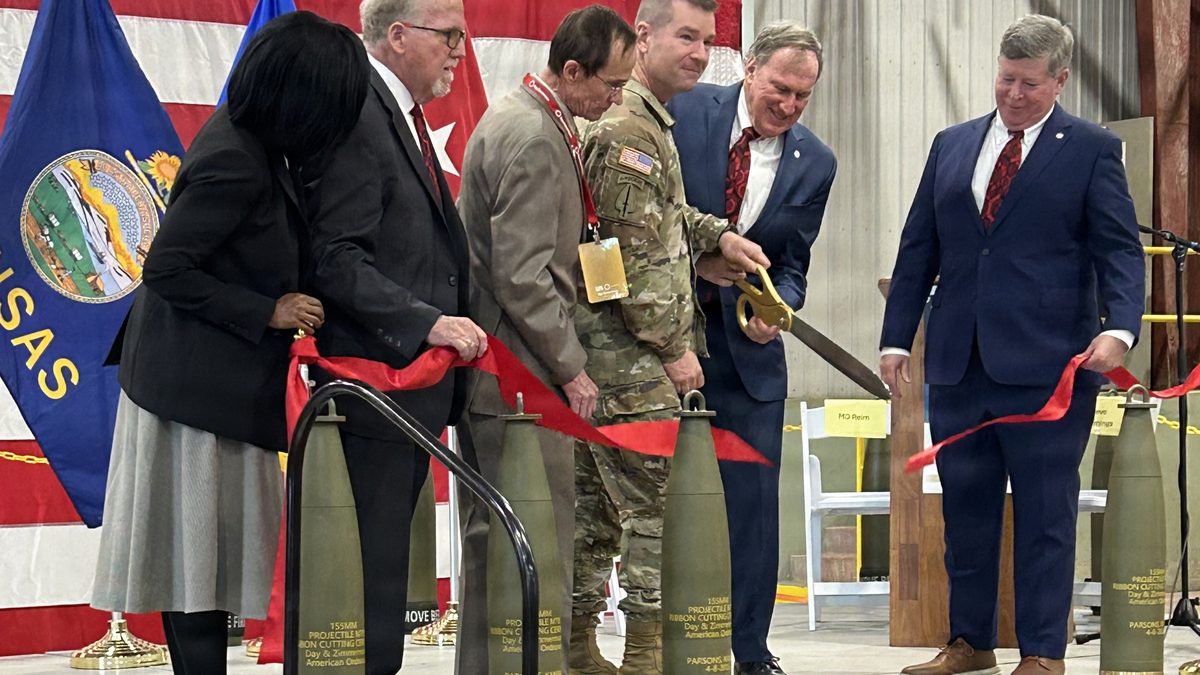
Load, assemble and pack: the United States Army and Day & Zimmermann opened a new 155 mm projectile facility at Parsons, Kansas, on 8 April 2026. Photo: Eric Kowal, Picatinny Arsenal, U.S. Army, public domain via the Defense Video Imagery Distribution System (DVIDS). Illustrative. The plant shown is American, not Canadian.
Redundant, Not Sovereign: The Case for an ASP Energetics and Explosives Supply Cell
Canada committed approximately C$1.4 billion on 18 March 2026 to four ammunition production lines, including C$355.7 million for a nitrocellulose facility at Valleyfield and up to C$642 million for 155 mm high explosive load, assemble and pack at Le Gardeur. Nitrocellulose production is planned to start in 2029. The Allied value is redundant qualified capacity, not self-sufficiency, and the vehicle is NATO’s Ammunition Support Partnership (ASP).
Technical Summary
Canada announced approximately C$1.4 billion for domestic ammunition production on 18 March 2026 and restated the package on 8 April 2026, funding it through the Canadian Defence Industry Resilience (CDIR) programme. Four lines were named. General Dynamics Ordnance and Tactical Systems Canada (GD-OTS Canada) receives C$355.7 million for a nitrocellulose (NC) facility at Valleyfield, Quebec, up to C$57.9 million for the country’s first facility able to load, assemble and pack (LAP) M231 and M232 charge modules for 155 mm artillery, and up to C$642 million for a 155 mm high explosive (HE) projectile LAP plant at Le Gardeur, Quebec. IMT Precision at Ingersoll, Ontario, receives up to C$305.4 million for empty 155 mm projectile bodies. Canada’s Defence Industrial Strategy, published on 17 February 2026, states that domestic nitrocellulose production is to start in 2029.
That is a materially different proposition from a subcontract award, because it closes four consecutive stages of the same chain: energetic feedstock, propelling charge assembly, projectile body manufacture and high explosive filling. It is also being built inside a procurement structure that has not changed. The Munitions Supply Program (MSP) run by Public Services and Procurement Canada directs contracts to five predetermined strategic sources: GD-OTS Canada for small, medium and large calibre ammunition, propellants and explosives; Magellan Aerospace for rockets and illuminating stores; IMT Defence, which now trades as IMT Precision, for forged projectiles and precision machining; Colt Canada for small arms; and HFI Pyrotechnics for pyrotechnic items. The C$305.4 million projectile-body award therefore went to an existing strategic source under a newer name, not to a new entrant. The published programme description sets out no competitive route by which a sixth company becomes a strategic source.
Roughly three quarters of the European Union’s €500 million ASAP allocation, some €372 million, went to powder and explosives rather than to shell bodies. Energetics, not machining capacity, is where the Alliance shortage actually sits. ISC assessment, derived from European Commission ASAP allocation figures
What the money actually buys
| Line | Recipient and site | Value | Maturity | Dependency it reduces |
|---|---|---|---|---|
| Nitrocellulose production | GD-OTS Canada, Valleyfield, Quebec | C$355.7 million | Funded, output from 2029 | European and Asian nitrocellulose sourcing |
| M231 and M232 charge LAP | GD-OTS Canada, Valleyfield, Quebec | Up to C$57.9 million | Funded, first of type in Canada | Single-continent charge assembly |
| 155 mm HE projectile LAP | GD-OTS Canada, Le Gardeur, Quebec | Up to C$642 million | Funded | European high explosive filling queues |
| Empty 155 mm projectile bodies | IMT Precision, Ingersoll, Ontario | Up to C$305.4 million | Funded | Forging and machining bottleneck |
| Energetic materials campus | NALAGX owner, EURENCO operator, Canada | Not disclosed | Letter of intent, plant targeted 2029 | Concentration of European process knowledge |
| NC, propellants and rocket fuels | MKE, Kırıkkale, Türkiye | Part of US$1.5 bn (2023–2027) | Trade-press report, operation during 2026 | Alliance-wide nitrocellulose concentration |
| NC-based powders, 6,000 t/year | CellCore Technologies, Saskatchewan | Not disclosed | Company statement, late 2028 | Incumbent concentration inside Canada |
Analysis of Effects
The Canadian lines map closely onto shortages the Alliance has already documented. Under the 2023 Act in Support of Ammunition Production (ASAP), the European Commission selected 31 projects in 2024 worth €500 million, of which approximately €248 million went to propellant powder and €124 million to explosives, against roughly €90 million for shells. The follow-on European Defence Industry Programme (EDIP) put €166.4 million into a single call for energetic components covering propellant powder, explosives, warheads, electronic fuzes, filling plants and raw material access. That call, reference EDF-EDIP-P-2026-LS-IRA-EC, closed on 16 June 2026 having drawn 83 proposals from 23 Member States and Norway, with expected co-financing taking total investment to around €470 million. The United Kingdom is running the same problem from the other end, having pledged at least six new energetics and munitions factories covering RDX, HMX, trinitrotoluene (TNT), nitrocellulose, nitroglycerine, nitroguanidine, hexanitrostilbene, ammonium perchlorate and boron potassium nitrate, with construction of the first plant expected to begin during 2026.
Against that backdrop Canada offers four things a European or British programme manager can actually use. It offers a additional nitrocellulose source outside the European Union and on a different continent from both the European incumbents and the Turkish programme described below, though no Canadian output is yet qualified by any receiving nation. That matters because a single plant outage or an export restriction currently propagates straight into propellant output. It offers intermediate and downstream 155 mm capacity rather than raw material alone, since projectile bodies, charge assembly and high explosive filling are funded together. It offers a transatlantic production reserve, where plants run a minimum always-on rate for national requirements and hold surge options for Allies. And it offers a European technology with Canadian capacity model: EURENCO of France and Canadian company NALAGX signed a letter of intent on 18 November 2025 for a Canadian energetic materials campus, NALAGX-owned and EURENCO-operated, with a first explosives plant targeted for 2029. Market access now exists to match. The Council of the European Union concluded an agreement on 15 June 2026 admitting Canada to the Security Action for Europe (SAFE) instrument, making Canada the first non-European country to participate, and the United Kingdom and Canada issued a joint statement on defence financing on 8 July 2026 committing to keep their respective initiatives coherent and mutually supportive.
An Ally whose reported timeline arrives sooner
Canada is not the only Ally building this, and the case that arrives sooner belongs in the argument rather than in a footnote. Türkiye has been running a state programme through Makina ve Kimya Endüstrisi Anonim Şirketi (MKE), the state-owned mechanical and chemical industry joint-stock company, reported at approximately US$1.5 billion spread across 2023 to 2027 and three factories, which is not directly comparable with the Canadian 2026 award tranche. Its centrepiece is an energetic materials factory at Kırıkkale producing nitrocellulose, propellants and rocket fuels, with operation expected during 2026 and a reported threefold increase in capacity for those materials. Separately, the Turkish manufacturer Repkon, which took a majority share in 2024 in Bowas, the Swiss-registered and Austrian-operating explosives-plant equipment specialist, is reported to be establishing an explosive filling facility in Germany for operation by early 2027.
If those dates hold, an Allied nitrocellulose source outside western Europe reaches production roughly three years before Valleyfield’s 2029 start, and a Turkish-built filling line inside the European Union is running well before Le Gardeur, for which no Canadian production date has been published at all. That does not weaken the case for Canadian capacity, because the argument was never that one plant fixes the shortage. It sharpens it. Two Allies building the same class of capability on different continents and different timetables is precisely the redundancy the Alliance lacks, and it is also precisely the situation that goes to waste without common qualification and a published demand signal. The qualification is that only the Kırıkkale line adds geographic separation. The Repkon plant sits inside the same European filling base whose queues Le Gardeur exists to bypass, so it deepens European capacity rather than distributing it. Nitrocellulose sources that no receiving nation has cross-accepted are still one source in a crisis, however many of them get built.
One caveat is load-bearing and belongs next to the claim rather than beneath it. The Turkish figures come from Turkish defence trade reporting rather than from a government publication or an audited statement, and the capacity multiples attached to them are announcements, not verified output. They are treated here as the Canadian independent claims are treated: reported, attributed and listed in the data gaps.
Why the obvious mechanism does not work
The intuitive answer is to have the Alliance aggregate demand for energetics the way it aggregates demand for ammunition. That answer is wrong, and the reason is worth stating plainly, because it disposes of most of what gets proposed in this area. Nations do not buy energetics. They buy finished rounds. The contracting chain runs from the nation through the NATO Support and Procurement Organisation to a prime contractor, and it stops there. Propellant, high explosive fill and the chemical precursors underneath them are bought by the prime from its own suppliers, under contracts to which no Ally is a party and of which no Ally has sight.
The consequence is an asymmetry rather than an inconvenience. A failure two tiers down reaches the nation as a delivery slip on a framework call-off, and the nation’s remedy is liquidated damages against the prime. That converts an industrial failure into a cash transfer and produces no additional propellant. The party carrying the operational risk has neither visibility of, nor a remedy against, the party that caused it. Europe understood this early and answered it with money rather than orders: ASAP and EDIP pay energetics manufacturers directly, because a grant needs no contractual relationship with the recipient’s customer. NATO has no comparable instrument.
What NATO already runs, and where each instrument stops
This is not empty ground. The Defence Production Action Plan agreed at the 2023 Vilnius Summit covers aggregating demand, industrial challenges and interoperability, and was updated on 13 February 2025 to add raw materials and supply chains and to implement the Industrial Capacity Expansion Pledge. The Defence Industrial Production Board, created in December 2023, gives Allies a forum on industrial capacity and defence-critical supply chains, meets at least twice a year and reports to the Conference of National Armaments Directors. A Defence-Critical Supply Chain Security Roadmap was endorsed in June 2024. At the Summit Defence Industry Forum in Ankara on 7 July 2026 NATO launched Front Door, which publishes a consolidated unclassified demand signal, and the NATO Engine, which the NATO Support and Procurement Agency (NSPA) manages as a pilot running to December 2027 with a Conference of National Armaments Directors evaluation in the first quarter of 2028.
Two gaps run through all of it. The first is that the list of 12 defence-critical raw materials NATO published on 11 December 2024 consists of aluminium, beryllium, cobalt, gallium, germanium, graphite, lithium, manganese, platinum, rare earth elements, titanium and tungsten. Every entry is a metal or a mineral. There is no nitrocellulose, no cellulose feedstock, no nitric acid, no ammonium nitrate and no ammonium perchlorate. The one NATO instrument built to see through to raw material supply does not look at the class of material that has been holding up artillery ammunition delivery across the Alliance.
The second is that the NATO Engine works by matching latent capacity, and opens on additive manufacturing, engineering services and manufacturing as a service, with air defence and strike as the first capability areas. That is a sound instrument for machined parts and castings. It does very little for energetics, because nitration is a licensed, sited, permitted and safety-cased process with quantity distance constraints and multi-year construction lead times. There is no idle nitration line waiting to be found on a platform. This capacity is created, not matched.
A mechanism, not another committee
What the list above has in common is that none of it signs anything. Policy boards, roadmaps, demand publications and capacity registries all stop at the prime, and so does every conversation they host. The Ammunition Support Partnership is the only body in the architecture that holds a contract, and a contract is the only lawful route to the tier below the one you are buying from. That, and not a shortage of coordination, is what an ASP energetics and explosives supply cell would exist to exploit.
Three functions follow from it, in the order they should be attempted. First, qualification. Fund cross-qualification and mutual recognition, linked to the AC/326 Ammunition Safety Group and its energetic materials specialists and to the European joint qualification work. A second source that a receiving nation will not accept is not a second source, and this workstrand needs no contractual relationship with anyone, which is why it should run first regardless of what happens to the rest. Second, visibility. Bind the prime, in the framework contract, to declare its energetics sources by site, its qualified alternates, its lead times and any single point of failure below the first tier, with NSPA holding the returns as custodian rather than circulating them among 28 nations. This needs no new mandate and no new budget. It needs different contract wording at the next competition. Third, the demand signal. The partnership already knows the contracted round volumes across its participating nations, and rounds convert to energetics through a bill of material, so NSPA can publish a derived forecast in tonnes of propellant by family, nitrocellulose by nitrogen grade and high explosive fill by type without any nation buying a kilogram of it. That is the artefact a supplier’s investment committee needs and cannot currently obtain.
Two harder instruments sit behind those and should be treated as pilots rather than policy. Capacity reservation pays an option fee to hold a defined tonnage of nitration or filling capacity, callable on surge and priced whether or not it is called, which finances a plant without anyone owning it. Government furnished material goes further: NSPA buys a critical commodity centrally and free issues it to the load, assemble and pack contractor, which moves the relationship inside the contractual perimeter but hands the agency title, storage, quantity distance liability, insurance and a weakened supplier warranty on Class 1 material. Worth trying on one commodity in one nature, and not more.
A first pilot worth running
Combine Canadian nitrocellulose output, British and European propellant and charge process expertise, Canadian 155 mm charge and high explosive LAP, one common qualification package, and multi-year offtake commitments from Canada, the United Kingdom and several European ASP participants. Measure it on qualified second sources, share of capacity covered by long-term orders, lead-time reduction, supplier diversity and cross-national interchangeability. Do not measure it on money announced. And weight the derived forecast on historical call-off conversion rather than declared national requirement, because framework contracts carry ceiling values that nations routinely do not exercise, and a supplier that builds to an overstated forecast is left holding the stranded capacity. One metric should be set hard: the share of Canadian output that achieves mutual recognition in at least two European ASP participants within 36 months of first production. If that number stays low, the capacity exists on paper and nowhere else.
One objection cuts at this proposal rather than at the Canadian one, and it deserves to be met rather than managed. Concentrating the derived demand of 28 nations onto a European energetics base of a handful of qualified suppliers creates a dominant buyer facing a thin supply side. The predictable result is that incumbents holding existing qualifications capture the long-term agreements and the barrier to entry rises, which is the same failure this article levels at a five-company Munitions Supply Program. A cell built without an explicit entrant allocation, and without the staged on-ramp that runs from test and research access through facility accreditation, pilot production and national qualification to framework eligibility, would reproduce at Alliance scale exactly the closure it was written to correct.
Personnel and Safety Considerations
Insensitive munitions are an enabler here, but the shipping argument attached to them is routinely overstated. Canada has ratified NATO STANAG 4439, Policy for Introduction, Assessment and Testing for Insensitive Munitions, without reservation, and requires ammunition and explosives used by the Department of National Defence and the Canadian Armed Forces to be assessed against its goals, with the threat analysis set out in Allied Ordnance Publication (AOP) 39. Canadian policy states that insensitive munitions may provide more cost effective and efficient transport, storage and handling. Three qualifications apply. Insensitivity is a certified property of a complete munition in a defined configuration, not of the explosive filling considered alone, so a compliant fill in a different projectile or packaging is a new assessment. Every product still needs national qualification and acceptance in the receiving state. And the article normally remains Class 1 dangerous cargo subject to export control, packaging, carrier, port and quantity distance requirements. The chemistry illustrates the point. Nitrocellulose is transported wetted, typically as UN 2555 with not less than 25 per cent water or UN 2556 with not less than 25 per cent alcohol, both Class 4.1 flammable solid, whereas dry or insufficiently wetted nitrocellulose falls under UN 0340, and unmodified or lightly plasticised nitrocellulose under UN 0341, both at Hazard Division 1.1, compatibility group D. A 155 mm high explosive projectile of the widely fielded M795 pattern carries a nominal 10.8 kg TNT fill, or the insensitive IMX-101 alternative in later production, and is typically classified at HD 1.1D in national hazard classification systems, while modular propelling charges are generally assigned to Hazard Division 1.3. Lowering a hazard division improves ship loading, magazine density and consequence management. It does not convert ammunition into ordinary commercial freight, and NSPA continues to run a separate commercial transportation engagement track, holding its fifth Transportation Industry Day in 2026.
Data Gaps
The following remain unresolved on open sources and are recorded rather than estimated. First, the projectile pattern, explosive fill and net explosive quantity (NEQ) per round for the Le Gardeur line are not stated in either Canadian announcement; the M795 figures above are the reference pattern, not a Canadian specification. Second, the hazard division and compatibility group Canada will assign to its M231 and M232 charge output are not published. Third, no annual tonnage or nitrogen-grade split has been published for the Valleyfield nitrocellulose plant; only the 2029 production start appears in the Defence Industrial Strategy. Fourth, the EURENCO and NALAGX arrangement is a letter of intent, not a final investment decision, and the site location and capital structure are not confirmed in the company announcement. Fifth, CellCore Technologies stated on 24 March 2026 that it will build an Indigenous-owned nitrocellulose facility in Saskatchewan with 6,000 tonnes of annual nitrocellulose-based powder capacity and first production in late 2028; capacity, contracts and schedule are company statements with no published government validation. Sixth, the agenda of the NSPA Transportation Industry Day could not be retrieved, as the agency site rejects automated retrieval, so its scope is taken from the published item title alone. Seventh, no competitive on-ramp to MSP strategic-source status has been published. Eighth, the Turkish figures rest on trade reporting rather than on a government publication or an audited figure, and the corroboration is thinner than it looks. The programme value, the 2026 Kırıkkale date and the threefold capacity claim appear in two trade outlets on the same day, both tracking one MKE announcement rather than reporting independently. The early 2027 date for the Repkon filling facility in Germany rests on a single outlet reporting in February 2025 and not updated since. No independent verification of Turkish nitrocellulose tonnage was located. Ninth, NSPA does not publish the ASP participant roster. Whether Canada and Türkiye are among the 28 participating nations could not be confirmed on open sources, and the mechanism proposed here assumes at minimum that Canadian suppliers can be reached through ASP framework contracts.
Key Questions
How much has Canada committed to domestic ammunition production in 2026?
Canada committed approximately C$1.4 billion, announced on 18 March 2026 and restated on 8 April 2026 under the Canadian Defence Industry Resilience programme. The awards are C$355.7 million for a nitrocellulose facility at Valleyfield, up to C$57.9 million for M231 and M232 charge loading, up to C$642 million for 155 mm high explosive projectile loading at Le Gardeur, and up to C$305.4 million to IMT Precision for empty projectile bodies.
Can Canadian companies bid into European Union defence funding?
In part, yes. The Council of the European Union concluded an agreement on 15 June 2026 admitting Canada to the Security Action for Europe instrument, making Canada the first non-European country to participate. The agreement had been signed on 14 February 2026. It opens SAFE-financed procurement to Canadian companies and Canadian-origin products, subject to the instrument's eligibility rules.
Do insensitive munitions remove shipping restrictions on ammunition?
No. Canada ratified NATO STANAG 4439 without reservation and assesses munitions against its goals using the AOP-39 threat analysis, and its own policy says insensitive munitions may allow more efficient transport, storage and handling. Insensitivity is certified for a complete configured munition, not for a filling, and the item normally stays Class 1 dangerous cargo under export control, packaging and quantity distance rules.
Is Canada the first Ally to build new nitrocellulose capacity?
No. Türkiye's MKE reports a US$1.5 billion programme running from 2023 to 2027 whose Kırıkkale energetic materials factory is expected to operate during 2026, around three years before Canada's Valleyfield plant. Those figures come from Turkish trade press rather than a government publication. Two Allies on different continents is redundancy only if the output is cross-qualified.
References
Source-evaluated under NATO STANAG 2022 (Reliability A–F / Accuracy 1–6). Tier 1 = government primary source; Tier 2 = quality news / specialist defence media; Tier 3 = authoritative aggregator / encyclopaedia.
- T1Department of National Defence (Canada) – Minister McGuinty announces investment of $1.4 billion into Domestic Ammunition Production, 18 March 2026. (Reliability A / Accuracy 1)
- T1Department of National Defence (Canada) – Canada’s Defence Industrial Strategy: Security, Sovereignty, Prosperity, 17 February 2026. (Reliability A / Accuracy 1)
- T1Public Services and Procurement Canada – Munitions Supply Program, accessed 9 August 2026. (Reliability A / Accuracy 1)
- T1Council of the European Union – SAFE: Council concludes agreement with Canada, 15 June 2026. (Reliability A / Accuracy 1)
- T1European Commission, DG Defence Industry and Space – First EDIP call closes and receives high number of proposals, 17 June 2026. (Reliability A / Accuracy 1)
- T1UK Ministry of Defence – New energetics factories for the UK, updated 23 June 2026. (Reliability A / Accuracy 1)
- T1Department of National Defence (Canada) – DAOD 3002-2, Insensitive Munitions, accessed 9 August 2026. (Reliability A / Accuracy 1)
- T1Department of National Defence (Canada) – Minister Lightbound underscores investment of $1.4 billion into Domestic Ammunition Production, 8 April 2026. (Reliability A / Accuracy 1)
- T1European Commission, DG Defence Industry and Space – ASAP: boosting defence production, accessed 9 August 2026. (Reliability A / Accuracy 1)
- T1Prime Minister of the United Kingdom and Prime Minister of Canada – Joint statement on defence financing, 8 July 2026. (Reliability A / Accuracy 1)
- T3CellCore Technologies via ACCESS Newswire – CellCore Technologies Emerges from Stealth at DEFSEC West, 24 March 2026. (Reliability C / Accuracy 3, company statement)
- T1NATO – Increasing defence industrial production, accessed 9 August 2026. (Reliability A / Accuracy 1)
- T1NATO – NATO releases list of 12 defence-critical raw materials, 11 December 2024. (Reliability A / Accuracy 1)
- T1NATO – NATO launches new initiatives to accelerate defence industrial cooperation, 7 July 2026. (Reliability A / Accuracy 1)
- T2NATO Support and Procurement Agency, via GlobalSecurity mirror – NSPA launches NATO Engine platform to expand Alliance production capacity, 16 July 2026. (Reliability B / Accuracy 2)
- T2NATO Support and Procurement Agency, via GlobalSecurity mirror – Switzerland joins the NSPO Ammunition Support Partnership as its 28th participating nation, 16 July 2026, effective 2 July 2026. (Reliability B / Accuracy 2)
- T3TURDEF – Türkiye moves toward explosive independence with $1.5bn push, 16 April 2026. (Reliability C / Accuracy 3, trade press)
- T3C4Defence – MKE launches $1.5 billion strategic investment initiative, three new factories, 16 April 2026. (Reliability C / Accuracy 3, trade press)
- T3Army Recognition – Strategic Agreement Between Turkey and Germany to Secure Europe's 155mm Shell Supply, 7 February 2025. (Reliability C / Accuracy 3, trade press)
- T2EURENCO – EURENCO and NALAGX agree to exclusive negotiations with a view to manufacturing energetic materials in Canada, 18 November 2025. (Reliability B / Accuracy 2)
- T1NATO Support and Procurement Agency – NATO Summit: Contract signed for 155 mm guided ammunition under NSPO’s Ammunition Support Partnership, 7 July 2026. (Reliability A / Accuracy 1)
Corrections & updates welcome. If you hold open-source data that refines or corrects any parameter in this article, please contact [email protected] citing the specific claim and your source. Verified corrections will be incorporated and credited in the revision history. AI-assisted technical assessment based on open-source material. Not a formal intelligence product.