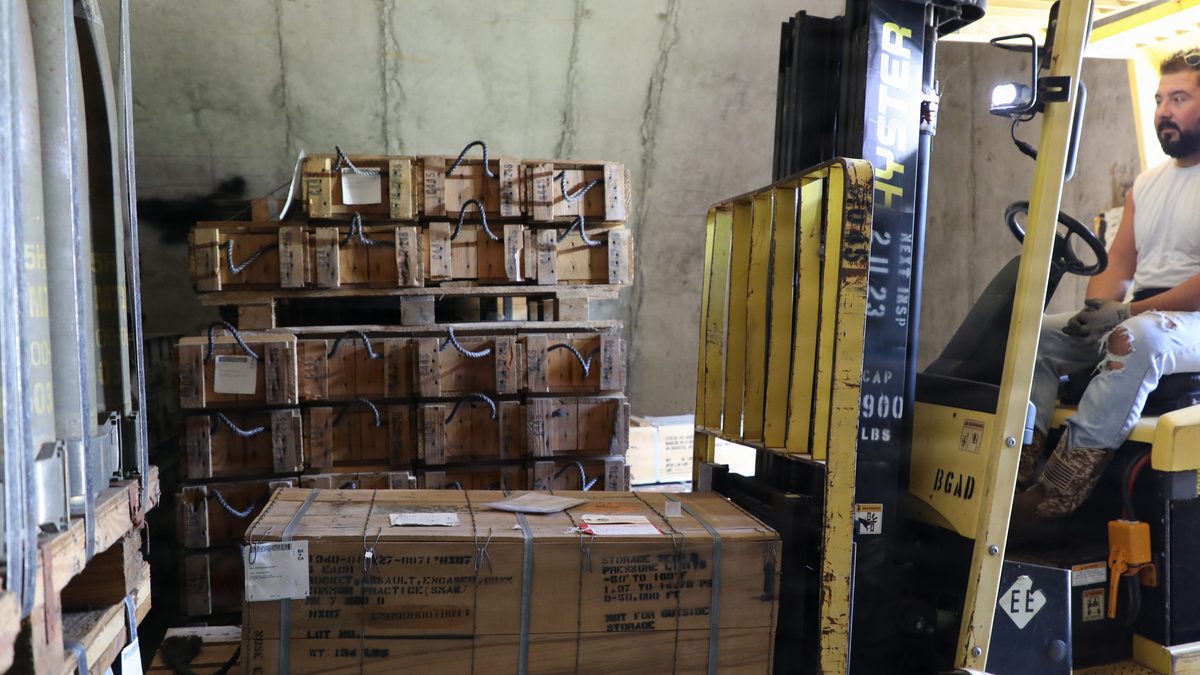
A Quality Assurance Specialist (Ammunition Surveillance) inspects munitions at Blue Grass Army Depot, Kentucky. U.S. Army photo by Dori Whipple, Joint Munitions Command, 24 March 2026. Released via DVIDS, public domain. Illustrative: the photograph is not connected to the standards discussed below.
AQAP-2110 Edition D Is About to Cite Four Superseded ISO Editions
No. AQAP-2110 Edition D lists ISO 9001:2015 as a dated normative reference at clause 3.2.1 and invokes that edition at clause 4.1, so a new ISO edition does not enter the contract on publication. ISO 9001:2026 has stood at stage 60.00 since 10 July 2026 and is scheduled for September. Suppliers stay bound to the 2015 text until the NATO Life Cycle Management Group (AC/327) issues Edition E.
Technical Summary
The sixth edition of ISO 9001 has stood at stage 60.00, international standard under publication, since 10 July 2026. The ISO record gives the month, September 2026, not a day. Certification bodies are already briefing clients on a three year transition that would close around September 2029, and every defence supplier holding a certificate will be asked to plan that migration. For anyone working to a NATO contract the useful question is narrower. Does the new edition change what the contract actually requires? It does not, and the reason sits in two clauses of the publication itself.
AQAP-2110 Edition D Version 1 was promulgated by the NATO Standardization Office on 24 June 2016, approved by nations in the Life Cycle Management Group (AC/327), with the agreement to use it recorded in STANAG 4107. Clause 3.2.1 lists five normative references. Four of them carry a year: ISO 9001:2015, ISO 9000:2015, ISO 10012:2003 and ISO 31000:2009. The fifth, ACMP-2100 on configuration management, is listed with no year at all. Clause 4.1 then requires the supplier to run a quality management system in accordance with AQAP-2110, incorporating the requirements of ISO 9001:2015 so far as the contract needs them. A dated reference points at one specific text. It does not travel when that text is replaced.
ISO 9000:2015 was withdrawn on 27 May 2026. AQAP-2110 clause 3.3 still takes its definitions from it. The vocabulary underpinning every NATO quality assurance contract in force today rests on a standard ISO retired ten weeks ago. ISC assessment of AQAP-2110 Edition D, clauses 3.2.1 and 3.3
Analysis of Effects
This is not a theoretical point about how dated references behave. It has already happened three times inside this one clause. ISO 31000:2009 was replaced by the second edition in February 2018 and withdrawn; the AQAP has cited the 2009 text for eight years since without consequence. ISO 10012:2003 was withdrawn on 12 February 2026 and replaced by ISO 10012:2026. ISO 9000:2015, the vocabulary standard from which AQAP-2110 clause 3.3 takes its definitions unless stated otherwise, was withdrawn on 27 May 2026 and replaced by ISO 9000:2026. When ISO 9001 follows in September, all four dated ISO references in clause 3.2.1 will point at superseded editions. Anyone arguing that ISO 9001:2026 flows automatically into a NATO contract has to explain why the other three did not.
| Reference as cited | Status of the cited edition | Current edition |
|---|---|---|
| ISO 9001:2015 | Current, replacement at stage 60.00 | ISO 9001:2026, September |
| ISO 9000:2015 | Withdrawn 27 May 2026 | ISO 9000:2026 |
| ISO 10012:2003 | Withdrawn 12 February 2026 | ISO 10012:2026 |
| ISO 31000:2009 | Withdrawn, superseded February 2018 | ISO 31000:2018 |
| ACMP-2100 | Cited without a year, so it floats | Current NATO edition |
The practical consequence is a period in which the certificate and the contract run on different clocks. A supplier transitions to ISO 9001:2026 on its certification body schedule. The Government Quality Assurance Representative (GQAR) continues to audit against AQAP-2110 Edition D, which invokes the 2015 text. Most of the time this will not bite, because the clause architecture is broadly stable between the two editions. It bites in two places. First, where the 2026 text carries something with no counterpart in 2015. As drafted, the clearest cases are the strengthened expectations on quality culture and ethical behaviour under leadership at clause 5.1, and the cleaner separation of risk actions from opportunity actions at clause 6.1. Second, where the precise 2015 wording is load bearing in a quality plan, a concession case, or an argument about a nonconformity. In those situations the edition matters and the contract decides which one applies.
Personnel and Safety Considerations
For ammunition and explosives work the risk is procedural rather than physical. A supplier that retires its ISO 9001:2015 clause mapping too early loses the evidence trail a GQAR expects to follow, and rebuilding that mapping under audit pressure is expensive. Run both maps. Tag every procedure, quality plan and evidence pack with the edition it satisfies, and keep the 2015 material indexed after the certificate migrates. One point is worth stating plainly for weapons, ordnance, munitions and explosives (WOME) lines, because it is widely misreported: the requirement to implement actions preventing human error is not new in 2026. It already sits at ISO 9001:2015 clause 8.5.1(g). Dual witness checks, mistake proofing and procedural barriers can therefore be documented against the contractual text now rather than held back for the new edition. Before any transition activity, extract the invocation wording from every live and pipeline contract and record whether it names Edition D or cites AQAP-2110 with no edition at all. Carry one further asymmetry: ACMP-2100 is cited without a year and floats, so configuration management records should track the current NATO edition even while the ISO references stay frozen. Note also that STANAG 4107 Edition 14 carries no ISO 9001 reference of its own, so the ISO linkage sits entirely inside the AQAPs and AC/327 can reissue AQAP-2110 without reopening the STANAG.
What this assessment does not say
It does not say ISO 9001:2026 is irrelevant to defence suppliers, and it does not advise delaying transition. It says the certificate and the contract run on separate clocks for a period, and that the contract clock is set by AQAP-2110 rather than by ISO. Contract wording governs in every case. This is analysis of published standards, not legal or contractual advice.
Data Gaps
No AC/327 WG/2 work item, target date or transition length for AQAP-2110 Edition E has been identified in open sources; the mid 2027 figure below is an estimate from one precedent, not a published plan. ISO has published a month for ISO 9001:2026, not a day, and the 16 September date circulating through certification bodies does not appear on the ISO record. Clause level detail of the 2026 text used here is read at draft stage, where only editorial change is permitted, so numbering and wording should be checked against the published standard. Whether national quality assurance authorities will issue interim guidance on which ISO edition a GQAR audits during the gap is unknown. Whether an individual contract invokes AQAP-2110 by edition or by floating reference varies in practice, and the contract wording governs in every case.
Key Questions
Does ISO 9001:2026 automatically apply to my AQAP-2110 contract?
No. AQAP-2110 Edition D cites ISO 9001:2015 as a dated normative reference at clause 3.2.1 and invokes that edition at clause 4.1. Until AC/327 issues a new edition of the AQAP, the contractual requirement stays with the 2015 text whatever your certificate says. Check your contract wording, because some contracts invoke standards by floating reference.
When will AQAP-2110 Edition E be published?
No date has been announced. The previous cycle is the only guide. ISO 9001:2015 published in September 2015 and AQAP-2110 Edition D was promulgated on 24 June 2016, roughly nine months later, with transition ending 21 September 2018. Repeating that pace would place an Edition E around mid 2027. That is an estimate, not a plan.
Should I delay transitioning to ISO 9001:2026 because of AQAP-2110?
No. Your certification body sets the certificate clock and a three year transition is expected to run to about September 2029. Transition on that schedule, but keep the ISO 9001:2015 clause mapping and its evidence alive while NATO contracts invoke it, because the Government Quality Assurance Representative audits the contract, not the certificate.
References
Source-evaluated under NATO STANAG 2022 (Reliability A–F / Accuracy 1–6). Tier 1 = government primary source; Tier 2 = quality news / specialist defence media; Tier 3 = authoritative aggregator / encyclopaedia.
- T1ISO/TC 176/SC 2 – ISO/FDIS 9001, Quality management systems, Requirements, stage 60.00 (2026-07-10), publication 2026-09, 10 July 2026. (Reliability A / Accuracy 1)
- T2International Organization for Standardization – ISO 9000:2015, Quality management systems, Fundamentals and vocabulary, withdrawn 27 May 2026 and replaced by ISO 9000:2026, 27 May 2026. (Reliability B / Accuracy 2)
- T2International Organization for Standardization – ISO 10012:2003, Measurement management systems, withdrawn 12 February 2026 and replaced by ISO 10012:2026, 12 February 2026. (Reliability B / Accuracy 2)
- T2International Organization for Standardization – ISO 31000:2018, Risk management, Guidelines, second edition, superseding the withdrawn ISO 31000:2009, February 2018. (Reliability B / Accuracy 2)
- T3DNV – Revision of ISO 9001, quality management system, transition guidance, accessed 9 August 2026. (Reliability C / Accuracy 3)
- T1NATO Standardization Office, public copy hosted by the Italian Ministry of Defence – AQAP-2110 Edition D Version 1, NATO Quality Assurance Requirements for Design, Development and Production (clauses 3.1, 3.2.1, 3.3, 4.1 and the Letter of Promulgation), 24 June 2016. (Reliability A / Accuracy 1)
Corrections & updates welcome. If you hold open-source data that refines or corrects any parameter in this article, please contact [email protected] citing the specific claim and your source. Verified corrections will be incorporated and credited in the revision history. AI-assisted technical assessment based on open-source material. Not a formal intelligence product.