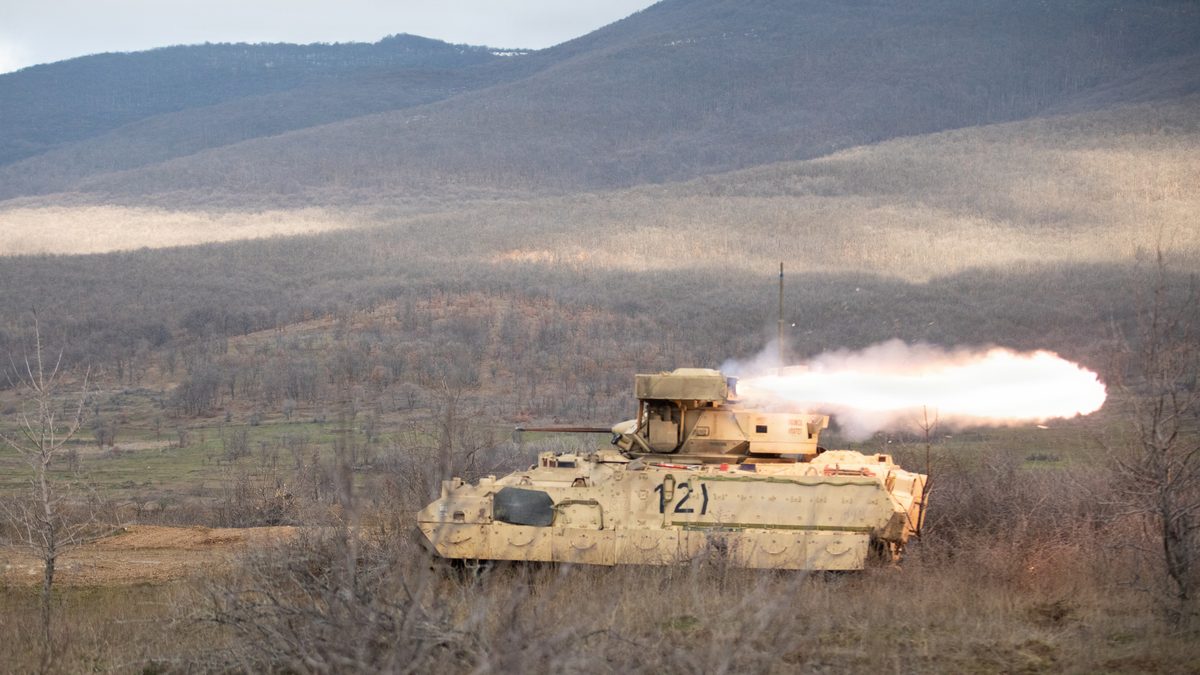
DVIDS / US Army. An M2A3 Bradley Infantry Fighting Vehicle of 1st Battalion, 16th Infantry Regiment, 1st Armored Brigade Combat Team, 1st Infantry Division fires a BGM-71 TOW from its twin-tube turret-mounted launcher, Novo Selo Training Area, Bulgaria, 25 February 2026. Photo: Spc. Brandi Frizzell, 7th Mobile Public Affairs Detachment. US Department of War imagery, public domain. Use does not imply endorsement.
US Army Puts Another $536 Million Into TOW Full-Rate Production as the Anti-Armour Line Runs to 2027
On 7 August 2026 the US Army awarded Raytheon a $535,975,860 modification (P00025) to contract W31P4Q-23-C-0026 for full-rate production and engineering services on the TOW Weapon System, lifting the cumulative face value to $750,818,274 and running the Tucson line to 31 August 2027. Fiscal 2026 procurement funds of $54,860,567 were obligated at award.
Technical Summary
Army Contracting Command at Redstone Arsenal announced modification P00025 to contract W31P4Q-23-C-0026 on 7 August 2026, adding $535,975,860 for full-rate production and engineering services in support of the Tube-launched, Optically-tracked, Wire-guided (TOW) Weapon System. The modification takes the total cumulative face value of the contract from $214,842,414 to $750,818,274, an increase of roughly 3.5 times the previously obligated ceiling. Work is performed at Tucson, Arizona, with an estimated completion date of 31 August 2027. Fiscal 2026 Other Procurement, Army funds of $54,860,567 were obligated at the time of award, meaning the announced figure is a ceiling authorisation rather than cash released.
The TOW family in current production is the BGM-71 series. Two natures dominate the anti-armour inventory. The TOW 2A (BGM-71E) carries a tandem shaped-charge warhead in which a precursor charge initiates explosive reactive armour before the main shaped-charge jet forms, a configuration adopted precisely because a single monolithic shaped charge is defeated by reactive tiles. The TOW 2B (BGM-71F) abandons direct impact altogether. It flies roughly 2.25 m above the gunner’s line of sight and fires two downward-oriented tantalum explosively formed penetrators (EFP) through the roof armour, where protection is thinnest. A dual-mode laser and magnetic sensor triggers the warheads over the target; the two EFPs function simultaneously, one directed vertically and the second offset slightly to raise hit probability. Published EFP penetration figures for the 2B are thin. A working order-of-magnitude estimate of 300 mm rolled homogeneous armour equivalent (RHAe) circulates in open sources, but the detailed variant tables generally record no figure at all, so it should be treated as an estimate rather than a stated performance value. The design is optimised against roof plate, not against maximising RHAe. The TOW 2B Aero extends maximum effective range to approximately 4,500 m against the 3,750 m of the earlier wire-guided variants, and the TOW 2B Aero RF replaces the trailing wire with a one-way radio-frequency command link. The RF transmitter sits in the expendable missile container rather than the launcher, so no launcher modification is needed. Storekeepers should note the consequence: the container is itself an electronic emitter, which is a packaging consideration the wire-guided natures never raised. The announcement does not disclose which natures or what quantities this modification buys.
A $535,975,860 modification against $54,860,567 obligated at award is not a delivery order. It is the Army buying option space on a line it does not intend to let cool. ISC Defence Intelligence assessment, 8 August 2026
Analysis of Effects
The significant fact is not the headline number but the gap between the ceiling and the obligation. Roughly 10 per cent of the announced value was released at award. That is the signature of a production line the customer wants held warm and scalable rather than one it is running at a fixed monthly rate. For a fifty-year-old missile family this is a deliberate capability-retention decision, and it mirrors the pattern seen across US medium-weight direct-fire munitions since 2022: keep mature, qualified, high-rate lines available rather than absorb the qualification cost of a replacement while demand signals remain volatile.
For NATO and allied users the practical consequence is stock availability. TOW is fielded well beyond the US inventory and the launcher installed base spans the dismounted tripod and Improved Target Acquisition System (ITAS), the Bradley, the Stryker Anti-Tank Guided Missile Vehicle, the Light Armored Vehicle-Anti-Tank and a wide range of foreign-military-sales platforms. Any allied nation planning a TOW replenishment through Foreign Military Sales draws against the same Tucson output as the US Army. A funded ceiling extension to August 2027 therefore shortens the practical lead-time conversation for allied programme managers, whether or not their own requirement has yet been placed. It also matters for the second-order calculation now facing armies fielding loitering munitions: TOW remains the fast, jam-resistant, short-time-of-flight answer at 3,750 m to 4,500 m, and the funding line says the Army is not treating it as displaced.
Personnel and Safety Considerations
Ammunition technicians and explosive ordnance disposal (EOD) operators handling TOW natures should note the configuration differences behind the common designation. The TOW 2A precursor charge is a separate energetic train forward of the main charge, mounted on an extensible probe; a round with a deformed or damaged probe assembly must be treated as having an unknown precursor state and not as a simple main-charge item. The TOW 2B EFP liners are oriented downward within the missile body, so a round recovered on its side does not present the hazard geometry an operator conditioned on axial shaped-charge natures will expect, and standoff planning based on a forward-firing assumption will be wrong. Net Explosive Quantity (NEQ) per round, hazard division and compatibility group for TOW natures in their shipping and firing containers are not published in the sources reviewed for this assessment; personnel must take these from the current in-service hazard data sheet for the specific nature and packaging configuration and not from any figure inferred from a press release.
Data Gaps
Five gaps limit confidence in this assessment. First, the contract announcement does not state which TOW natures are in scope, so the balance of TOW 2A, TOW 2B Aero and Bunker Buster rounds within the modification is unknown. Second, no quantity is disclosed, so a unit-cost or output-rate figure cannot be derived without guessing. Third, NEQ per round is not published in open sources for any current TOW nature, and no hazard division or compatibility group is confirmed here. Fourth, the split between US Army quantities and any Foreign Military Sales content is not identified in the announcement. Fifth, the announcement gives no monthly delivery profile, so the 31 August 2027 completion date cannot be converted into a production rate.
Key Questions
How much is the new US Army TOW missile contract worth?
The 7 August 2026 modification, P00025 to contract W31P4Q-23-C-0026, adds $535,975,860 and brings the contract's total cumulative face value to $750,818,274. Only $54,860,567 in fiscal 2026 Other Procurement, Army funds was obligated at the time of award, so the larger figure is an authorised ceiling rather than money already committed to deliveries.
What is the difference between the TOW 2A and TOW 2B warheads?
The TOW 2A uses a tandem shaped-charge warhead: a precursor charge on an extensible probe initiates explosive reactive armour, then the main shaped charge attacks the base armour. The TOW 2B flies over the target and fires two downward tantalum explosively formed penetrators through the thinner roof armour. Open sources offer an order-of-magnitude estimate near 300 mm rolled homogeneous armour equivalent, though most detailed variant tables publish no penetration figure for the 2B at all.
Why is the US Army still buying TOW instead of switching to loitering munitions?
Loitering munitions and TOW answer different problems. TOW gives a short time of flight, a qualified warhead and a jam-resistant engagement inside 4,500 m. Loitering munitions trade that immediacy for search time and reach. The August 2026 funding shows the Army treating TOW as a retained capability alongside, not replaced by, its Lethal Unmanned System purchases.
References
Source-evaluated under NATO STANAG 2022 (Reliability A–F / Accuracy 1–6). Tier 1 = government primary source; Tier 2 = quality news / specialist defence media; Tier 3 = authoritative aggregator / encyclopaedia.
- T1US Department of War – Contracts for Aug. 7, 2026, 7 August 2026. (Reliability A / Accuracy 1)
- T2GlobalSecurity.org – BGM-71 M-220 Tube-launched, Optically tracked, Wire-guided missile (TOW): characteristics, accessed 8 August 2026. (Reliability B / Accuracy 2)
- T2Directory of US Military Rockets and Missiles – Raytheon (Hughes) BGM-71 TOW, accessed 8 August 2026. (Reliability B / Accuracy 2)
- T2Army Guide – TOW 2B BGM-71F, accessed 8 August 2026. (Reliability B / Accuracy 2)
- T2US Army FM 23-34 via GlobalSecurity.org – TOW Weapon System, Chapter 1: fly-over shoot-down engagement and 2.25 m offset, accessed 8 August 2026. (Reliability B / Accuracy 2)
- T2Army Technology – TOW 2 Wire-Guided Anti-Tank Missile, United States of America, accessed 8 August 2026. (Reliability B / Accuracy 2)
- T3Wikipedia – BGM-71 TOW, accessed 8 August 2026. (Reliability C / Accuracy 3)
Corrections & updates welcome. If you hold open-source data that refines or corrects any parameter in this article, please contact [email protected] citing the specific claim and your source. Verified corrections will be incorporated and credited in the revision history. AI-assisted technical assessment based on open-source material. Not a formal intelligence product.