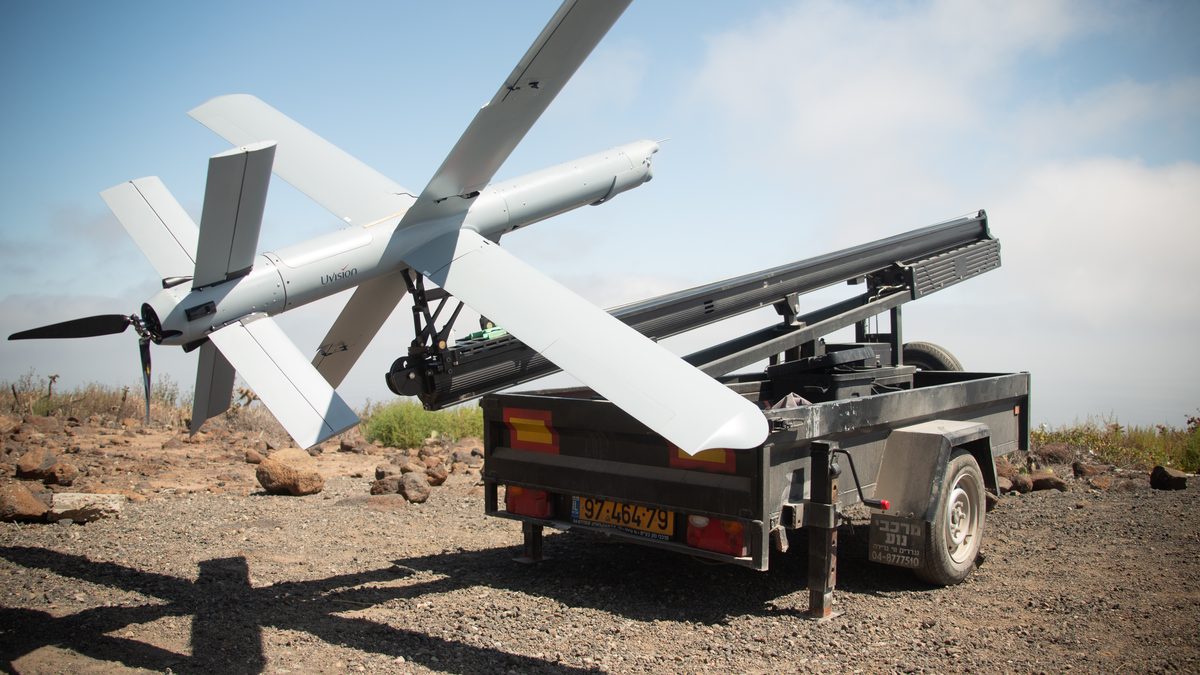
DVIDS / US Marine Corps. A UVision HERO-family loitering munition staged before flight, San Clemente Island, California, 25 May 2022. The airframe shown is the larger HERO-400 from the same manufacturer, not the HERO 120 described in this article; no cleared image of the HERO 120 lot acceptance test is in the public domain. Photo: Lance Cpl. Daniel Childs, 3rd Marine Aircraft Wing. US Department of War imagery, public domain. Use does not imply endorsement.
HERO 120 Clears Its First Lot Acceptance Test, Turning a $982 Million Ceiling Into a Repeatable Order Pipeline
On 4 August 2026 prime contractor Mistral Inc. and design authority UVision completed the first Lot Acceptance Tests (LAT) for the HERO 120 loitering munition under the US Army Lethal Unmanned System programme. The milestone lets the Army place recurring delivery orders against a $982 million indefinite-delivery, indefinite-quantity ceiling awarded in October 2025 without repeating prototype-level qualification for each batch.
Technical Summary
Lot Acceptance Testing is the quality gate that separates a demonstrated design from a demonstrated production line. Prototype qualification proves that a munition can meet its requirement; LAT proves that serially manufactured rounds drawn from an actual production lot reproduce the approved configuration with enough consistency for government acceptance. Testing under the Precision Strike Reconnaissance Systems portfolio required several HERO 120 rounds from the production lot to complete the full specified acceptance mission sequence, exercising assembly consistency, software configuration, seeker function, datalink performance and launcher compatibility. In NATO quality-assurance terms this is the function AQAP-2131 addresses at final inspection and testing, and it is the mechanism by which configuration control is enforced from one lot to the next.
UVision lists the HERO 120 at 24 kg complete launch weight with a warhead of up to 4.5 kg, a range of up to 60 km and 60 minutes of endurance. Propulsion is electric and launch is pneumatic, which removes the rocket efflux signature associated with conventional missile launch and permits employment from concealed positions. Guidance is via a gimballed electro-optical and infrared payload with image-processing support for tracking, and the datalink is encrypted to AES-256 with a stated GPS-denied capability. Available lethality packages span anti-tank, anti-personnel, multi-purpose and enhanced-blast warheads, with selectable impact, proximity and delay fuzing modes. That selectable fuzing, not the airframe, is the part of the system that matters most to ammunition technicians.
A munition that can be launched, recalled, returned to loiter and re-tasked is a munition that can also be recovered in an unknown fuze state. The engagement doctrine has moved faster than the disposal doctrine. ISC Defence Intelligence assessment, 8 August 2026
Analysis of Effects
The contracting significance is that a ceiling becomes a pipeline. Before LAT, each batch of a newly produced munition invites requalification argument; after it, the Army can issue delivery orders against the $982 million framework and check subsequent lots against a demonstrated baseline. For a weapon that is consumed on use, that distinction governs whether a stated ceiling ever becomes a stockpile. The mechanism showed its hand within forty-eight hours: on 6 August 2026, two days after the acceptance test, Mistral and UVision announced a further order worth more than $50 million under the same programme, covering additional systems and ancillary equipment. That is what a demonstrated production baseline buys: the next order arrives as an order rather than as a qualification argument. The scope of the framework covers complete munition systems, launch and fire-control equipment, mission planning software, batteries, spares, operator and maintainer training, logistics and lifecycle sustainment, so what is being bought is an operating architecture rather than a pallet of rounds.
The capability gap being filled sits between the FGM-148 Javelin and battalion or higher fires. Javelin gives a rifle platoon organic anti-armour effect but no search radius, no persistence and no post-launch decision point. Artillery and aviation offer reach and warhead mass but depend on fire-support coordination and asset priority. A 4.5 kg warhead loitering for 60 minutes across 60 km gives a company or battalion commander an organic answer against fleeting, high-value targets: mobile air-defence vehicles, electronic warfare systems, artillery in the open and command elements moving between hides. The trade is time of flight and vulnerability to electronic attack, which is why the earlier TOW production news and this one are complementary rather than competing signals.
The Army is not adopting the HERO 120 cold. UVision supplied the same round, through Mistral, for the US Marine Corps Organic Precision Fires-Mounted (OPF-M) requirement, where the multi-canister launcher was integrated onto the 8x8 Light Armored Vehicle-Mortar, the 4x4 Joint Light Tactical Vehicle and the Long-Range Unmanned Surface Vessel. A US service has therefore already carried the integration and training burden for this airframe, which is part of why the Army programme reached a production acceptance gate as quickly as it did. The smaller HERO-90 sits in a separate lane: it was selected to take part in the Army’s Low Altitude Stalking and Strike Ordnance (LASSO) effort alongside Textron Systems’ Damocles, Teledyne FLIR’s Rogue 1 and AeroVironment’s Switchblade 400, so a single vendor pairing now has rounds in two distinct US Army loitering-munition programmes at two different weight classes.
Personnel and Safety Considerations
The recoverable-munition problem deserves more attention than it is getting. A HERO 120 operator can launch, search, break off an attack, return the round to loiter and re-engage. That control loop is an operational strength and a disposal liability: a round that lands after an aborted engagement, a lost datalink or battery exhaustion is unexploded ordnance whose fuze may have been armed and then de-armed by software rather than by a mechanical safe-and-arm sequence an EOD operator can inspect. Selectable impact, proximity and delay modes mean the render-safe assumption differs by mission load, and the mode set cannot be read from the airframe exterior. Compounding this, the round pairs an energetic warhead with a substantial lithium battery, so a damaged item presents a combined explosive and thermal-runaway hazard that a single-hazard cordon does not address. NEQ per warhead variant, hazard division and compatibility group for the HERO 120 in its canister are not published in the sources reviewed here and must be taken from the in-service hazard data sheet.
Data Gaps
Four gaps constrain this assessment. First, the number of rounds tested and the number of missions flown in the first LAT are not disclosed, so the statistical basis of the acceptance decision cannot be evaluated. Second, order values are now partly visible but quantities are not: no round count has been announced against the $982 million ceiling or against the August 2026 follow-on order, so no delivery profile or unit cost can be derived. Third, NEQ, hazard division and compatibility group for each of the four stated lethality packages are not in open sources. Fourth, no public render-safe procedure or fuze-state indication guidance exists for the HERO 120 in a post-abort recovery scenario, which is the disposal case most likely to arise in practice.
Key Questions
What is a Lot Acceptance Test and why does it matter for HERO 120?
A Lot Acceptance Test verifies that rounds drawn from an actual production lot reproduce the approved configuration and performance, rather than proving the design once. For the HERO 120, completing the first LAT on 4 August 2026 lets the US Army accept subsequent lots against a demonstrated baseline and issue recurring delivery orders without repeating prototype qualification for each batch.
How big is the US Army HERO 120 contract?
The HERO 120 is procured under a multi-year indefinite-delivery, indefinite-quantity contract with a ceiling of $982 million awarded in October 2025 under the Lethal Unmanned System programme. The ceiling covers munitions, launch and fire-control equipment, mission planning software, spares, training, logistics support and lifecycle sustainment, not munitions alone.
What are the HERO 120 specifications?
UVision lists a complete launch weight of 24 kg, a warhead of up to 4.5 kg, a range of up to 60 km and 60 minutes of endurance. Propulsion is electric and launch is pneumatic. Guidance uses a gimballed electro-optical and infrared payload with an AES-256 encrypted datalink, and lethality packages include anti-tank, anti-personnel, multi-purpose and enhanced-blast warheads.
References
Source-evaluated under NATO STANAG 2022 (Reliability A–F / Accuracy 1–6). Tier 1 = government primary source; Tier 2 = quality news / specialist defence media; Tier 3 = authoritative aggregator / encyclopaedia.
- T1US Department of War – Contracts for Aug. 7, 2026 (context for concurrent US munitions awards), 7 August 2026. (Reliability A / Accuracy 1)
- T2Army Recognition – First production batch of HERO 120 attack drones clears US Army's final quality test before deployment, 7 August 2026. (Reliability B / Accuracy 2)
- T2Army Recognition – GM Defense's new Infantry Squad Vehicle variant to deploy UVision's Hero-120 loitering munitions, accessed 8 August 2026. (Reliability B / Accuracy 2)
- T2PR Newswire – Mistral Inc. and UVision receive an additional order under U.S. Army Lethal Unmanned Systems Program, 6 August 2026. (Reliability B / Accuracy 2)
- T2Janes – Hero-120 loitering munition selected for USMC OPF-M system requirement, accessed 8 August 2026. (Reliability A / Accuracy 2)
- T2Army Technology – HERO-90 selected to participate in US Army’s LASSO initiative, accessed 8 August 2026. (Reliability B / Accuracy 2)
- T3Wikipedia – Loitering munition, accessed 8 August 2026. (Reliability C / Accuracy 3)
Corrections & updates welcome. If you hold open-source data that refines or corrects any parameter in this article, please contact [email protected] citing the specific claim and your source. Verified corrections will be incorporated and credited in the revision history. AI-assisted technical assessment based on open-source material. Not a formal intelligence product.