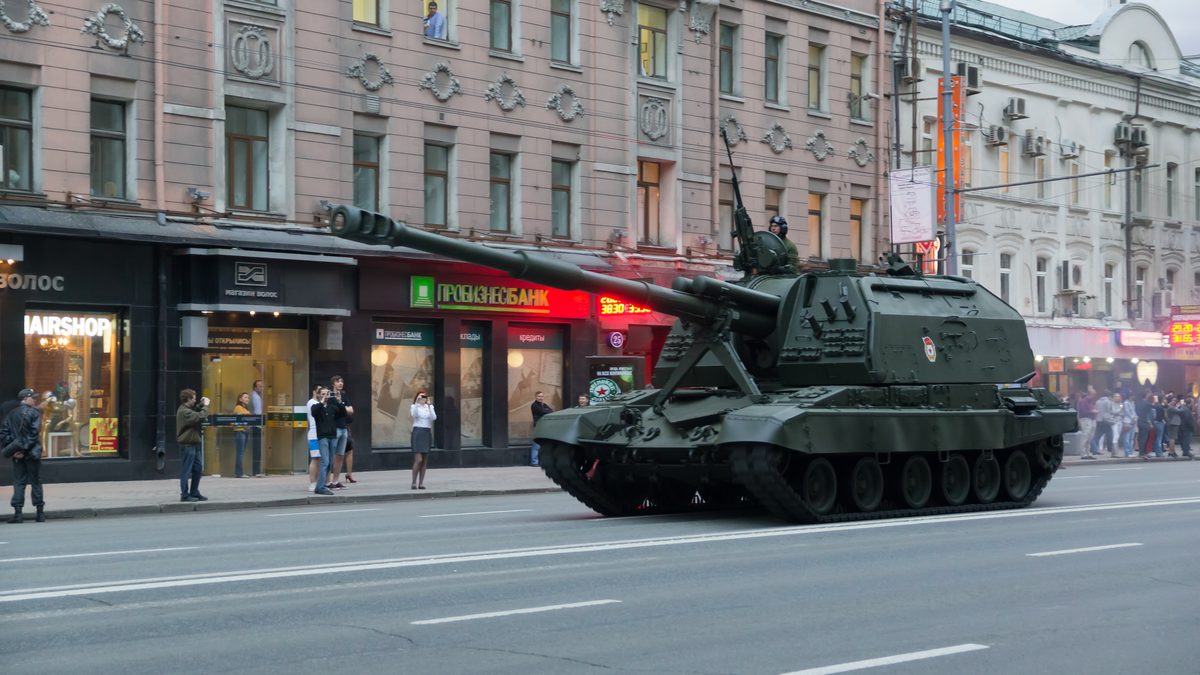
2S19 Msta-S at a Victory Day parade rehearsal, Moscow, 26 April 2012. Photo: Vyacheslav Argenberg, via Wikimedia Commons, CC BY 4.0.
The 2S19 Msta-S: A Technical Report on Russia’s 152 mm Divisional Howitzer
The 2S19 Msta-S is a 42 tonne tracked self-propelled howitzer accepted into Soviet service in 1989 and still the mainstay of Russian divisional artillery. Its 152.4 mm 2A64 gun reaches 24.7 km with the 3OF45 high explosive fragmentation (HE-FRAG) projectile and about 28.9 km with the 3OF61 base bleed round. The 1990 crew manual gives barrel life as roughly 2,000 rounds.
Technical Summary
Product 2S19, service name Msta-S, was the last divisional self-propelled gun the Soviet Union fielded. Design work ran at the Ural Transport Machine-Building Plant, Uraltransmash, under chief designer Yuriy Tomashov, with the 152 mm 2A64 howitzer developed at OKB-2 of the Barrikady plant in Volgograd. Two layouts competed: Object 316, a conventional turreted vehicle, and Object 327, a lighter open-mount design with a four-man crew. The turreted Object 316 won, and the vehicle was accepted for service in 1989. Serial output began around 1988 to 1989, with the plant sequencing between Uraltransmash in Yekaterinburg and the Bashkir machine plant at Sterlitamak reported in opposite orders by different sources.
What follows is drawn primarily from the 1990 crew technical description, «Изделие 2С19. Техническое описание», printed at Ufa in 1990 in a run of 200 copies, and from the 2006 crew aide-memoire that teaches from it. Both are open-source documents. Where those manuals are silent, the report falls back on the United States Marine Corps Intelligence Activity study of Soviet and Russian armour and artillery design practices, and on specialist reporting. Figures that no reviewed source establishes are listed as data gaps rather than estimated.
The manual gives barrel life as approximately 2,000 rounds and maximum recoil length as 900 mm. It also states the time from travelling to combat position, crew mounted, as no more than two minutes. 1990 crew technical description, product 2S19
Baseline specification, 2S19 (1990 crew manual unless noted)
| Combat mass | 42 t (+2 per cent) |
| Crew | 5, rising to 7 when firing from ground-supplied ammunition |
| Length, gun forward | 11,917 mm |
| Width over tracks / height over machine gun | 3,380 mm / 3,350 mm |
| Ground pressure | approx. 0.87 kgf/cm² |
| Armour | 15 mm rolled homogeneous armour, all round |
| Gun | 152.4 mm 2A64 rifled howitzer, L/47 |
| Barrel length over muzzle brake | 8,130 mm (approx. L/53.3) |
| Barrel (tube) mass / gun mass | 2,670 kg / 4,360 kg |
| Rifling | 48 grooves |
| Barrel life | approx. 2,000 rounds |
| Maximum recoil length | 900 mm |
| Elevation / traverse | −4° to +68° / 360° |
| Onboard ammunition | 50 rounds |
| Rate of fire | 7 to 8 rounds/min from internal stowage |
| Maximum range, HE-FRAG | 24.7 km (3OF45) |
| Time into action | up to 2 min, crew mounted |
| Engine | V-84A V12 multi-fuel diesel |
| Road speed / range | 60 km/h / 500 km |
The 2A64 gun and how the barrel is put together
The 2A64 is a rifled howitzer of 152.4 mm calibre, 47 calibres in bore length, ballistically and logistically unified with the towed 2A65 Msta-B. The two guns share the barrel, breech, electrics, rammer, recoil gear, cradle, guard and the balancing and elevating mechanisms. That unification was a deliberate production economy, and it is the reason ballistic data for one gun transfers to the other.
The manual breaks the barrel into four items: a monobloc tube, the breech ring, the muzzle brake and the receiver, which is the Russian term for the bore evacuator. Internally the tube carries a chamber and a rifled guiding portion of forty-eight grooves. Monobloc means the pressure-bearing tube is machined from one forged billet rather than built up from a shrunk-on jacket or fitted with a replaceable liner.
Three construction details in the manual are more specific than the usual secondary accounts. The muzzle brake is screwed onto the muzzle on a left-hand thread and locked by two stops. The bore evacuator sits in the middle of the tube, not forward of it as several English summaries state, and its job is described plainly: it blows through the bore to reduce the ingress of propellant gases into the fighting compartment. The breech ring carries a control platform at top left, used as the datum when the crew check the sights.
The breech is a vertical sliding wedge with copy-cam semi-automatics. It locks the bore, fires, ejects the spent case, re-cocks the striker after a misfire without opening the wedge, refuses to fire if the wedge is not fully closed, opens automatically after firing and closes during loading, and centres the case during ramming. Recoil is controlled by a hydraulic spindle-and-moderator recoil brake with its cylinder fixed in the breech ring, and a nitrogen-charged pneumatic recuperator returns the barrel to battery. Maximum recoil length is 900 mm. A pneumatic equilibrator balances the swinging mass, and the elevating gear is a sector type with electric drive and a manual flywheel behind it.
Ramming is done by a chain rammer mounted so that it can swing down from the rear wall of the guard, driven hydromechanically with a manual back-up. It rams the projectile first, then the cased charge. The guard also carries the manual firing handle, the striker re-cocking lever, the recoil-length indicator and the gun loading panel, which tells you a good deal about what the crew is expected to do by hand when the electrics fail.
Two things the manual does not give are worth stating plainly, because secondary sources sometimes supply them as if they were sourced. Neither the autofrettage schedule nor confirmation of a chromium-plated bore appears in the reviewed text. Both are normal practice for a gun tube of this class and pressure, and both remain inference here rather than fact.
Ammunition and ballistics
The 2A64 fires separate-loading ammunition: projectile first, then a cased variable charge. The standard combat load is 50 rounds. Carrying Krasnopol guided projectiles cuts that load, by eight rounds if four are stowed in the frame tubes, by three if three are carried in cradles, and by eleven if both. The full charge weighs 16.3 kg and the standard high explosive fragmentation projectile weighs 43.56 kg.
| Projectile | Type | Mass (kg) | Explosive fill (kg) | Max range (km) |
|---|---|---|---|---|
| 3OF45 | HE-FRAG, standard | 43.56 | 7.65 | 24.7 |
| 3OF64 | HE-FRAG, improved effect | 43.56 | 7.8 | 24.7 |
| 3OF61 | HE-FRAG, base bleed | 43.56 | 7.8 | 28.9 |
| 3OF25 | HE-FRAG, legacy | 43.56 | 6.8 | approx. 17 |
| 3-O-23 | Cargo, 40 dual-purpose bomblets | 42.8 | n/a | approx. 21 |
| 3O16 | Cargo, 8 fragmentation bomblets | 57.9 | n/a | approx. 14.5 |
| 3OF39 Krasnopol | Laser-guided HE-FRAG | 50 | 6.6 | approx. 20 |
| 3OF38 Santimetr | Laser-corrected HE-FRAG | 49.5 | 8.5 | approx. 12 |
Muzzle velocity is quoted variously because it is a per-projectile figure rather than a property of the gun. The commonly cited 828 m/s belongs to the 3OF61 base-bleed round; the standard 3OF45 is commonly given at about 823 m/s on the full charge. Guided rounds use the Krasnopol and Santimetr families, laser designated by a forward observer. Illuminating, smoke and radio-jamming projectiles were also provided for, and in Soviet service so were nuclear rounds.
Secondary armament is a 12.7 mm NSVT machine gun at the commander’s cupola with a PZU-5 sight, 800 rounds carried, elevating from −3° to +70° and traversing 255° to the right of the vehicle axis. The crew also carry five AKS-74 rifles with 900 rounds and a signal pistol.
Fire control, crew drills and time into action
Laying and fire control sit on the 1V124 system, which automates elevation, mechanises traverse and restores the lay after each shot. Its parts are the 1P22 panoramic sight for indirect fire, the 1P23 direct-fire sight, the 1V122 control set and the 2E46 electric drives. Firing data reaches the 1V122 by radio or field wire from the battery senior officer’s vehicle. External communication is by R-173 very high frequency radio and the internal intercom serves seven stations, which allows attached observers to ride in the vehicle.
Two rear conveyors, one for projectiles and one for charges, present rounds to the rammer. A roof hatch and an external tray allow the gun to be fed from the ground, so a vehicle sitting near a resupply point can fire without drawing down its internal 50 rounds. That is the reason for the second crew figure. Five men fight the vehicle; seven are needed when ammunition is coming up from the ground.
One widely repeated figure deserves correcting. Several English-language summaries give a deployment time of 22 minutes, which would be indefensible for a shoot-and-scoot howitzer. Both Russian manuals state the transition from travelling to combat position and back, without the crew dismounting, as no more than two minutes. The 2006 textbook prints the same figure in its comparison table alongside the M109A6. The 22-minute number most likely describes a full survey and occupation-of-position sequence for a battery, not a single gun coming into action from a halt.
Two features support that speed. An AP-18D gas-turbine auxiliary power unit supplies 16 kW of direct current for up to eight hours, so the turret, the laying drives and the fire control all run with the main engine shut down, which cuts the acoustic and thermal signature of a gun waiting on a fire mission. A dozer blade lets the vehicle entrench itself, and the Federation of American Scientists reference sheet puts a complete firing pit at 40 to 60 minutes of digging. That same sheet gives emplacement time as one to two minutes, which corroborates the Russian manuals from a separate lineage of sources.
Variants and derivatives
| Designation | Gun | Notes |
|---|---|---|
| 2S19 (1989) | 2A64, L/47 | Baseline. 7 to 8 rounds/min, 24.7 km with HE-FRAG. |
| 2S21 Msta-K | 2A67 | Wheeled attempt on a KrAZ-6316 chassis, authorised August 1985, later cancelled. |
| 2S33 Msta-SM | 2A79 | Deep upgrade, over 30 km with HE and over 40 km with rocket assistance. Halted in favour of Koalitsiya-SV. |
| 2S19M1 | 2A64 | Automated fire control and GLONASS (Global Navigation Satellite System) navigation. Unveiled 2000, deliveries from 2007 to 2008. |
| 2S19M1-155 | MZ-158, L/52, 155 mm | Export variant with a 23-litre chamber, 45 rounds, quoted to 33.8 km. Shown at Nizhny Tagil in 2002. |
| 2S19M2 | 2A64M2 | New fire control and navigation, up to 10 rounds/min, in service from 2013. Often field-labelled 2S33 Msta-SM2. |
| 1K17 Szhatie | Laser array | Self-propelled laser complex on the 2S19 chassis. Not serially produced. |
| 2S35 Koalitsiya-SV | 2A88 | Successor programme. State tests reported complete in October 2023, with first deliveries from an experimental batch reported that December. |
Operators, combat record and attrition
The International Institute for Strategic Studies recorded in The Military Balance 2024 that Russia held roughly 300 2S19 and 2S19M1 alongside 300 2S19M2 in the Ground Forces, 36 with the Naval Infantry and 150 in storage. Ukraine held 35, Venezuela 48, Azerbaijan 18, Ethiopia 10 and Georgia 1. Belarus, listed with 12 in the 2023 edition of the same publication, no longer appears as an operator.
Attrition in Ukraine is the clearest public measure of how the type has fared. The Oryx visually confirmed loss dataset, checked on 8 August 2026, lists 266 Russian 2S19 Msta-S and a further 59 recorded as 2S33 Msta-SM2, the field label for the 2S19M2. That is 325 vehicles of the family, of which 250 were destroyed and 51 captured, the balance recorded as damaged or abandoned. Ukrainian losses of the same type stand at five. Oryx counts only what is photographed, so the real figure is higher by an unknown margin, and the dataset is a floor rather than an estimate.
For scale, Army Recognition put the same dataset at 234 Msta-S and 52 Msta-SM2 in April 2025. Roughly 40 further family losses were documented over the following sixteen months, a slower rate than the first two years of the war. Whether that reflects fewer vehicles in contact, better dispersal, or the counter-battery balance shifting is not answerable from loss counts alone.
Russian industry has responded visibly to one threat. From April 2025 cage shielding over the turret roof became a factory-fitted feature rather than a field improvisation, aimed at first person view drones and at protecting the loading mechanism. The wider industrial picture is less comfortable. Barrel manufacture, not hull assembly, is the constraint: tubes come from Plant No. 9 at Yekaterinburg, Titan-Barrikady at Volgograd, Motovilikha at Perm and Burevestnik at Nizhny Novgorod, and Uraltransmash is a final assembler rather than an observed barrel producer at scale. On output, the last hard public datapoint is the company's own: Uraltransmash director general Oleg Emelyanov told the Russian defence minister in January 2024 that self-propelled gun production had risen sixfold against 2022, across the 2S19, 2S3, 2S4, 2S5 and 2S35 lines. No absolute number was given, and the claim is the manufacturer's.
Analysis of Effects
The limit on the 2S19 is ballistic rather than mechanical. A 47-calibre tube with a 16-litre chamber sets a ceiling on chamber pressure and projectile energy that no fire-control upgrade can lift. The gun reaches 24.7 km with a standard shell and 28.9 km with base bleed. Front-line expectation is now 40 km to 45 km.
The comparison that matters is with the five-nation standard adopted for 155 mm systems. The Joint Ballistics Memorandum of Understanding signed by France, Germany, Italy, the United Kingdom and the United States entered into force on 18 December 2009, superseding a 1978 instrument, and it is the framework under which the 155 mm calibre, 52-calibre barrel and 23-litre chamber combination became the shared Western reference. That combination is what the PzH 2000 and the RCH 155 exploit. It is also, precisely, what Uraltransmash and Motovilikha built into the 2S19M1-155 export variant, which tells you the Russian industry understood the problem and could solve it when the customer required a NATO-calibre gun.
At introduction the vehicle compared well. It carried more rounds than the M109A6, AS-90 or AuF.1T, matched or beat their standard-round range, fired faster than the M109A6, and mounted a 12.7 mm rather than a 7.62 mm self-defence weapon. Everything after that has been an attempt to buy performance somewhere other than the muzzle. The 2S19M1 bought accuracy and responsiveness through navigation and automated laying. The 2S19M2 bought rate of fire, reaching 10 rounds a minute and the ability to put several rounds on coordinated trajectories. Range ambition moved to the 2S35 Koalitsiya-SV and its 2A88 gun.
Personnel and Safety Considerations
The crew-safety architecture on this vehicle is a system rather than a component, and the bore evacuator is the visible part of it. Firing a separate-loading gun inside a sealed, overpressured compartment moves a large volume of hot propellant gas past the crew twice a minute or more. Three elements manage that: the bore evacuator scavenges the tube as the projectile leaves, a breech-sealing arrangement limits what reaches the compartment when the wedge opens, and two filter-ventilation units clear what does. The nuclear, biological and chemical protection system seals the hull and holds it above ambient pressure. There is no air conditioning.
For technicians the practical points are the ones the manual itself makes. Fire is permitted only from a halt. The pre-firing sequence is a fixed checklist: inspect bore and muzzle brake, function-check the wedge, extractor, striker and semi-automatics, check both laying planes in electric and manual modes, check equilibrator balance, check the conveyors, coordinator and rammer, load the mechanised stowage, check recoil fluid and recuperator pressure, then inspect and align the sights against the control platform on the breech ring. Recoil-length indication is read at the guard, and a recoil beyond the 900 mm limit is the signal that the brake or recuperator needs attention before the next round.
Protection against direct fire is minimal and was never intended to be otherwise. Fifteen millimetres of rolled homogeneous armour all round, including the roof and engine deck, covers small arms and shell splinters. The roof is the reason cage shielding appeared: a top-attack munition against 15 mm of steel over a compartment holding 50 rounds and their charges is a total-loss event for vehicle and crew alike.
Data Gaps
Four items remain open after the manuals. Rifling geometry beyond the groove count, meaning land and groove widths and the twist rate, is not stated. Neither is confirmation of a chromium-plated bore, though it is standard for the class. The autofrettage schedule and residual-stress data are absent, and are inferred here on engineering grounds only. Two reporting disputes also stand unresolved. Engine output is given as 840 hp for the V-84A by the Marine Corps Intelligence Activity, which explicitly identifies 780 hp as the figure for the alternative V-46 family powerpack, while Russian-language sources apply 780 hp to the V-84A itself; the American reading is the better documented of the two. Cumulative production is quoted as more than 720 by a 2010 Arsenal study by Belogrud and Zheltonozhko, and as roughly 1,130 by Western summaries, but that higher number traces to a single unverifiable blog post and should not be treated as authoritative. Finally, no source at any tier gives a current annual production rate, and the widely repeated NATO reporting name M1990 Farm appears in no Tier 1 or Tier 2 source; the Soviet development codename was Ferma, and the Western designation looks like a back-formation from it.
Key Questions
How far can the 2S19 Msta-S shoot?
The 2S19 reaches 24.7 km with the standard 3OF45 high explosive fragmentation projectile on the full charge, and about 28.9 km with the 3OF61 base bleed round. It cannot reach the 40 km to 45 km now expected of front line artillery, which is why Russian range ambition moved to the 2S35 Koalitsiya-SV and its 2A88 gun.
What is the barrel life of the 2A64 howitzer?
The 1990 crew technical description gives barrel life as approximately 2,000 rounds for the monobloc tube. Actual life depends heavily on charge management, because firing reduced charges where the range allows imposes far less thermal and chemical erosion on the forcing cone just ahead of the chamber, where wear concentrates.
Is the 2S19 Msta-S still in production?
Uraltransmash still builds and refurbishes the type, and cage shielding against first person view drones became a production standard during 2025. No open source gives an annual output figure. The nearest datapoint is Uraltransmash's own January 2024 claim of a sixfold rise in self propelled gun output against 2022, across several types.
References
Source-evaluated under NATO STANAG 2022 (Reliability A–F / Accuracy 1–6). Tier 1 = government primary source; Tier 2 = quality news / specialist defence media; Tier 3 = authoritative aggregator / encyclopaedia.
- T1Marine Corps Intelligence Activity – Soviet/Russian Armor and Artillery Design Practices: 1945 to Present, chapter on the 2S19 Msta-S, 1999 printing. (Reliability B / Accuracy 2)
- T1United States Department of State – TIAS 09-1218: Joint Ballistics Memorandum of Understanding on the standardization of elements of 155 mm weapon and ammunition systems, in force 18 December 2009. (Reliability A / Accuracy 1)
- T1Product 2S19 technical description and crew operating instructions (Ufa, 1990, 364 pp.) and the 2S19 Msta-S crew aide-memoire (2006). Russian-language manuals, scans held offline in the ISC reference library and publicly archived by – military-references.com (provenance only, no stable deep link), 1990 and 2006. (Reliability A / Accuracy 2)
- T3Oryx (Stijn Mitzer and Jakub Janovsky) – Attack On Europe: Documenting Russian Equipment Losses During The Russian Invasion Of Ukraine, checked 8 August 2026. (Reliability B / Accuracy 2)
- T3Army Recognition – Russia upgrades 2S19 Msta-S howitzers with new cage armour against Ukrainian drone threats, 22 April 2025. (Reliability C / Accuracy 3)
- T3Defense Express – Artillery Barrel Production in Russia: Structure, Importance, and Weak Points, 11 October 2024. (Reliability C / Accuracy 3)
- T3International Institute for Strategic Studies – The Military Balance 2023 and 2024, operator inventories for the 2S19 family, 13 February 2024. (Reliability B / Accuracy 2)
- T2RIA Novosti – Uraltransmash increased self-propelled gun output sixfold in 2023, manufacturer statement reported as a claim, 31 January 2024. (Reliability D / Accuracy 4)
- T3Federation of American Scientists, Military Analysis Network – 2S19 MSTA-S 152 mm self-propelled howitzer specification sheet, including emplacement time and the self-entrenching blade, accessed 8 August 2026. (Reliability C / Accuracy 3)
- T3GlobalSecurity.org – 2S19 MSTA-S 152 mm Self-Propelled Howitzer, including the 2S19M1-155 export configuration, accessed 8 August 2026. (Reliability C / Accuracy 3)
Corrections & updates welcome. If you hold open-source data that refines or corrects any parameter in this article, please contact [email protected] citing the specific claim and your source. Verified corrections will be incorporated and credited in the revision history. AI-assisted technical assessment based on open-source material. Not a formal intelligence product.