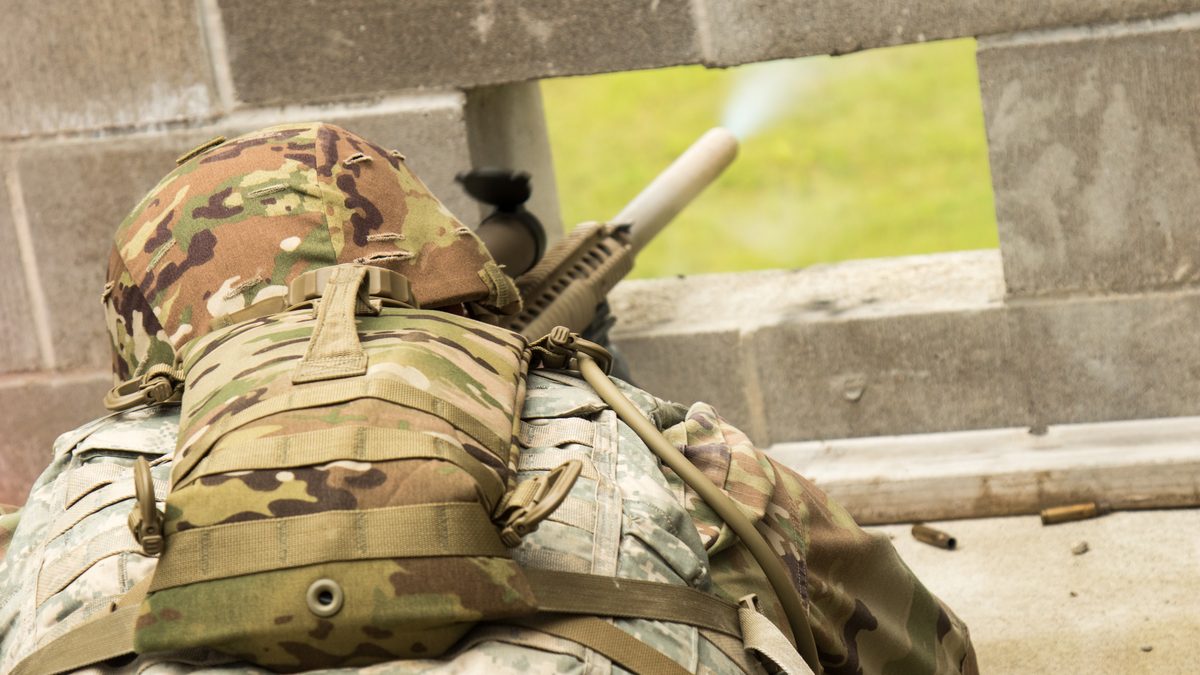
A U.S. Army Reserve Soldier fires a suppressed shot from the M110 Semi-Automatic Sniper System during qualification at the 2021 U.S. Army Reserve Best Warrior Competition. U.S. Army photo by Staff Sgt. Christopher Hernandez / DVIDS (public domain). Use does not imply Department of Defense endorsement.
A Match Bullet Enters the Military Catalogue: Berger’s 140-Grain Open-Tip Match Becomes SOCOM’s M1200 6.5 Creedmoor Round
Capstone Precision Group will load the M1200 6.5 mm Creedmoor Special Ball Long-Range round for United States Special Operations Command using Berger’s 6.5 mm 140-grain open-tip match projectile. Several million rounds will be assembled at Mesa, Arizona, with first deliveries scheduled for spring 2027. The nature is graded on precision fired suppressed from semi-automatic hosts beyond 1,500 metres.
Technical Summary
M1200 is the United States Special Operations Command (USSOCOM) designation for 6.5 mm Creedmoor Special Ball Long-Range ammunition, catalogued under Department of Defense Identification Code (DODIC) AC58 and governed by detail specification MIL-DTL-32665 (with Amendment 1), Cartridge, 6.5 Millimeter: Special Ball Long Range. Capstone Precision Group (CPG), which manufactures Berger bullets and loaded ammunition at Mesa, Arizona, has been selected as an approved supplier under the Special Operations Unique Munitions Requirements (SUMR) programme. The selected projectile is Berger’s 6.5 mm 140-grain Hybrid Target open-tip match (OTM) design, a projectile mass of 9.07 g, until now known chiefly on F-Class and long-range prone firing lines rather than in a military catalogue.
This is a second approved source rather than the whole of M1200 production. The large-volume vehicle for the nature is Naval Surface Warfare Center Crane indefinite-delivery, indefinite-quantity contract N0016425DJN20, awarded to Black Hills Ammunition of Rapid City, South Dakota in August 2025 against solicitation N0016425RJN20, with a ceiling of approximately 40 million United States dollars and up to some 17.4 million rounds serving both the United States Marine Corps and USSOCOM. Black Hills is the incumbent loader and uses the same Berger 140-grain projectile. The Capstone selection is a separate SUMR route for special operations quantities, so the two awards should not be read as one.
Berger publishes the component as a hybrid-ogive boat-tail with a G1 ballistic coefficient of 0.607 and a G7 ballistic coefficient of 0.311, sectional density 0.287, overall length 1.407 in and a minimum rifling twist of 1:8 in or faster. Those are commercial reference figures for the projectile alone. Acceptance values for the loaded military nature sit in MIL-DTL-32665 and are not published.
Contract value and precise quantity have not been disclosed. Capstone states that several million rounds will be assembled at the Mesa plant, with first deliveries to special operations units scheduled for spring 2027. The company is the United States distributor for Lapua components, Vihtavuori propellants and SK rimfire ammunition, and forms part of the Nammo Group, the Norwegian and Finnish ammunition manufacturer jointly owned by the Norwegian Ministry of Trade, Industry and Fisheries and Finland’s Patria. A NATO-allied, state-linked group therefore sits behind the loading of a United States special operations sniper nature.
The M1200 is graded on precision and reliability fired suppressed from a semi-automatic host, not on raw velocity or terminal effect. Consistency across several million rounds is the specification, not a single good group. ISC Defence Intelligence technical assessment
Analysis of Effects
The requirement set explains the projectile choice. Beyond roughly a kilometre, dispersion is governed less by the rifle than by round-to-round variation in muzzle velocity and in ballistic coefficient, and by the projectile’s behaviour through the transonic transition. A high ballistic coefficient open-tip match design delays that transition and reduces the wind deflection that accumulates over a long time of flight. At the 1,500 m engagement distance cited for the M1200, small variations in drag compound into misses that no fire control solution can recover.
The suppressed semi-automatic condition is the harder half of the specification. A sound suppressor raises muzzle and port pressure in a gas-operated action, which advances unlocking, increases bolt carrier velocity and shifts extraction timing. It also alters muzzle exit conditions and can move the mean point of impact between suppressed and unsuppressed fire. Propellant selection, charge weight consistency, case neck tension and primer sensitivity all have to be held inside tighter bands than a commercial match load requires, because the acceptance standard is applied across a multi-million round production run rather than a single lot.
The hosts are the Mid-Range Gas Gun family. The sniper and designated-marksman variant, MRGG-S, went to Geissele Automatics in 2023 and is type-classified Mk 1 Mod 0 with a 20 in barrel. The shorter selective-fire assault variant, MRGG-A, went to Lewis Machine & Tool in 2025 as the Mk 24, replacing the Mk 17 SCAR-H. Both are built around the M1200, which is why the acceptance condition is a suppressed semi-automatic gas gun rather than a bolt action.
Personnel and Safety Considerations
Packaged small-arms ball ammunition of this type is normally consigned as UN 0012, Cartridges for Weapons, Inert Projectile, and carried at Hazard Division (HD) 1.4, Compatibility Group (CG) S. Articles at HD 1.4 S present no significant blast or fragment hazard beyond the immediate vicinity of the package and are handled under AASTP-1 Edition C and, in United Kingdom service, Defence Safety Authority regulation DSA 03.OME. Net Explosive Quantity (NEQ) for an inert-projectile ball nature derives from the propellant charge and primer composition alone. The classification actually assigned to the M1200 in its final packaging configuration has not been published and should be taken from the approved hazard classification document rather than inferred.
Data Gaps
Contract value, precise quantity and lot structure are not disclosed. It is not stated whether the Berger loading supplements or replaces the incumbent M1200 projectile. Propellant type and charge mass, nominal muzzle velocity, maximum chamber pressure and the accuracy acceptance criterion are not published. The specific suppressor used for acceptance firing is not identified, and it is not stated which Mid-Range Gas Gun variant sets the acceptance condition. The assigned Hazard Division and Compatibility Group for the packaged nature are not stated in open source.
Key Questions
What is the M1200 6.5 Creedmoor round?
M1200 is the United States Special Operations Command designation for 6.5 mm Creedmoor Special Ball Long-Range ammunition, catalogued as DODIC AC58. It is a precision nature intended for semi-automatic sniper systems engaging targets beyond 1,500 metres, and it is graded on consistency when fired suppressed rather than on velocity or terminal effect.
Who is making the new M1200 load and when does it arrive?
Capstone Precision Group, the Nammo Group company that manufactures Berger bullets and ammunition, will assemble several million rounds at Mesa, Arizona as an approved supplier under the Special Operations Unique Munitions Requirements programme. First deliveries to special operations units are scheduled for spring 2027. Contract value has not been disclosed. Capstone is a second approved source: the larger M1200 vehicle is Naval Surface Warfare Center Crane contract N0016425DJN20, awarded to Black Hills Ammunition in August 2025.
Why does SOCOM use 6.5 Creedmoor instead of 7.62x51 mm NATO?
Special Operations Command adopted 6.5 mm Creedmoor for semi-automatic sniper systems in place of 7.62x51 mm because higher ballistic coefficient projectiles hold velocity and resist wind deflection better at extended range, lengthening useful engagement distance from a comparable action. The trade is a non-STANAG calibre sitting outside the standard NATO small-arms supply chain.
References
Source-evaluated under NATO STANAG 2022 (Reliability A–F / Accuracy 1–6). Tier 1 = government primary source; Tier 2 = quality news / specialist defence media; Tier 3 = authoritative aggregator / encyclopaedia.
- T1United States federal contract record – 6.5 mm Creedmoor Special Ball Long Range Ammunition M1200, DODIC AC58 – solicitation N0016425RJN20, award N0016425DJN20 to Black Hills Ammunition Inc, August 2025. (Reliability A / Accuracy 1)
- T1Naval Publications and Form Center – MIL-DTL-32665, Cartridge, 6.5 Millimeter: Special Ball Long Range, XM1200. (Reliability A / Accuracy 1)
- T2Berger Bullets (Capstone Precision Group) – 6.5 mm 140 Grain Hybrid Target Rifle Bullet, published specifications, accessed 7 August 2026. (Reliability B / Accuracy 1)
- T2NRA Shooting Sports USA – Berger Bullets Selected for SOCOM’s M1200 6.5 Creedmoor Load, 3 August 2026. (Reliability B / Accuracy 1)
- T2The Outdoor Wire (Capstone Precision Group release) – Capstone Precision Group Awarded USSOCOM 6.5 Creedmoor Ammunition Contract, July 2026. (Reliability B / Accuracy 1)
- T2The Firearm Blog – Berger Bullets Land USSOCOM M1200 6.5 Creedmoor Contract, 6 August 2026. (Reliability B / Accuracy 2)
- T3AccurateShooter Daily Bulletin – Capstone Awarded 6.5 Creedmoor U.S. SOCOM Contract, July 2026. (Reliability C / Accuracy 3)
Corrections & updates welcome. If you hold open-source data that refines or corrects any parameter in this article, please contact [email protected] citing the specific claim and your source. Verified corrections will be incorporated and credited in the revision history. AI-assisted technical assessment based on open-source material. Not a formal intelligence product.