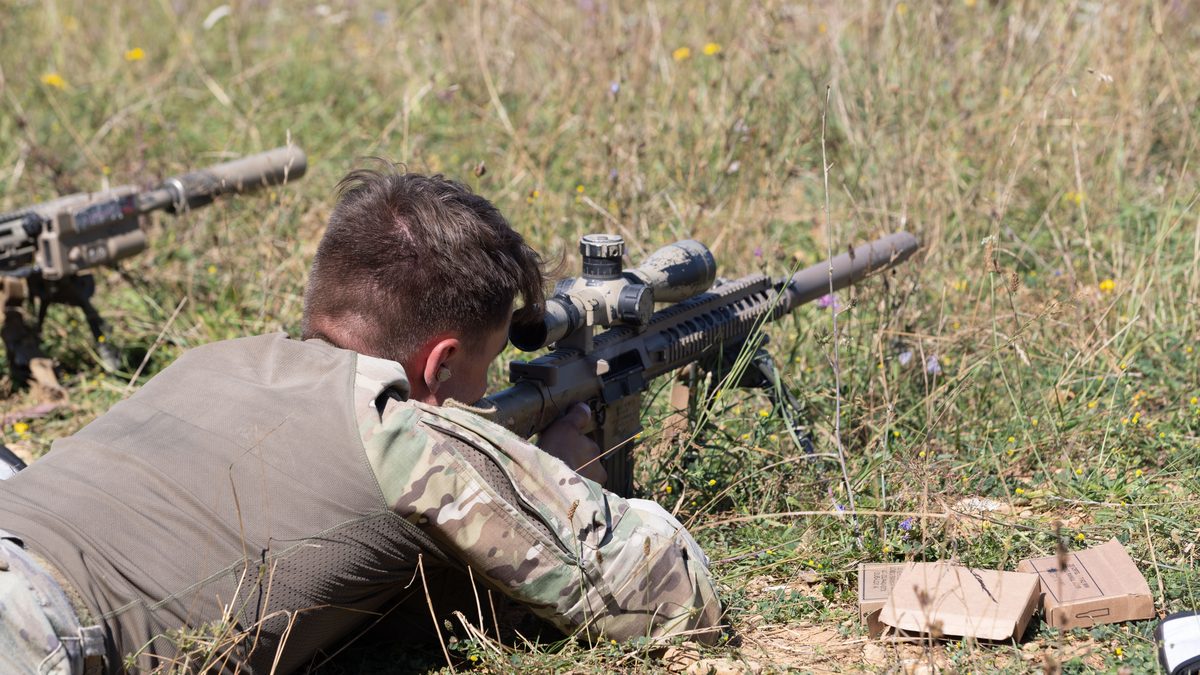
A U.S. Soldier fires a Heckler & Koch HK416 service rifle fitted with a sound suppressor during the Friendship Shoot concluding the 2024 European Best Sniper Team Competition, Joint Multinational Readiness Center, Hohenfels, Germany. U.S. Army photo by Spc. Andrew Clark / DVIDS (public domain). Use does not imply Department of Defense endorsement.
Suppressors Leave the Munitions List: How the ITAR to Commerce Transfer Changes Allied Small-Arms Programmes
From 20 November 2026, sound suppressors for non-automatic and semi-automatic firearms leave United States Munitions List Category I and move to the Commerce Control List under new export classifications 0A501.f and 0A502.f. Suppressors specially designed for fully automatic firearms up to .50 calibre remain under State Department control. Export authorisation is still required in most cases.
Technical Summary
The United States Department of State and the Department of Commerce published coordinated interim final rules in the Federal Register on 23 July 2026 transferring export jurisdiction over most firearm sound suppressors. Suppressors for non-automatic or semi-automatic firearms leave United States Munitions List (USML) Category I, administered by the Directorate of Defense Trade Controls under the International Traffic in Arms Regulations (ITAR), and move to the Commerce Control List (CCL), administered by the Bureau of Industry and Security (BIS) under the Export Administration Regulations (EAR). The transfer takes effect on 20 November 2026, 120 days after publication. The comment period closes on 24 August 2026.
Most rifle and pistol suppressors fall under new Export Control Classification Number (ECCN) 0A501.f. Suppressors made exclusively for shotguns fall under 0A502.f, and a multi-host suppressor intended to serve rifles, pistols and shotguns is classified in the first entry rather than the second. The State Department retains control of suppressors specially designed for fully automatic firearms up to .50 calibre and for fully automatic shotguns, citing design features such as greater heat dissipation for sustained automatic fire. The reassessment follows Executive Order 14268 of 9 April 2025, Reforming Foreign Defense Sales to Improve Speed and Accountability, which directed a review holding on the USML only those technologies conferring a critical military or intelligence advantage.
Moving from the Munitions List to the Commerce Control List is a change of regulator, not a removal of control. Authorisation remains required for exports, re-exports and in-country transfers, including controlled technology released to foreign persons. ISC Defence Intelligence regulatory assessment
Analysis of Effects
For defence readers the boundary is the interesting part. The dividing line is the host weapon’s mode of fire, not the suppressor’s durability under sustained use. A suppressor that would survive belt-fed employment but is specially designed for a semi-automatic precision rifle moves to Commerce. One specially designed for a general-purpose machine gun stays on the Munitions List. That leaves a classification question in the middle, because a large share of military suppressors are sold for host weapons that exist in both semi-automatic and selective-fire configurations, and the specially designed test must be resolved case by case. The two regimes do not apply an identical test: specially designed is defined at ITAR § 120.41 and, separately, at EAR § 772.1, so an item can sit awkwardly between two definitions rather than simply on one side of a line.
The practical effect on allied procurement is a change of licensing route rather than a change of access. BIS expects roughly 200 additional licence applications each year. Under the EAR some destinations qualify for licence exceptions: Limited Value Shipments covers consignments up to 500 United States dollars where Canada is the final destination, and shotgun-only suppressors generally require a licence except to NATO members and a listed group including Australia, Austria, India, Ireland, Japan, Liechtenstein, New Zealand, South Korea and Switzerland. End-user restrictions, embargoes and anti-diversion controls continue to apply, so a European ministry of defence buying United States suppressors changes the department it deals with, not the requirement to be authorised.
Personnel and Safety Considerations
The companion Commerce rule also widens License Exception TMP at EAR § 740.9, covering temporary imports, exports, re-exports and transfers, to include company-owned firearms and related items carried abroad as tools of trade. The exception is bounded: up to three firearms, reasonable quantities of related parts and accessories and up to 1,000 rounds of specified ammunition, all of which must stay under the effective control of the owner or an employee, serve a legitimate business purpose, and return rather than be sold or permanently transferred abroad. Items must be declared to United States Customs and Border Protection before departure and presented for inspection. Country Group E:1 destinations are excluded from the exception. Destination-country import law remains a separate obstacle, and Commerce warns that a foreign authority may still demand an import certificate.
Data Gaps
These are interim final rules and the comment period does not close until 24 August 2026, so the final text may change. No published guidance yet resolves how the specially designed test applies to a suppressor marketed for both semi-automatic and selective-fire hosts. The treatment of suppressors integral to a weapon system already listed on the USML is not addressed in the material reviewed. Whether allied government-to-government cases previously handled through Foreign Military Sales will now route through direct commercial sale under the EAR is not stated. The effect on existing Directorate of Defense Trade Controls registrations and open ITAR licences during the transition window is not set out; the savings provision in the Commerce rule reaches only shipments already en route on 23 July 2026 that would otherwise lose licence-exception or no-licence-required eligibility, which is narrower than a general transition arrangement.
Key Questions
When do suppressor exports move from ITAR to the Commerce Control List?
The State and Commerce interim final rules were published in the Federal Register on 23 July 2026 and the jurisdiction transfer takes effect 120 days later, on 20 November 2026. Some supporting Commerce revisions, including the expanded tools-of-trade provision, took effect on 23 July 2026. Public comments close on 24 August 2026.
Which suppressors stay on the United States Munitions List?
Suppressors specially designed for fully automatic firearms up to .50 calibre, and for fully automatic shotguns, remain in USML Category I under State Department control. The department cites features such as greater heat dissipation for sustained automatic fire. Suppressors designed for non-automatic or semi-automatic hosts move to Commerce Control List entries 0A501.f and 0A502.f.
Does the change remove export controls on suppressors?
No. Authorisation is still required for exports, re-exports and in-country transfers, including controlled technology and software released to foreign persons. What changes is the administering agency and the regulatory framework. The Export Administration Regulations offer licence exceptions and some licence-free destinations that the International Traffic in Arms Regulations did not.
References
Source-evaluated under NATO STANAG 2022 (Reliability A–F / Accuracy 1–6). Tier 1 = government primary source; Tier 2 = quality news / specialist defence media; Tier 3 = authoritative aggregator / encyclopaedia.
- T1Federal Register, United States Department of State – International Traffic in Arms Regulations: USML Category I Firearm Suppressors (interim final rule, RIN 1400-AG11), 23 July 2026. (Reliability A / Accuracy 1)
- T1Federal Register, Bureau of Industry and Security – Implementation of EAR Export Controls on Silencers, Mufflers and Sound Suppressors, and Other Firearms Related Changes (interim final rule, RIN 0694-AK35), 23 July 2026. (Reliability A / Accuracy 1)
- T1Federal Register – Executive Order 14268, Reforming Foreign Defense Sales To Improve Speed and Accountability, 9 April 2025. (Reliability A / Accuracy 1)
- T1United States Department of State, Bureau of Political-Military Affairs – Interim Final Rule to Eliminate Burdensome Regulations on Firearms Suppressors, July 2026. (Reliability A / Accuracy 1)
- T2The Firearm Blog – U.S. Moves Most Suppressor Exports From ITAR to Commerce Control, 5 August 2026. (Reliability B / Accuracy 2)
- T2KPMG TaxNewsFlash – US interim final rules: Transfer of firearm suppressors to Commerce (EAR/CCL) jurisdiction, July 2026. (Reliability B / Accuracy 2)
Corrections & updates welcome. If you hold open-source data that refines or corrects any parameter in this article, please contact [email protected] citing the specific claim and your source. Verified corrections will be incorporated and credited in the revision history. AI-assisted technical assessment based on open-source material. Not a formal intelligence product.