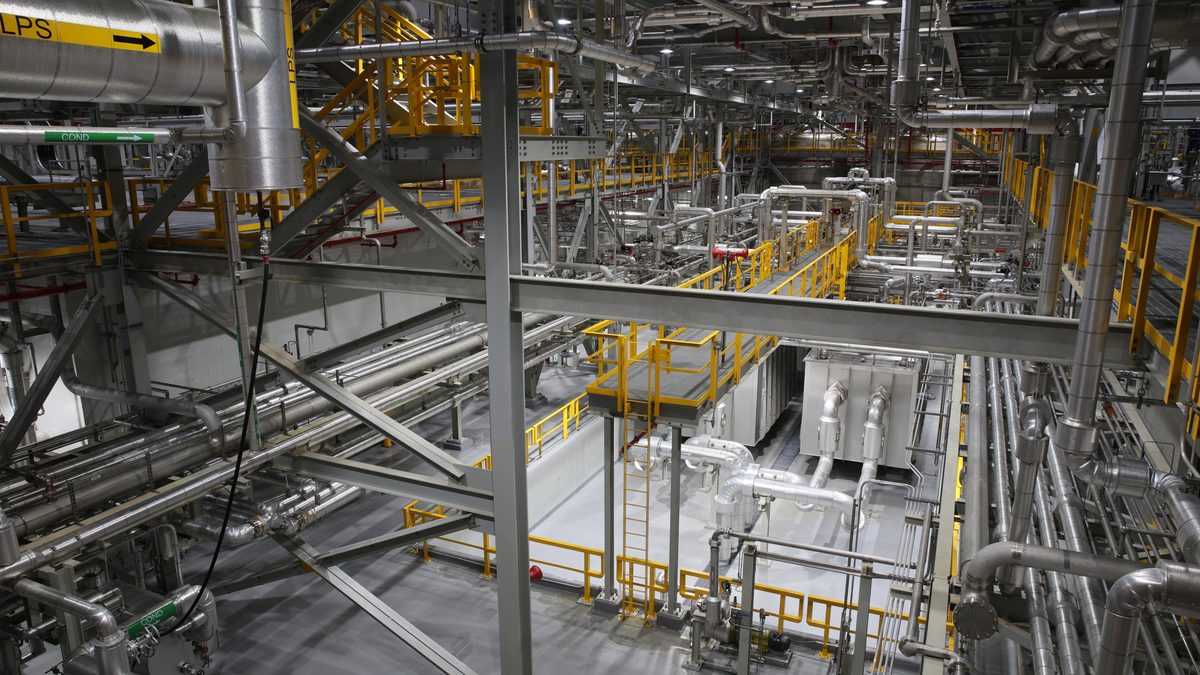
Process floor of the new nitrocellulose facility at Radford Army Ammunition Plant, Virginia, 18 September 2024. Radford is the United States government-owned nitrocellulose and propellant plant, and the plant architecture shown here, continuous process lines, acid and solvent pipework and segregated bays, is the same class of installation CSG must license and build at Gnaschwitz. U.S. Army photo by Christine Mitchell, Radford Army Ammunition Plant, via DVIDS. Public domain. Use of this image does not imply endorsement by the U.S. Department of Defense or the U.S. Army.
CSG Buys Gnaschwitz for Nitroglycerin, Targeting the Narrowest Point in European Propellant Supply
CSG completed the purchase of the 57-hectare Gnaschwitz industrial site near Bautzen in Saxony from MAXAM, announced on 4 August 2026, and will invest more than 100 million euro in the first development phase. The plant is to produce nitroglycerin, the nitrate ester that gives double-base and triple-base gun propellants their energy, for small, medium and large calibre ammunition.
Technical Summary
CSG, the Czech industrial group formerly styled Czechoslovak Group, has completed the acquisition of a 57-hectare site at Gnaschwitz near Bautzen, Saxony, through its German subsidiary CSG Energetic Materials Germany GmbH. The seller was MAXAM. Consideration was not disclosed. The stated first-phase investment exceeds 100 million euro and is directed at production capacity for nitroglycerin and nitroglycerin-based products, with preparation of the site for ammunition and ammunition-component manufacture running alongside. CSG expects the completed projects to create up to 125 posts. The site has carried energetic-materials production since 1874, when the Königlich Sächsische Pulverfabrik Gnaschwitz was constituted on 23 October of that year with cannon and rifle powder leaving the plant from 1 July 1875, and it retains usable process infrastructure.
Nitroglycerin, correctly glycerol trinitrate, is not an end item. It is a plasticising energetic ingredient. Combined with nitrocellulose it produces double-base gun propellant; adding nitroguanidine, also called picrite, produces triple-base propellant. The distinction matters at the muzzle rather than in the factory. Double-base formulations deliver higher force and impetus per unit mass and dominate small-arms and medium-calibre applications, but burn hot enough to erode barrels quickly. Triple-base formulations trade some impetus for a markedly lower flame temperature, which is why they are the standard charge chemistry for large-calibre tank and artillery natures where barrel life is a sustainment cost in its own right. CSG has stated that Gnaschwitz output will feed its Medium & Large Calibre and Ammo+ divisions and external customers, which places the site upstream of both charge lines.
Gnaschwitz is CSG’s second energetic-materials site in Germany. Walsrode supplies nitrocellulose; Gnaschwitz is to supply nitroglycerin. Between them they cover both principal ingredients of double-base propellant inside one corporate boundary. ISC assessment, 6 August 2026
Analysis of Effects
The European ammunition debate has concentrated on shell bodies and filling lines because those are visible and countable. Propellant chemistry is the quieter constraint. A 155 mm high-explosive projectile without a charge is inert freight, and a charge cannot be made without nitrocellulose and, for double-base and triple-base natures, nitroglycerin. Nitration capacity is difficult to add at short notice: it requires mixed-acid handling, nitric acid supply, effluent treatment, quantity-distance separation, and a regulatory approval path that is measured in years rather than quarters. Buying a site with an existing energetic-materials history and permitting heritage is a materially faster route than greenfield construction, and it is the same logic CSG applied at Walsrode.
The Walsrode link is the part worth tracking. CSG agreed the purchase of the MSM Walsrode facility at Bomlitz, Lower Saxony, from International Flavors & Fragrances in October 2024 and completed in May 2025, then began converting its industrial nitrocellulose operation to produce energetic-grade nitrocellulose. CSG statements in mid-2025 indicated a conversion path of roughly two years, which puts energetic-grade output from Walsrode around 2027 as a stated target rather than a delivered date. Pairing that with nitroglycerin at Gnaschwitz gives CSG both legs of a double-base propellant chain under one owner, inside Germany, and outside the handful of incumbent European suppliers that currently set delivery dates for everyone else. The third leg is further along than the announcement implies. Triple-base propellant additionally needs nitroguanidine, and CSG has been building a position in Alzchem Group, one of the few European producers of it: its trading arm STALUNA TRADE holds roughly 9.9 per cent of the voting rights directly, with about a further 10.2 per cent of economic exposure through total return swaps running to May 2027, for a combined position near 20 per cent. Read against Gnaschwitz and Walsrode, that puts all three principal charge ingredients inside or adjacent to one corporate perimeter. CSG has also flagged potential follow-on work at Gnaschwitz in medium-calibre assembly, tank rounds and 120 mm mortar ammunition. Those remain stated intentions, not funded programmes, and should be read as such.
CSG is not moving alone, which is what makes the move structural rather than opportunistic. Rheinmetall bought the Osnabrück industrial nitrocellulose producer Hagedorn-NC in 2025, adding a fourth nitrocellulose site to its existing Nitrochemie footprint in Switzerland, Spain and South Africa, and said plainly that the purchase was about a strategic bottleneck in propellant production. Eurenco and Polish capacity under Grupa Azoty and PGZ are expanding on the same reasoning. What CSG has done differently is buy both double-base molecules in the same country rather than one of them, which creates a second German-based owner of the full chain where previously there was one.
Personnel and Safety Considerations
Nitroglycerin is a secondary explosive of high sensitivity and is handled accordingly. Under the United Nations Model Regulations the relevant entries are UN 0143, nitroglycerin desensitised with not less than 40 per cent non-volatile water-insoluble phlegmatiser by mass, and UN 0144, nitroglycerin solution in alcohol with more than 1 per cent but not more than 10 per cent nitroglycerin, both assigned Hazard Division 1.1, Compatibility Group D. Finished smokeless propellant is separately classified under UN 0160 as HD 1.1C or UN 0161 as HD 1.3C depending on the article and packaging configuration, which is why a propellant plant and a nitration plant carry different quantity-distance cases even on the same estate. Those two entries describe how the material is actually handled rather than a laboratory ideal: production nitroglycerin is not moved or held neat, it is phlegmatised for any intermediate storage or transfer and then blended continuously into nitrocellulose dough. Modern practice is continuous nitration, typically a Biazzi-type or equivalent plant, precisely to keep in-process inventory, and therefore net explosive quantity at risk, as low as reasonably practicable at any instant; batch nitration has largely gone from Western European production on those grounds. One point of scope is worth stating plainly. For a United Kingdom or NATO reader the reference framework is DSA 03.OME, which replaced the withdrawn JSP 482, with siting and quantity-distance rules in AASTP-1 Edition C. Gnaschwitz itself will not be licensed against those documents. It sits under German national explosives law, the Sprengstoffgesetz, with BAM as the competent technical authority, and the retained infrastructure shortens that licensing case without removing it.
Data Gaps
Five gaps limit confidence. First, no annual nitroglycerin tonnage has been published, so the capacity added to the European pool cannot be sized. Second, no net explosive quantity, licensed inventory or quantity-distance case for the rebuilt site is in open source. Third, the purchase price was withheld, so the capital intensity of the acquisition cannot be separated from the 100 million euro development figure. Fourth, the split of planned output between double-base and triple-base feedstock is unstated, which is what would indicate whether the site is aimed primarily at small and medium calibre or at large-calibre charge lines. Fifth, no commissioning date has been given; the 1874 industrial heritage and retained infrastructure suggest a shorter path than greenfield, but permitting timelines under German and Saxon regulation are not public.
Key Questions
What is nitroglycerin actually used for in ammunition?
It is an energetic plasticiser in gun propellant, not a filling in its own right. Mixed with nitrocellulose it forms double-base propellant; adding nitroguanidine forms triple-base propellant. Double-base gives higher energy and suits small and medium calibre. Triple-base burns cooler and is preferred for large-calibre tank and artillery charges because it slows barrel erosion.
Why does buying an old site matter more than building a new one?
Nitration plants need mixed-acid handling, effluent treatment, explosive quantity-distance separation and lengthy regulatory approval. A site such as Gnaschwitz, in energetic-materials use since 1874, carries existing infrastructure and permitting heritage. That shortens the route to production compared with greenfield construction, which is the same reasoning CSG applied at its Walsrode nitrocellulose plant.
Does this reduce European dependence on outside propellant suppliers?
Potentially, but the size of the effect is unknown. CSG has not published an annual nitroglycerin tonnage or a commissioning date. What can be said is that pairing Gnaschwitz nitroglycerin with Walsrode nitrocellulose places both principal double-base propellant ingredients inside one corporate boundary in Germany, which is a structural change rather than a marginal one.
References
Source-evaluated under NATO STANAG 2022 (Reliability A–F / Accuracy 1–6). Tier 1 = government primary source; Tier 2 = quality news / specialist defence media; Tier 3 = authoritative aggregator / encyclopaedia.
- T1CSG corporate release (via GlobeNewswire) – CSG acquires the Gnaschwitz industrial site in Germany and plans to invest more than EUR 100 million in its initial development, 4 August 2026. (Reliability A / Accuracy 1)
- T2Defence Industry Europe – CSG acquires German energetic-materials site and plans over €100 million investment in nitroglycerin and ammunition production, 4 August 2026. (Reliability B / Accuracy 2)
- T2Militarnyi – Czechoslovak Group Acquires German Site for Nitroglycerin and Ammunition Production, 4 August 2026. (Reliability B / Accuracy 2)
- T2EDR Magazine – CSG acquires the Gnaschwitz industrial site in Germany, 4 August 2026. (Reliability B / Accuracy 2)
- T3Militär Aktuell – CSG is investing over 100 million euros in Germany, August 2026. (Reliability C / Accuracy 3)
- T2Defense News – Rheinmetall secures nitrocellulose supply amid European ammo scramble, 7 April 2025. Cited for the Hagedorn-NC acquisition and Rheinmetall's nitrocellulose footprint. (Reliability B / Accuracy 2)
- T2MarketScreener – Czech defense group CSG significantly increases stake in Alzchem, 2026. Cited for the STALUNA TRADE voting-rights holding and the total return swap exposure. (Reliability B / Accuracy 2)
- T2soldat & technik – Gnaschwitz: CSG übernimmt Sprengstoffproduktion von MAXAM, August 2026. Cited for the site's German industrial lineage. (Reliability B / Accuracy 2)
Corrections & updates welcome. If you hold open-source data that refines or corrects any parameter in this article, please contact [email protected] citing the specific claim and your source. Verified corrections will be incorporated and credited in the revision history. AI-assisted technical assessment based on open-source material. Not a formal intelligence product.