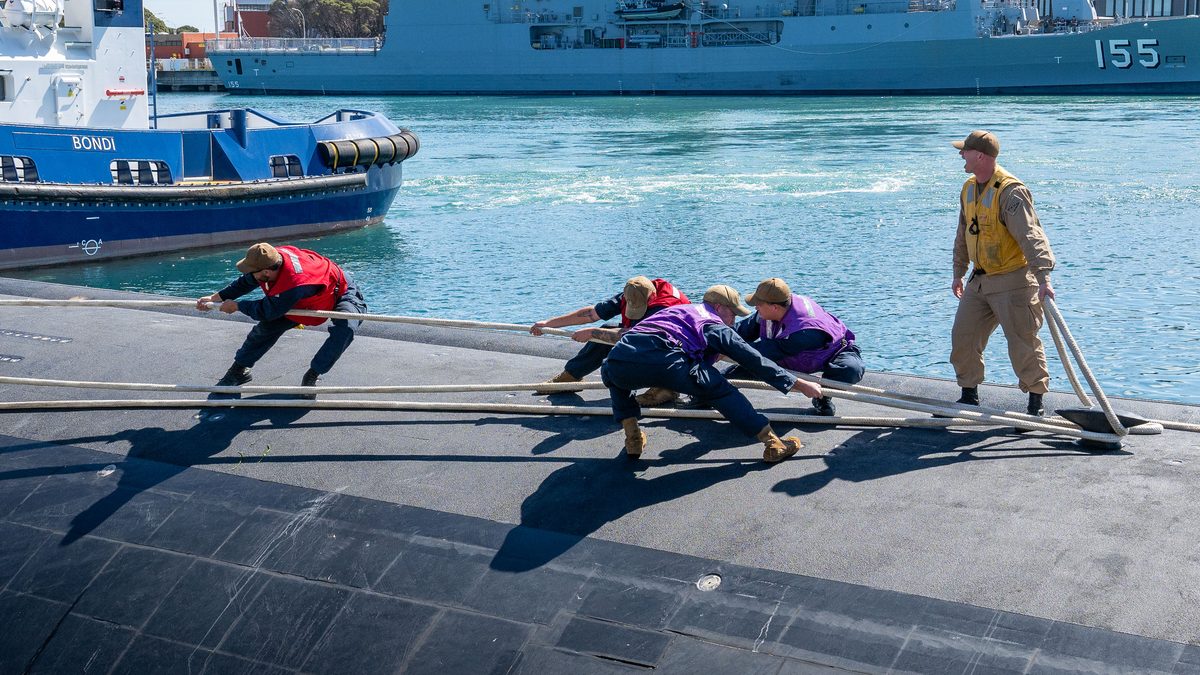
The Virginia-class fast-attack submarine USS Minnesota (SSN 783) conducts mooring operations at HMAS Stirling, Western Australia, 25 February 2025. Photo: Lt. James Cavila, AUKUS Integration & Acquisition, US Navy. Public domain (DVIDS 8884873). Use does not imply endorsement by the US Department of Defense.
Three Used Boats and a Build Rate: What AUKUS Now Actually Buys Australia
On 30 May 2026 the AUKUS defence ministers agreed Australia would “acquire three in-service VCS in lieu of a mixture of new and in-service VCS variants”. Australia therefore buys three second-hand Virginia-class submarines rather than two used boats and one new one, trading roughly a decade of hull life for earlier certainty against a US build rate of 1.2 to 1.3 boats a year.
Technical Summary
The Optimal Pathway announced at San Diego on 13 March 2023 set out a three-stage route to an Australian nuclear-powered attack submarine force. Rotational visits first, then a sale of used American hulls, then a jointly designed boat built in Adelaide. The published fact sheet committed the United Kingdom and the United States to establishing a rotational presence at HMAS Stirling near Perth “as early as 2027”, and stated that “beginning in the early 2030s, pending approval from the U.S. Congress, the United States intends to sell Australia three Virginia class submarines, with the potential to sell up to two more if needed”. Australia would then take delivery of its own SSN-AUKUS boats from the early 2040s, with the Royal Navy receiving the first of the class in the late 2030s.
That structure survives. The contents changed. The AUKUS Defence Ministerial Joint Statement of 30 May 2026 records an approach that “would enable Australia to acquire three in-service VCS in lieu of a mixture of new and in-service VCS variants”, alongside the “finalization of necessary arrangements for the establishment of SRF-West in 2027” and Australian infrastructure spending the statement puts at AUD 8 billion at SRF-West. The United States Studies Centre reads the revision as replacing a newly built boat in 2038 with a third second-hand Block IV hull on the same date, and assesses that an in-service transfer carries roughly 23 years of operational availability against roughly 33 years for a new build. On that arithmetic the third boat leaves Australian service around 2061 rather than around 2071. The option on two further new boats in 2041 and 2044 remains.
Australia is buying three used hulls from a production line delivering 1.2 to 1.3 boats a year against a stated requirement of 2.33, and the US Navy’s own date for reaching two a year has moved from 2028 to around 2032. ISC assessment, drawn from CRS RL32418, USSC and USNI News reporting
The Australian Case, Stated Fairly
Supporters of the partnership do not argue that submarines arrive soon. They argue that nothing else buys reach. A conventionally powered boat operating from Western Australia spends most of a patrol transiting. A nuclear-powered boat does not. The strategic logic set out by supporters, including the Labor member Luke Gosling writing for the Lowy Institute in June 2024, is deterrence by denial at distance: an adversary contemplating coercion against Australia has to price in a submarine it cannot locate, operating far from Australian waters, for as long as the crew can be fed. Interoperability is the second argument. Rotational American and British boats at HMAS Stirling from 2027 give the Royal Australian Navy access to operating patterns, maintenance practice and a reactor safety culture it cannot generate alone. Technology access is the third, and Pillar 2 is where it is meant to land.
There is also an industrial argument, and it is the strongest of the three because it is already visible. Australia has a submarine construction yard under construction at Osborne, a sovereign nuclear safety regulator, an ASC maintenance workforce that in November 2025 was fitting Australian-fabricated maintenance platforms to the sail of a US Navy Virginia-class boat at Garden Island, and Australian companies holding AUD 1.9 billion in awarded contracts. Sovereign capability of that kind does not evaporate if a hull slips. It is the part of AUKUS that is being delivered on time.
The Case Against, Stated Fairly
Three criticisms have force. The first is sequencing. The Australian National Audit Office found that risk on the Collins-class Life of Type Extension was escalated to extreme as early as August 2022, that the Australian Submarine Corporation advised from September 2022 that the work was not feasible within a two-year docking cycle, and that Defence did not begin investigating alternative delivery approaches until October 2025. A revised approach was approved in May 2026 with reduced scope on HMAS Farncomb. The bridging force is therefore thinner than the plan assumed, at exactly the point where the destination has moved further away.
The second is sovereignty. Gareth Evans has argued that genuine Australian agency over how the boats are used is illusory, and Malcolm Turnbull put the fiscal version of the same point at Chatham House on 11 May 2026, calling AUKUS “a huge wealth transfer from the Australian government to the US and the UK” and suggesting the United Kingdom would do better designing a new class with France. The third is opportunity cost. Hugh White and Sam Roggeveen have both argued that the same money buys a larger denial force of missiles, mines and uncrewed systems sooner. That argument is about tempo as much as about money, and the June 2026 change to used hulls strengthens it, because a second-hand boat delivered in 2038 with 23 years left is a smaller answer than a new one with 33.
A fourth criticism is procedural rather than strategic. The AUD 268 billion to AUD 368 billion cost range has never been accompanied by a published cost model, and it has not been restated since the submarine mix changed. Parliament is being asked to fund a thirty-year programme against a three-year-old figure that no longer describes what is being bought.
How the United States, United Kingdom and France Compare
The three partners and the country Australia walked away from are running four different bets. The comparison below is ISC’s own synthesis of the sourced positions, not a published side-by-side study.
| Approach | What it buys | Principal constraint | Delivery status |
|---|---|---|---|
| United States | Scale, through Virginia and Columbia lines, roughly USD 9.8 billion of Congressionally appropriated industrial-base support since FY2018, and a USD 76.6 billion multi-year award placed on 29 July 2026 | Yard and workforce capacity; the Columbia deterrent boat has first call on both | Funded, behind schedule |
| United Kingdom | Up to 12 SSN-AUKUS boats under the June 2025 Strategic Defence Review, on a stated drumbeat of one boat every 18 months from Barrow | Availability now, not capacity later; the Commons Defence Committee found submarine availability critically low in April 2026 | Designed and part funded |
| France | Sovereign design, build and fuel at Cherbourg. Four Suffren-class boats delivered since 2022, the fourth on 24 June 2026, with SNLE 3G entering full industrial construction in January 2026 | Force size. Six attack boats, no allied production surge to draw on | Delivering |
| Australia | Reach without a domestic nuclear industry, bought through partnership and paid for in advance | Total dependence on two other nations’ production rates and one statutory certification | Committed, nothing delivered |
France is the instructive control case. It cancelled nothing, partnered with nobody, and has put four attack submarines into service in four years while Australia has put none. It also cannot surge, cannot draw on an allied industrial base, and fields a fleet of six where the US Navy counts 49 attack boats against a stated requirement of 66. Sovereignty and scale trade against each other. Australia chose scale and accepted dependence; France chose sovereignty and accepted a small fleet; the United Kingdom is attempting both and is, on the Defence Committee’s own evidence, currently short on the first.
What a Block IV Hull Actually Carries
The change agreed on 30 May 2026 is usually reported as a change of age. It is also a change of magazine. The three boats Australia is buying are Block IV standard, and a Block IV Virginia carries its vertical launch load in two Virginia Payload Tubes holding twelve Tomahawk-sized weapons in total. The Virginia Payload Module fitted from Block V adds four further large-diameter tubes at seven weapons each, taking a later boat to forty. Australia is therefore acquiring roughly a third of the vertical land-attack capacity of the variant the United States is now building, in addition to accepting a shorter hull life.
The gap is about to become a formal one. On 4 August 2026 the US Navy announced that nineteen Virginia-class submarines fitted with the Payload Module, covering Block V and Block VI boats delivering through 2038, will be redesignated from fast-attack submarines to guided-missile submarines. Admiral Daryl Caudle said the change “accurately reflects the extraordinary strike capacity, operational flexibility, and global reach these platforms bring to the fleet”. The first Payload Module boat, USS Arizona, is scheduled for delivery in fiscal year 2029. Australia will operate the class the US Navy has just decided is a different kind of ship. That is not an argument against the purchase, and a twelve-cell boat with a nuclear plant still outranges anything Australia has today. It is an argument for reading the Pillar 2 uncrewed underwater vehicle work, and Australia’s separate long-range strike programmes, as load-bearing rather than decorative.
Analysis of Effects
Everything in the Pillar 1 timetable rests on one number. The Congressional Research Service reports that Virginia-class procurement has never reached two boats a year, and actual output since 2022 has run at roughly 1.1 to 1.3. The requirement to sustain the US fleet and sell to Australia is put at 2.33. On 12 May 2026 the Chief of Naval Operations, Admiral Daryl Caudle, told reporters the two-a-year rate should arrive “around 2032”. In 2023 the date given was 2028. A four-year slip in a three-year period is the single hardest fact in this programme, and it sits directly upstream of a statutory gate: 22 U.S.C. § 10431(d)(1) requires the President to certify to Congress, at least 270 days before any transfer, that the sale “will not degrade the United States undersea capabilities”. No such certification has been made public. Nor is one due yet. Money is now moving at scale against that constraint. On 29 July 2026 the US Navy placed a USD 76.6 billion award with General Dynamics Electric Boat and HII, covering USD 42.1 billion for nine Block VI Virginia-class boats plus material for a tenth, USD 29.5 billion for five Columbia-class Build II boats and USD 5 billion for workforce measures, after a delay of nearly three years. Contracts are not hulls. The award tells Australia that the American line is being funded properly at last. It does not tell Australia that the line will deliver at 2.33 before 2032.
Against that, the Australian case is not merely rhetorical. Money has moved and concrete has been poured. Australia has committed USD 3 billion to the US submarine industrial base, of which USD 500 million was paid on 10 February 2025 and a further USD 525 million in July 2025, and GBP 2.4 billion to the United Kingdom, a figure confirmed by Vice Admiral Jonathan Mead at Senate Estimates on 6 June 2024. Domestically the Osborne Submarine Construction Yard drew AUD 3.9 billion on 16 February 2026 and a further AUD 4.6 billion on 24 July 2026, taking the committed total to AUD 8.5 billion, with AUD 12 billion earmarked for the Henderson Defence Precinct. Australia stood up a sovereign nuclear regulator, the Australian Naval Nuclear Power Safety Regulator, announced on 1 November 2025 under the Australian Naval Nuclear Power Safety Act 2024. Pillar 2 produced its first signature project on 30 May 2026, covering uncrewed underwater vehicle payloads and enabling systems, with deliveries stated to begin in 2027. The licence-free defence trade environment created by the US interim final rule of 1 September 2024 was finalised on 30 December 2025. None of that is nothing.
Personnel and Safety Considerations
The weapons and safety burden arrives before the submarines do. A Virginia-class hull transferred to Australia brings with it a heavyweight torpedo and land-attack missile inventory that Australia must store, certify and account for under its own regime. The United States notified Congress in March 2023 of a possible Foreign Military Sale of up to 200 Tomahawk Block V and 20 Tomahawk Block IV all-up rounds, with an estimated total cost of USD 895 million, and Australia contracted for Mk 48 Mod 7 heavyweight torpedo work in March 2025. Each of those creates explosives licensing, quantity-distance and net explosive quantity questions at HMAS Stirling and at Henderson that are separate from the naval nuclear propulsion safety case and are regulated by different authorities. The propulsion plant is now the responsibility of the Australian Naval Nuclear Power Safety Regulator; the ordnance is not. Two regulatory lanes, one wharf. That interface, rather than the reactor, is where ISC expects the first serious Australian assurance friction to appear, because it is the interface that no partner nation has yet had to build from a standing start. The competence question is the same one that recurs across NATO quality assurance: the standards exist, but the trained population to apply them does not yet.
Data Gaps
Five gaps are material and are recorded here rather than papered over. First, the Australian Government has not published a revised total programme cost since the AUD 268 billion to AUD 368 billion range announced on 14 March 2023, and that range predates the change in submarine mix. Second, the conditions attached to the conclusion of the US Department of Defense AUKUS review in December 2025 have not been disclosed, so no sourced causal line can be drawn between the review and the June 2026 revision. Third, the instalment record for Australia’s USD 3 billion contribution is reported inconsistently in US dollars and Australian dollars, and no payment between January and August 2026 has been located. Fourth, no figure has been published for the capital cost of the Rolls-Royce Raynesway expansion. Fifth, the safeguards arrangement under Article 14 of Australia’s IAEA agreement had still not been concluded when the three partners addressed the IAEA Board of Governors on 5 March 2026, roughly four and a half years after the partnership was announced.
Key Questions
Is Australia still getting a brand new Virginia-class submarine under AUKUS?
No. The AUKUS Defence Ministerial Joint Statement of 30 May 2026 replaced the original mix of two used and one newly built Virginia-class boat with three in-service boats. Australia keeps an option on two further new-build submarines in 2041 and 2044, but the firm commitment is now three second-hand hulls.
Why does the US submarine build rate matter to Australia?
Because US law requires the President to certify that a transfer will not degrade American undersea capability. The Congressional Research Service reports Virginia-class output has never reached two boats a year, and Admiral Daryl Caudle said on 12 May 2026 that two a year should arrive around 2032, four years later than the 2028 date given in 2023.
How does the French submarine programme compare with AUKUS?
France builds sovereign nuclear submarines at Cherbourg and has delivered four Suffren-class boats since 2022, the fourth, De Grasse, on 24 June 2026. Australia cancelled its conventional Naval Group contract in September 2021 and paid a settlement of EUR 555 million in June 2022. France trades reach for control; Australia trades control for reach.
References
Source-evaluated under NATO STANAG 2022 (Reliability A–F / Accuracy 1–6). Tier 1 = government primary source; Tier 2 = quality news / specialist defence media; Tier 3 = authoritative aggregator / encyclopaedia.
- T1GOV.UK / UK Ministry of Defence – AUKUS Defence Ministerial Joint Statement: 30 May 2026, 30 May 2026. (Reliability A / Accuracy 1)
- T2Congressional Research Service – RL32418: Navy Virginia-Class Submarine Program and AUKUS Submarine (Pillar 1) Project, 26 January 2026. (Reliability B / Accuracy 2)
- T2UK Parliament, House of Commons Defence Committee – AUKUS: Government must do more, and do it faster, 28 April 2026. (Reliability B / Accuracy 2)
- T2Australian National Audit Office – Defence’s Collins Class Submarines Life of Type Extension: Planning and Implementation, 22 May 2026. (Reliability B / Accuracy 2)
- T3USNI News – Virginia Subs Will Hit 2-a-Year Build Rate in 2030s, CNO Caudle Says, 12 May 2026. (Reliability C / Accuracy 3)
- T2United States Studies Centre – By the numbers: AUKUS revised timeline comparison, 2026. (Reliability B / Accuracy 2)
- T1Naval Group – Naval Group delivers the fourth Barracuda-class nuclear attack submarine, 24 June 2026. (Reliability A / Accuracy 1)
- T2USNI News – Navy Awards USD 76.6B for 9 Virginia, 5 Columbia Subs to General Dynamics, HII, 29 July 2026. (Reliability B / Accuracy 1)
- T2Military Times – US Navy is reclassifying 19 Virginia-class submarines to reflect increased attack capabilities, 4 August 2026. (Reliability B / Accuracy 2)
Corrections & updates welcome. If you hold open-source data that refines or corrects any parameter in this article, please contact [email protected] citing the specific claim and your source. Verified corrections will be incorporated and credited in the revision history. AI-assisted technical assessment based on open-source material. Not a formal intelligence product.