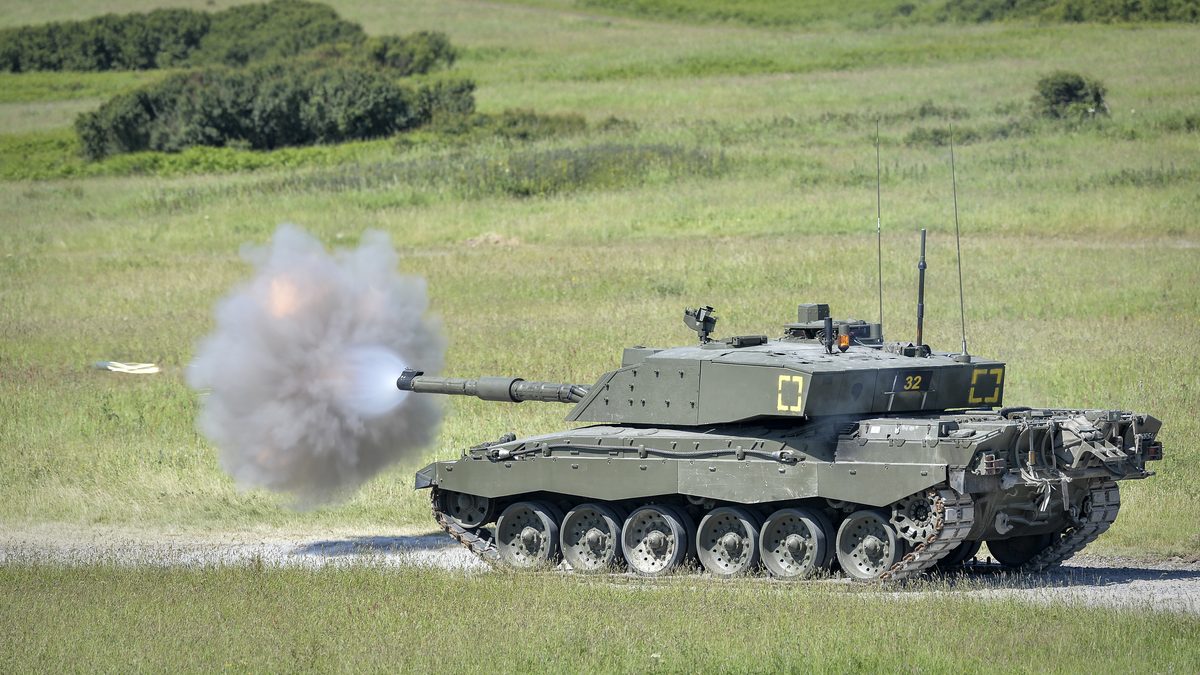
A Challenger 2 of the Royal Tank Regiment fires a squash-head practice round on Castlemartin Ranges, Pembrokeshire, June 2014. Photo: Cpl Si Longworth RLC (Phot) / UK MOD. Crown copyright, reproduced under the Open Government Licence v1.0. Illustrative; not the vehicle involved in the 2017 accident.
Castlemartin Nine Years On: A Crown Censure for the MOD and a Charge Over the L30 Safety Case
On 1 July 2026 the Health and Safety Executive authorised a Crown Censure of the Ministry of Defence and a criminal charge against Rheinmetall BAE Systems Land Ltd over the Challenger 2 turret explosion at Castlemartin Range on 14 June 2017, which killed Corporals Darren Neilson and Matthew Hatfield. Neither step is a finding of guilt.
Technical Summary
Two soldiers of the Royal Tank Regiment died when the L30 gun of a Challenger 2 main battle tank exploded on Castlemartin Range in Pembrokeshire on 14 June 2017. Corporal Darren Neilson was 31. Corporal Matthew Hatfield was 27. Two further crew members were injured, one of them with life-changing injuries. On 1 July 2026 the Health and Safety Executive (HSE) announced that its legal services division had authorised a Crown Censure of the Ministry of Defence (MOD) under Section 2 of the Health and Safety at Work etc. Act 1974, and a charge against Rheinmetall BAE Systems Land Ltd (RBSL), formerly BAE Systems Global Combat Systems Ltd, under Section 3 of the same Act.
The regulator drew the line in a way that matters to anyone who writes or accepts an ordnance safety case. HSE states that RBSL was responsible for producing the safety case for the tank and the gun, while the MOD held ultimate responsibility for the health, safety and welfare of its soldiers and for the suitability and sufficiency of that safety case. Section 3 reaches the contractor because the soldiers were not its employees. Section 2 reaches the department because they were. Two duties, one document, one turret.
RBSL was responsible for producing the safety case for the tank and gun, while the MOD held ultimate responsibility for the health, safety and welfare of its soldiers, and for the suitability and sufficiency of the safety case. Health and Safety Executive, 1 July 2026
Analysis of Effects
The L30A1 is the last rifled 120 mm gun in front-line NATO tank service, and it is the design detail that makes this accident an ordnance case rather than a driving or handling one. It fires two-part ammunition. The projectile is loaded, then a separate propellant charge, and that charge arrives as a cloth bag or a combustible cartridge case rather than inside a metal cartridge. Nothing in the charge seals the breech. The gun has to do it, through an elastomeric obturating ring at the sliding-block breech and through the bolt vent axial (BVA) assembly that carries the electrically fired vent tube into the chamber. Remove the BVA assembly and the rearward gas path is open.
That is what the inquest found had happened. The BVA assembly had been taken out during an earlier exercise and was never refitted. No written procedure obliged anyone to confirm it was there before firing, and the crew did not know it was missing. Senior Coroner Louise Hunt concluded in July 2018 that the main cause was the tank being able to fire at all without the assembly in place, and that the hazard had not been adequately considered or investigated when the L30 was produced. High temperature propellant gas then entered the fighting compartment and reached bagged charges stowed loose in the turret rather than inside the protected charge bins. Evidence at the inquest described charges kept outside those bins, at times on crew members' laps. The coroner also issued a prevention of future deaths report, directed at the department and at the designers of the gun.
Personnel and Safety Considerations
For ammunition technicians and safety case authors the transferable lesson sits in the gap between two documents. A hazard analysis that assumes an assembly is present is only as good as the procedural control that guarantees it. Here the guarantee did not exist in writing, and the design carried no interlock to enforce it. ISC assesses the turret event as a rapid deflagration of nitrocellulose-based gun propellant in a confined volume, producing intense thermal flux and a steep pressure rise, rather than a high-order detonation. That assessment rests on the propellant type and the reported effects; it is not drawn from a published detonics analysis, and confidence is moderate. The current UK regulatory anchor for this class of work is DSA 03.OME, which replaced the withdrawn JSP 482. Any safety case still citing the withdrawn publication is overdue a read.
Data Gaps
Several parameters remain unresolved in open sources. The hazard division and compatibility group of the specific bag charge stowed in the turret are not stated in the material ISC has reviewed, so no net explosive quantity figure is offered here. The Service Inquiry report published on 26 July 2018 is redacted, and the redactions cover technical passages. HSE has not published a date or venue for the Crown Censure hearing, nor a first appearance date for the charge against RBSL. It is also unclear from the public record why the file took until July 2026 to reach a charging decision. Whether the design change history of the BVA assembly formed part of the evidence is not disclosed.
Key Questions
What did the Health and Safety Executive decide about the Castlemartin tank explosion?
On 1 July 2026 the Health and Safety Executive authorised two separate actions. The first is a Crown Censure of the Ministry of Defence under Section 2 of the Health and Safety at Work etc. Act 1974. The second is a criminal charge against Rheinmetall BAE Systems Land Ltd under Section 3 of the same Act. No other organisation or individual has been charged.
What is a Crown Censure, and does it mean the Ministry of Defence has been found guilty?
A Crown Censure is the strongest sanction the Health and Safety Executive can apply to a Crown body, which cannot be prosecuted in the ordinary way. It carries no fine. Authorising one is equivalent to authorising a charge, not a verdict. A formal hearing follows, and only if the censure is confirmed there does it become a permanent public record of the failure.
Why did the L30 gun vent propellant gas into the Challenger 2 turret?
The L30A1 fires two-part ammunition, so the propellant charge is loaded separately and has no metal case to seal the breech. That sealing job falls to the gun. A bolt vent axial assembly had been removed at an earlier exercise and never refitted, no written check required its presence, and the gun fired anyway. Hot gas passed rearward into the crew compartment.
References
Source-evaluated under NATO STANAG 2022 (Reliability A–F / Accuracy 1–6). Tier 1 = government primary source; Tier 2 = quality news / specialist defence media; Tier 3 = authoritative aggregator / encyclopaedia.
- T1Health and Safety Executive – HSE authorises Crown Censure of MOD and prosecution of defence contractor over fatal tank explosion, 1 July 2026. (Reliability A / Accuracy 1)
- T1Ministry of Defence, Defence Safety Authority – Service Inquiry report into the Challenger 2 incident at Castlemartin Ranges, Pembrokeshire on 14 June 2017, 26 July 2018. (Reliability A / Accuracy 1)
- T1Health and Safety Executive – Crown Censures taken by HSE since 1 April 1999, accessed 5 August 2026. (Reliability A / Accuracy 1)
- T2BBC News – Army tank explosion deaths caused by design flaw, July 2018. (Reliability B / Accuracy 2)
- T2Forces News – MOD faces legal action over soldiers' deaths in Challenger 2 turret explosion, 6 July 2026. (Reliability B / Accuracy 2)
- T2Forces News – Challenger 3 fires live rounds from L55A1 main gun with crew in turret for first time, 21 January 2026. (Reliability B / Accuracy 2)
Corrections & updates welcome. If you hold open-source data that refines or corrects any parameter in this article, please contact [email protected] citing the specific claim and your source. Verified corrections will be incorporated and credited in the revision history. AI-assisted technical assessment based on open-source material. Not a formal intelligence product.