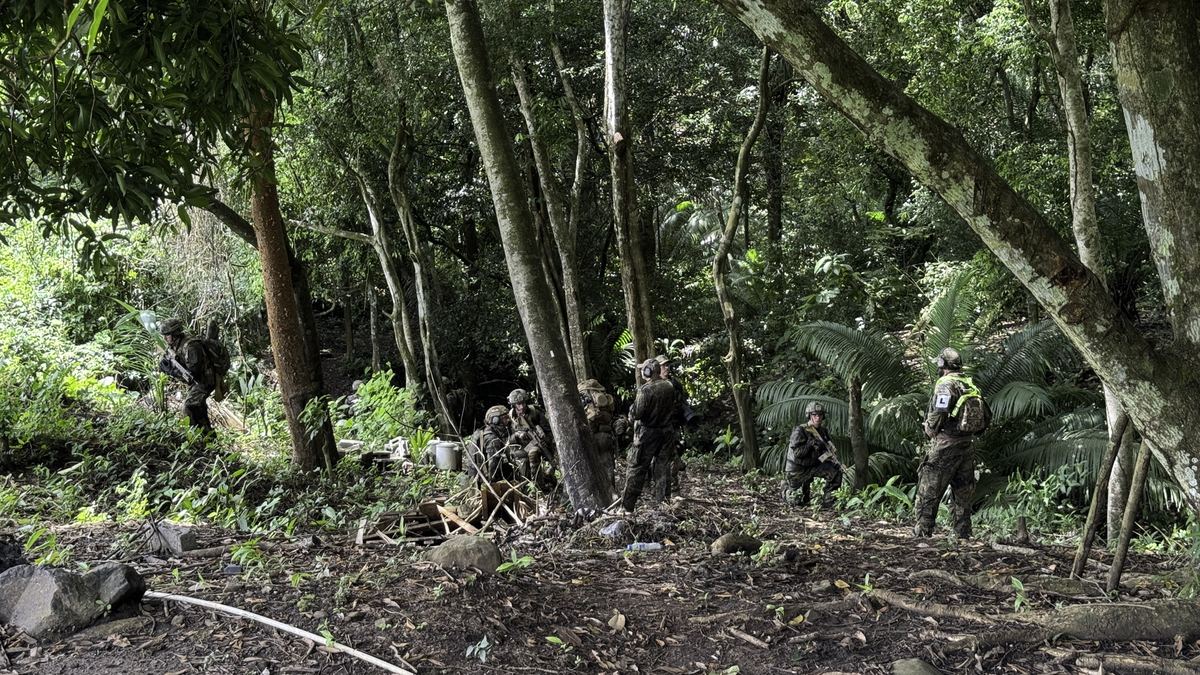
German soldiers on the jungle trail at the U.S. Army Tropic Regions Test Center, where 55 Bundeswehr personnel put the G95 through environmental and live-fire trials. Image: U.S. Army Yuma Proving Ground via DVIDS, public domain (asset 8613591, published 12 September 2024).
Bundeswehr Weighs a Second 250,000-Rifle G95 Tranche as War Reserve, Not Replacement
Hartpunkt reported on 3 August 2026 that the Bundeswehr intends to buy up to 250,000 further G95A1 and G95KA1 rifles after the current 250,000-weapon tranche is delivered, taking planned stocks to about 500,000. BAAINBw and Heckler und Koch have not confirmed it. The driver is mobilisation depth for a planned 460,000-strong force, not a fault in the first tranche.
Technical Summary
Hartpunkt reported on 3 August 2026 that the Bundeswehr intends to procure up to 250,000 further G95A1 and G95KA1 assault rifles once the current tranche is delivered, which would take planned inventory to roughly 500,000 weapons. Neither the Bundesamt für Ausrüstung, Informationstechnik und Nutzung der Bundeswehr (BAAINBw) nor Heckler und Koch has confirmed the plan, so the figure carries reporting confidence only. The existing framework, ceilinged at approximately 800 million euro for 250,000 rifles, was expanded by the Bundestag from 118,718 units on 3 December 2025 and exercised in full by BAAINBw on 6 July 2026, with deliveries scheduled through 2032. A second tranche would therefore open a new production run behind an existing schedule rather than backfill an unfulfilled one. Capacity to absorb it is being built now: Heckler und Koch reported 393 million euro of revenue and 802 million euro of order intake for financial year 2025, and has stated planned investment of 235 million euro across 2025 to 2028, principally on expanding production at Oberndorf.
The G95A1 and G95KA1 are Bundeswehr configurations of the Heckler und Koch HK416 A8, chambered for the 5.56 x 45 mm NATO cartridge and fed from 30-round magazines. Both use a short-stroke gas piston acting on a rotating bolt, with an adjustable gas regulator carrying a suppressed setting that compensates for the elevated back pressure a sound moderator generates. Cyclic rate is approximately 850 rounds per minute and the declared effective combat distance is 450 m for both variants. The manufacturer quotes 790 m/s and 1,250 J with the DM11 nature, figures that vary with barrel length and lot. Barrel length is the principal difference: 355 mm on the G95KA1 at 3.3 kg bare against 419 mm on the G95A1 at 3.4 kg, rising to 4.3 kg and 4.4 kg respectively once the ELCAN Specter DR 1-4x optic, Aimpoint ACRO P-2 reflex sight, Rheinmetall LLM-VarioRay laser light module and a loaded magazine are fitted.
Set against the G36 it replaces, the comparison is not the one a reader would expect. On the Bundeswehr’s own published figures the G36 has a cyclic rate of 750 rounds per minute and a maximum combat distance of 500 m, so the G95 is the faster-firing weapon at 850 rounds per minute and the shorter-reaching one at 450 m. Both figures point the same way for a war-reserve calculation: a like-for-like burst draws more cartridges from the stockpile, and the engagement envelope the stockpile has to support has narrowed rather than widened. First serial handover took place on 4 December 2025 at Grafenwöhr, when the first 300 G95KA1 were issued to Panzergrenadierbataillon 122 as the lead unit for introduction.
Three published framework ceilings, roughly 800 million euro for rifles, 605.87 million euro net for 250,000 sight packages and 412.53 million euro net for 250,000 laser light modules, total about 2.01 billion euro with German value added tax, or some 8,050 euro per soldier set before a single cartridge is bought. ISC assessment of published Bundeswehr framework ceilings, August 2026
Analysis of Effects
The case for a second tranche rests on mobilisation arithmetic rather than on any technical shortfall. Germany held 184,194 active personnel at the end of 2025 and is planning towards approximately 260,000 active and 200,000 reservists. Against that 460,000-person construct, 250,000 rifles yields 0.54 weapons per person, which leaves no margin for training establishments, depot float, maintenance pools or replacement stocks. A 500,000-rifle inventory yields 1.09 per person and permits allocation across operational units, schools, war reserve and repair pipelines simultaneously. The most likely first claimant is the Homeland Defence Division, whose six regiments, 60 companies and 42 locations are roughly 90 per cent reservist and are tasked with protecting ports, power facilities, rail movements and convoys while allied formations transit Germany towards the eastern flank.
For WOME planners the consequential figure is not the rifle count but the ammunition and storage tail it implies. The Bundeswehr fields the G95 with armour-piercing, dual-core, soft-core, training and blank natures, so a doubled fleet does not simply double one line item: it multiplies the number of distinct natures that must be held, rotated and surveilled at each depot. The service designations matter here because surveillance and shelf-life records are kept per nature, not per calibre: the dual-core round is the 5.56 x 45 mm DM11A1 (Doppelkern) at 62 grains, the current production mark of the DM11 nature quoted above, and the soft-core round the DM41A1 (Weichkern), both built on the SS109 and M855 projectile design with a SINOXID primer and a REACH-compliant propellant. Packaged small-arms ammunition of this class is normally consigned as UN 0012, cartridges for weapons, inert projectile, Hazard Division 1.4 Compatibility Group S in its approved packaging configuration. Net Explosive Quantity is not the governing storage parameter for HD 1.4 S in the way it governs HD 1.1 natures, because the propellant charge is the only energetic present in a ball round and the classification reflects the packaging as much as the cartridge. Blank and pyrotechnic-bearing natures do not automatically inherit that classification, so hazard classification has to be read per nature and per packaging configuration, never per calibre.
Personnel and Safety Considerations
Two practical consequences follow for ammunition technicians and explosives safety staff. First, storage capacity has to be planned against the licensed Net Explosive Quantity of each Potential Explosion Site and the quantity-distance separations in AASTP-1 Edition C, applied to the specific hazard classification of each nature rather than to a single assumed HD 1.4 S figure across the inventory. Reserve and homeland-defence sites are the constraint here, because they were not built for war-reserve holdings on this scale. Second, the adjustable gas regulator is a competence issue as much as an engineering one: an incorrectly set regulator running suppressed increases cyclic rate, fouling and component stress, and a reserve force at roughly 90 per cent part-time strength will need that setting taught and checked at unit level. Common equipment across active and reserve formations reduces the number of weapons, optics, spare parts and qualification courses to be sustained during mobilisation, which is the operative argument for issuing the G95 to reservists rather than retaining separate G36 stocks.
Data Gaps
ISC has not verified the following. The reported 250,000-rifle second tranche is unconfirmed by BAAINBw or Heckler und Koch and rests on a single trade report. No value, contract vehicle or delivery schedule for a second tranche has been published. The Bundeswehr per-weapon war-reserve ammunition scaling factor is not in open source, so the packaged tonnage implied by a 500,000-rifle fleet cannot be calculated and no estimate is offered here. The propellant charge mass of the DM11A1 nature is not published, and nor is its qualified temperature range, so no storage or surveillance envelope can be stated for it here. The hazard classification and packaging configuration of each G95 nature in German service, and the licensed Net Explosive Quantity of the reserve storage estate, are likewise unpublished. Whether existing G36 stocks are retained, cascaded or disposed of has not been stated.
Key Questions
Is Germany replacing the G95 rifles it has already ordered?
No. The reported 250,000-rifle purchase would be a second production tranche beginning after the existing 250,000-rifle contract completes its deliveries in 2032. BAAINBw exercised the full existing quantity on 6 July 2026. Nothing in the reporting suggests a technical fault or a shortfall in the first tranche.
Why does Germany need 500,000 assault rifles?
Germany is planning towards roughly 260,000 active personnel and 200,000 reservists. At 250,000 rifles that is 0.54 weapons per person, leaving nothing for schools, depot float or replacement stocks. At 500,000 it is 1.09 per person, which supports mobilisation, training and war reserve at the same time.
What does doubling the rifle fleet mean for ammunition storage?
It multiplies the distinct 5.56 mm natures, armour-piercing, dual-core, soft-core, training and blank, that each depot must hold and surveil. Storage has to be planned against the licensed Net Explosive Quantity of each site and the quantity-distance rules in AASTP-1 Edition C, per nature and packaging configuration.
References
Source-evaluated under NATO STANAG 2022 (Reliability A–F / Accuracy 1–6). Tier 1 = government primary source; Tier 2 = quality news / specialist defence media; Tier 3 = authoritative aggregator / encyclopaedia.
- T1Bundeswehr – G95: das neue Sturmgewehr für die Truppe, accessed 5 August 2026. (Reliability A / Accuracy 1)
- T1Bundesministerium der Verteidigung (BMVg) – Parlament genehmigt weitere Sturmgewehre G95, Sprechsätze und Geländefahrzeuge, accessed 5 August 2026. (Reliability A / Accuracy 1)
- T1Bundeswehr Heer – Das Gewehr G95 ist das neue Standardgewehr der Bundeswehr, accessed 5 August 2026. (Reliability A / Accuracy 1)
- T2Hartpunkt – G95A1 und G95KA1: Bundeswehr will offenbar bis zu 250.000 weitere Sturmgewehre beschaffen, 3 August 2026. (Reliability B / Accuracy 2)
- T2Army Recognition – Germany Could Double G95 Rifle Fleet to 500,000 as Bundeswehr Expands Active and Reserve Forces, 4 August 2026. (Reliability B / Accuracy 2)
- T1Bundeswehr – Gewehr G36 (technische Daten: Schussfolge 750 Schuss/min; max. 500 m Kampfentfernung), accessed 5 August 2026. (Reliability A / Accuracy 1)
- T2Heckler und Koch – Heckler und Koch delivers first G95A1 assault rifles to the Bundeswehr, December 2025. (Reliability B / Accuracy 2)
- T2Heckler und Koch – Financial figures 2025, accessed 5 August 2026. (Reliability B / Accuracy 2)
- T2RWS Technology – 5.56 mm x 45, DM11A1, Doppelkern, 62 gr, accessed 5 August 2026. (Reliability B / Accuracy 2)
- T2RWS Technology – 5.56 mm x 45, DM41A1, Weichkern, 62 gr, accessed 5 August 2026. (Reliability B / Accuracy 2)
Corrections & updates welcome. If you hold open-source data that refines or corrects any parameter in this article, please contact [email protected] citing the specific claim and your source. Verified corrections will be incorporated and credited in the revision history. AI-assisted technical assessment based on open-source material. Not a formal intelligence product.