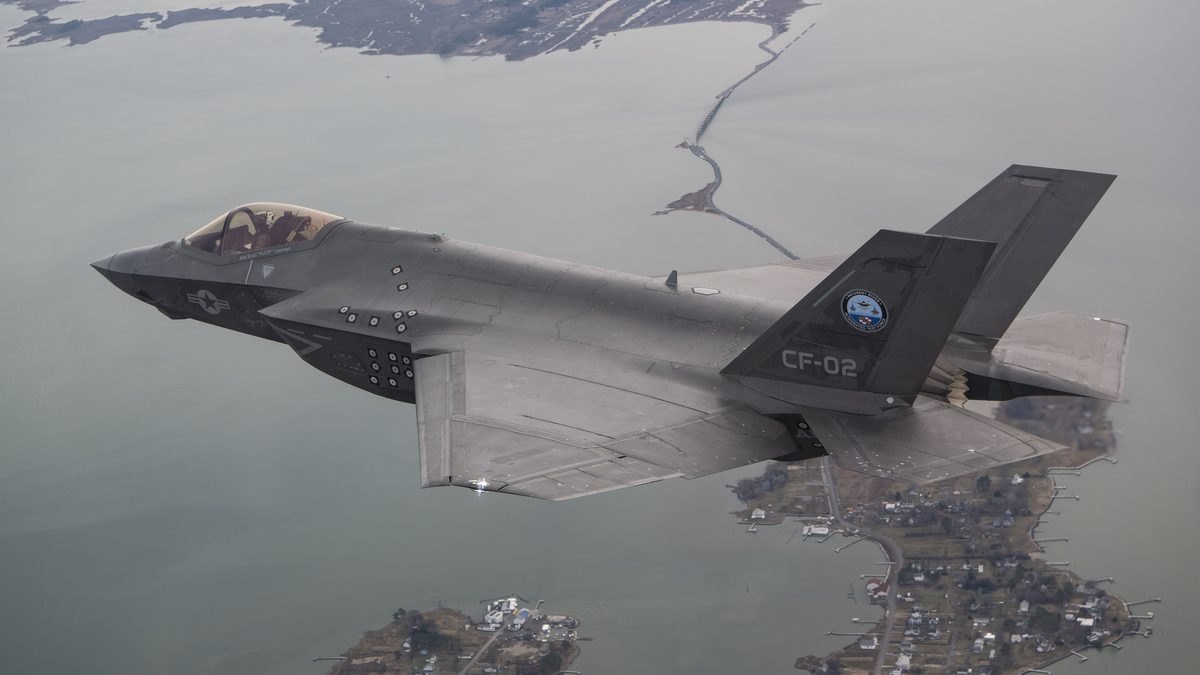
An F-35C Lightning II flown by U.S. Marine Maj. Alex Horne during initial airborne testing of the carrier variant with an inert GBU-53/B StormBreaker, Naval Air Station Patuxent River. Illustrative of the baseline unpowered weapon, not the turbojet-powered variant. U.S. Navy photo by Dane Wiedmann, via DVIDS (public domain).
RTX Fits a Turbojet to StormBreaker, Turning a Glide Weapon into a Fuelled Round
RTX chief executive Chris Calio told the company's second quarter 2026 earnings call on 23 July that Raytheon is fitting a modified Pratt and Whitney TJ-150 turbojet to the GBU-53/B StormBreaker to create a longer range variant, moving from concept to an upcoming flight test in under twelve months. RTX disclosed no range figure, flight test date or customer.
Technical Summary
The GBU-53/B StormBreaker, formerly Small Diameter Bomb II, is a roughly 93 kg class air launched precision guided munition. Open sources describe a tri mode seeker combining millimetre wave radar, imaging infrared and semi active laser, backed by satellite and inertial navigation and a two way datalink, with a multi effects warhead of approximately 48 kg offering blast fragmentation, shaped charge and fragmentation modes against moving targets in all weather. Standoff in the unpowered configuration is widely cited at about 72 km, achieved with a deployable wing kit and therefore highly sensitive to release altitude and speed.
The TJ-150 is a Pratt and Whitney single spool turbojet in the 150 lbf thrust class, roughly 0.67 kN, built around a single stage mixed flow compressor, an annular reverse flow combustor and a single stage radial turbine with a fixed area nozzle. It is a mature and high volume design rather than a development engine: it powers the ADM-160 Miniature Air Launched Decoy family, and was selected to power the Leidos Dynetics AGM-190A small cruise missile under a follow on contract announced on 10 March 2026. Readers should not confuse it with the Czech PBS TJ150, an unrelated engine of the same designation in a higher thrust class. Calio said only that Raytheon is using a modified TJ-150 to develop a longer range StormBreaker variant, and that the effort ran from concept to an upcoming flight test in less than twelve months. No range, test date, location, customer, production volume or fielding date was given.
Adding a hydrocarbon fuelled turbojet to a weapon previously stored as an unpowered glide munition changes what is in the round. A fuelled all up round is a different storage, transport and disposal problem from an inert bodied glide bomb, whatever its ballistic advantages. ISC technical assessment, 4 August 2026
Analysis of Effects
Powering StormBreaker addresses the structural weakness of every glide weapon, which is that range is bought with release altitude and therefore with launch aircraft exposure. A turbojet decouples the two, letting a fast jet release at low level and still reach a target at operationally useful distance. It also lengthens time of flight, which suits a weapon already built around a two way datalink and a moving target capability, because the seeker has more time to be retasked before terminal handover.
The engineering cost is volume. StormBreaker's four round carriage on the BRU-61/A rack is a function of its compact form, and an engine, an inlet, an exhaust and a fuel cell all have to come from somewhere inside a body of fixed diameter. Whether the powered variant preserves the 48 kg multi effects warhead, the full tri mode seeker, or four round carriage is not stated. Any of the three would be a meaningful capability trade, and RTX's silence on all of them is the most informative part of the disclosure.
Growth in length is the likelier route than growth in diameter, because the diameter is what sets rack density and internal bay compatibility. Length growth carries its own penalty in rounds per station and in mixed load planning. A turbojet installed aft also shifts the centre of gravity and changes the flow over a deployable wing kit designed for an unpowered body, so control authority and the guidance software will need requalifying across a flight regime the weapon has never flown. None of that is exotic engineering, but it is the difference between an engine that fits and a weapon that works, and it is why a first flight test is the only milestone worth watching.
Personnel and Safety Considerations
From an ammunition technician's standpoint the fuel is the story. An unpowered StormBreaker is classified on its warhead fill, thermal battery and electro explosive devices, and is handled as a conventional guided bomb nature. Introducing a hydrocarbon fuel load, and any pyrotechnic engine start cartridge, adds a flammable liquid to the all up round and forces the hazard classification, compatibility group and quantity distance to be reassessed under AASTP-1 Edition C and the United Nations Recommendations on the Transport of Dangerous Goods rather than carried across from the unpowered weapon. Disposal is affected in the same way. A failed to function powered round obliges an explosive ordnance disposal team to account for residual fuel before planning a demolition, and a weapon that fails after engine light off may travel well beyond the designed impact area, widening the search footprint for range clearance.
Data Gaps
RTX has not published the expected range of the powered variant, the flight test date or location, the customer, the production quantity or an in service date. The fuel type and quantity carried are unstated, as is whether a pyrotechnic start cartridge is fitted. No hazard division, compatibility group or net explosive quantity has been released for the powered all up round. Whether the 48 kg multi effects warhead and the tri mode seeker carry across unchanged, and whether four round carriage on the BRU-61/A rack survives, are both unconfirmed. The 93 kg and 48 kg figures used above are the widely cited open source values for the unpowered GBU-53/B and are not independently verified by ISC.
Key Questions
What is RTX changing about the StormBreaker bomb?
Raytheon is fitting a modified Pratt and Whitney TJ-150 turbojet to the GBU-53/B StormBreaker to produce a longer range variant. Chief executive Chris Calio disclosed the work on RTX's second quarter 2026 earnings call on 23 July 2026, saying the project ran from concept to an upcoming flight test in under twelve months. No range figure was given.
How far can StormBreaker fly at the moment?
In its current unpowered form the GBU-53/B relies on a deployable wing kit, and open sources put its standoff at about 72 km against moving targets, depending heavily on release altitude and speed. RTX has not stated what range the turbojet powered variant is expected to achieve, so no comparison figure can responsibly be given.
Does adding an engine change how the weapon has to be stored?
Almost certainly. A hydrocarbon fuel load makes the all up round a combined explosive and flammable liquid item, so its hazard division, compatibility group and quantity distance have to be reassessed rather than carried over from the unpowered weapon. RTX has published no classification data for the powered variant.
References
Source-evaluated under NATO STANAG 2022 (Reliability A–F / Accuracy 1–6). Tier 1 = primary source (government, alliance or originating organisation); Tier 2 = quality news / specialist defence media; Tier 3 = authoritative aggregator / encyclopaedia.
- T1RTX Corporation (company primary) – RTX Reports Q2 2026 Results, 23 July 2026. (Reliability A / Accuracy 1)
- T2Defence Industry Europe – RTX pushes longer-range StormBreaker toward flight testing after advancing the air-launched weapon from concept in under 12 months, 3 August 2026. (Reliability B / Accuracy 2)
- T2RTX Corporation – RTX's Pratt & Whitney awarded follow-on contract to supply TJ150 engines for Leidos' small cruise missile, 10 March 2026. (Reliability B / Accuracy 2)
- T2RTX Corporation – U.S. Navy approves Raytheon's StormBreaker smart weapon for use on Super Hornet fleet, 20 February 2026. (Reliability B / Accuracy 2)
- T3Air & Space Forces Magazine – GBU-53 StormBreaker (Small Diameter Bomb II), accessed 4 August 2026. (Reliability C / Accuracy 3)
- T1Pratt & Whitney – TJ150 Turbojet Engine, manufacturer data sheet, accessed 4 August 2026. Source of the thrust class and engine architecture. (Reliability B / Accuracy 2 – manufacturer claim)
- T1Pratt & Whitney – Small But Powerful: The TJ-150, 3 August 2017. Confirms the Miniature Air Launched Decoy application. (Reliability B / Accuracy 2)
Corrections & updates welcome. If you hold open-source data that refines or corrects any parameter in this article, please contact [email protected] citing the specific claim and your source. Verified corrections will be incorporated and credited in the revision history. AI-assisted technical assessment based on open-source material. Not a formal intelligence product.