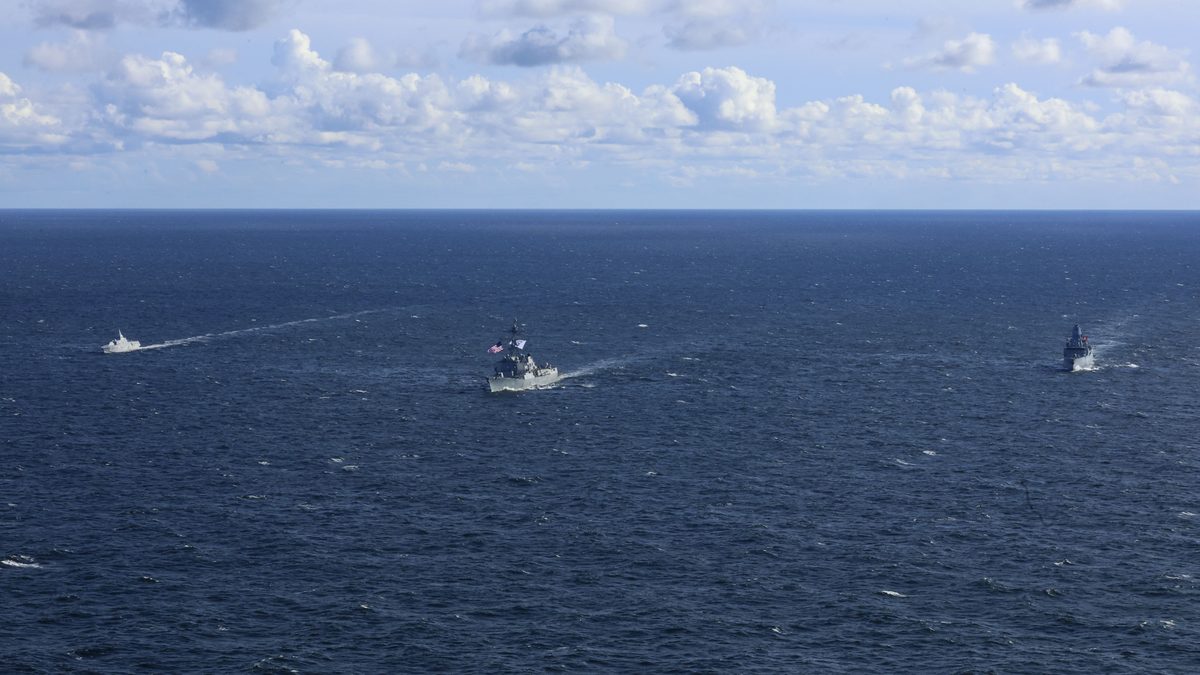
The Arleigh Burke-class destroyer USS Bainbridge (DDG 96), the German Navy Sachsen-class frigate FGS Hamburg (F220) and the Swedish Navy Visby-class corvette HSwMS Helsingborg (K32) in formation in the Baltic Sea, 22 September 2025. Photo: Seaman Cesar Licona, US Navy. Public domain, via DVIDS. Illustrative: the GMF140 exists only as a design.
Sixty-Four Cells and No Named Shipyard: What the Rheinmetall GMF140 Is Actually Competing Against
Rheinmetall unveiled the GMF140 on 3 August 2026: 140 metres, over 6,000 tonnes, 64 strike-length vertical launch cells and an AEGIS combat system. Its direct competitors are built by BAE Systems, Naval Group, Fincantieri, TKMS, Babcock, Navantia, Hanwha, HD Hyundai and Mitsubishi Heavy Industries. Every frigate competition decided during 2025 and 2026 went to a design already in the water.
Technical Summary
Rheinmetall announced the GMF140 on 3 August 2026 through its Naval Systems division, the business built on Naval Vessels Lürssen (NVL), which the group took over on 1 March 2026. The stated configuration is 140 metres in length, displacement given as approximately 6,000 tonnes, 64 Strike-Length Vertical Launching System (VLS) cells, a 127 mm (5 inch) main gun, anti-ship missiles, torpedo launchers, a close-in weapon system (CIWS), a laser effector, electronic warfare, hull-mounted and towed sonar, and decoy systems. The combat management system is AEGIS, with the Lockheed Martin CMS 330 offered as an alternative for European sensor integration. The primary radar is described only as United States sourced, in several fits, including full ballistic missile defence tracking. Rheinmetall named no shipyard, no price, no crew figure, no propulsion arrangement and no beam.
This is not a clean sheet. The GMF140 is a stretch of the GMF-120 that NVL showed at Danish Defence Acquisition and Logistics Organisation (DALO) Industry Days on 27 August 2025: 121.1 metres, 19 metres in the beam, roughly 5,000 tonnes, and the same 64 Mk 41 strike-length cells in two 32-cell magazines. What changed in twelve months is the sensor and gun fit, and the change is the whole commercial story. The GMF-120 was a European ship, built around Thales APAR Block 2 and NS200 radar with a Leonardo 76 mm gun. The GMF140 swaps to an American combat system, an American radar and a 5 inch gun. That is a deliberate re-sensoring to make the design compatible with Foreign Military Sales, and it explains the stated intention to offer the ship first into a procurement campaign in North America.
“Through this acquisition we do not merely become platform manufacturers. As an integrated naval power centre we want to offer complete system solutions: naval missiles and launchers, main and secondary guns for the navy, missile defence, sensors and further electronics.” Armin Papperger, Chief Executive Officer, Rheinmetall AG, on the NVL acquisition, 15 September 2025
GMF140 baseline specification (Rheinmetall stated, 3 August 2026)
| Length | 140 m |
| Displacement | Approximately 6,000 tonnes |
| Vertical launch | 64 Strike-Length VLS cells |
| Combat system | AEGIS, optionally Lockheed Martin CMS 330 |
| Primary radar | US sourced, fits including full BMD tracking |
| Main gun | 127 mm (5 inch) |
| Other weapons | Anti-ship missile, torpedo launcher, CIWS, laser, EW, decoys |
| Sonar | Hull-mounted and towed |
| Aviation | Flight deck and hangar for NH90 or MH-60 |
| Not published | Beam, draught, crew, propulsion, price, build yard |
The Competitor Set and Who Builds It
Nine industrial groups hold the designs a GMF140 would meet in a tender. The distinction that matters is not capability on a brochure, it is whether the hull exists. Every design below is either in service, in serial production or under contract, which is the standing the GMF140 does not yet have.
| Design | Manufacturer | Confirmed customers and hulls | Build status |
|---|---|---|---|
| Type 26 / Hunter / River-class | BAE Systems (UK) | UK 8, Norway 5, Australia 6, Canada 15 | In build |
| FDI / Belh@rra | Naval Group (France) | France 5, Greece 4, Sweden 4 | In service |
| Type 31 / Arrowhead 140 | Babcock (UK), licence built | UK 5, Poland 3, Indonesia 4 | In build |
| FREMM EVO | Fincantieri (Italy) | Italy 2, Portugal 3 | Under contract |
| MEKO A-200 DEU (F128) and A400 (F127) | TKMS (Germany) | Germany 8 plus 8, export MEKO fleet | Under contract |
| F-110 Bonifaz | Navantia (Spain) | Spain 5 | In build |
| Upgraded Mogami | Mitsubishi Heavy Industries (Japan) | Japan 12, Australia up to 11 | In service |
| FFX Batch III, HDF-3200 and HDF-6000 | HD Hyundai and Hanwha Ocean (Korea) | Korea 6, Philippines 2 | In build |
| Istif / I-class | Sedef and Istanbul Naval Shipyard (Türkiye) | Türkiye 6, Indonesia 2 | In build |
| GMF140 | Rheinmetall Naval Systems / NVL (Germany) | None | Design only |
Which Manufacturing Sites Could Actually Build It
A 140 metre, 6,000 tonne combatant needs a covered building position of roughly 150 metres clear, about 28 to 30 metres of working width around a hull of some 19 to 20 metres in the beam, and heavy lift adequate for grand-block construction. On those tests the GMF140 is not a difficult ship to house. Availability, not capability, is the binding constraint, and the two best-fitting sites are one Rheinmetall does not own and one that belongs to a competitor.
| Site | Owner | Principal building facility | Heavy lift | Current work and free slot |
|---|---|---|---|---|
| German Naval Yards Kiel | CMN Naval, Rheinmetall bid pending | Covered dry dock 240 x 44 m; mega dock 426 x 88 m | 900 t portal | Short-time work reported 2025; F126 aft ships cancelled. Free now |
| Blohm+Voss, Hamburg | Rheinmetall (NVL) | Covered Dock 10, 287 x 44 m, 50,000 t, roughly 200 m roofed | Seven quay cranes | F126 final assembly removed by cancellation. Free from 2027 |
| Fincantieri Marinette, Wisconsin | Fincantieri (Italy) | Building 34, two frigate-sized bays; ship lift | Not published | Landing Ship Medium from Q4 2026. Frigate line vacant |
| Peene-Werft, Wolgast | Rheinmetall (NVL) | Covered dry dock 175 x 30 m; stated ceiling 170 m | 2 x 160 t | Three Class 424 hulls to 2031. Free 2030 to 2031 |
| Mangalia 2 Mai, Romania | Insolvent; Rheinmetall and MSC in talks | Dock 3, 360 x 60 x 13 m; 1,590 m quay | Not published | Two MMPV 90 and two dive vessels to 2030 |
| HII Ingalls, Pascagoula | HII (US) | 800 acres; vessels 14 to 325 m; 70,000 LT transfer dock | Float-off launch | FF(X), DDG-51, LPD, LHA, NSC. No slot this decade |
| Irving Shipbuilding, Halifax | J.D. Irving (Canada) | Assembly hall 408 m; shiplift 165 m, over 30,000 t | Very high | Fifteen River-class destroyers to 2039 |
| Norderwerft, Hamburg | Rheinmetall (NVL) | Dock 1, 164 x 28 m, 12,500 t | 60 t maximum | Crane limited. Repair and conversion only |
| Neue Jadewerft, Wilhelmshaven | Rheinmetall (NVL) | Heated hall caps at 80 m and 2,000 t | Yard power 1.5 MW | F123 modernisation. Refit role only |
Two constraints do not appear in any dock table. The first is workforce. Peene-Werft employs over 330 people and Norderwerft around 90, against 11,500 at Ingalls. Serial construction of 6,000 tonne combatants is a several-thousand-person undertaking, and Rheinmetall reportedly halted a plan to recruit about 1,000 naval staff after the F126 cancellation. The second is the St Lawrence Seaway, which governs any Marinette build. Published maxima are 225.5 m length, 23.77 m beam, 8.08 m draught and 35.5 m air draught. A GMF140 clears all four, and by a wider margin than the larger Constellation that Marinette was already contracted to deliver by that route.
Which Nations Could Realistically Buy It
| Nation | Programme and hulls | Status at August 2026 | Assessment |
|---|---|---|---|
| Denmark | Iver Huitfeldt replacement, about 4 | Pre-RFP, no decision before autumn 2026. GMF-120 pitched August 2025 | Addressable |
| Belgium | ASWF alternative, 2 | RFI issued 19 July 2026 to five nations; decision expected October 2026 | Addressable |
| Saudi Arabia | Naval Expansion Program II, about 5 | Selection expected during 2026; six or more bidders | Constrained |
| Netherlands | Future Air Defender, 4 | AEGIS pricing requested January 2026, US response April 2026 | Constrained |
| United States | FF(X), 50 to 65 | Awarded to HII Ingalls 28 April 2026. No Mk 41, no BMD radar | Closed |
| Canada | River-class destroyer, 15 | Irving contracted March 2025, keel laid June 2026 | Closed |
| New Zealand | Anzac replacement, 2 | Shortlisted 7 May 2026 to Mogami and Type 31 only | Closed |
| Germany | F127 (8) and F128 (8) | Both awarded to TKMS designs during 2026 | Closed |
| Norway, Sweden, Poland, Portugal, Greece, Spain, Australia | Various | All decided between September 2025 and July 2026 | Closed |
Analysis of Effects
Take the order-book question first, because the answer is more interesting than a yes or no. In aggregate the incumbents are committed for a decade. The International Institute for Strategic Studies recorded seven frigates delivered by all European yards combined in the twelve months to November 2025. Set that observed throughput against the work already booked: thirteen Type 26 hulls for the United Kingdom and Norway, eight or nine Defence and Intervention Frigates (FDI) for France and Greece, four more for Sweden, five F-110 for Spain, eight MEKO A-200 DEU for Germany, five FREMM EVO for Italy and Portugal, five Type 31 at Rosyth, three Miecznik in Gdynia and six anti-submarine warfare frigates for the Netherlands and Belgium. On that arithmetic the sector is sold out well past 2035. But saturation is not evenly spread, and the exceptions matter more than the rule.
BAE Systems is the documented case. Norway's five Type 26 hulls were fitted into the Clyde line by displacing Royal Navy build slots, a point the UK defence minister Luke Pollard conceded openly when he said a number of slots had been ceded and the delta was yet to be made up. The combined thirteen-hull Clyde programme runs to at least 2040. Fincantieri reports deliveries scheduled through 2039. Thyssenkrupp Marine Systems (TKMS) carries a record backlog of 20.6 billion euro and has just absorbed eight F128 hulls it did not have a year ago. Against that, Naval Group states Lorient is revamped for two FDI per year and is actively marketing to new customers, Damen has slots but has just lost the F126 and is fighting to keep Belgium, and Fincantieri Marinette in Wisconsin has a purpose-built two-bay frigate hall and no frigate to put in it since the United States Navy cancelled the Constellation class on 25 November 2025. The yard with the emptiest surface-combatant book in Europe is NVL itself. It lost the F126 prime role when Berlin cancelled the programme on 24 June 2026 and gave eight MEKO A-200 DEU to TKMS instead. Read in that light, the GMF140 is not a response to everyone else being full. It is a response to Rheinmetall's own yards being empty.
Personnel and Safety Considerations
The step from what NVL has actually delivered to what the GMF140 requires is an ordnance engineering problem before it is a steel problem. The largest surface combatant in the group's recent record is the MMPV 90, roughly 90 metres and 2,300 tonnes, and the two Bulgarian hulls were built by MTG Dolphin at Varna under NVL design supervision. A GMF140 is around 2.6 times heavier and carries an entirely different explosives problem. Mk 41 strike-length modules are approximately 7.7 metres deep, which drives hull depth and demands continuous structural magazine trunks rather than the shallow tactical-length arrangements a corvette can accept. Sixty-four cells, a 127 mm magazine with hoists and gun-bay structure, torpedo stowage and decoy magazines together impose a quantity-distance, magazine-siting and ordnance-handling certification regime no NVL yard has any published record of executing. Shock qualification to first-rank combatant standard reaches into every foundation and mount in the supply chain. Separately, AEGIS and a United States ballistic missile defence radar require facility security accreditation, controlled compartments for installation and setting to work, and cleared personnel. None of that exists at Wolgast or Hamburg today. Crane capacity tells the same story in a single number: Norderwerft tops out at 60 tonnes, Peene-Werft at two cranes of 160 tonnes, while German Naval Yards Kiel has a 900 tonne portal crane and Rheinmetall does not yet own it.
Data Gaps
Rheinmetall has not published the GMF140's beam, draught, mast height, propulsion arrangement, crew complement or unit price, and every dock-fit and waterway conclusion here therefore rests on carrying the GMF-120's 19 metre beam across to the larger hull. No build yard has been named. The company says only “a campaign in North America” and does not identify the programme; the CMS 330 option points towards Canada rather than the United States, but that is inference. It is not confirmed which CIWS is meant, and Rheinmetall's own Millennium 35 mm gun is an obvious but unstated candidate. Nor is it confirmed that the “decoy systems fully supported” line means the company's Multi Ammunition Softkill System (MASS). Fincantieri Marinette does not publish its ship-lift capacity, which is the figure that would decide whether a 6,000 tonne hull could be launched there. The Peenestrom fairway depth at Wolgast is unpublished, and Rheinmetall and marineforum disagree on whether the Peene-Werft covered dock is 30 or 27 metres wide. Reported NVL figures of roughly 5.5 billion euro in inherited maritime work and a halted plan to recruit about 1,000 naval staff rest on a single trade source and are treated here as indicative only.
Key Questions
Who manufactures the frigates that compete with the Rheinmetall GMF140?
Nine builders hold the competing designs: BAE Systems (Type 26), Naval Group (FDI), Babcock (Type 31 and Arrowhead 140 licensees), Fincantieri (FREMM EVO), TKMS (MEKO A-200 and A400), Navantia (F-110), Mitsubishi Heavy Industries (upgraded Mogami), HD Hyundai and Hanwha Ocean (Korean FFX and export designs), and Turkish yards (Istif class). All have hulls in the water or in serial production.
Are the world's frigate shipyards already fully booked?
Mostly, but not uniformly. BAE's Clyde yards are committed to at least 2040, Fincantieri publishes deliveries through 2039 and TKMS holds a record 20.6 billion euro backlog. Naval Group, Damen and Fincantieri Marinette have genuine near-term capacity. So does NVL, which has no frigate in build after losing the German F126 programme in June 2026.
Is the GMF140 a sales platform for Rheinmetall weapons and countermeasures?
Partly, and deliberately. Rheinmetall concedes the combat system and radar to Lockheed Martin and United States suppliers, then fills the layers it owns: the laser, the close-in gun, secondary armament, decoys and propellant. Its Weapon and Ammunition division ran a 29.0 per cent operating margin in 2025 against 10.1 per cent for Naval Systems. The effectors, not the hull, carry the profit.
References
Source-evaluated under NATO STANAG 2022 (Reliability A–F / Accuracy 1–6). Tier 1 = government primary source; Tier 2 = quality news / specialist defence media; Tier 3 = authoritative aggregator / encyclopaedia.
- T1Rheinmetall AG – Rheinmetall Unveils GMF 140: The Next Generation of Multi-Mission Naval Combat Power, 3 August 2026. (Reliability A / Accuracy 1)
- T1Congressional Budget Office – Challenges Facing the Navy's and Coast Guard's Shipbuilding Programs and the Shipbuilding Industrial Base, April 2026. (Reliability A / Accuracy 1)
- T2Naval News – NVL Proposes GMF-120 Guided Missile Frigate For Danish Fleet Plan, 27 August 2025. (Reliability B / Accuracy 2)
- T2Naval News – Germany is Cancelling the F126 Frigate Project and Procuring Eight MEKO Frigates, June 2026. (Reliability B / Accuracy 2)
- T2USNI News – Navy Awards $282.9M FF(X) Frigate Contract to HII's Ingalls Shipbuilding, 28 April 2026. (Reliability B / Accuracy 2)
- T2hartpunkt – GMF140: Rheinmetall stellt neue Multi-Domain-Lenkwaffenfregatte vor, 3 August 2026. (Reliability B / Accuracy 2)
Corrections & updates welcome. If you hold open-source data that refines or corrects any parameter in this article, please contact [email protected] citing the specific claim and your source. Verified corrections will be incorporated and credited in the revision history. AI-assisted technical assessment based on open-source material. Not a formal intelligence product.