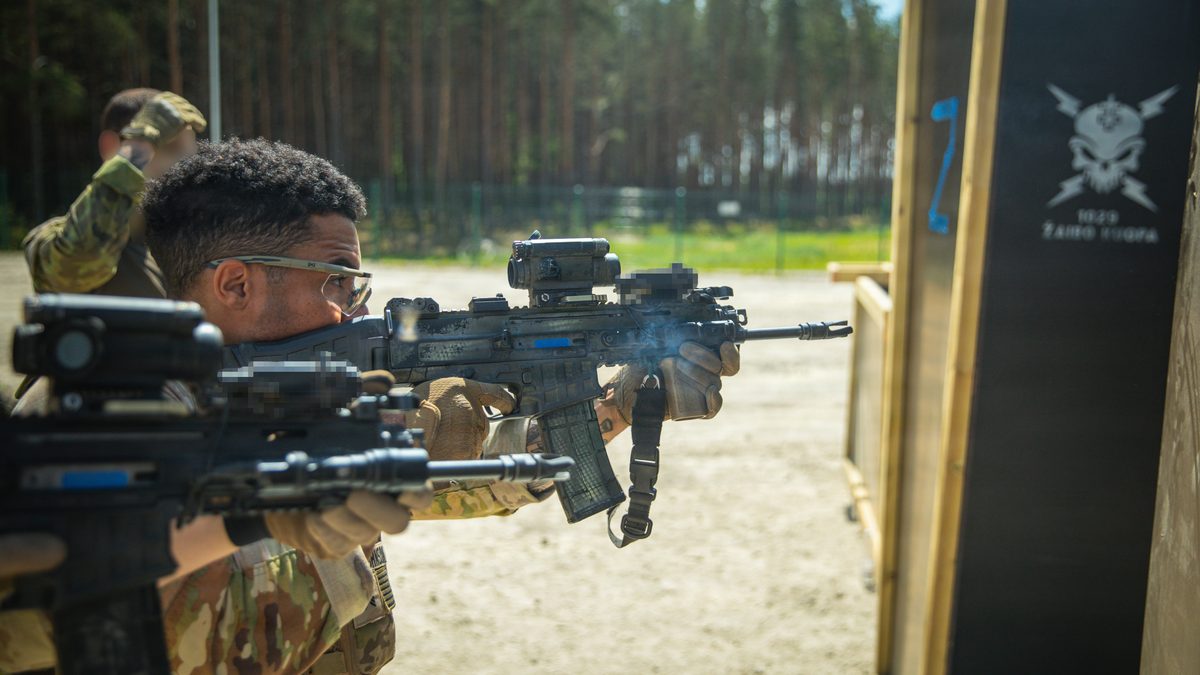
Illustrative: a soldier fires a CZ BREN rifle during close-quarters battle training with Czech forces at Pabradë Training Area, Lithuania, 3 June 2026. The rifle shown is an in-service BREN-family weapon, not specifically the BREN 3. U.S. Army photo by Sgt. Max Elliott / DVIDS (public domain).
Montenegro Becomes First NATO State to Adopt the CZ BREN 3 in Colt CZ Small-Arms Package
Colt CZ Group will supply Montenegro's armed forces with CZ BREN 3 assault rifles, pistols, sniper rifles, submachine guns and Sellier & Bellot small-calibre ammunition under an intergovernmental Czech-Montenegrin agreement announced on 24 July 2026. Montenegro is the first NATO member state to adopt the 5.56x45mm BREN 3; trade press values the package at about 24.2 million euros for roughly 6,500 weapons.
Technical Summary
Colt CZ Group announced on 24 July 2026 that it will equip the Armed Forces of Montenegro with small arms, ammunition and accessories drawn from three group companies: Česká zbrojovka (CZ), Sellier & Bellot (S&B) and 4M Systems. The package is delivered under an implementing arrangement to the intergovernmental defence cooperation agreement between the Czech Republic and Montenegro, signed during the official visit of Montenegrin Prime Minister Milojko Spajić to Prague. Within the government-to-government (G2G) structure, Colt CZ Group acts as the industrial partner while the Czech state enterprise LOM PRAHA serves as system integrator.
The core weapon is the CZ BREN 3, a gas-operated, selective-fire assault rifle chambered in 5.56x45mm NATO and, in a variant configuration, in .300 AAC Blackout (7.62x35mm). Reported deliverables also include pistols, sniper rifles, submachine guns and associated accessories, alongside small-calibre ammunition from Sellier & Bellot. Trade reporting places the package value at approximately 24.2 million euros covering on the order of 6,500 weapons, figures ISC has not independently confirmed against a primary contract document. This is the first adoption of the CZ BREN 3 by a NATO member state. It consolidates a NATO-calibre transition already under way: the Armed Forces of Montenegro already field 5.56x45mm rifles, including the Heckler & Koch G36 and the domestic Tara TM4, alongside residual Warsaw Pact-pattern 7.62x39mm weapons retained in reserve and second-line roles.
Montenegro is the first NATO member state to adopt the CZ BREN 3, taking 5.56x45mm NATO rifles and Sellier & Bellot small-calibre ammunition under a Czech government-to-government arrangement worth a reported 24.2 million euros. ISC open-source assessment, 31 July 2026
Analysis of Effects
For Weapons, Ordnance, Munitions and Explosives (WOME) purposes the significance is interoperability rather than explosive effect. The 5.56x45mm NATO cartridge is governed by Standardization Agreement (STANAG) 4172, which underpins ammunition interchangeability across Alliance members. By fielding a 5.56x45mm primary rifle and NATO-nature ball, tracer and blank ammunition from Sellier & Bellot, Montenegro aligns its individual-weapon logistics with the Alliance supply chain it joined in 2017. Net Explosive Quantity (NEQ) is not a meaningful parameter for inert ball ammunition; the hazard and storage profile is dominated instead by the propellant charge, primer composition and the Hazard Division 1.4 classification typical of packaged small-arms cartridges.
The dual-calibre element carries a logistics cost. .300 AAC Blackout is not a NATO-standardised calibre and has no STANAG governing interchangeability, so any Blackout-configured BREN 3 rifles, typically intended for suppressed or short-barrel special-applications use, create a separate ammunition line outside the 5.56x45mm supply chain. The wider industrial point is vertical integration: Colt CZ Group manufactures the rifle (CZ), the cartridge (Sellier & Bellot) and, through its 51 per cent stake in Synthesia Nitrocellulose (acquisition closed 6 January 2026, with an agreed path to full ownership), the nitrocellulose propellant base itself. A single group therefore supplies the weapon, the ammunition and a key energetic precursor, a sovereignty argument European buyers increasingly weigh against dependence on non-European ammunition designs.
Personnel and Safety Considerations
No explosive-safety concern arises from the announcement itself; the materiel is conventional in-service small arms and packaged small-calibre ammunition. Ammunition technicians receiving the S&B natures should confirm the Hazard Classification and Compatibility Group markings per packaging configuration (small-arms ball is normally HD 1.4 S), verify lot documentation and proof records, and establish the propellant and primer specifications for magazine storage and quantity-distance planning under current national regulations. Dual-calibre fielding (5.56x45mm and .300 Blackout) warrants clear physical segregation and marking discipline at unit level to prevent cross-loading, since the two cartridges will not interchange safely between differently chambered uppers.
Data Gaps
Key parameters remain undisclosed at announcement. The calibre split of the ammunition package (proportion of 5.56x45mm versus 9x19mm pistol and any .300 Blackout), the exact quantity per weapon type, the delivery schedule and the specific Sellier & Bellot cartridge natures (ball, tracer, subsonic Blackout) are not stated in the primary release. The 24.2 million euro value and 6,500-unit figure derive from trade press rather than a published contract notice, and the sniper rifle model and calibre (for example .308 Winchester or .338 Lapua Magnum) are unconfirmed. These gaps should be closed against a Czech or Montenegrin government source before the figures are treated as firm.
Key Questions
Why is Montenegro adopting the CZ BREN 3 rifle?
Montenegro is modernising its armed forces and moving away from legacy 7.62x39mm small arms. The intergovernmental Czech deal supplies CZ BREN 3 rifles in 5.56x45mm NATO plus Sellier & Bellot ammunition, aligning individual-weapon logistics with the NATO supply chain Montenegro joined in 2017.
What does Colt CZ Group supply Montenegro under the agreement?
The package includes CZ BREN 3 assault rifles, pistols, sniper rifles, submachine guns, accessories and small-calibre Sellier & Bellot ammunition. Trade press reports about 6,500 weapons for roughly 24.2 million euros. Colt CZ is the industrial partner; the Czech state enterprise LOM PRAHA is the system integrator.
Is the CZ BREN 3 compatible with NATO ammunition standards?
The 5.56x45mm NATO variant conforms to the interchangeability framework under STANAG 4172, aiding Alliance logistics. The .300 AAC Blackout variant is not a NATO-standardised calibre and has no governing STANAG, so it forms a separate ammunition line outside the 5.56x45mm supply chain.
References
Source-evaluated under NATO STANAG 2022 (Reliability A–F / Accuracy 1–6). Tier 1 = government primary source; Tier 2 = quality news / specialist defence media; Tier 3 = authoritative aggregator / encyclopaedia.
- T1Colt CZ Group SE – Colt CZ Group to Supply Small Arms, Ammunition, and Accessories to the Armed Forces of Montenegro Under Intergovernmental Cooperation, 24 July 2026. (Reliability A / Accuracy 1)
- T2The Firearm Blog – Colt CZ Group Secures Montenegro Military Contract, Marking CZ BREN 3, July 2026. (Reliability B / Accuracy 2)
- T2Militarnyi – Montenegro Ordered 6,500 Units of Czech Weapons for Rearmament, July 2026. (Reliability B / Accuracy 2)
- T2MILMAG – CZ Bren 3 for Montenegro, July 2026. (Reliability B / Accuracy 2)
- T3Mezha / Bukvy – Czech government signs 24.2 million euros arms deal to supply Montenegro, July 2026. (Reliability C / Accuracy 3)
Corrections & updates welcome. If you hold open-source data that refines or corrects any parameter in this article, please contact [email protected] citing the specific claim and your source. Verified corrections will be incorporated and credited in the revision history. AI-assisted technical assessment based on open-source material. Not a formal intelligence product.