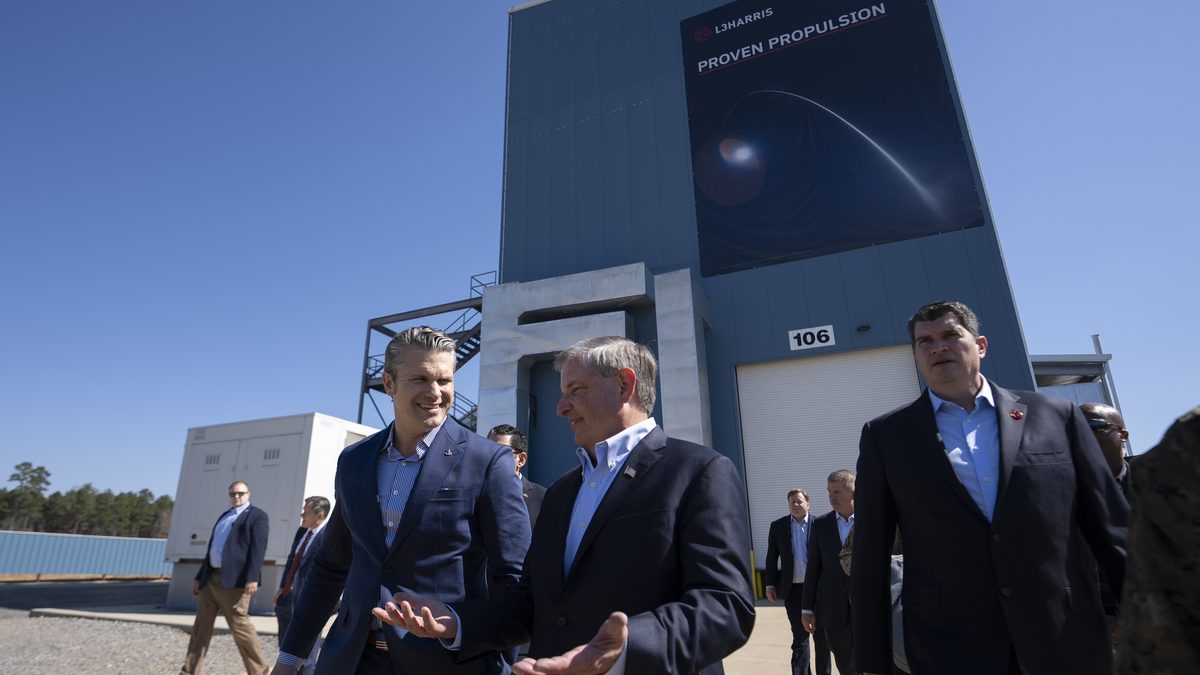
Secretary of War Pete Hegseth tours the L3Harris Patriot Advanced Capability-3 (PAC-3) Missile Segment Enhancement (MSE) facility during the Arsenal of Freedom Tour, Camden, Arkansas, 27 February 2026. U.S. photo by Petty Officer 1st Class Alexander Kubitza via DVIDS (public domain). Appearance of U.S. DoD visual information does not imply or constitute DoD endorsement.
Pentagon Locks In Seven-Year Propulsion Deals to Triple PAC-3 and Quadruple THAAD Motor Output
On 27 July 2026 the United States Department of War signed two seven-year framework agreements with L3Harris and Lockheed Martin to expand missile-defence propulsion output, aiming to nearly triple production of the PAC-3 Missile Segment Enhancement two-pulse solid rocket motor and quadruple output of the THAAD interceptor solid rocket boost motor, easing an energetics bottleneck that has constrained interceptor deliveries.
Technical Summary
The United States Department of War (DoW, the renamed Department of Defense) announced on 27 July 2026 two seven-year framework agreements covering the propulsion sections of the Patriot Advanced Capability-3 Missile Segment Enhancement (PAC-3 MSE) interceptor and the Terminal High Altitude Area Defense (THAAD) interceptor. L3Harris Technologies is the propulsion prime on both, working alongside interceptor prime Lockheed Martin. For the PAC-3 MSE, the framework targets a near-tripling of output of the advanced two-pulse solid rocket motor, the Attitude Control Motors (ACMs) and the Lethality Enhancer. For THAAD, a parallel agreement expands manufacture of the solid rocket boost motor and the Liquid Divert and Attitude Control System (LDACS).
From a Weapons, Ordnance, Munitions and Explosives (WOME) standpoint these agreements are an energetics-manufacturing story, not a missile-design story. The PAC-3 MSE two-pulse solid rocket motor uses a segmented propellant grain with two independently initiated pulses, letting the interceptor hold thrust in reserve for a terminal manoeuvre against an agile target. The Lethality Enhancer is a small explosive device that projects metal fragments outward at intercept to enlarge the hit-to-kill lethal radius. L3Harris casts and cures the PAC-3 MSE motors at Camden, Arkansas, a site fitted with automated digital X-ray bays for non-destructive inspection of the cured propellant grains.
L3Harris will nearly triple PAC-3 MSE propulsion output and quadruple THAAD solid rocket boost motor output under two seven-year frameworks, alongside a THAAD interceptor procurement worth up to 35 billion United States dollars. ISC assessment of the US Department of War announcement, 27 July 2026
Analysis of Effects
The binding constraint on Western air- and missile-defence interceptor delivery has shifted from final assembly to the energetics that fill and propel the round. Solid rocket motor production is rate-limited by cast-and-cure cycle time, propellant mixer capacity and the supply of ammonium perchlorate oxidiser, aluminium fuel and polymer binder. A seven-year demand signal is the specific instrument that lets a propulsion house commit private capital to new mix buildings, cure bays and X-ray inspection lines, because the payback horizon on that plant runs well beyond a single annual order. The near-tripling and quadrupling figures are output targets against that expanded plant, not orders already on the books.
THAAD and PAC-3 MSE draw on overlapping but distinct energetic supply chains. Both rely on class 1.1 solid propellant boost or sustainer motors, so both compete for the same oxidiser and mixer throughput, which is why the DoW placed the two frameworks together rather than in isolation. THAAD adds the LDACS, a liquid bipropellant divert system that provides exo-atmospheric agility a solid motor cannot throttle. Quadrupling THAAD boost motor output only yields more deliverable interceptors if LDACS, seeker and kill vehicle keep pace, which is why the release names the boost motor and LDACS together. The PAC-3 MSE framework sits on earlier agreements with Lockheed Martin, seeker maker Boeing and component supplier Honeywell, showing the DoW is contracting each tier of the interceptor bill of materials separately.
The propulsion frameworks were reinforced two days later. On 29 July 2026 the Department of War converted its April 2026 one-year PAC-3 MSE deal into a seven-year multiyear procurement, adding a modification of up to 53.86 billion US dollars to bring the total award to about 58.62 billion US dollars and explicitly aiming to triple interceptor output by the end of 2030, with the Camden, Arkansas final-assembly workforce rising from roughly 1,200 to about 1,850. Read together, the interceptor multiyear and the propulsion frameworks are the same demand signal applied at two tiers of the same bill of materials: tripling all-up round assembly is only deliverable if the two-pulse solid rocket motors, attitude control motors and lethality enhancers underneath it scale at the same rate.
Personnel and Safety Considerations
Large solid rocket motors are hazard division 1.3 or 1.1 items depending on propellant formulation and confinement, and a near-tripling of motor throughput multiplies the quantity of bulk energetic material moving through mixing, casting, curing and storage at Camden and the associated sites. For ammunition and explosives safety staff the practical exposure is net explosive quantity (NEQ) per process building and per magazine rising against fixed quantity-distance (QD) siting, which can force either new licensed explosives facilities at greater separation or a re-argued explosives safety case. The automated digital X-ray inspection L3Harris cites is the non-destructive test that screens cured grains for cracks, voids and debonds that would otherwise cause a pressure spike or motor failure on ignition. Propellant type, per-motor NEQ and hazard classification are not disclosed in open sources.
Data Gaps
Open sources do not state the propellant formulation or hazard division of the PAC-3 MSE and THAAD motors; the per-motor net explosive quantity; the baseline and target annual production rates behind the words triple and quadruple; the framework contract values for the propulsion sections themselves, as distinct from the up-to-35-billion-dollar THAAD interceptor procurement; the delivery schedule; or the split of new plant between Camden, Arkansas and the L3Harris sites in Alabama and Virginia. These figures should be treated as data gaps pending a definitised contract award.
Key Questions
What did the Pentagon agree with L3Harris and Lockheed Martin in July 2026?
On 27 July 2026 the US Department of War signed two seven-year framework agreements to expand missile-defence propulsion production. One nearly triples output of the PAC-3 MSE two-pulse solid rocket motor, Attitude Control Motors and Lethality Enhancer; the other quadruples THAAD solid rocket boost motor and Liquid Divert and Attitude Control System output.
Why does missile-defence output depend on solid rocket motor production?
Interceptor delivery is rate-limited by energetics, not final assembly. Solid rocket motors need long cast-and-cure cycles, scarce propellant mixer capacity and oxidiser supply. A seven-year demand signal lets propulsion makers invest private capital in new mixing, curing and inspection plant, because that investment only pays back over a horizon longer than a single annual order.
What is the PAC-3 MSE Lethality Enhancer?
The Lethality Enhancer is a small explosive device carried on the PAC-3 MSE hit-to-kill interceptor. At intercept it projects metal fragments outward to enlarge the lethal radius, improving the chance of destroying cruise missiles and aircraft where a pure body-to-body impact might miss. L3Harris builds it alongside the interceptor solid rocket motor.
References
Source-evaluated under NATO STANAG 2022 (Reliability A–F / Accuracy 1–6). Tier 1 = government primary source; Tier 2 = quality news / specialist defence media; Tier 3 = authoritative aggregator / encyclopaedia.
- T1US Department of War – Department of War and L3Harris Secure Landmark Deals to Expand Propulsion Production for PAC-3 MSE and THAAD, 27 July 2026. (Reliability A / Accuracy 1)
- T2Defence Industry Europe – American industry to nearly triple PAC-3 MSE propulsion production under seven-year missile manufacturing framework, 27 July 2026. (Reliability B / Accuracy 2)
- T2Army Technology – L3Harris to quadruple THAAD propulsion in contract with DoW, Lockheed, July 2026. (Reliability B / Accuracy 2)
- T2Lockheed Martin – 35 Billion THAAD Seven-Year Procurement Award Propels Acceleration of Critical Missile Defense Interceptor Production, 24 June 2026. (Reliability B / Accuracy 2)
- T3Interesting Engineering – US expands PAC-3 MSE missile production with plan to nearly triple propulsion output, July 2026. (Reliability C / Accuracy 3)
- T1Lockheed Martin – Department of War Awards Lockheed Martin 58.62B for Multiyear PAC-3 MSE Production, 29 July 2026. (Reliability A / Accuracy 1)
Corrections & updates welcome. If you hold open-source data that refines or corrects any parameter in this article, please contact [email protected] citing the specific claim and your source. Verified corrections will be incorporated and credited in the revision history. AI-assisted technical assessment based on open-source material. Not a formal intelligence product.