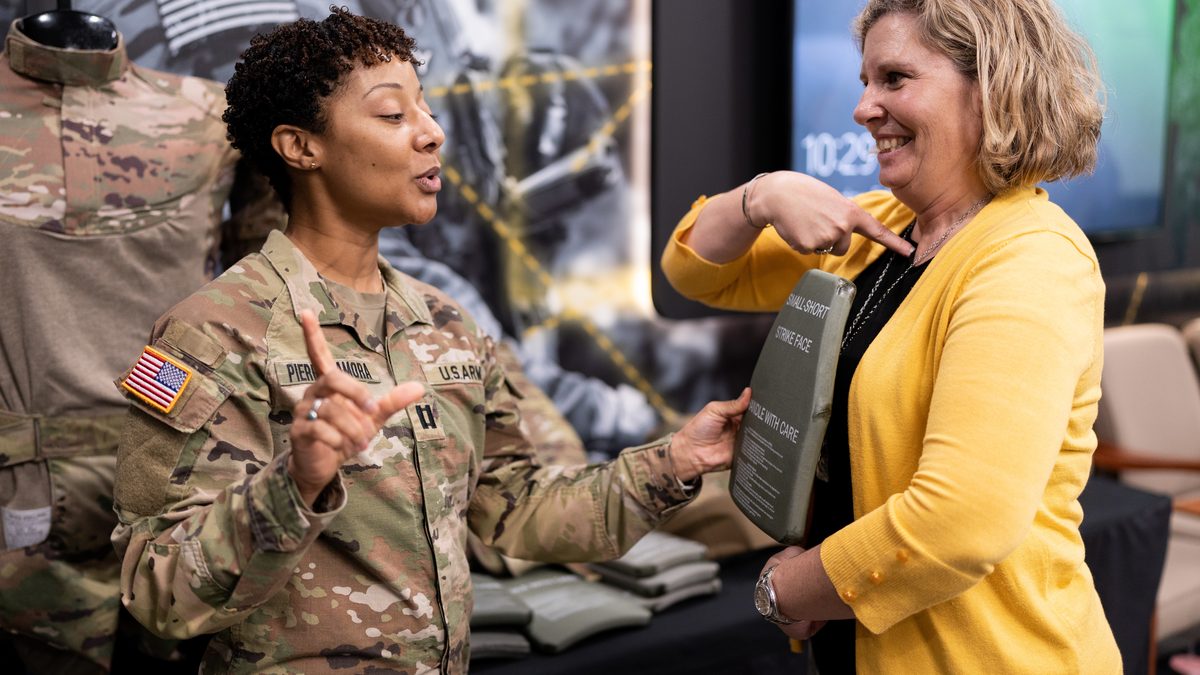
An Enhanced Small Arms Protective Insert plate, strike face uppermost, held against the torso during a body armour demonstration at Fort Belvoir, Virginia, 23 February 2023. Image: U.S. Army photo by Jason Amadi, released via DVIDS (public domain, VIRIN 230223-A-IG696-0387). Use does not imply endorsement by the U.S. Department of the Army or the Department of Defense.
The .30-06 standard: what Level IV armour is actually required to stop
NIJ Standard 0123.00 defines Level IV, redesignated RF3, by a single test threat: the .30-06 M2 armour-piercing bullet, 10.7 g, driven at 878 m/s. Backface deformation is capped at 44.0 mm. Fifty years of revisions built that number, and on 30 July 2026 only 12 RF3 models were certified against 4,516 legacy listings still valid until 2029.
Technical Summary
Level IV is the most quoted rating in small arms protection. It is also among the least understood. The term belongs to the United States National Institute of Justice (NIJ), a law enforcement standards body, and it gets borrowed freely for military plates that are specified somewhere else entirely. NIJ Standard-0101.06, issued in 2008, built Type IV around one test threat: the .30 calibre armour-piercing bullet carrying the United States military designation M2 AP, in 7.62 × 63 mm (.30-06 Springfield), with a hardened steel core. The current standard keeps that threat and renames the level.
Bullet mass under the 2008 standard is 10.8 g (166 grain). Reference velocity is 878 ± 9.1 m/s, equal to 2,880 ± 30 ft/s. Backface signature, meaning the depression left in the clay witness block behind the plate, must not exceed 44 mm in Roma Plastilina No. 1. Test items are capped at 254 × 305 mm and minimum shot-to-shot spacing is 51 mm. The manufacturer defines the minimum shot-to-edge distance for each model and each threat, and for a single-threat armour, which is what Type IV is, that figure may not exceed 51 mm. Conditioning comes first: roughly ten days at 65 °C and 80 per cent relative humidity, with thermal cycling and mechanical drop exposure, before a single round is fired. One detail gets missed almost every time. Type IV never carried the inherent multi-hit floor that Type III does, and the successor standard is blunter still about it: NIJ Standard 0101.07 provides one-shot and two-shot test item layouts at Figure 11, and that figure is captioned for RF3 alone. RF1 and RF2 plates are shot in three-shot or six-shot patterns. A rifle plate carrying the top rating can therefore have been certified on fewer impacts than one carrying a lower rating.
| Level | Test threat | Bullet mass | Reference velocity |
|---|---|---|---|
| RF1 | 7.62 × 51 mm M80 Ball NATO; 7.62 × 39 mm mild steel core Type 56 (Factory 31); 5.56 mm M193 | 149 +0/−3 gr (9.7 g) / 123 gr (8.0 g) / 56 +0/−2 gr (3.6 g) | 847 / 732 / 990 m/s |
| RF2 | All RF1 threats plus 5.56 mm M855 | 61.8 ± 1.5 gr (4.0 g) | 950 m/s (3,115 ft/s) |
| RF3 | .30-06 M2 armour piercing, and nothing else | 165.7 +0/−7 gr (10.7 g) | 878 m/s (2,880 ft/s) |
Rifle protection levels as set out in the 0123.00 threat schedule, incorporating the Addendum 1 mass revision of 31 October 2024. RF2 subsumes RF1. RF3 does not subsume either.
Lineage of the requirement
-
1975
The NIJ demonstration project issues Type I body armour, the first fielded generation.
Left uncovered Rifle threats sit entirely outside the scheme.
-
Sept 2000
NIJ Standard-0101.04 published, revised to Rev. A in June 2001.
Left uncovered Shot-to-edge distance still set at 76 mm, later found unnecessarily conservative.
-
Aug 2005
NIJ 2005 Interim Requirements issued after field concerns about fielded soft armour.
Left uncovered An interim instrument, not a full revision, so the underlying test method stays unchanged.
-
2008
NIJ Standard-0101.06 supersedes 0101.04 and the 2005 Interim Requirements. Type IV is fixed at one threat, .30-06 M2 AP at 878 m/s, with a 44 mm backface limit and a full conditioning regime.
Left uncovered Type IV can be certified on a single impact. The standard states in terms that publication does not invalidate armour already found compliant.
-
2017
United Kingdom publishes the Home Office Body Armour Standard, CAST 012/17. HO4 tops the ballistic scale. Manufacturers must declare a product life expectancy and evidence it.
Left uncovered The top UK level uses an expanding projectile, not an armour-piercing one, so the UK never certifies against the .30-06 threat at all.
-
2022 to 2023
The 2007 UK standard is closed down in stages: no recertification on any change from 31 May 2022, MQT2 restricted from 1 September 2022, full withdrawal in April 2023.
Left uncovered A hard sunset on the old certification route, with no equivalent on the NIJ side.
-
30 Nov 2023
NIJ Standard 0101.07 and NIJ Standard 0123.00 published in the Federal Register. Type IV retires. Rifle levels split into RF1, RF2 and RF3.
Left uncovered RF3 does not subsume RF1 or RF2, so the top level stops covering the small calibre threats.
-
Jan 2024
The Compliance Testing Program stops accepting new 0101.06 model applications on 5 January and additional listee submissions on 12 January.
Left uncovered No new model can ever be certified to the old standard, but every model already listed stays listed.
-
31 Oct 2024
Addendum 1 revises Table 2, raising the 7.62 × 51 mm M80 Ball mass to 149 +0/−3 grain for RF1 and RF2. Released 13 November 2024.
Left uncovered Any threat table still quoting 147 grain predates the amendment and is out of date.
-
1 July 2025
Addendum 2 narrows the RF3 ammunition identifier to United States military supply, deleting rounds meeting NATO specifications. Released 8 July 2025.
Left uncovered Tighter laboratory repeatability, and a smaller pool of qualifying test lots.
-
30 July 2026
The 0101.07 list carries 48 active models. The 0101.06 list carries 4,516 and is to be retained until at least 31 December 2029.
Left uncovered Twelve RF3 models exist, and one RF2 model. The level that closes the small calibre gap has almost nothing certified behind it.
Each entry pairs the instrument that was written with what it left out. The right-hand line of one era becomes the pressure behind the next.
Publication of this revision of the standard does not invalidate or render unsuitable any body armour models previously determined by NIJ to be compliant. Agencies are advised to always require their procurements to meet or exceed the most recent version. NIJ Standard-0101.06, purpose and scope, 2008
Analysis of Effects
NIJ Standard 0101.07 and its companion NIJ Standard 0123.00 were published in the Federal Register on 30 November 2023. Type IV is retired. The rifle levels are now RF1, RF2 and RF3, and only the last of those is the successor to Level IV. Backface deformation is capped at 44.0 mm per measurement, with a narrow statistical allowance out to 50.0 mm; any single measurement above 50.0 mm fails the article outright. Any complete penetration of a fair hit at or below reference velocity plus 30 ft/s also fails. Conditioning now runs through ASTM E3078, covering impact durability and the torso plate procedure, followed by submersion under ASTM E3112, with shot spacing to ASTM E3107. Shots are taken at either 0 or 30 degrees angle of incidence. A plate may be certified stand-alone or in conjunction with a named soft armour model, and the two certificates are not interchangeable.
Two addenda have since amended the threat table. Addendum 1, dated 31 October 2024, revised the 7.62 × 51 mm M80 Ball mass to 149 +0/−3 grain for both RF1 and RF2, so any table still quoting 147 grain predates it. The standard's own cover notice records its release on 13 November 2024. Addendum 2 is dated 1 July 2025 and released on 8 July 2025. It narrowed the RF3 ammunition identifier to United States military supply only, deleting the earlier alternative of rounds meeting NATO specifications. That is a test-repeatability change rather than a threat change.
The gap that matters is one of scope. RF3 does not subsume RF1 or RF2. An RF3 plate is under no obligation to defeat 5.56 mm M855, 5.56 mm M193, or steel-cored 7.62 × 39 mm, because none of those rounds appears in its test schedule. This is not an academic point. Monolithic ceramic constructions optimised against a single heavy armour-piercing core can perform worse against small calibre, high velocity, hard-cored projectiles than a well designed RF2 plate. A procurement officer who reads RF3 as a superset of RF2 has made a factual error the standard does not support anywhere in its text. A plate advertised as RF3 and also as stopping M855 is making a special-threat claim that sits outside the RF3 certificate, and it should be evidenced by a separate test report rather than by the level.
Two further families of specification get conflated with the NIJ scale. Enhanced Small Arms Protective Insert (ESAPI) plates are not NIJ certified at all. They are procured against a controlled United States Government purchase description carrying its own threat list, its own multi-hit requirement and its own backface criteria, none of which is public. In the United Kingdom the Home Office Body Armour Standard (2017), Centre for Applied Science and Technology (CAST) publication 012/17, tops out at HO4. That level uses a 7.62 × 51 mm expanding projectile of 10.7 g at 820 ± 15 m/s, so it is not an armour-piercing threat, and its backface limits are far tighter than NIJ practice at a mean of 25.0 mm and a single shot limit of 30.0 mm. The United Kingdom also closes the gap the NIJ scale leaves open: a footnote to the CAST protection level table requires that any armour submitted for testing at HO4 shall also meet the requirements of HO3. The higher UK level subsumes the one below it. RF3 does not. Germany's VPAM APR 2006 scale runs levels 1 to 14 and places the armour-piercing threats at the upper end. There is no NATO Level IV. STANAG 2920 is a method for determining ballistic limit, V50, using fragment simulating projectiles, and citing it as a protection level is a recurring error in tender documents.
What is actually certified today
A standard changing does not retire the armour already in service. The 2008 standard says so in its own opening pages, and the current transition repeats the advice: keep wearing the armour you have. What supersession retires is the certification route.
That route closed on a hard timetable. The Compliance Testing Program stopped accepting applications for new 0101.06 models on 5 January 2024 and stopped accepting additional listee submissions against already-listed models a week later. No new model will be added to the 0101.06 list. Everything already on it stays, subject to Follow-up Inspection Testing, and NIJ intends to maintain that list until at least 31 December 2029. The United Kingdom ran the same manoeuvre faster and harder, withdrawing the 2007 standard entirely in April 2023 after closing recertification the previous May.
| Specification | New model certification | Still purchasable | Closure date |
|---|---|---|---|
| NIJ 0101.06 (Type IIA to IV) | Closed | Yes, 4,516 listings, subject to Follow-up Inspection Testing | 5 and 12 January 2024 |
| NIJ 0101.07 (HG1 to RF3) | Open | Yes, 48 active models | Current route |
| UK Home Office 2007 (39/07) | Closed | No recertification route | Withdrawn April 2023 |
| UK CAST 012/17 (2017) | Open | Yes, certificates carry expiry dates | Current route |
| ESAPI | Government | Controlled purchase description, not public | Not applicable |
Certification routes and market availability, read from the NIJ Compliant Products List and the Home Office police equipment database on 30 July 2026. Both lists are dynamic: counts move with adjudications, withdrawals and Follow-up Inspection Testing, and the 0101.06 total counts listees and variants accumulated since 2008 rather than distinct designs.
The consequence is a market split down the middle, and the numbers are stark. Counted on 30 July 2026, the current standard carries 48 certified models against 4,516 legacy listings. An agency buying a rifle plate this year is far more likely to buy a 0101.06 article than a 0101.07 one, simply because that is what exists.
Look at how those 48 break down and the picture sharpens. Twelve rifle plates worldwide carry RF3. Exactly one model carries RF2, the level that adds 5.56 mm M855 and closes the small calibre gap described above. The remedy for the scope problem is certified, in the sense that a single product exists. It is not yet a market.
| Level certified to NIJ 0101.07 | Active models | Share |
|---|---|---|
| HG2 handgun | 25 | 52 per cent |
| RF3 rifle, armour piercing | 12 | 25 per cent |
| HG1 handgun | 6 | 13 per cent |
| RF1 rifle | 4 | 8 per cent |
| RF2 rifle, includes 5.56 mm M855 | 1 | 2 per cent |
Every model on the NIJ 0101.07 Compliant Products List, counted on 30 July 2026. All 48 carry Active status.
Service life and through-life management
Ask any of these standards how long a plate lasts and the answer is silence. The words service life, shelf life and expiry do not appear in NIJ 0101.06, 0101.07 or 0123.00 in any operative sense. The 2008 standard goes further and disclaims the question outright at sections 5.1 and 6.1, covering flexible and hard armour conditioning: the protocol will not predict the service life of the armour, nor does it simulate an exact period of time in the field. Ten days at 65 °C is a robustness check. It says the plate still works after abuse. It says nothing about years.
What fills the gap differs sharply by regime, and the difference is worth a procurement officer's attention. NIJ leans on the manufacturer's warranty, and its own guidance is candid that those warranties are not evaluated by the Compliance Testing Program. The United Kingdom makes the manufacturer declare a product life expectancy at section 3.6.1 and evidence it with destructive testing over at least that period. Where the evidence falls short, the model enters In-Life Monitoring at section 11: the oldest in-service armour is retrieved from operational officers every two years, tested at an accredited facility, and replaced at the manufacturer's cost. The United States military ignores the calendar and inspects condition, requiring plates issued to deploying personnel to have been X-rayed within the previous nine months.
| Regime | Life set by | Control mechanism | Interval |
|---|---|---|---|
| NIJ 0101.06 and 0101.07 | Manufacturer warranty | Follow-up Inspection Testing on the model, not the item. Warranties are not evaluated by the Compliance Testing Program | No mandated in-service inspection |
| UK CAST 012/17 | Declared product life expectancy, evidenced by destructive testing over at least that period | Production Quality Testing, plus In-Life Monitoring where the evidence is insufficient | Oldest in-service armour sampled every two years |
| US military plates | Not published | Armor Inspection System, X-ray non-destructive inspection, plus lot recall by contract number | Inspection currency of nine months for deploying issue |
Three philosophies. One trusts a commercial warranty, one makes the manufacturer prove the life and then checks it on worn plates, one ignores the calendar and inspects condition.
The five year figure that circulates in the trade turns out to be measurable rather than folkloric. NIJ publishes each model's declared warranty as a column on the Compliant Products List. Across all 48 models certified to the current standard, 37 declare five years. The rest run to seven, eight or ten. Five years is therefore the market convention and nothing more: no standard requires it, and no independent body has examined it.
| Declared warranty | Models on the 0101.07 list | Share of 48 |
|---|---|---|
| 5 years | 37 | 77 per cent |
| 8 years | 6 | 13 per cent |
| 7 years | 3 | 6 per cent |
| 10 years | 2 | 4 per cent |
Declared warranty as published in the Warranty column of the NIJ Compliant Products List, all 48 models, 30 July 2026. Five years is the market convention, not a requirement of any standard.
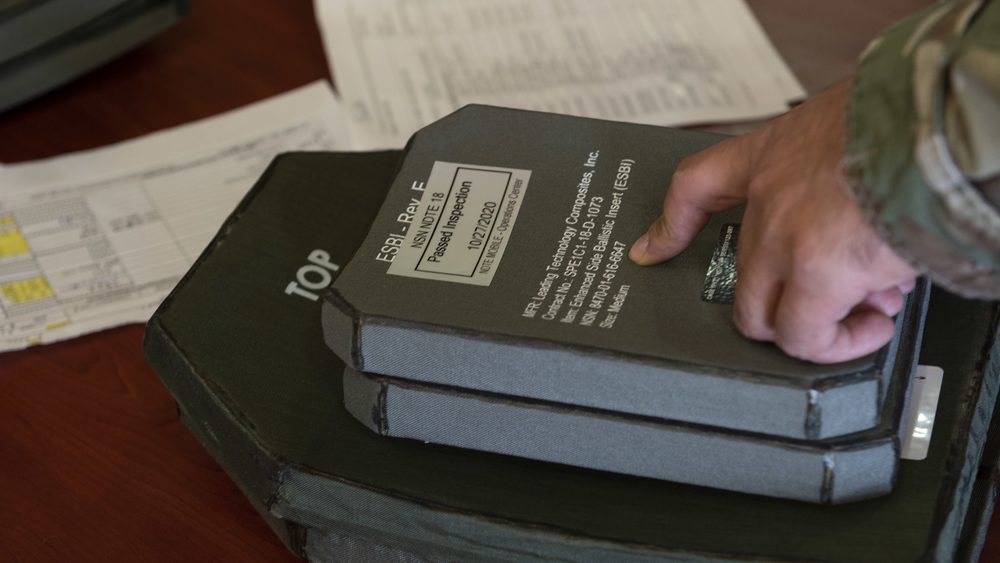
Two practical points follow for anyone managing a fleet. Ceramic strike faces fail by damage rather than by date, so a plate dropped onto a hard surface can keep perfect markings and lose its rating, which is why the military answer is inspection currency rather than a disposal date. And the label is the fleet management system. CAST requires an in-service label at least 75 × 75 mm on the body side of every panel, carrying date of manufacture, batch, serial number and care instructions, readable for the product life expectancy plus two years. The NIJ standards specify a pretest label for the sample sent to the laboratory and leave production marking to the programme. If the date cannot be read, the fleet cannot be managed.
Personnel and Safety Considerations
For anyone writing a specification, the reading discipline is to treat a level as a certificate against a named threat rather than a statement of capability. Where the threat assessment includes small calibre hard cores, specify RF2 and RF3 together, because RF3 alone does not cover them, and check what is actually certified before writing the requirement. State the required number of hits and their spacing explicitly, because multi-hit performance is a supplier declaration and not a property of the level. State whether the plate is required stand-alone or in conjunction with a specified soft armour panel, because the certificate differs and so does the areal density. Ask for the declared life and the evidence behind it, not just the warranty length.
The backface figure deserves one caution of its own. It is a proxy for behind-armour blunt trauma, not a guarantee against it. A reading of 44.0 mm of clay deformation represents a survivable but potentially injurious loading, and the number was chosen for repeatability in a laboratory rather than as a medical threshold.
What this does to the 6.8 × 51 mm argument
The Next Generation Squad Weapon (NGSW) overmatch case is usually summarised as a requirement to defeat advanced enemy body armour at range. Read against the specifications themselves, three things follow. The requirement was never written against NIJ RF3. It was written against a projected peer plate, and the threat model behind it is not the law enforcement standard. Any claim that begins with the phrase “6.8 defeats Level IV” is comparing a military requirement against a civil certificate.
Defeating RF3 is also a narrower achievement than the phrase implies, for the reason set out above: a single steel-cored projectile of 1930s design at 878 m/s, with the modern small calibre threats absent from the schedule. The counter-argument on exposure geometry deserves a hearing too. Frontal and rear torso plates cover a limited share of the presented area of a standing target, and close to none of a target that is prone or fighting from a trench. Presented area is the wrong denominator. The requirement derives from probability of incapacitation given an engagement, not probability of a hit landing on the plate, and the plate covers the region where a hit is most likely to be immediately fatal.
Both of those propositions can be true at once, which is why the argument has run so long. A round that cannot get through the plate converts a would-be kill into a bruise. Whether that shifts the aggregate enough to justify the mass, chamber pressure, recoil, barrel life and combat load penalties of a 6.8 × 51 mm cartridge is a separate question, and it is contested inside the United States Army as well as outside it.
Data Gaps
The internal trade studies that set the NGSW penetration requirement, including the 2017 small arms ammunition configuration work, are not available in full open source, and confidence in any reconstruction is LOW. The ESAPI threat list, multi-hit count, backface criteria and service-life terms are held in a controlled purchase description and are not published, so no direct numerical comparison with RF3 is possible. Comparative test data showing RF3-certified plates against 5.56 mm M855A1 is not published by NIJ, which tests only the threats in its schedule; the performance concern raised above is a structural inference from the standard's scope, not a measured result. The 0101.06 warranty figures quoted here come from the first 100 rows of a 4,516-row list read in listee-alphabetical order, so treat that shape as indicative while the 0101.07 figures are complete. The 2026 status of AC/326 and AC/327 work on personal protective equipment standardisation was not confirmed.
Key Questions
What round does NIJ Level IV body armour have to stop?
One: the .30-06 M2 armour-piercing bullet, 10.7 g (165.7 grain), fired at 878 m/s (2,880 ft/s). Under the current NIJ Standard 0123.00 this level is designated RF3. Backface deformation must not exceed 44.0 mm, with a limited statistical allowance to 50.0 mm, and any complete penetration of a fair hit is a failure.
Does a Level IV or RF3 plate stop 5.56 mm M855?
Not necessarily. RF3 does not include the RF1 or RF2 threats, so an RF3 certificate carries no obligation to defeat 5.56 mm M855 or M193, or steel-cored 7.62 x 39 mm. Buyers who need coverage against small calibre hard cores should specify RF2 and RF3 together, and check what is certified: one RF2 model existed on 30 July 2026.
How long do ballistic plates last?
No ballistic standard sets a service life. NIJ 0101.06 states its conditioning protocol will not predict service life. Life comes from the manufacturer's warranty, and 37 of the 48 models certified to NIJ 0101.07 declare five years. The UK requires a declared product life expectancy backed by destructive testing, with in-service sampling every two years.
References
Source-evaluated under NATO STANAG 2022 (Reliability A–F / Accuracy 1–6). Tier 1 = government primary source; Tier 2 = quality news / specialist defence media; Tier 3 = authoritative aggregator / encyclopaedia. Every reference below is a Tier 1 primary source, appropriate for a specification article; the assessment of the 6.8 × 51 mm requirement rests on secondary reporting and is flagged as a data gap.
- T1National Institute of Justice – Specification for NIJ Ballistic Protection Levels and Associated Test Threats, NIJ Standard 0123.00, 2023. (Reliability A / Accuracy 1)
- T1National Institute of Justice – Ballistic Resistance of Body Armor, NIJ Standard 0101.07, 2023. (Reliability A / Accuracy 1)
- T1National Institute of Justice – Ballistic Resistance of Body Armor, NIJ Standard-0101.06, 2008. (Reliability A / Accuracy 1)
- T1National Institute of Justice – Addendum 1 to NIJ Standard 0123.00 (Table 2 mass revision), 31 October 2024. (Reliability A / Accuracy 1)
- T1National Institute of Justice – Addendum 2 to NIJ Standard 0123.00 (RF3 ammunition identifier), 1 July 2025. (Reliability A / Accuracy 1)
- T1National Institute of Justice – Compliant Products List: Ballistic Resistant Body Armor (model counts and declared warranties read live), read 30 July 2026. (Reliability A / Accuracy 1)
- T1Criminal Justice Technology Testing and Evaluation Center – NIJ Standard 0101.07 Information, and Body Armor Care and Replacement, 2024. (Reliability A / Accuracy 1)
- T1Home Office Centre for Applied Science and Technology – Body Armour Standard (2017), CAST publication 012/17, 2017. (Reliability A / Accuracy 1)
- T1United States Army – New Armor Inspection System ensures ballistic plates safe for deploying Soldiers, 2013. (Reliability A / Accuracy 2)
Corrections & updates welcome. If you hold open-source data that refines or corrects any parameter in this article, please contact [email protected] citing the specific claim and your source. Verified corrections will be incorporated and credited in the revision history. AI-assisted technical assessment based on open-source material. Not a formal intelligence product.