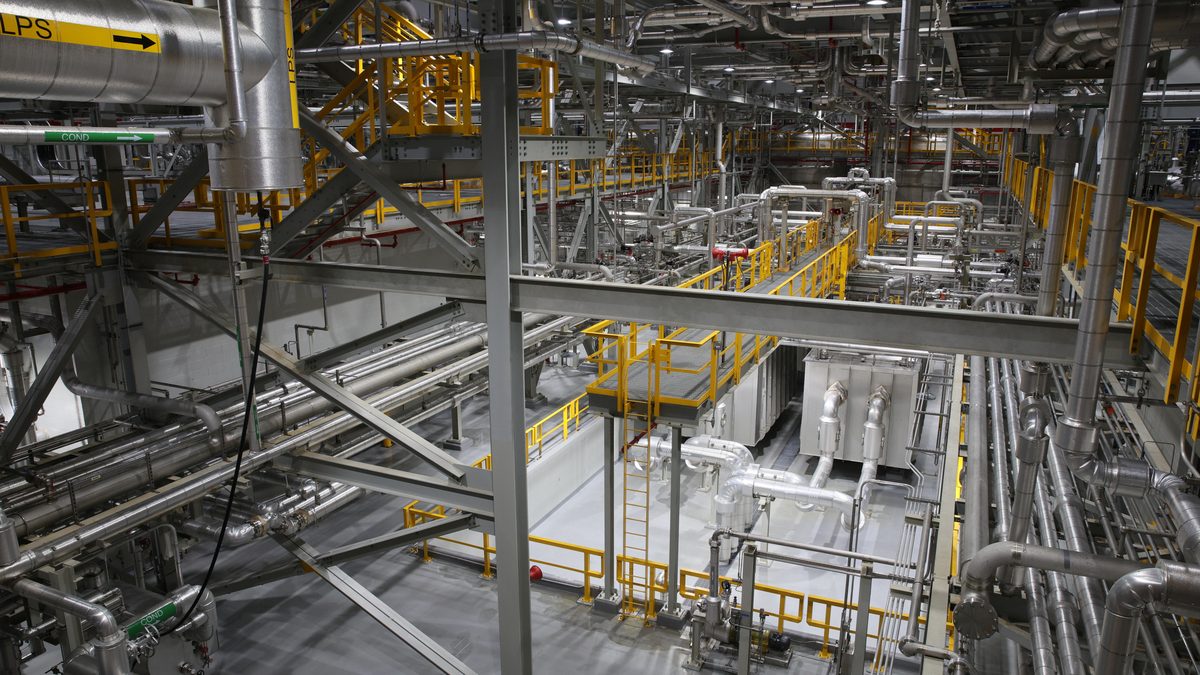
Illustrative: the new nitrocellulose production facility at Radford Army Ammunition Plant, Virginia. U.S. Army photo by Christine Mitchell via DVIDS, public domain; use does not imply endorsement by the U.S. Department of Defense. No United Kingdom plant has yet been built under the programme described here.
MOD Funds 22 Energetics Feasibility Studies and Still Holds a Construction Start Inside 2026
The Ministry of Defence announced on 29 July 2026 that 22 companies, including small and medium enterprises in England, Scotland and Wales, hold feasibility study contracts worth up to £300,000 each for new energetic materials plants. The studies report by the end of September 2026. Front End Engineering Design contracts of up to £5 million follow, with construction still targeted to begin during 2026.
Technical Summary
The Ministry of Defence has placed feasibility study contracts with 22 companies to examine sites for the manufacture of energetic materials, the explosives, propellants and pyrotechnic compositions that sit inside everything from small arms ammunition to guided weapons. Each contract is worth up to £300,000, so the maximum exposure across the cohort is £6.6 million. The studies are due to report at end September 2026. The strongest proposals will then be offered Front End Engineering Design (FEED) contracts worth up to £5 million, and the Ministry still intends construction of the first factories to begin during 2026. The cohort includes small and medium enterprises registered in England, Scotland and Wales.
Scope is set by the nine materials the Ministry named in its Strategic Defence Review energetics information notice of 19 November 2025: RDX, HMX, TNT, nitrocellulose, nitroglycerine, nitroguanidine, hexanitrostilbene, ammonium perchlorate and boron potassium nitrate. Those nine are not one industry. RDX (cyclotrimethylenetrinitramine) and HMX (cyclotetramethylenetetranitramine) are nitramines produced from hexamine and handled wet, by direct nitric acid nitration on the Woolwich route or by the Bachmann route using ammonium nitrate and acetic anhydride, which are different plants with different acid recovery and impurity profiles. Nitrocellulose and nitroglycerine are nitrate esters, the first stored under water or alcohol, the second sensitive enough that it is normally manufactured and consumed inside the same plant. TNT (trinitrotoluene) is a nitroaromatic with its own acid train. Ammonium perchlorate is a solid rocket motor oxidiser and boron potassium nitrate is a pyrotechnic igniter composition. Hazard division (HD) and compatibility group (CG) attach to a specific substance in a specific packaging and quantity, assessed under STANAG 4123 and the United Nations test series, so one site licence can span several divisions.
Feasibility studies are planned to be contracted in Spring 2026, and to conclude in August 2026. The Ministry of Defence intends to announce investments in quarter 3 2026 with a view to beginning construction of the first factories before the end of the year. Luke Pollard MP, Minister for Defence Readiness and Industry, Written Answer 129263, 27 April 2026
| Stage | When | Position |
|---|---|---|
| Strategic Defence Review commits £1.5bn to energetics and munitions | June 2025 | Committed |
| Energetics information notice names nine materials | 19 November 2025 | Published |
| Expressions of interest close | 15 December 2025 | Closed |
| Feasibility studies stated to Parliament as contracting in spring, concluding August | 27 April 2026 | Superseded |
| Feasibility contracts announced, 22 companies, up to £300,000 each | 29 July 2026 | Awarded |
| Feasibility studies report | End September 2026 | Scheduled |
| FEED contracts, up to £5 million each | After September 2026 | Planned |
| Construction begins on first factories | Before end December 2026 | Target |
Analysis of Effects
The schedule is the story. In April the Ministry told Parliament that studies would be contracted in spring and would conclude in August, with investment announcements in the third quarter and construction starting before the end of the year. Contracting slipped to late July. The reporting date moved into late September. The construction target did not move at all. What was a four month gap between a finished study and a spade in the ground is now closer to three, and a FEED contract worth up to £5 million has to be competed, awarded and delivered inside it. FEED on a nitration plant is not a drawing exercise. It fixes the process flow diagram, the hazardous area classification, the in-process inventory at each stage and, through that inventory, the quantity distance envelope that determines how much land the site needs. Design efforts of that size on chemical process plant are usually measured in six to twelve months. The money has its own queue. A notice published on 2 April 2026 set out investment windows through which companies bid for capital grants capped at £45 million per proposal or 50 per cent of total project cost, whichever is lower, with the first window in the third quarter of 2026 and further windows in the second and fourth quarters of 2027. A December start therefore depends on the September studies, an autumn grant decision and a FEED award all landing in sequence inside one quarter (see ISC, 15 April 2026).
The second constraint is consent rather than engineering. Manufacture and storage of explosives in Great Britain is licensed under the Explosives Regulations 2014, with the Health and Safety Executive as licensing authority for the higher hazard sites this programme implies, and separation distances set against the licensed maximum net explosive quantity (NEQ) per building. A plant on this scale is likely to fall above upper tier thresholds under the Control of Major Accident Hazards Regulations 2015, and hazardous area classification falls to the Dangerous Substances and Explosive Atmospheres Regulations 2002. Nitration generates spent mixed acid and a nitrate loaded effluent, so an environmental permit is required from the Environment Agency, the Scottish Environment Protection Agency or Natural Resources Wales depending on where the plant lands. Planning consent sits on top of all of it. That is why the Ministry published thirteen candidate locations in November 2025, among them Grangemouth, Teesside and Milford Haven, instead of inviting greenfield proposals. Sites with an existing chemical or explosives history bring consent history, buffer land and services with them, and to a programme defending a December milestone those are worth more than design maturity.
Personnel and Safety Considerations
A new energetics plant is where process safety is bought or lost, because nearly every decision that matters is fixed at design. Continuous nitration rather than batch cuts the in-process inventory and with it the credible event size. Remote operation and blast resistant separation between process buildings hold exposure down to the smallest number of people. Inherently safer design of that kind is far cheaper at FEED than at commissioning, which is precisely why compressing FEED carries a safety cost as well as a programme one. Then there is a competence question that capital does not answer. The Explosives Regulations 2014 and, on the Ministry side, Defence Safety Authority standard DSA 03.OME both assume a duty holder who understands the material. Britain has spent close to two decades not training energetics process engineers, explosives safety practitioners and qualified persons in any volume. Against the programme total of at least 1,000 jobs the Ministry has stated, it is the specialist safety and process engineering share, not the general manufacturing headcount, that cannot be recruited at short notice. Building that cadre takes longer than pouring the concrete, and none of the 22 studies will tell the Ministry where the people come from.
Data Gaps
The Ministry has not published the names of the 22 companies, the individual award values, or which of the nine materials each study addresses. There is no published mapping of the 22 studies onto the thirteen candidate locations announced in November 2025, no stated number of FEED contracts to be let, and no confirmation that the £6.6 million ceiling reflects committed spend rather than a maximum. The phrase construction starting before 2026 closes is undefined: enabling works on an already consented site and first concrete for a process building are very different milestones. No offtake structure has been published. The November 2025 notice told bidders to assume surge demand alongside reduced or minimal Ministry of Defence demand, with export and civil markets as the primary drivers, and stated that the Ministry would not form the majority of funding. Whether that position still stands is not on the record.
Key Questions
What did the MOD actually award on 29 July 2026?
Feasibility study contracts worth up to £300,000 each to 22 companies, including small and medium enterprises in England, Scotland and Wales. The studies examine sites for producing energetic materials and report at end September 2026. These are studies, not factory build contracts, and no site has been selected.
Which materials will the new UK energetics factories make?
The Ministry of Defence named nine in its November 2025 information notice: RDX, HMX, TNT, nitrocellulose, nitroglycerine, nitroguanidine, hexanitrostilbene, ammonium perchlorate and boron potassium nitrate. They span nitramines, nitrate esters, a nitroaromatic, a rocket oxidiser and a pyrotechnic igniter, so no single plant design covers the whole list.
Can construction really start before the end of 2026?
It is tight. Studies report in late September, after which Front End Engineering Design contracts worth up to £5 million must be competed, awarded and delivered. Design of that scale on chemical process plant usually runs six to twelve months, so a late 2026 start most likely means enabling works rather than process construction.
References
Source-evaluated under NATO STANAG 2022 (Reliability A–F / Accuracy 1–6). Tier 1 = government primary source; Tier 2 = quality news / specialist defence media; Tier 3 = authoritative aggregator / encyclopaedia.
- T1GOV.UK – New energetics factories for the UK, updated 20 November 2025. (Reliability A / Accuracy 1)
- T1UK Parliament – Written question 129263: munitions factories, answered by Luke Pollard MP, 27 April 2026. (Reliability A / Accuracy 1)
- T1Contracts Finder – Strategic Defence Review: Energetics Information Notice, 19 November 2025. (Reliability A / Accuracy 1)
- T1GOV.UK – UK building the factories of the future as government launches next phase of new munitions and energetics factories, 19 November 2025. (Reliability A / Accuracy 1)
- T2UK Defence Journal – UK funds 22 firms to plan new munitions plants, 29 July 2026. (Reliability B / Accuracy 2)
- T2Mirage News (Ministry of Defence public release) – UK munitions production gets funding boost, 29 July 2026. (Reliability B / Accuracy 2)
- T2UK Defence Journal – UK sets out funding plan for new munitions factories, reporting the MOD notice of 2 April 2026 on investment windows and capital grants, April 2026. (Reliability B / Accuracy 2)
Corrections & updates welcome. If you hold open-source data that refines or corrects any parameter in this article, please contact [email protected] citing the specific claim and your source. Verified corrections will be incorporated and credited in the revision history. AI-assisted technical assessment based on open-source material. Not a formal intelligence product.