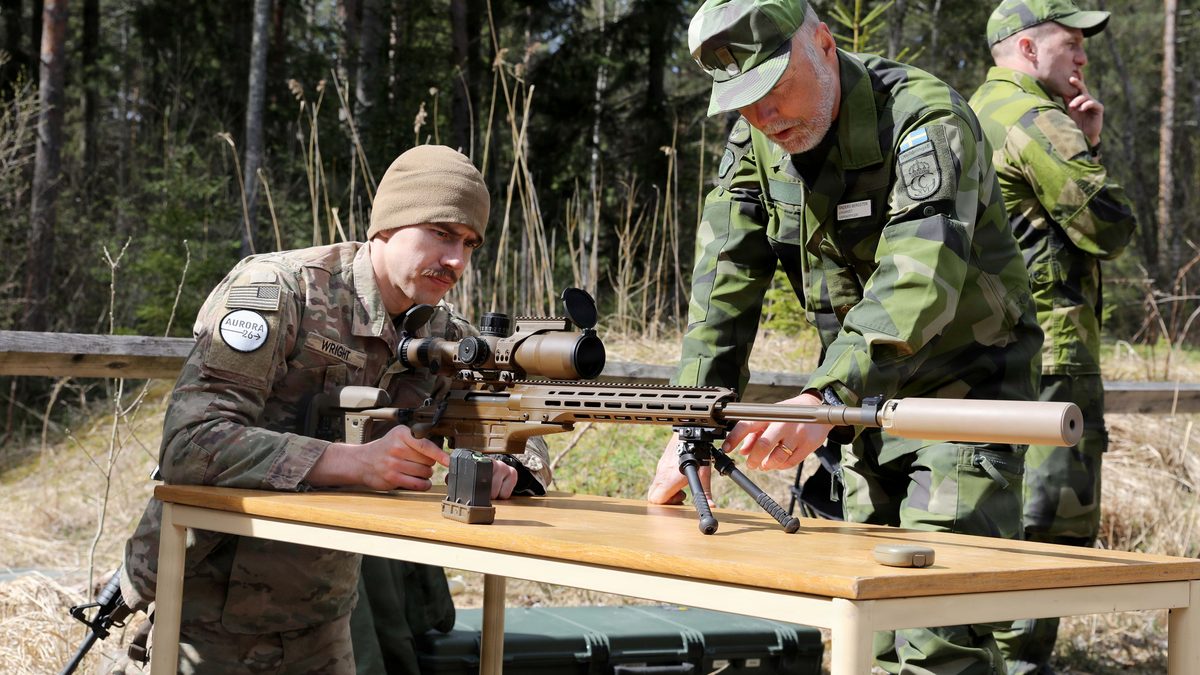
A Swedish Armed Forces service member shows a Swedish sniper rifle to a New York National Guard soldier at Kungsängen, Sweden, 26 April 2026, during exercise Northern Lights 26 / Aurora 26. Illustrative: the weapon is identified by the photographer only as a Swedish Armed Forces sniper rifle and is not a Sako ARG. Photo: Master Sgt. Warren Wright, New York National Guard, via DVIDS. US Government work, public domain. No Department of Defense endorsement is implied.
Sako’s ARG at Enforce Tac 2026: Two MOA on Acceptance, One Firing Ban in Service
The Sako ARG, short for Arctic Rifle Generation, is an AR-pattern military rifle family launched on 25 August 2025 in three forms: the ARG 40 GP and ARG 40 DI in 5.56x45 mm NATO, and the ARG 50 GP in 7.62x51 mm NATO. Finland and Sweden buy from the family under a framework agreement signed on 27 March 2023 that can run to 31 December 2053.
Technical Summary
At Enforce Tac 2026 in Nuremberg, which ran from 23 to 25 February 2026, a Sako representative walked The Firearm Blog through the three production configurations of the Arctic Rifle Generation. Two are chambered in 5.56x45 mm NATO. The ARG 40 GP uses a short-stroke gas piston; the ARG 40 DI is a direct impingement gun. The ARG 50 GP is the 7.62x51 mm NATO designated marksman variant, and Sako stated on camera that it is already being delivered to Finland. The numbers given at the booth were specific. Factory acceptance for the 5.56 mm rifles is set at 2 minutes of angle, described as 60 mm at 100 m, with the better rifles landing nearer 1 MOA, and every rifle test fired before it leaves the plant. The 7.62 mm marksman variant carries a tighter 1.5 MOA acceptance figure. Trigger pull on that variant was given as approximately 2 kg, roughly 4.4 lb, through a Sako two-stage unit fitted as standard across the service models.
The architecture matters more than the ballistics. Sako designed the upper and lower receivers to be common across the piston and direct impingement guns, and the representative tied that decision explicitly to security of supply. Converting between the two operating systems means changing the bolt carrier group, the gas system and one bushing inside the upper receiver, which is machined to take either a pusher rod or a gas tube. The piston assembly has been reduced in section so the handguard keeps the outside diameter of a conventional direct impingement AR, rather than the thick forend typical of short-stroke conversions and of the HK416 class of piston rifle the ARG is most often measured against. Gas regulation is deliberately crude: two positions, normal and suppressed, chosen because a multi-click regulator tends to be found on the wrong setting. Controls are ambidextrous, with 60 degree and 90 degree safety selector throws both offered and the shorter throw taken by the launch customers. The left-side magazine catch is intentionally stiffer than the right, a direct response to reports from Ukraine of right-handed soldiers shedding magazines against their kit. Sako also made a point of the supply chain: European parts, no United States International Traffic in Arms Regulations content, and therefore no re-export licence chain running back through Washington.
the factory acceptance standard is 2 MOA, so 60 mm at 100 m Sako representative, interviewed by The Firearm Blog at Enforce Tac 2026, 24 February 2026

The 7.62 mm Variant, and What Finland Actually Bought
The ARG 50 GP is the narrowest member of the family and the least like an AR-15. It is semi-automatic only, short-stroke piston, chambered in 7.62x51 mm NATO, and offered at launch on a single barrel length of 406 mm. The magazine interface is not the AR-15 pattern used by the ARG 40: it takes Magpul SR and LR magazines on the AR-10 and SR-25 footprint, in 10 or 20 rounds. The handguard runs longer than the 5.56 mm guns to carry a bipod, a laser designator, a rangefinder, a ballistic computer, or a forward-mounted night or thermal sight. Everything about the configuration says designated marksman rather than automatic rifle.
Sako ARG 50 GP, baseline from open sources
| Calibre | 7.62x51 mm NATO |
| Operating system | Short-stroke gas piston, semi-automatic only |
| Barrel | 406 mm (16 in), cold-hammer forged, hard-chrome lined |
| Magazines | Magpul SR / LR, AR-10 and SR-25 pattern, 10 or 20 rounds |
| Trigger | Two-stage, approximately 2 kg (4.4 lb) per Sako at Enforce Tac 2026 |
| Factory acceptance | 1.5 MOA |
| Weight, overall length, twist rate | Not published, including on Sako's own product page |
Finland did buy the 7.62 mm rifle, and the sequencing is the part most coverage gets wrong. The Finnish contract came first. On 21 December 2021 the Finnish Defence Forces Logistics Command signed an implementation arrangement with Sako for Rifle System M23, a semi-automatic 7.62 mm NATO system on an AR-10 pattern, worth about EUR 10 million including value added tax. Sako announced it on 12 January 2022. The Finnish Defence Forces put the additional procurement option attached to that contract at EUR 525 million excluding value added tax, a figure that appears in their own release and is not repeated in secondary reporting, so it should be read as a stated ceiling for follow-on orders rather than committed spend.
The system arrives in two configurations. The 7.62 Sniper Rifle 23 carries a high-quality optical sight and, with precision ammunition, is stated to achieve effects on targets out to 800 m. The 7.62 Designated Marksman Rifle 23 has simpler weapon-mounted equipment and goes to jaeger and infantry section marksmen, lifting the section's reach to 600 m. Between them they replace the Sniper Rifle 85 and the Dragunov. Development work with Sako ran from 2020 to 2022, first deliveries were due by the end of 2022, training began in 2023, and manufacture is at Riihimaki.
Delivery is not a promise, it is a record. Ruotuvaki, the Defence Forces newspaper, set out the destination at the point of contract: operational and local force sniper groups, plus infantry and jaeger platoons. Colonel Rainer Peltoniemi, then Infantry Inspector, described the system as developed and customised for Finnish conditions rather than taken off a shelf. The first series rifles left Sako during 2022, conscript use followed from 2023, and by September 2023 the reserve press reported the system already in trials with troops, with experience good and some improvements identified. By November 2023 the Finnish Infantry Centre was listing the M23 as infantry equipment rather than a programme. Ruotuvaki returned to it in September 2024 and recorded the order as placed and the weapons as going to sharpshooters, while noting that no decision had yet been taken on replacing the older assault rifles. Sako's government business director Juuso Austin put the relationship plainly in that piece: the M23 is a customer product created jointly by the Finnish Defence Forces and Sako. What Helsinki has never published is a delivered quantity. It has, though, done something more telling than issue a press release: the Finnish Defence Forces carry Rifle System M23 as a numbered entry in their public equipment catalogue, under Army, Infantry, with a full technical data sheet. Catalogues list what a force holds, not what it has ordered. That is the firmest open-source confirmation available that the 7.62 mm system is in service rather than in procurement.
The service fit differs between the two configurations, and the differences are instructive. The 7.62 Sniper Rifle 23 carries a Steiner M7Xi 2.9 to 20 x 50 telescopic sight and a user-adjustable, user-replaceable stock. The 7.62 Designated Marksman Rifle 23 carries a Trijicon VCOG 1 to 6 x 24 with a ballistic reticle, which is a close-quarters-capable variable rather than a sniper optic, and that single choice tells you the marksman rifle is expected to fight at section range rather than observe from a hide. Both run 16 in barrels, Magpul PMAG magazines in 10 or 20 rounds, a NATO accessory rail to STANAG 4694, M-LOK, a Magpul telescoping stock, and a sound suppressor as part of the system. Sako has put roughly EUR 20 million into production expansion across two years to carry this and the Swedish work.
Rifle System M23 in Finnish service, official figures
| Role | Semi-automatic, magazine-fed precision rifle, used against personnel and vehicles and against weapon and command systems |
| Calibre | 7.62 x 51 NATO |
| Length | 88 to 96.5 cm, stock short to long, weapon only; 108 to 116.5 cm with suppressor |
| Weight | 3.9 kg weapon only; 7.5 kg combat weight with sight, suppressor, front supports, back-up sights, one full 20-round magazine and sling |
| Rate of fire | 40 aimed shots per minute |
| Effective range | 600 to 800 m, depending on sight and ammunition |
| Sights | Steiner M7Xi 2.9-20 x 50 on the TKIV 23; Trijicon VCOG 1-6 x 24 on the KIV 23 |
| Equipment | 20 and 10-round magazines, suppressor, front supports, back-up sights, sling, exchangeable stock on the TKIV 23, maintenance tools, transport bag and case, magazine pouch set |
| Country of manufacture | Finland |
Source: Finnish Defence Forces equipment catalogue entry for Kiväärijärjestelmä M23. Barrel length, rifling twist and trigger data are not given.
That contract predates the joint Finnish and Swedish framework by fifteen months. The framework signed on 27 March 2023 is the follow-on vehicle, not the origin of Finland's 7.62 mm capability. It also settles a designation the secondary sources muddle: Helsinki uses Rifle System M23 for the 7.62 mm system in its sniper and marksman forms, whatever wider use the label has picked up elsewhere.
Analysis of Effects
Take the acceptance figure first. Two MOA at 100 m is a competent service-rifle standard, and 100 per cent test firing is a meaningful commitment: NATO quality assurance practice under AQAP-2131 Edition C, Final Inspection and Testing, more commonly rests on sampling plans rather than screening every item. What Sako has not published is the measurement basis. Two MOA can mean extreme spread, mean radius or a circular error probable figure, over three, five or ten rounds, with a specified ammunition lot. Those choices move the number by a wide margin, and none of them appear in the open material. The 60 mm figure is itself a rounding: two minutes of angle subtends about 58 mm at 100 m, so the booth number and the specification are the same requirement stated loosely. The 1 MOA figure quoted for the best rifles is a distribution tail, not a specification, and should be read that way. The company also cites testing to a standard it calls NATO D14, alongside arctic, mud and sand environmental exposure. ISC could not map that reference to a publicly available Standardization Agreement or Allied Publication, so it is recorded here as a claim rather than a verified compliance statement.
The service record is where the interesting engineering question sits. Sweden adopted the 11.5 in 5.56 mm piston variant as the Automatkarbin 24, or Ak 24A. The 2023 framework it sits under is a wholesale small-arms replacement for Sweden, covering the Ak 4, the Ak 5 and the Psg 90 sniper rifle. FMV, the Swedish Defence Materiel Administration, ordered a further 22,500 rifles on 5 November 2024, on top of roughly 7,300 already delivered and inspected, with 7,500 scheduled into 2024 and 15,000 into 2025. Then the weapon was stopped. In early 2025 FMV imposed a firing ban on the Ak 24A after some rifles showed a delay between the trigger being pressed and the shot going off, a stop first reported publicly on 13 March 2025. FMV attributed the fault to a tolerance error, said it affected a small number of weapons, and its project manager Anders Östberg compared the response to a motor industry recall while calling the delay a safety defect that could not be accepted. Sako, FMV and the Swedish Armed Forces jointly developed an inspection method. Verification firing restarted on 1 November 2025 at four units, Amf 4 at Göteborg, F 17 at Ronneby, I 19 at Boden and P 4 at Skövde, on a programme running to 1 May 2026, with the ban lifted locally on individual weapons as they cleared. The four units were picked for different operating profiles, amphibious, air, arctic and armoured, and each ran the trial with roughly 150 continuously employed soldiers. Henrik Lundin put the purpose plainly: the continued verification is decisive for lifting the firing ban in its entirety. Unit feedback reported from P 4 in January 2026 described the corrected rifles as solid, with good shooting performance and no recurrence of the delayed discharge. Deliveries of corrected and new-production rifles were targeted for the second quarter of 2026, while conscript basic training continued on the interim Ak M4. As at 30 July 2026 the ban is reported as partially lifted with the weapon in use, and ISC has found no open-source confirmation of release across the whole delivered inventory. Finland, meanwhile, has still not closed its 5.56 mm decision. A test batch was due with the Army in spring 2026, the changeover was described in October 2025 as beginning in 2026 and running potentially into the 2040s across hundreds of thousands of legacy weapons, and while the calibre question settled on 5.56x45 mm NATO in the course of 2025, barrel length and unit allocation were still open as the year closed. No full-fleet 5.56 mm production order has been announced publicly.
The Trigger, and Where the Fault Sat
Sako sells the ARG on a match-grade two-stage trigger, and the unit repays a close look, because the Swedish stop turned out to be a fire-control problem rather than a peripheral one. A two-stage trigger splits the pull into a long light take-up that carries the trigger to a defined wall, then a short firmer second stage that releases the sear. The firer feels the wall and knows the shot is one deliberate increment away.
For a service rifle that arrangement buys two things which normally pull against each other. A soldier can take up the first stage while acquiring the target, and because the release force sits behind a definite wall, a startle response during take-up does not fire the rifle. A single-stage unit tuned to the same break weight is far less forgiving. At the same time the break itself stays light and repeatable, which is the characteristic the 2 MOA acceptance standard is partly measuring. Sako's own product language markets exactly that, a predictable break point with consistent travel press to press.
| Configuration | Trigger | Pull weight |
|---|---|---|
| Automatkarbin 24 (Swedish service ARG 40 GP) | Two-stage | 2.5 to 3.5 kg |
| ARG 50 GP (7.62 mm marksman) | Two-stage | Approximately 2 kg |
| ARG S 40 semi-automatic service variants | Match-grade, semi-automatic only | Not published |
| ARG S 40 Reservist (civilian limited run) | Mil-spec, reported single-stage | Not published |
Three qualifications belong with that table. Trigger type is a configuration option across the family rather than a fixed feature, with single-stage and two-stage units both offered on most models. The civilian Reservist rifle sold in Finland does not carry the service trigger at all, so hands-on reviews of that weapon say nothing useful about what a Swedish or Finnish soldier is holding. And the most important one: Sako publishes no pull weight for any service variant. The company's own product pages describe a match-grade two-stage unit and a predictable break point, and stop there. Every figure in circulation comes from somewhere else, the Swedish reference literature for the 2.5 to 3.5 kg band and a Sako representative speaking to a camera at a trade show for the roughly 2 kg on the marksman rifle. For a weapon whose acceptance standard is expressed to a tenth of a minute of angle, the absence of a published trigger specification is a conspicuous gap rather than a trivial one.
Now the fault. Reporting on 13 March 2025 put the malfunction inside the firing mechanism itself. Henrik Lundin, the Swedish Armed Forces officer running the introduction of the new firearms, said the malfunction most likely arises in the discharge mechanism, producing a delay of up to several seconds between the trigger press and the shot. It was found during instructor training. His description of the consequence was blunt: the firer aims at a target, and the round can be released in the wrong direction. FMV traced the underlying cause to a tolerance error on a small number of weapons.
One caution matters here. The phrase used in the Swedish reporting covers the whole sear, hammer, disconnector and firing-pin path, not the trigger blade unit alone, and neither FMV nor the Swedish Armed Forces has published which component carried the out-of-tolerance dimension. It is established that the fault sits inside the fire-control chain. It is not established that the match trigger unit was the culprit, and ISC does not claim it.
Two things follow from that, and both are more favourable to Sako than the headline suggests. The first is the shape of the fault. Prototypes and early experimental examples are reported not to have shown the delay; it appeared once series production began. That is the signature of process variation inside an accepted design, not a design error. It is a different and far more recoverable class of problem. FMV said as much in its own words. Anders Östberg called it a tolerance error that delays discharge and a safety-unacceptable fault, on a few weapons, and reached for the motor industry rather than the courtroom to describe the response.
The second is that the platform makes the remedy cheap. The ARG is an AR-pattern design with an aluminium upper and lower, and on an AR lower the fire-control group is retained by its own pins. Trigger, hammer, disconnector, springs and pins come out as a set, and a drop-in or near drop-in replacement is armourer-level work, not a factory rebuild. Sako builds its match-grade two-stage units in-house and markets modularity and AR component compatibility across the range; the same philosophy is visible in its TRG bolt-action series, where the trigger unit lifts out without disturbing the action. So once the factory had identified the offending dimensional stack, whether engagement surfaces, spring rates or pin-hole geometry, correcting already-delivered rifles became a depot-level exchange instead of a write-off. That is the practical reason a fleet of roughly 7,300 delivered weapons could be recovered rather than replaced. It should be read as what the architecture permits, not as a confirmed account of the repair FMV and Sako actually performed, which has not been published.
Finland is the quiet control in this experiment. Finnish service use of the family has centred on the 7.62x51 mm Rifle System M23 in its sniper and marksman configurations, and open sources record no equivalent firing-delay problem on Finnish rifles. The two-stage unit is the standard configuration for the military models across the family, so the trigger architecture is not the variable. One candidate difference is that Finnish practice runs a different lubrication regime, and a marginal sear engagement is exactly the condition that lubricant viscosity in the cold would either mask or expose. ISC records that as a hypothesis worth testing and not as a cause; the calibre, the duty cycle, the production lots and the acceptance sequence all differ too.
Personnel and Safety Considerations
The failure mode deserves precision, because the loose description travels badly. A delay between trigger actuation and discharge is a mechanical fire-control fault, not a hangfire. A hangfire is a perceptible delay in propellant ignition after the primer has been struck, and it is handled by the standard drill of holding the weapon pointed in a safe direction for the prescribed waiting period before touching the action. The Ak 24A fault sits upstream of that. The rifle fires late relative to the firer's input, by up to several seconds on the Swedish account, which means the round can leave the muzzle after the firer has judged the shot did not go, has begun to lower the weapon or has started an immediate action drill on the assumption of a stoppage. That is an unintentional discharge waiting for a range conduct sequence to line up with it, and it explains why FMV treated the defect as a safety stop rather than a reliability annoyance. For units holding the weapon, the practical instruction is unchanged and unglamorous: any perceptible lag between trigger press and discharge is reported, the weapon is withdrawn to the armourer, and it is not cleared back onto the range on the firer's judgement.
Data Gaps
Open sources leave several parameters unresolved. The measurement basis behind the 2 MOA and 1.5 MOA acceptance figures, including group definition, round count and qualification ammunition, is not published. The NATO D14 test reference cited by Sako could not be mapped to a public Standardization Agreement or Allied Publication. On the Ak 24A, the specific component carrying the out-of-tolerance dimension, the tolerance band, and the number of weapons involved are all withheld, and no root-cause teardown has been published by FMV, the Swedish Armed Forces or Sako, so the hammer and sear geometry, firing-pin and dimensional-stack explanations circulating in secondary reporting remain unconfirmed. Confirmation that the firing ban has been lifted across the whole delivered inventory is not in the public record as at 30 July 2026, nor is a statement that new deliveries have fully resumed. The suggestion that a different Finnish lubrication regime accounts for the absence of a comparable Finnish fault is untested and is carried here as a hypothesis only. Sako does not publish a pull weight, a take-up length or an adjustment range for the service trigger on any variant, so the 2.5 to 3.5 kg band quoted here rests on a Swedish reference source rather than the manufacturer. Nor has Helsinki published a delivered quantity for the M23 system, only its destination and its in-service date. Sako publishes no weight, overall length or rifling twist rate for the commercial ARG 50 GP. The Finnish Defence Forces catalogue closes the first two for the M23 configuration at 3.9 kg and 88 to 96.5 cm, but gives neither barrel length nor twist, and no trigger data at all. Barrel lengths beyond the 11.5 in, 14.5 in and 16 in options are not consistently stated, and weights by variant remain incomplete. Finally, the contract quality assurance regime, meaning which AQAP is invoked and whether Government Quality Assurance is delegated between the Finnish and Swedish national authorities, is not disclosed.
Key Questions
What is the Sako ARG 40 and how does it differ from a standard AR-15?
The ARG 40 is Sako's 5.56x45 mm NATO service rifle, offered as the gas piston ARG 40 GP or the direct impingement ARG 40 DI. Both share one upper and lower receiver set, so a unit can convert between operating systems by swapping the bolt carrier group, gas system and a single receiver bushing. The piston is slimmed so the handguard matches a conventional AR profile.
Why was Sweden's Ak 24 rifle placed under a firing ban?
FMV imposed a firing ban on the Ak 24A in February 2025 after some rifles showed a delay between the trigger being pressed and the shot firing. FMV traced it to a tolerance error on a few weapons and classed it as an unacceptable safety defect. Sako corrected it, and verification firing at four Swedish units ran from 1 November 2025 to 1 May 2026, roughly 150 continuously employed soldiers per unit. As at 30 July 2026 the ban is reported as partially lifted.
Did Finland buy the 7.62 mm Sako rifle, and when?
Yes. The Finnish Defence Forces Logistics Command signed for Rifle System M23, a semi-automatic 7.62 mm NATO system, on 21 December 2021 for about EUR 10 million including value added tax, with an option the Finnish Defence Forces value at EUR 525 million. It fields as the 7.62 Sniper Rifle 23 and the 7.62 Designated Marksman Rifle 23, replacing the Sniper Rifle 85 and the Dragunov. First rifles left Sako in 2022 and the system entered service from 2023, though no delivered quantity has been published.
References
Source-evaluated under NATO STANAG 2022 (Reliability A–F / Accuracy 1–6). Tier 1 = government primary source; Tier 2 = quality news / specialist defence media; Tier 3 = authoritative aggregator / encyclopaedia.
- T1FMV (Swedish Defence Materiel Administration) – Skjutförbud för Ak 24A, accessed 29 July 2026. (Reliability A / Accuracy 1)
- T1Försvarsmakten (Swedish Armed Forces) – Återupptagen målsättningskontroll av AK 24, 30 October 2025. (Reliability A / Accuracy 1)
- T1FMV – FMV tecknar avtal om fler automatkarbiner, 5 November 2024. (Reliability A / Accuracy 1)
- T1Sako Ltd (company primary source, via Cision) – Finnish and Swedish Defence Forces to acquire a joint range of firearms from Sako Ltd, 27 March 2023. (Reliability B / Accuracy 2)
- T2Sako Ltd – SAKO launches Arctic Rifle Generation (ARG), 25 August 2025. (Reliability B / Accuracy 2)
- T2Officerstidningen – Skjutförbudet på AK 24 kan hävas till våren, accessed 29 July 2026. (Reliability B / Accuracy 2)
- T3TFB TV (The Firearm Blog) – Did Sako Just Make the Best AR-15 Ever? ARG 40 & 50, Enforce Tac 2026 booth interview, 24 February 2026. (Reliability C / Accuracy 3)
- T1Finnish Defence Forces (Puolustusvoimat) – New rifle system to supplement infantry capability, 21 December 2021. (Reliability A / Accuracy 1)
- T2Officerstidningen – Skjutförbud på nya AK 24, problem med fördröjd avfyrning, 13 March 2025. (Reliability B / Accuracy 2)
- T2Yle – Historiallinen aseuudistus alkaa 2026, 28 October 2025. (Reliability B / Accuracy 2)
- T1Ruotuväki (Finnish Defence Forces newspaper) – Täysin uusi ja räätälöity kiväärijärjestelmä kehittää ja yhdistää, 31 December 2021. (Reliability A / Accuracy 1)
- T1Ruotuväki – Sako on investoinut miljoonia uudenlaiseen kivääriperheeseen, 6 September 2024. (Reliability A / Accuracy 1)
- T1Finnish Defence Forces, Kalustokuvasto – Kiväärijärjestelmä M23, equipment catalogue entry with technical data, accessed 29 July 2026. (Reliability A / Accuracy 1)
Corrections & updates welcome. If you hold open-source data that refines or corrects any parameter in this article, please contact [email protected] citing the specific claim and your source. Verified corrections will be incorporated and credited in the revision history. AI-assisted technical assessment based on open-source material. Not a formal intelligence product.