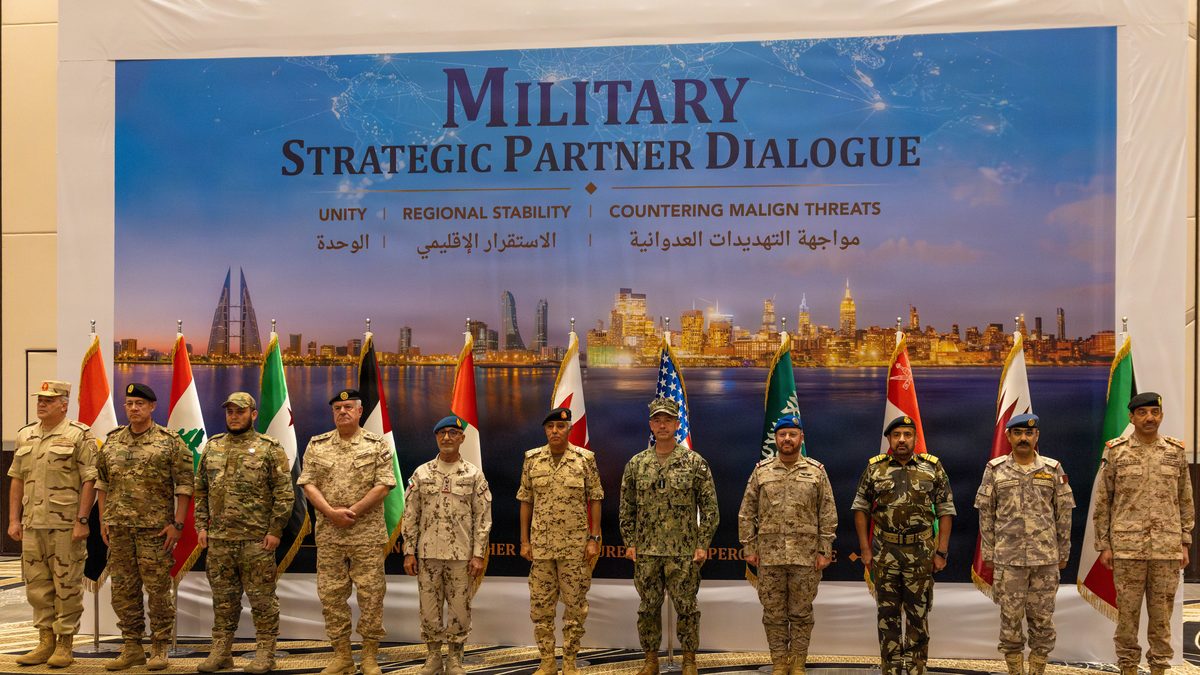
Adm. Brad Cooper, CENTCOM commander, with senior military officials from eleven regional nations including the United Arab Emirates, at a regional security dialogue hosted by the Bahrain Defense Force, 1 July 2026. Photo: Master Sgt. Kulani Lakanaria, U.S. Central Command Public Affairs (DVIDS asset 9786313). U.S. Government work, public domain. Use does not imply endorsement.
CENTCOM and the UAE Launch Task Force Talon Synapse, the First Bilateral Military AI Team
Task Force Talon Synapse is the first bilateral military artificial intelligence unit agreed between U.S. Central Command and the United Arab Emirates. It was announced on 28 July 2026, will base roughly 20 American and Emirati specialists in Abu Dhabi, and stands up within weeks. Its declared work is intelligence support, critical infrastructure protection and monitoring of the regional security environment.
Technical Summary
U.S. Central Command (CENTCOM) announced on 28 July 2026 that it had agreed with the United Arab Emirates (UAE) to establish Task Force Talon Synapse. The command describes it as the first bilateral task force built specifically to accelerate military artificial intelligence (AI) applications. Roughly 20 people will staff it, drawn from both nations and selected for expertise in AI, data and cybersecurity. The team sits in Abu Dhabi, not at the Tampa headquarters.
Three mission lines were published with the announcement: integrating AI applications for intelligence support, protecting critical infrastructure, and monitoring the regional security environment. Formal launch is set for the coming weeks. DefenseScoop reported that a memorandum of understanding is expected inside the same window, which puts the public announcement ahead of the governing document rather than after it. No budget line, manning authority or command relationship has been published.
This will be a historic milestone as we work with one of our most capable regional partners to rapidly deliver evolving AI advancements to our warfighters. Adm. Brad Cooper, Commander, U.S. Central Command, 28 July 2026
Analysis of Effects
Placement matters more than headcount. Twenty people is a cell, not a capability, and the number is small enough that Talon Synapse reads as an integration node rather than a development organisation. Siting it in Abu Dhabi puts American operators inside an Emirati technology base that has spent close to a decade building sovereign AI capacity, including the Mohamed bin Zayed University of Artificial Intelligence, founded in 2019. Value flows both ways. CENTCOM gains working access to Emirati data, compute and infrastructure knowledge across an area of responsibility it cannot cover from Florida. The UAE gains earlier sight of American military AI tooling, and of the assurance practice that travels with it. Sheikh Tahnoun bin Zayed Al Nahyan, who proposed the task force and serves as National Security Adviser and Deputy Ruler of Abu Dhabi, also chairs G42, the state-linked group at the centre of Emirati compute.
Timing sits directly on top of an export-control shift. On 10 July 2026 the United States Bureau of Industry and Security removed the UAE from Country Groups D:3 and D:4 and added it to Country Group A:5, the treatment reserved for close partners. The carve-out is the interesting part. Advanced computing items under Export Control Classification Numbers 3A090 and 4A090 still require a licence unless every end user sits on a new approved list, which covers UAE government agencies including the Ministry of Defence, two named Emirati AI companies, and Emirati subsidiaries of United States hyperscalers. Access was widened and fenced in the same rule. The National reported that the Emirates had taken delivery of a first shipment of Nvidia processors in June. A joint task force is the operational expression of that policy. Hardware access without a body to absorb it produces inventory, not capability.
WOME scope note
Nothing in the CENTCOM announcement touches ordnance, energetic materials, fuzing or explosive safety. Talon Synapse is a data and software body. It reaches Weapons, Ordnance, Munitions and Explosives (WOME) only where AI-derived intelligence products feed target development, and where any resulting weaponeering decision must still satisfy the collateral damage estimation and munition selection rules that govern it. Those rules are unchanged by this agreement.
Personnel and Safety Considerations
Two risks belong on the record at stand-up rather than after a first incident. The first is provenance. An AI product shaping intelligence support inherits the reliability of whatever fed it, and a bilateral cell mixing national data holdings needs a documented confidence chain before any output reaches a targeting cycle. Traceability from source to recommendation is the control. Model accuracy claims are not. The second risk is scope creep. Talon Synapse is described as intelligence support and infrastructure protection, with no declared weapons role. Should its outputs migrate toward weapon employment decisions, the human authority for those decisions and the legal review behind them need restating explicitly and in writing, not inferring from the original charter.
Data Gaps
The following were not published and are recorded as gaps rather than estimated: the memorandum of understanding text and its signature date; the command relationship between the task force and CENTCOM staff directorates; funding source and value on either side; the specific AI systems, models or vendors involved; classification handling and data-sharing rules between the two nations; whether Emirati personnel will hold billets with access to United States national intelligence; and any accreditation route for models used in intelligence support. Regional operational context varies between outlets and is not treated as established here.
Key Questions
What is Task Force Talon Synapse?
It is a bilateral military artificial intelligence unit agreed between U.S. Central Command and the United Arab Emirates, announced on 28 July 2026. About 20 American and Emirati specialists in AI, data and cybersecurity will be based in Abu Dhabi. CENTCOM describes it as the first task force of its kind.
What will the CENTCOM and UAE AI task force actually do?
CENTCOM published three mission lines: integrating AI applications for intelligence support, protecting critical infrastructure, and monitoring the regional security environment. No weapons role was declared. Budget, manning authority and command relationship remain unpublished, so working scope beyond those three lines is not yet on the record.
Why is the task force based in Abu Dhabi rather than in the United States?
The UAE holds the data, compute and infrastructure the cell needs, and has invested in sovereign AI capacity since appointing a dedicated minister and founding the Mohamed bin Zayed University of Artificial Intelligence in 2019. Basing the team in country also places it inside the region it is meant to monitor.
References
Source-evaluated under NATO STANAG 2022 (Reliability A–F / Accuracy 1–6). Tier 1 = government primary source; Tier 2 = quality news / specialist defence media; Tier 3 = authoritative aggregator / encyclopaedia.
- T1U.S. Central Command (@CENTCOM) – CENTCOM to Launch 1st Bilateral AI Task Force with UAE, 28 July 2026. (Reliability A / Accuracy 1)
- T2DefenseScoop – U.S. military forms first bilateral AI task force with United Arab Emirates, 28 July 2026. (Reliability B / Accuracy 2)
- T2Military Times – US Central Command, UAE to launch artificial intelligence task force, 28 July 2026. (Reliability B / Accuracy 2)
- T2The National (Abu Dhabi) – UAE and US to develop AI military applications, 28 July 2026. (Reliability B / Accuracy 2)
- T2The National (Abu Dhabi) – Profile: Sheikh Tahnoun bin Zayed, Deputy Ruler of Abu Dhabi, 30 March 2023. (Reliability B / Accuracy 2)
- T1US Bureau of Industry and Security / Federal Register – Export Controls: United Arab Emirates Country Group Reclassification (A:5) and Advanced-Computing Conditions, 14 July 2026 (effective 10 July 2026). (Reliability A / Accuracy 1)
Corrections & updates welcome. If you hold open-source data that refines or corrects any parameter in this article, please contact [email protected] citing the specific claim and your source. Verified corrections will be incorporated and credited in the revision history. AI-assisted technical assessment based on open-source material. Not a formal intelligence product.