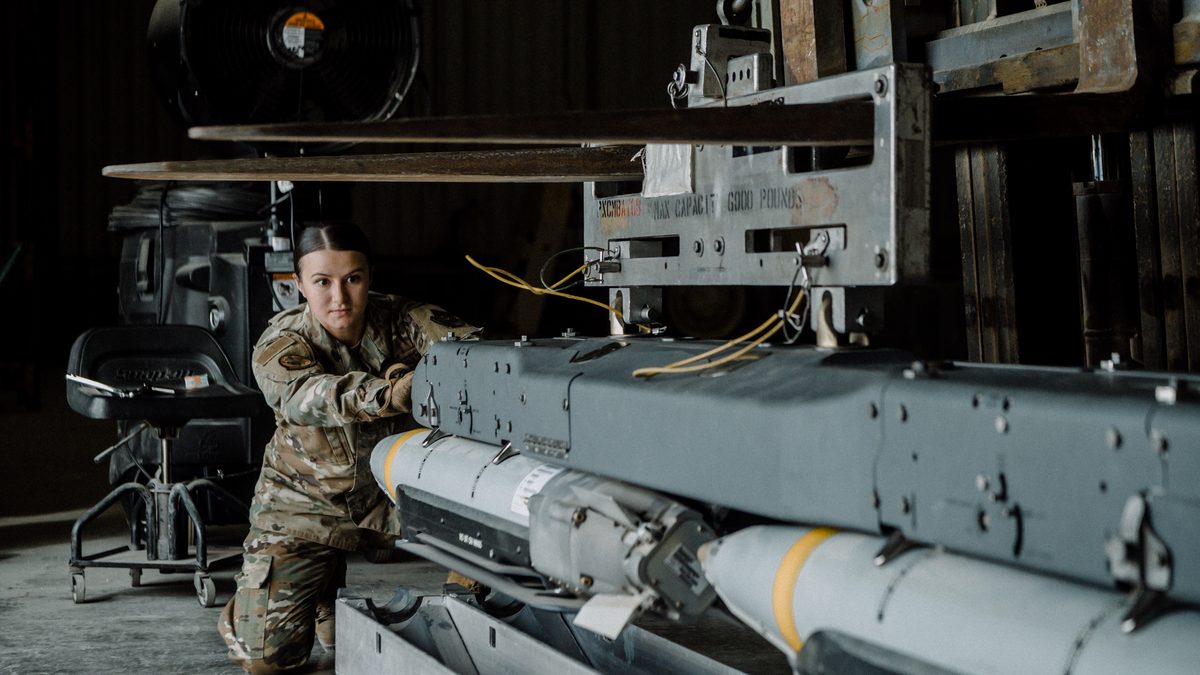
Munitions systems technicians position a bomb rack loaded with GBU-39 small diameter bombs at Al Udeid Air Base. The composite-cased GBU-39A/B Focused Lethality Munition is a fielded example of the low-collateral design class. Photo: Staff Sgt. Jordan Martin / U.S. Air Force, via DVIDS (public domain).
General Dynamics Wins $33.9 Million US Army Contract for Low-Collateral Bomb Cases
On 27 July 2026 the US Army awarded General Dynamics Ordnance and Tactical Systems a $33.9 million indefinite-delivery contract for low-collateral bomb cases: warhead bodies engineered to limit fragmentation and blast beyond the target. The single-response award, managed by Army Contracting Command at Rock Island Arsenal, Illinois, runs to July 2029.
Technical Summary
A bomb case, in ordnance terms, is the warhead body: the metallic or composite shell that houses the explosive fill, accepts the fuze well and suspension lugs, and shapes the fragmentation and blast output on functioning. The award to General Dynamics Ordnance and Tactical Systems (GD-OTS) of Lincoln, Nebraska is a firm-fixed-price contract worth $33,911,620, placed by Army Contracting Command at Rock Island Arsenal, Illinois under contract number W519TC-26-D-A026. Work locations and funding are set with each delivery order, and the ordering period runs to an estimated completion of 26 July 2029.
The procuring line item is described only as low-collateral bomb cases. In Weapons, Ordnance, Munitions and Explosives (WOME) usage, a low-collateral-damage (LCD) case is a warhead body designed to confine lethal effect to the aim point and to sharply reduce the hazard footprint from high-velocity fragments and residual unexploded ordnance. The solicitation drew a single bid and a single award, indicating a narrow qualified supplier base for this class of hardware. The Department of War announcement does not identify the parent munition, the case material, or the explosive fill, each of which is recorded below as a data gap.
The award commits $33,911,620 to a class of warhead body whose defining requirement is not maximum lethality but the deliberate containment of fragmentation and blast beyond the intended target. ISC Defence Intelligence assessment, 28 July 2026
Analysis of Effects
Two case-design routes dominate the open-source low-collateral literature. The first replaces the traditional forged or cast steel body with a wound carbon-fibre composite shell that fractures into low-mass, low-velocity debris rather than throwing lethal steel fragments. The United States has fielded this approach in the GBU-39A/B Focused Lethality Munition, which pairs a composite case with a Dense Inert Metal Explosive (DIME) fill. A documented 500-lb-class example of the same composite approach is the BLU-129/B Very Low Collateral Damage Weapon, a carbon-fibre-cased body of MK-82 external form filled with a Multiphase Blast Explosive (MBX), whose case is engineered to break up into low-mass debris rather than throw high-velocity steel fragments. The second route retains a metallic body but engineers controlled or frangible fragmentation, so that fragment size, mass and throw distance are bounded by design rather than left to the physics of a monolithic steel case.
Both routes trade a measure of standoff lethality for a smaller and more predictable collateral envelope, which matters most in dense urban engagements and in strikes where friendly forces or non-combatants sit close to the aim point. A case that disintegrates rather than fragments also leaves less large-fragment debris and lowers the residual unexploded-ordnance and dud-hazard burden that follows conventional strikes. Without the munition designation or fill type in the public notice, ISC cannot state which route this contract supports, but the low-collateral requirement places it squarely in this reduced-effect design space.
Personnel and Safety Considerations
As a procurement line item the deliverable is the empty case, not a filled munition, so as manufactured and shipped it is inert hardware carrying no Net Explosive Quantity (NEQ) and no assigned Hazard Division (HD) or Compatibility Group (CG). Those classifications attach only once the case is loaded with an energetic fill at a load, assemble and pack facility, at which point the finished round takes the Hazard Division of its fill: for example HD 1.1 for a standard high-explosive general-purpose bomb, or a lower division for an insensitive-munition fill qualified under STANAG 4439. Storage, transport and disposal handling for the loaded item follow DSA 03.OME and the relevant NATO safety standards. For explosive ordnance disposal (EOD) planning, a composite-cased low-collateral weapon behaves differently on functioning from a steel-cased bomb, and render-safe and post-strike clearance assumptions built around steel fragmentation should not be transferred to it unverified.
Data Gaps
Several parameters central to a full technical assessment are absent from the public announcement. The parent munition is not identified, so the calibre and the general-purpose or penetrator class of the weapon the cases feed is unknown. On the open-source record, fielded 500-lb-class composite low-collateral bodies such as the BLU-129/B represent the leading candidate class for hardware of this description, but the announcement names no designation and the formal gap stands. The case material is not stated, leaving open whether this is a carbon-fibre composite or an engineered frangible-steel body. The explosive fill, and therefore the eventual NEQ, HD and CG of the loaded round, is not disclosed. Order quantities, unit price and the split between production and qualification work are undefined, consistent with the indefinite-delivery structure. Finally, the announcement does not confirm whether the cases support an existing programme of record or a new low-collateral variant. Each gap is expected to narrow as delivery orders are placed against the contract.
Key Questions
What are low-collateral bomb cases?
A low-collateral bomb case is a warhead body designed to confine a weapon's lethal effect to its aim point. It reduces the size, mass and throw of fragments, and in composite designs the case disintegrates rather than fragmenting, cutting the collateral and residual unexploded-ordnance hazard around the target.
How much is the General Dynamics contract worth and who awarded it?
General Dynamics Ordnance and Tactical Systems received a firm-fixed-price contract worth $33,911,620, announced by the US Department of War on 27 July 2026. Army Contracting Command at Rock Island Arsenal, Illinois placed the award, which runs to an estimated completion date of 26 July 2029.
Does an empty bomb case carry an explosive hazard classification?
No. As delivered, an empty bomb case is inert hardware with no Net Explosive Quantity and no Hazard Division or Compatibility Group. Those classifications apply only after the case is filled with an energetic charge, when the finished round takes the Hazard Division of its explosive fill.
References
Source-evaluated under NATO STANAG 2022 (Reliability A–F / Accuracy 1–6). Tier 1 = government primary source; Tier 2 = quality news / specialist defence media; Tier 3 = authoritative aggregator / encyclopaedia.
- T1US Department of War – Contracts for July 27, 2026, 27 July 2026. (Reliability A / Accuracy 1)
- T2The Defense Post – Inside the GBU-39 Small Diameter Bomb, 3 December 2025. (Reliability B / Accuracy 2)
- T2L3Harris Technologies – Composite Bomb Bodies, accessed 28 July 2026. (Reliability B / Accuracy 2)
- T2General Dynamics Ordnance and Tactical Systems – Warheads and Payloads, accessed 28 July 2026. (Reliability B / Accuracy 2)
- T3Wikipedia – GBU-39 Small Diameter Bomb, accessed 28 July 2026. (Reliability C / Accuracy 3)
Corrections & updates welcome. If you hold open-source data that refines or corrects any parameter in this article, please contact [email protected] citing the specific claim and your source. Verified corrections will be incorporated and credited in the revision history. AI-assisted technical assessment based on open-source material. Not a formal intelligence product.