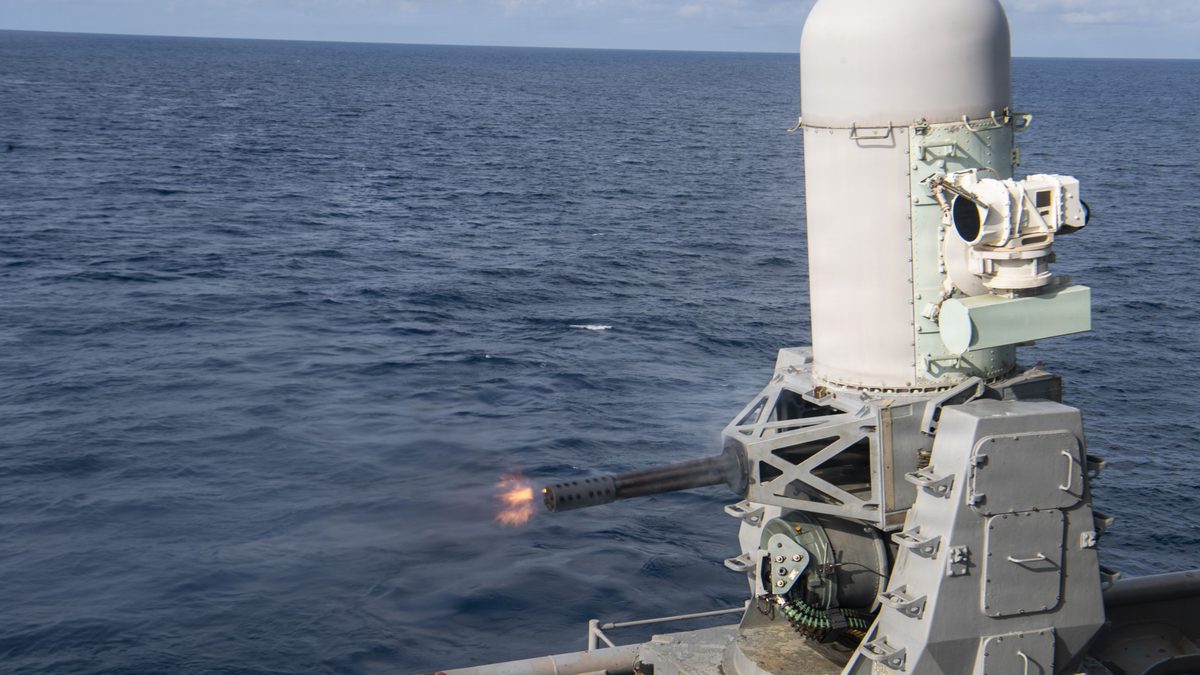
USS Boxer Conducts CIWS Live Fire Exercise. U.S. Navy photo by Seaman Martin Perez via DVIDS (U.S. Department of Defense imagery, public domain). Illustrative; ISC did not commission this image.
US Navy Places US$49.7m Sole-Source Order to Sustain the 20mm Phalanx Close-In Weapon System
On 21 July 2026 the United States Navy awarded Raytheon a not-to-exceed, firm-fixed-price delivery order worth US$49,720,000 to repair 29 part numbers for the Phalanx Close-In Weapon System (CIWS), the 20 mm M61A1 Vulcan last-ditch defence against anti-ship missiles. The sole-source order runs to August 2032, with US$24.36 million obligated at award.
Technical Summary
The Phalanx Close-In Weapon System (CIWS), designated Mk 15, is a self-contained, radar-directed gun system built around the 20 mm M61A1 Vulcan, a six-barrel Gatling gun firing at up to about 4,500 rounds per minute. It is the United States Navy's terminal, last-ditch defence against anti-ship cruise missiles (ASCM) and, in later blocks, against aircraft, small craft and unmanned aerial systems (UAS). The gun fires the 20x102 mm cartridge; the Mk 149 Armour-Piercing Discarding Sabot (APDS) round drives a sub-calibre penetrator, originally depleted uranium and later tungsten, with the Mk 244 Enhanced Lethality Cartridge introduced for the Block 1B configuration.
On 21 July 2026 the United States Department of War listed a not-to-exceed, firm-fixed-price delivery order (N00104-26-F-CL0K) to Raytheon Company, Tucson, Arizona, valued at US$49,720,000, for the repair of 29 part numbers in varying quantities for the Close-In Weapon System. The order was placed under a previously awarded basic ordering agreement (N000104-24-G-CL01) and carries no option period. Work will be performed in Louisville, Kentucky, with completion expected by August 2032. Fiscal 2026 Navy working capital funds of US$24,362,800 were obligated at award as an undefinitised contract action. The requirement was solicited sole-source under 10 U.S. Code 3204(a)(1), with one offer received. Naval Supply Systems Command Weapon Systems Support, Philadelphia, is the contracting activity.
A US$49.72 million sole-source order to repair 29 part numbers keeps the 20 mm Phalanx supported to 2032, funding standing depot capacity for the fleet's hard-kill floor rather than a one-off surge. ISC assessment of the US Department of War contract listing, 21 July 2026
The fleet-standard Block 1B configuration pairs the Ku-band search-and-track radar with a forward-looking infrared sensor and an automatic video tracker, feeds a 1,550-round magazine, and fires closed-loop correcting bursts to an effective range of about 1.5 km against subsonic anti-ship cruise missiles (NavWeaps).
Analysis of Effects
This is a sustainment award, not a new-build or ammunition buy, and its significance is industrial rather than tactical. Repairing 29 discrete part numbers keeps the depot pipeline for Phalanx components alive, which matters because CIWS remains the hard-kill floor of the fleet's layered air defence beneath SM-2, Evolved Sea Sparrow Missile (ESSM) and RAM. The undefinitised contract action structure, where work starts before final price and terms are settled, signals the Navy wants parts flowing quickly rather than waiting on a fully negotiated agreement.
The sole-source justification under 10 U.S. Code 3204(a)(1) reflects the reality that Raytheon is the original equipment manufacturer for Phalanx and holds the technical data and repair authority for these assemblies. That assures quality but concentrates the sustainment base in a single vendor, a recurring theme across mature naval gun and missile systems. The eight-year completion horizon to 2032 indicates a standing repair capacity being funded, not a one-off surge, consistent with CIWS being retained and upgraded rather than retired as the counter-UAS mission grows.
The repair order also fits a deliberate retain-and-upgrade posture rather than divestment. It follows a September 2025 production, upgrade, conversion and overhaul contract worth about US$205 million, with work running to roughly 2029 (Naval Today, 9 September 2025), evidence of sustained depot-pipeline funding as the counter-uncrewed-aircraft mission expands.
Personnel and Safety Considerations
The order covers gun-system component repair, not the procurement of live ammunition, so no Net Explosive Quantity attaches to this action. For context, 20x102 mm natures are Class 1 explosives; high-explosive incendiary and target-practice variants fall under Hazard Division (HD) 1.2 or HD 1.3 by configuration, while the Mk 149 APDS is a kinetic penetrator round. Depot repair of Vulcan components involves stored mechanical energy in drive and recoil assemblies and residual propellant fouling, and is governed by the facility's own occupational safety regime rather than by ammunition storage rules. Any DU-penetrator stock still in inventory carries specific radiological handling controls.
Data Gaps
The contract listing does not identify which 29 part numbers are covered, whether they are gun-barrel, drive, search-and-track radar or fire-control assemblies, or which Phalanx block (1B or SeaRAM-adjacent) they support. It does not state unit quantities, the split between US Navy and Foreign Military Sales end users, or whether any Mk 244 or Mk 149 ammunition sustainment is bundled elsewhere. The undefinitised value ceiling of US$49.72 million may not equal the final definitised price.
Key Questions
What did the US Navy award Raytheon for Phalanx CIWS?
On 21 July 2026 the Navy awarded Raytheon a not-to-exceed, firm-fixed-price delivery order worth US$49.72 million to repair 29 part numbers for the Phalanx Close-In Weapon System. Work runs in Louisville, Kentucky, to August 2032, with US$24.36 million obligated at award.
What is the Phalanx CIWS and what ammunition does it fire?
The Phalanx Close-In Weapon System (Mk 15) is a radar-directed 20 mm M61A1 Vulcan Gatling gun firing up to about 4,500 rounds per minute. It is a terminal defence against anti-ship missiles, aircraft, small craft and drones, firing 20x102 mm rounds including the Mk 149 armour-piercing discarding sabot.
Why was the Phalanx repair order awarded sole-source?
The order was solicited sole-source under 10 U.S. Code 3204(a)(1) because Raytheon is the original equipment manufacturer for Phalanx and holds the technical data and repair authority for the assemblies. One offer was received. This assures quality but concentrates sustainment in a single vendor.
References
Source-evaluated under NATO STANAG 2022 (Reliability A–F / Accuracy 1–6). Tier 1 = government primary source; Tier 2 = quality news / specialist defence media; Tier 3 = authoritative aggregator / encyclopaedia.
- T1US Department of War – Contracts for July 21, 2026, 21 July 2026. (Reliability A / Accuracy 1)
- T2NavWeaps – USA 20 mm Phalanx Close-in Weapon System (CIWS), accessed 27 July 2026. (Reliability B / Accuracy 2)
- T2GlobalSecurity.org – MK 15 Phalanx Close-In Weapons System (CIWS) specifications, accessed 27 July 2026. (Reliability B / Accuracy 2)
- T2Wikipedia – Phalanx CIWS, accessed 27 July 2026. (Reliability B / Accuracy 2)
- T3Wikipedia – M61 Vulcan, accessed 27 July 2026. (Reliability C / Accuracy 3)
Corrections & updates welcome. If you hold open-source data that refines or corrects any parameter in this article, please contact [email protected] citing the specific claim and your source. Verified corrections will be incorporated and credited in the revision history. AI-assisted technical assessment based on open-source material. Not a formal intelligence product.