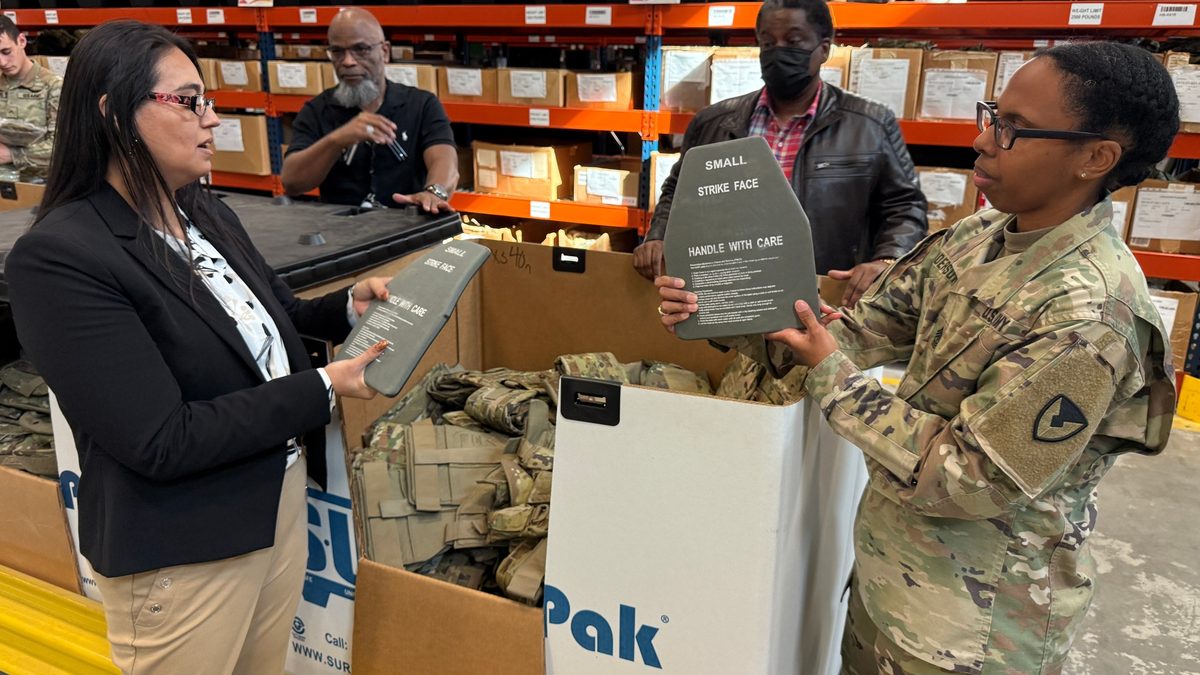
Pictured: a lightweight Enhanced Small Arms Plate (ESAPI Gen III) for the Modular Scalable Tactical Vest at the Fort Liberty Clothing Issue Facility. Photo by Nutan Chada, Defense Logistics Agency Public Affairs (VIRIN 250129-D-LU733-2625), 29 January 2025. U.S. Department of Defense imagery, public domain; its use does not imply DoD endorsement.
US Army Awards Hardwire $35M for Small Arms Protective Inserts as Soldier-Armour Demand Holds
The US Army Contracting Command at Aberdeen Proving Ground has awarded Hardwire LLC a five-year, firm-fixed-price contract worth up to $35 million for small arms protective inserts, the ceramic and polyethylene hard-armour plates that defeat rifle-calibre threats. Announced on 23 July 2026, the order signals steady demand for lighter torso protection across the force.
Technical Summary
The award covers small arms protective inserts (SAPI), the rigid armour plates a soldier slides into the front, back and side pockets of a plate carrier or the Improved Outer Tactical Vest (IOTV). In the United States Army inventory the insert is the hard-armour element of the Soldier Protection System (SPS) Vital Torso Protection (VTP) sub-system, worn over a soft aramid vest that stops fragmentation and pistol-calibre rounds. The contract, reference W91CRB-26-D-A017, is a firm-fixed-price, indefinite-delivery indefinite-quantity (IDIQ) vehicle: work locations and funding are set against each delivery order rather than committed up front, which lets the Army flex quantities across the five-year period running to July 2031.
A modern hard plate is a two-part system. The strike face is a technical ceramic, typically boron carbide (B4C) or silicon carbide (SiC), chosen for extreme hardness at low mass. Behind it sits a composite backing of ultra-high-molecular-weight polyethylene (UHMWPE). On impact the ceramic fractures and erodes the incoming projectile, blunting and slowing it, while the polyethylene laminate catches the resulting fragments and arrests the residual energy over a controlled depth. The engineering goal is to hold a given protection level at the lowest possible areal density, because every gramme saved on a plate is weight a dismounted soldier does not carry into close combat. Modern light plates aim for areal densities around or below four pounds per square foot while holding multi-hit capability, typically three strikes under military test protocols.
Newer inserts field roughly 30 percent lighter than legacy plates for the same protection class, cutting the load a soldier carries into close combat. ISC WOME technical assessment, open sources
Analysis of Effects
The relevant metric here is not net explosive quantity, which does not apply to an inert protective insert, but ballistic protection level against small-arms threats. A standard SAPI is specified to defeat rifle rounds up to and including 7.62x51mm NATO M80 ball. The Enhanced SAPI (ESAPI) and X-Threat variants raise that bar to armour-piercing natures up to 7.62x63mm (.30-06) M2 armour-piercing (AP). The Department of War contract notice records only the phrase small arms protective inserts and does not state which threat class this order buys, so the protection level is a data gap. What the notice does confirm is a competitive award with two offers received, indicating a live domestic supplier base rather than a sole-source position.
The industrial-base signal is the substance of the story. Body armour is the protective counterpart to the 5.56x45mm and 7.62x51mm ammunition natures that dominate current small-arms procurement, and sustained plate buying tracks the same rearmament curve. Hardwire LLC, based in Pocomoke City, Maryland, is an established armour manufacturer that has supplied ceramic plates to the US Marine Corps and the Federal Bureau of Investigation and is associated with the Army lightweight-insert effort. Within Vital Torso Protection the lighter general-purpose plate, the Lares Small Arms Protective Insert (LSAPI), is graded as the Class I plate and is reported to run roughly 30 percent lighter than the earlier Enhanced SAPI Generation III, while the armour-piercing plate sits at Class II. A separate, larger multiple-award VTP LSAPI programme, reported at roughly $416 million and shared with a second supplier, is already in production and runs in parallel to this new $35 million vehicle. US body-armour buys also fall under Berry Amendment domestic-content rules, so keeping a qualified US small-business production base warm carries a sovereign-supply weight beyond the headline figure. A $35 million ceiling on an order-driven vehicle is modest against a full programme of record, but it keeps a second source warm and production lines active.
Personnel and Safety Considerations
For weapons, ordnance, munitions and explosives (WOME) staff the classification point is straightforward: a small arms protective insert contains no energetic fill, so it carries no hazard division or compatibility group and falls outside explosives storage and transport licensing. It is handled and held as general stores. The safety questions that matter for inserts are different in kind: correct sizing and coverage, in-date certification, and above all condition. Ceramic plates are damage-sensitive. A plate that has been dropped, cracked or subjected to multiple strikes can lose protective capability with no visible sign, which is why fielded inserts are subject to periodic visual inspection, serialised tracking, non-destructive evaluation such as ultrasound or radiography where available, and firm shelf-life and event-based retirement rules. Any judgement of protective adequacy depends on the specification the plate was built to, which this notice does not disclose.
Data Gaps
The following remain unconfirmed in open sources: the threat protection class (standard SAPI versus ESAPI or X-Threat) bought under this order; the plate cut and size mix and the governing performance specification; the ceramic type and areal density; whether the vehicle sits under the Soldier Protection System Vital Torso Protection programme of record or a separate procurement line; and the delivery quantities and schedule, which are set order by order under the IDIQ structure. The separate, larger multiple-award Vital Torso Protection programme for the lighter Lares insert, reported at roughly $416 million and shared with a second supplier, is a distinct award and is not conflated with this $35 million vehicle.
Key Questions
What did the US Army buy from Hardwire?
The US Army awarded Hardwire LLC a firm-fixed-price contract worth up to $35 million for small arms protective inserts, the hard-armour plates worn in a soldier's vest to stop rifle-calibre rounds. The five-year vehicle was announced on 23 July 2026 and runs to July 2031.
What is a small arms protective insert made of?
A small arms protective insert pairs a hard ceramic strike face, usually boron carbide or silicon carbide, with an ultra-high-molecular-weight polyethylene backing. The ceramic breaks up the incoming projectile and the polyethylene layer captures the fragments and absorbs the remaining energy.
What rifle threats do these plates stop?
A standard small arms protective insert defeats rounds up to 7.62x51mm NATO ball, while the enhanced variant stops armour-piercing threats up to 7.62x63mm M2 AP. The specific protection level of this Hardwire order was not stated in the contract notice.
References
Source-evaluated under NATO STANAG 2022 (Reliability A–F / Accuracy 1–6). Tier 1 = government primary source; Tier 2 = quality news / specialist defence media; Tier 3 = authoritative aggregator / encyclopaedia.
- T1U.S. Department of War – Contracts for July 23, 2026 (Army: Hardwire LLC, small arms protective inserts), 23 July 2026. (Reliability A / Accuracy 1)
- T2Hardwire LLC (company newsroom) – Hardwire LLC Newsroom: ceramic body armor plate programmes, accessed 27 July 2026. (Reliability B / Accuracy 2)
- T2Body Armor News – Hardwire Awarded Contract to Supply Lightweight Body Armor for U.S. Army, 2026. (Reliability B / Accuracy 2)
- T2WMDT 47ABC – Pocomoke's Hardwire LLC providing state-of-the-art armor to USMC, FBI, November 2024. (Reliability B / Accuracy 2)
- T3Wikipedia (encyclopaedia, background) – Small Arms Protective Insert, accessed 27 July 2026. (Reliability C / Accuracy 3)
Corrections & updates welcome. If you hold open-source data that refines or corrects any parameter in this article, please contact [email protected] citing the specific claim and your source. Verified corrections will be incorporated and credited in the revision history. AI-assisted technical assessment based on open-source material. Not a formal intelligence product.