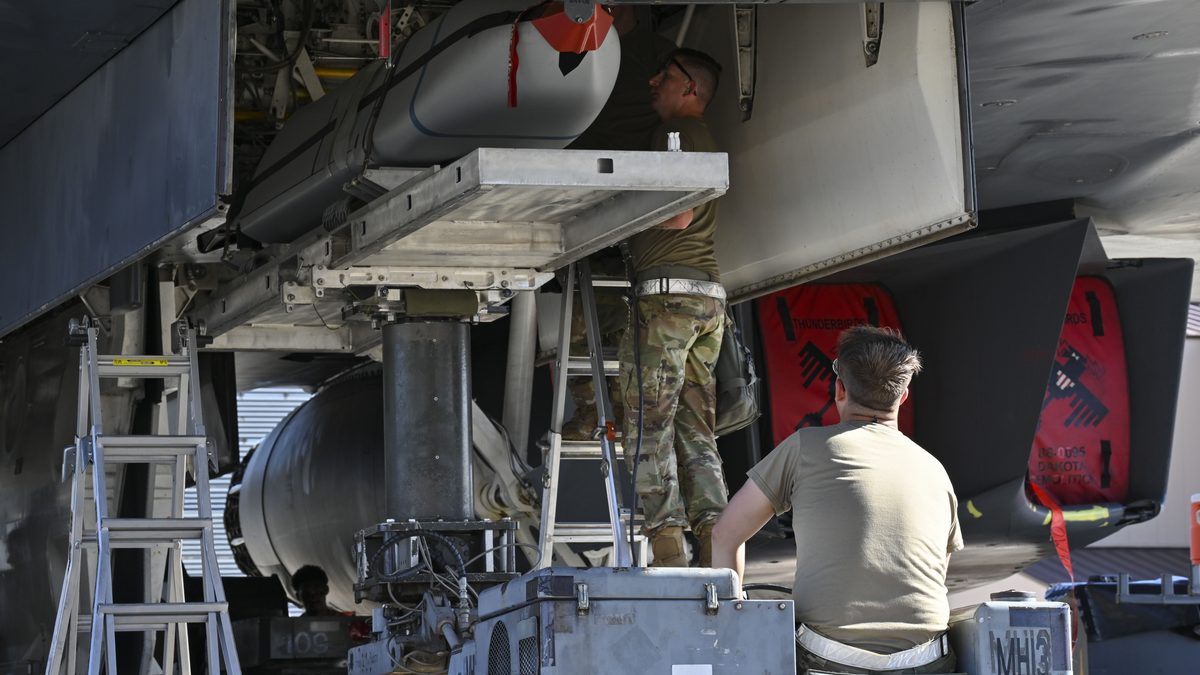
Ellsworth weapons load teams prepare a B-1B Lancer during a Raider Reach exercise. U.S. Air Force photo by Airman 1st Class Brittany Kenney via DVIDS (U.S. Department of Defense imagery, public domain). Illustrative; ISC did not commission this image.
Exercise Trident Fury and the Munitions-Generation Chain Behind Allied JASSM Standoff Strike
Exercise Death Strike: Trident Fury, reported by the U.S. 7th Bomb Wing on 22 July 2026 and run at Dyess Air Force Base, tested whether U.S., Marine Corps and Royal Australian Air Force crews could turn stored Joint Air-to-Surface Standoff Missiles (JASSMs) and conventional bombs into combat-ready loads under changing tasking. It validated the weapons-build chain, not the missile in isolation.
Technical Summary
On 22 July 2026 the U.S. 7th Bomb Wing, part of Air Force Global Strike Command, reported that American and allied personnel had completed Exercise Death Strike: Trident Fury at Dyess Air Force Base, Texas. Hosted by the 7th Munitions Squadron as a Capabilities Exercise, the event brought together the U.S. Air Force, the U.S. Marine Corps (USMC) and the Royal Australian Air Force (RAAF) for continuous munitions generation under simulated operational pressure. The training began with an air tasking order that required crews to assess available stocks, select munition lots and move components to designated production areas, then run 24-hour operations building weapons and delivering them to the flightline for inspection.
The signature activity was a set of Multi-Role Pylon Loads inside the weapons armament area. Using a launcher load frame, technicians ran a rapid, magazine-style build and secured heavy conventional bombs and Joint Air-to-Surface Standoff Missiles (JASSMs, the AGM-158 family) directly onto launcher racks. This backshop work matters because it moves time-consuming preparation away from the aircraft parking area, letting missile configuration and aircraft servicing proceed in parallel. Daily fragmentary-order changes forced the multinational teams to revise priorities while sustaining output, replacing scripted drills with decision-making under load. The official account did not disclose production times, missile quantities, or whether the weapons handled were live, inert or training assets.
Allied long-range strike power begins on the production pad. A B-1B can carry up to twenty-four AGM-158 missiles, but that magazine only exists once trained crews have selected lots, built up the rounds, inspected them and mated them to launcher assemblies under changing orders. ISC operational assessment, 26 July 2026
The exercise itself was executed from 22 to 25 June 2026 at Dyess Air Force Base, Texas. The official 7th Bomb Wing account and allied coverage followed in the week of 21 July 2026, which is the reporting window this analysis draws on; the event itself took place in June.
Analysis of Effects
From a Weapons, Ordnance, Munitions and Explosives (WOME) standpoint the exercise is a study in the weapons-generation chain rather than in any single effect on target. The measured variables are throughput and adaptability: how quickly a munitions squadron can convert stored assets into certified, flightline-ready loads while an air tasking order keeps changing. The AGM-158 is a low-observable, GPS/INS-guided standoff missile in the roughly 1,000 pound warhead class fitted with a penetrating blast-fragmentation warhead; the baseline AGM-158A is generally cited at around 370 kilometres range and the extended-range AGM-158B (JASSM-ER) beyond 900 kilometres. None of that reach is usable until the round is inspected, configured and mated to a launcher, which is precisely the step Trident Fury stressed.
The platform context is the B-1B Lancer, whose published conventional payload reaches about 34,000 kilograms (75,000 pounds) with an advertised capacity of up to 24 AGM-158A missiles, giving even a small bomber formation the potential for a substantial precision-standoff salvo. Realising that salvo is a munitions-logistics problem: lot selection from the munitions storage area, build-up and fuzing where applicable, transport, inspection and pylon mating, each under explosive-safety control. RAAF armament specialists from No. 6 Squadron and No. 77 Squadron took the lead on a short-notice conventional bomb build on the final day, which is the interoperability point that matters. It shows allied munitions technicians working to compatible procedures inside the same weapons-generation system, not merely sharing a ramp.
The austere-conditions phase maps directly onto Agile Combat Employment. The exercise set out to prove that multinational teams can still generate flightline-ready loads under reduced tooling, infrastructure and base support. Royal Australian Air Force armament specialists from No. 6 and No. 77 Squadrons took part and led a short-notice conventional bomb build on the final day.
The wider limiting factor is the industrial base. US JASSM production has been subject to multi-year procurement ramps and post-tempo replenishment orders, so allied technicians trained to common munitions-generation procedures matter to both demand and supply.
Personnel and Safety Considerations
A 24-hour surge build-up compresses exactly the activities that explosive-safety regimes exist to govern. Continuous lot movement, assembly and pylon loading in and around a munitions storage area concentrate net explosive quantity (NEQ) at build pads and transiting routes, so quantity-distance (QD) separation, compatibility-group segregation, electrostatic-discharge control and lightning-warning states all bear directly on how fast the chain can safely run. For guided standoff weapons the dominant handling hazards are mechanical damage to the airframe and seeker, and correct configuration of the electrical and safe-and-arm interfaces, rather than bulk energetic sensitivity. The training value lies in proving that these controls can be maintained while tempo rises, because it is under surge that shortcuts and configuration errors are most likely.
Data Gaps
Several figures needed for a full WOME reading were not released and are recorded as data gaps: whether the JASSMs and bombs handled were live, inert or training rounds; the production times achieved and any comparison with standard loading; the number of missiles built up; the specific AGM-158 variant handled; whether a B-1B actually flew or loaded a round during the exercise; and the stockpile depth and industrial replenishment rate that would determine how long such a tempo could be sustained. The exercise ran as a training event, so absolute throughput figures are understandably withheld; their absence limits any assessment of true surge capacity.
Key Questions
What was Exercise Trident Fury actually testing?
It tested munitions generation: whether U.S., Marine Corps and Royal Australian Air Force crews at Dyess Air Force Base could assess stocks, select lots, build up JASSMs and conventional bombs and deliver them flightline-ready during 24-hour operations while the tasking order kept changing. The focus was the weapons-build chain, not a strike on a target.
Why does the munitions-generation chain matter as much as the missile?
A standoff missile only contributes to a salvo once it has been inspected, configured and mated to a launcher. A B-1B can carry up to 24 AGM-158s, but that capacity depends on trained crews building up rounds under pressure. The exercise stressed that build-up chain, which sets the real strike tempo in a contested campaign.
What is the significance of Australian participation?
Royal Australian Air Force armament specialists from No. 6 and No. 77 Squadrons worked inside the U.S. munitions-generation system and led a short-notice bomb build on the final day. That demonstrates allied munitions technicians operating to compatible procedures, which supports sustained combined long-range strike in the Indo-Pacific rather than one-off cooperation.
References
Source-evaluated under NATO STANAG 2022 (Reliability A–F / Accuracy 1–6). Tier 1 = government primary source; Tier 2 = quality news / specialist defence media; Tier 3 = authoritative aggregator / encyclopaedia.
- T1U.S. Air Force, 7th Bomb Wing (Air Force Global Strike Command) / U.S. Strategic Command – Exercise Death Strike: Trident Fury, munitions-generation Capabilities Exercise (official account), 22 July 2026. (Reliability A / Accuracy 1)
- T2Army Recognition – Australia and U.S. Strengthen Indo-Pacific Long-Range Strike Readiness in Major Munitions Exercise, 23 July 2026. (Reliability B / Accuracy 2)
- T2Lockheed Martin – AGM-158 Joint Air-to-Surface Standoff Missile (JASSM) product overview, 2026. (Reliability B / Accuracy 2)
- T2U.S. Air Force – B-1B Lancer fact sheet, accessed 26 July 2026. (Reliability B / Accuracy 2)
- T3Wikipedia – AGM-158 JASSM, accessed 26 July 2026. (Reliability C / Accuracy 3)
Corrections & updates welcome. If you hold open-source data that refines or corrects any parameter in this article, please contact [email protected] citing the specific claim and your source. Verified corrections will be incorporated and credited in the revision history. AI-assisted technical assessment based on open-source material. Not a formal intelligence product.