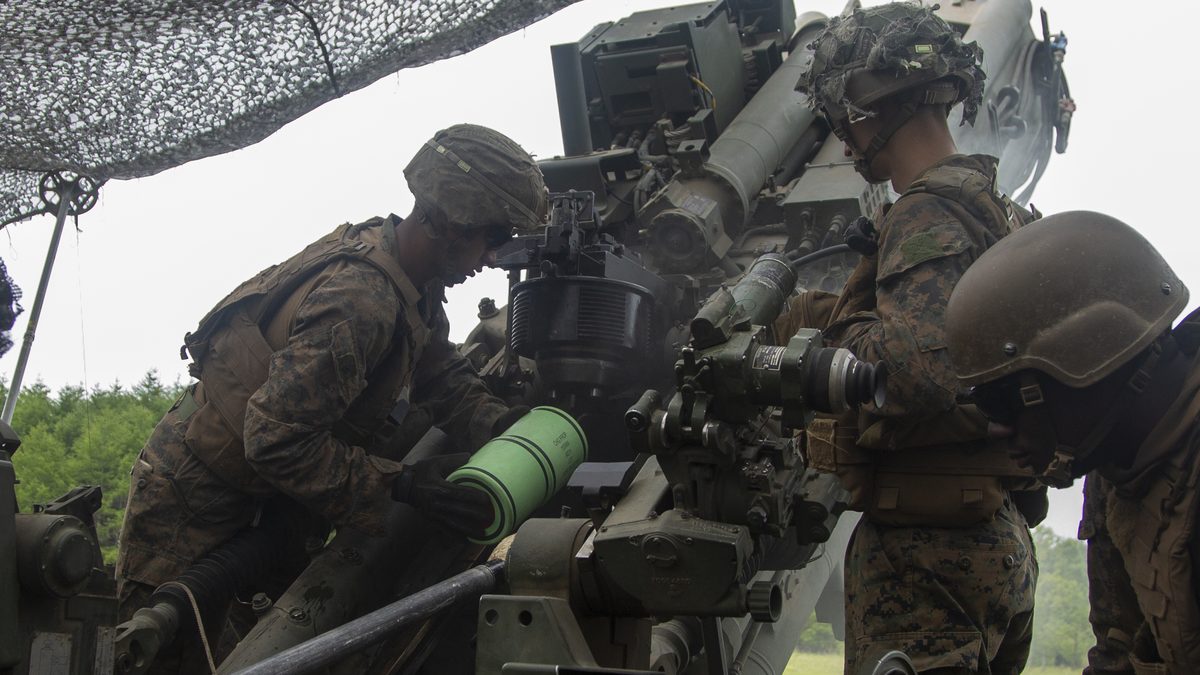
Illustrative: a 155 mm round is loaded into an M777 howitzer, the calibre Aschau propellant serves. Photo: Lance Cpl. Jeffrey Pruett, US Marine Corps (DVIDS, public domain). Not the Aschau plant; no endorsement implied.
Project Firepower: Rheinmetall Breaks Ground on Europe's Largest Powder Plant
Project Firepower is Rheinmetall's drive to lift its propellant powder output to around 20,000 tonnes a year by 2030. Its flagship is Aschau am Inn, where the company laid a foundation stone on 22 July 2026 to raise powder capacity from about 1,700 to as much as 4,200 tonnes a year, over a fifth of the group target.
Technical Summary
Rheinmetall has begun construction of a major propellant powder plant at the Aschau am Inn site of its subsidiary Nitrochemie Aschau GmbH, the flagship of the group's Project Firepower capacity programme. Nitrochemie, a joint venture between Rheinmetall Group and RUAG MRO Holding AG, manufactures gun propellant, the smokeless powder that fires projectiles from barrel artillery and other large-calibre weapons. The Aschau expansion is aimed at propellant for 155 millimetre (mm) barrel artillery and comparable large-calibre natures, the ammunition category NATO land forces consume fastest in a sustained artillery fight.
The company reports current propellant powder capacity of about 1,700 tonnes a year rising to as much as 4,200 tonnes, with annual output of propellant charge modules climbing from roughly 300,000 to around 1 million units. The site footprint grows from 90 to about 110 hectares and the workforce from over 800 to more than 1,400, a rise of up to 600 new roles. Investment in the Aschau expansion is reported variously at around 350 million euro in regional coverage and about 500 million euro by the Bavarian Minister-President and financial wires, while the company's own release refers only to a figure in the several hundred million euro range. New production is expected to begin in 2027 and reach full capacity by 2028.
What is Project Firepower?
Project Firepower is Rheinmetall's company-wide programme to expand propellant powder and ammunition capacity across several of its sites, framed as a response to European and NATO rearmament demand and the artillery consumption seen in Ukraine. The company's stated goal is to raise its total propellant powder output to around 20,000 tonnes a year by 2030. Aschau am Inn is the programme's flagship: at up to 4,200 tonnes a year it accounts for more than a fifth of that headline target on its own.
The programme reaches beyond powder chemistry. Rheinmetall has signalled further capacity across its ammunition footprint and, according to trade reporting, a separate competency centre near Munich of around 500 staff focused on electronics, digitalisation and artificial intelligence. For Aschau specifically, new lines are expected to start producing in 2027 and reach full output by 2028. The 20,000 tonne figure is the number to track, because it is the benchmark against which each individual site announcement, Aschau included, should be read.
Propellant powder output at Aschau is set to rise from around 1,700 tonnes a year to as much as 4,200 tonnes, more than a fifth of Rheinmetall's Project Firepower target of roughly 20,000 tonnes a year by 2030. Rheinmetall Project Firepower figures, July 2026
Analysis of Effects
The significance of Aschau lies less in shell bodies than in chemistry. Across NATO, the binding constraint on 155 mm shell output has rarely been forging or machining the steel projectile. It has been the propellant, and the nitrocellulose (NC) upstream of it. Nitrocellulose production, which nitrates purified cellulose with mixed acid, is a hazardous, capital-intensive and slow-to-scale unit operation, and it sits at the head of the propellant supply chain. By expanding powder and charge-module capacity rather than final assembly, Rheinmetall is investing in the part of the chain that actually gates artillery ammunition throughput.
Modern 155 mm charge systems are modular. A gunner builds a firing charge from standardised increments, typically a bi-modular family of top and bottom charges, to select the range zone without loose bagged powder. Higher module output therefore translates fairly directly into more complete firing charges for L52-class howitzers such as the Panzerhaubitze 2000 and the wheeled RCH155. Propellant formulation, whether single-base, double-base or triple-base with nitroguanidine added to lower flame temperature and barrel wear, sets muzzle velocity, achievable range and flash signature. Aschau feeds the propellant end of that equation for German and allied gun lines, and its scale is what turns a political commitment to sustained artillery support into deliverable rounds.
Personnel and Safety Considerations
Scaling propellant manufacture is a major-accident hazard undertaking rather than a routine factory build. Nitration, solvent recovery, drying and the storage of finished charges each carry explosion or mass-fire risk, and a plant of this size sits within the upper tier of the European major-accident (Seveso) controls and under German explosives law, the Sprengstoffgesetz. Finished gun propellant charges are commonly assigned to United Nations Hazard Division 1.3, Compatibility Group C, written in the notation HD 1.3 C, a mass-fire rather than mass-detonation hazard, while dry nitrocellulose and certain energetic intermediates carry higher divisions and are handled wetted or phlegmatised to reduce sensitivity. The exact hazard classification and the net explosive quantity (NEQ) held per storage location at the enlarged site are not published, and are recorded below as a data gap. The growth of up to 600 roles also implies a substantial competence pipeline in energetic-materials handling, quantity-distance siting and process safety, because trained technicians, not plant alone, set the real ceiling on safe output.
Data Gaps
Several load-bearing technical parameters remain outside the open-source record. The propellant chemistries in production, whether single, double or triple-base, and any insensitive or reduced-erosion formulations, are not disclosed. Per-module and per-charge propellant mass, and therefore net explosive quantity, are not published, so throughput in tonnes cannot be resolved into a precise number of complete firing charges. The hazard division and compatibility group assigned to each product line and storage house, the quantity-distance arcs for the enlarged footprint, and the split between military propellant and civil applications such as automotive gas generators are likewise unstated. Investment figures for the Aschau expansion diverge across sources, from around 350 million euro in regional coverage to about 500 million euro in ministerial and wire reporting, and are presented here with that spread noted rather than reconciled to a single value.
Key Questions
What is Rheinmetall's Project Firepower?
Project Firepower is Rheinmetall's programme to expand propellant powder and ammunition capacity across several sites for NATO and German forces. The company aims to reach around 20,000 tonnes of propellant powder a year by 2030. The Aschau am Inn plant, at up to 4,200 tonnes, is more than a fifth of that target.
How much will propellant output at Aschau increase?
Rheinmetall reports propellant powder capacity rising from about 1,700 tonnes a year to as much as 4,200 tonnes, with annual charge-module output growing from roughly 300,000 to around 1 million units. The workforce grows from over 800 to more than 1,400, and new production is expected to begin in 2027 and reach full capacity by 2028.
Why does propellant capacity matter for NATO artillery?
Propellant and its nitrocellulose feedstock, not shell bodies, are the slowest and most hazardous part of the 155 millimetre supply chain to scale. Expanding powder and charge-module capacity, rather than final assembly, addresses the actual bottleneck on sustained artillery ammunition output, which is why the site carries strategic weight for Germany and NATO.
References
Source-evaluated under NATO STANAG 2022 (Reliability A–F / Accuracy 1–6). Tier 1 = government primary source; Tier 2 = quality news / specialist defence media; Tier 3 = authoritative aggregator / encyclopaedia.
- T1German Federal Ministry of Defence (BMVg) – Grundsteinlegung fuer Europas modernstes Pulverwerk in Aschau, 22 July 2026. (Reliability A / Accuracy 1)
- T2Rheinmetall AG – Grundsteinlegung fuer Pulverwerk Aschau bei der Nitrochemie (official press release), 23 July 2026. (Reliability B / Accuracy 2)
- T2CNBC – Project Firepower: Inside Rheinmetall's gunpowder expansion as Europe races to replenish its ammunition, 23 July 2026. (Reliability B / Accuracy 2)
- T2Bloomberg – Rheinmetall to More Than Double Gunpowder Output at German Plant, 22 July 2026. (Reliability B / Accuracy 2)
- T3t-online (Muenchen) – Projekt Firepower: Rheinmetall baut Munitionswerk in Aschau massiv aus, 23 July 2026. (Reliability C / Accuracy 3)
Corrections & updates welcome. If you hold open-source data that refines or corrects any parameter in this article, please contact [email protected] citing the specific claim and your source. Verified corrections will be incorporated and credited in the revision history. AI-assisted technical assessment based on open-source material. Not a formal intelligence product.