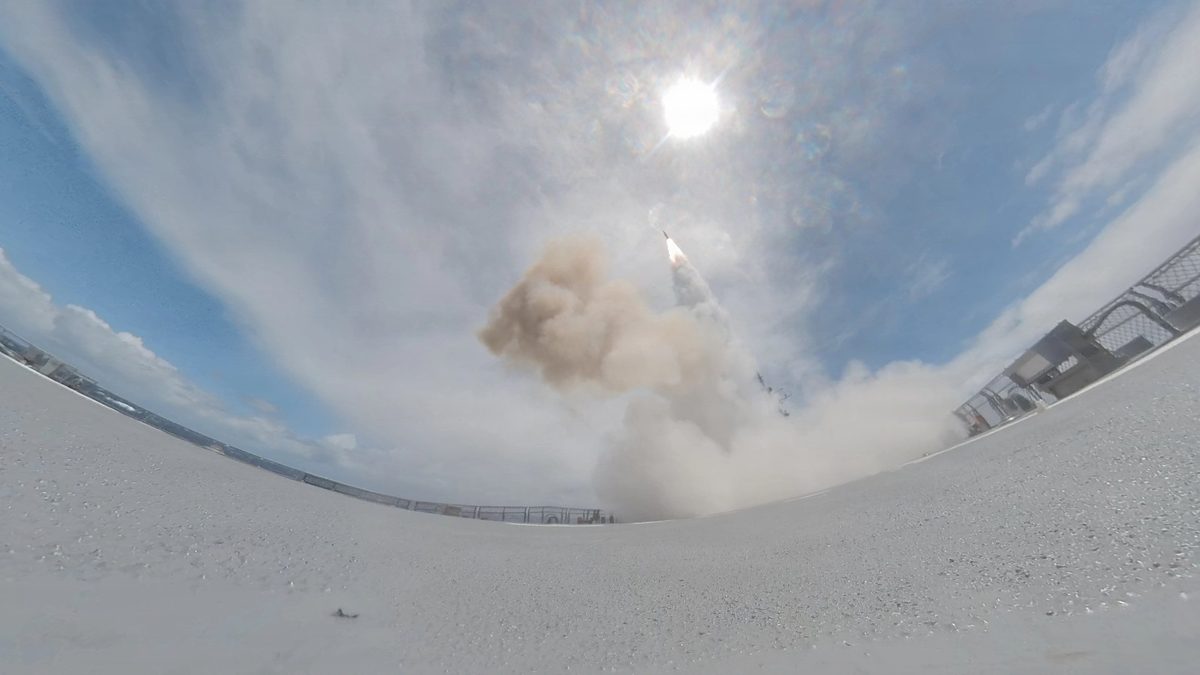
Illustrative: a Standard Missile 2 (SM-2) live-fire during Exercise Rim of the Pacific 2026. Photo: Yusuke Tanaka / U.S. Navy via DVIDS, public domain. This image depicts an SM-2 firing at sea and is not the Woomera ground-based test.
Australia's 'Frankenstein' Air Defence: SM-2, an Aegis Core and a CEA Radar Bolted Into a Ground Launcher
At the Woomera Test Range in June 2026, during Exercise Taipan Strike 2026, the Royal Australian Navy fired a Standard Missile 2 (SM-2) from a trailer-mounted Expeditionary Launch System and intercepted an aerial target. Fire control came from a virtualised Lockheed Martin Aegis combat system cued by a CEA Technologies phased-array radar, integrating equipment Australia already owns into a medium-range ground-based air defence (GBAD) prototype rather than buying a new system such as Patriot.
Technical Summary
The demonstration combined four elements that were never designed to sit together on land. The interceptor was a Royal Australian Navy (RAN) Standard Missile 2, the surface-to-air round that arms the Navy's Hobart-class destroyers. The launcher was the Derringer, a trailer-mounted, two-cell Expeditionary Launch System that lifts a naval canister onto a road-towable frame. The sensor was a phased-array radar from the Canberra firm CEA Technologies, whose CEAFAR family already equips Australian warships. The brain was a virtualised version of the Lockheed Martin Aegis Weapon System, running the same software baseline fielded on the Hobart-class destroyers and destined for the future Hunter-class frigates.
According to the Australian Department of Defence, the firing took place during Exercise Taipan Strike 2026 and was sponsored by the Royal Australian Air Force (RAAF), with the RAN launching the round and the Capability Acquisition and Sustainment Group (CASG) supporting the activity alongside CEA Technologies, Lockheed Martin and United States government partners. Defense News reported the target as a BQM-74E aerial drone, while several outlets characterised the intercepted object as representative of a cruise missile. The public announcement on 9 July 2026 followed a reported Chinese ballistic missile test in the South Pacific by a matter of days, which sharpened the political framing around Australia's air and missile defence gap.
The prototype leverages existing weapons, launchers and command and control. It can fire any of the weapons currently fielded on the Hobart-class destroyers or future Hunter-class frigates. Jeremy King, Chief Executive, Lockheed Martin Australia and New Zealand, quoted by Defense News
Analysis of Effects
The engineering interest sits in the fire-control chain, not the launcher. The SM-2 Medium Range family homes on its target using semi-active radar homing (SARH), which means the round follows radar energy reflected off the target by an external illuminator rather than carrying its own transmitter. On an Aegis warship that illumination is provided by dedicated AN/SPG-62 directors. A ground battery built around a single CEA phased-array face therefore has to answer a specific question: does the array provide the continuous-wave illumination the SM-2 needs in the terminal phase, or was the demonstration flown with an interceptor variant that carries an active seeker. This is the load-bearing technical uncertainty in the whole concept, and open sources do not resolve it.
Assuming an SM-2 Block IIIA or IIIB round, the interceptor offers an engagement envelope commonly cited in open sources at roughly 90 to 170 kilometres in range and around 20 kilometres in altitude, carrying a blast-fragmentation warhead in the 115 pound (about 52 kilogram) class with proximity and contact fuzing. Those figures are interceptor characteristics, not a property of the trailer, so the ground system inherits the missile's reach directly. What the ground system does not inherit is a warship's magazine. A two-cell trailer holds two rounds. Depth of fire, reload time and the number of targets a single fire-control channel can service therefore become the honest measures of operational value, and none were demonstrated by a single successful intercept.
Personnel and Safety Considerations
An all-up SM-2 round pairs a dual-thrust solid rocket motor with a fuzed high-explosive warhead, so for storage and transport it is handled as a Hazard Division 1.1 item, mass-detonating, subject to the quantity-distance rules that govern any such store. Moving that hazard from a warship magazine onto a road-towable trailer changes the safety geometry rather than removing it. A deployed launcher needs a defined danger area for launch, arcs cleared of personnel and structures, and an explosive licence regime for any forward holding of rounds, all of which are routine for naval magazines but new considerations for a land site chosen for tactical rather than explosive-safety reasons. The exact net explosive quantity per round and the launch danger area at Woomera are not published and are recorded below as data gaps.
Data Gaps
Several load-bearing parameters remain unconfirmed in open sources and are flagged rather than asserted. These are: the exact SM-2 variant fired and therefore whether terminal homing was semi-active or active; the specific CEA radar model and whether it provided illumination; the identity of the target, reported variously as a BQM-74E drone and as a cruise-missile surrogate; the engagement range and altitude achieved on the day; the net explosive quantity and hazard classification of the round as configured; and the programme path from this prototype to any funded acquisition under the 2026 National Defence Strategy. Each would materially change the assessment and none should be inferred from the single confirmed fact, which is that one round launched and intercepted one target.
Key Questions
What did Australia actually test at Woomera?
During Exercise Taipan Strike 2026 at the Woomera Test Range in June 2026, the Royal Australian Navy fired a Standard Missile 2 from a trailer-mounted Expeditionary Launch System and intercepted an aerial target. Fire control came from a virtualised Aegis combat system cued by a CEA Technologies phased-array radar.
Why is the system called a Frankenstein air defence weapon?
Officials used the term because the prototype stitches together capabilities Australia already owns rather than buying a new system such as Patriot. It reuses the naval SM-2 interceptor, a CEA radar already fitted to Australian warships, and the Aegis software baseline from the Hobart-class destroyers and future Hunter-class frigates.
Does this replace a dedicated medium-range air defence buy?
Not yet. The June 2026 firing was a risk-reduction prototype demonstration, not a fielded system. It shows a credible path to medium-range ground-based air defence under the 2026 National Defence Strategy, but questions on magazine depth, mobility, radar dedication and interceptor variant remain open.
References
Source-evaluated under NATO STANAG 2022 (Reliability A–F / Accuracy 1–6). Tier 1 = government primary source; Tier 2 = quality news / specialist defence media; Tier 3 = authoritative aggregator / encyclopaedia.
- T1Australian Department of Defence (Defence Ministers) – Australia achieves landmark prototype missile defence live fire, 9 July 2026. (Reliability A / Accuracy 1)
- T2Defense News – Australia whips together a hybrid air defense weapon, 23 July 2026. (Reliability B / Accuracy 2)
- T2Defence Connect – Australian Defence Force completes successful firing of SM-2 from Derringer launch system, July 2026. (Reliability B / Accuracy 2)
- T2Janes – Australia tests SM-2/Aegis ground-based air-defence capability, July 2026. (Reliability B / Accuracy 2)
- T2Asian Military Review – Australia's SM-2 test paves way for medium-range GBAD capability, July 2026. (Reliability B / Accuracy 2)
- T3Wikipedia – RIM-66 Standard (SM-2) reference data, accessed 23 July 2026. (Reliability C / Accuracy 3)
Corrections & updates welcome. If you hold open-source data that refines or corrects any parameter in this article, please contact [email protected] citing the specific claim and your source. Verified corrections will be incorporated and credited in the revision history. AI-assisted technical assessment based on open-source material. Not a formal intelligence product.