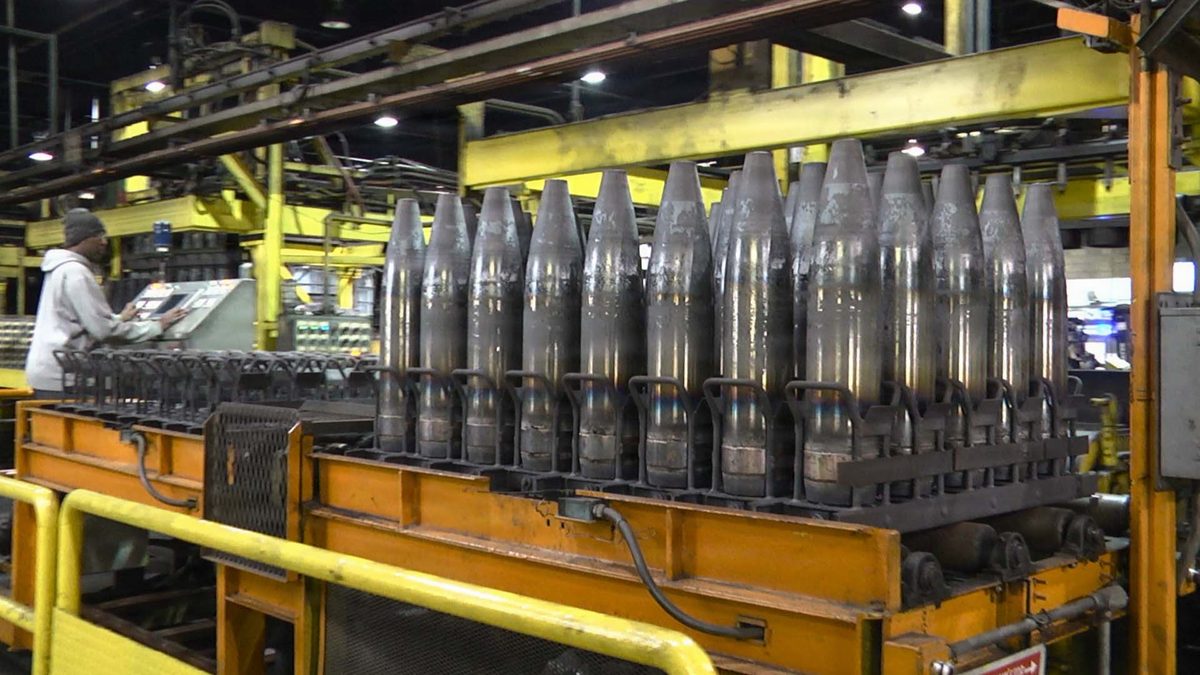
155mm artillery projectiles on the heat-treat line at Scranton Army Ammunition Plant, 6 April 2026. Photo: Dori Whipple, U.S. Army (DVIDS, public domain). Appearance of U.S. Department of Defense visual information does not imply endorsement.
US 155mm Ammunition Ramp-Up Stalls at One Third of Plan as Inspector General Flags Shell-Body Bottleneck
A United States Department of War Office of Inspector General report dated 9 July 2026 found 155mm artillery ammunition output reached only about 36,000 rounds a month by March 2026, roughly one third of the 100,000 round monthly target set for October 2025 under the 2022 Ammunition Plant Modernization Plan, despite about 4.5 billion dollars of investment. The binding constraint is qualified metal projectile bodies, not explosive fill.
Technical Summary
The United States Department of War Office of Inspector General (OIG) published its evaluation of national capacity to produce 155 millimetre (155mm) artillery ammunition on 9 July 2026. The audit measured progress against the 2022 Ammunition Plant Modernization Plan, which set a path from 14,000 rounds a month toward 100,000 rounds a month by October 2025. By March 2026, after roughly 4.5 billion United States dollars of investment, actual output stood at about 36,000 rounds a month. That is equivalent to some 432,000 rounds a year, little more than a third of the planned rate.
The report identifies metal projectile parts, the forged and machined steel shell bodies, as the principal bottleneck rather than energetic fill or propellant. The Universal Artillery Projectile Lines facility at Mesquite, Texas, which opened in 2024 at a construction and equipment cost of 469 million dollars and is operated by General Dynamics Ordnance and Tactical Systems, did not deliver on schedule any metal projectile part that met the technical requirements of its order. To accelerate output the plant adapted production equipment originally built for the M107 projectile, a design close to 70 years old, to manufacture the newer and longer range M795 body. The Army accepted this as a high risk, high reward route because the M107-era machinery was already available and looked faster than buying equipment designed for the M795, but the reworked lines never produced conforming M795 parts and the Army issued a stop-work order in August 2025. Work has shifted onto lines at Scranton, Wilkes-Barre and Ingersoll in Canada, which have not yet closed the gap.
Output reached about 36,000 rounds a month by March 2026, roughly one third of the 100,000 round monthly goal set for October 2025, even after some 4.5 billion dollars of modernisation investment. ISC assessment of the US Department of War OIG report, 9 July 2026
Analysis of Effects
The finding matters because the constraint sits in metallurgy, not chemistry. A 155mm high explosive (HE) projectile is a pressure vessel: the steel body must be forged, heat treated and machined to controlled hardness and wall thickness so that it survives chamber pressures on the order of hundreds of megapascals and then fragments predictably on functioning. Qualifying that forging base, and the automated lines that produce it at volume, is slower and less forgiving than pouring additional explosive fill. A result of zero conforming metal parts delivered on schedule from a highly automated 469 million dollar plant points to process qualification and yield problems rather than a shortage of raw floor space.
The M107 and M795 differ in ways that shape the trade being made. The M107 is a legacy round with a bursting charge of approximately 6.6 kilograms of trinitrotoluene (TNT) or Composition B and an unassisted range near 18 kilometres. The M795 uses a high fragmentation steel body and around 10.8 kilograms of TNT for improved lethality, extends unassisted range toward 22 kilometres, and is the projectile the modernised base is meant to deliver at scale. Betting that adapted M107-era tooling could reach M795 output faster, then getting no conforming parts from it, has left the force short of the more capable round the modernised base is meant to deliver. Against that, the report records a stock drawdown of more than 3.6 million rounds, including over 3 million sent to Ukraine, about 217,857 delivered through Foreign Military Sales and roughly 111,637 expended in training.
Personnel and Safety Considerations
Production quality is a safety matter as much as an output one. Shell bodies that miss metallurgical or dimensional specifications cannot be safely proofed or fielded, which is why qualification cannot simply be waived to lift numbers. Finished 155mm HE projectiles are mass detonating stores, Hazard Division (HD) 1.1, with the applicable Compatibility Group, commonly D, and United Nations serial set by fuze state and packaging configuration. Net Explosive Quantity (NEQ) per projectile therefore drives magazine and storage licensing across the loading, assembly and packing (LAP) base and the depots that hold the finished rounds. A surge that outran quality assurance (QA) governance would move risk downstream into storage and handling, the opposite of the intended effect.
Data Gaps
Open reporting does not specify which steel grade, forging route or heat treatment failed qualification at Mesquite, nor whether the 36,000 round figure counts all natures or high explosive projectiles alone. The status of the separable propellant stream, the Modular Artillery Charge System (M231 and M232), and of fuzing such as the M1156 Precision Guidance Kit, is not addressed in the summary reporting, and neither is the capacity of the energetic fill supply (TNT and IMX-101). The 469 million dollar figure covers construction and equipment; recurring unit costs are not disclosed. These items are recorded as gaps rather than estimated.
Key Questions
How far behind is US 155mm artillery ammunition production?
By March 2026 output had reached about 36,000 rounds a month, roughly one third of the 100,000 round monthly target set for October 2025 under the 2022 Ammunition Plant Modernization Plan. That is some 432,000 rounds a year against a plan near 1.2 million, despite around 4.5 billion dollars of investment.
What is the main bottleneck in US 155mm shell production?
The Inspector General identifies qualified metal projectile parts, the forged and machined steel shell bodies, as the binding constraint rather than explosive fill. The Mesquite, Texas plant delivered no metal parts meeting its technical requirements on schedule, forcing more work onto lines at Scranton, Wilkes-Barre and Ingersoll, Canada.
What is the plan to close the US 155mm shortfall?
The Department now aims for about 71,000 rounds a month in September 2026 and 140,000 a month by December 2027, drawing on new plants at Camden and Parsons and the modernised Iowa Army Ammunition Plant. The report recommends reviewing the Mesquite construction contract and related production contracts.
References
Source-evaluated under NATO STANAG 2022 (Reliability A–F / Accuracy 1–6). Tier 1 = government primary source; Tier 2 = quality news / specialist defence media; Tier 3 = authoritative aggregator / encyclopaedia.
- T1US Department of War, Office of Inspector General – Evaluation of the DoW’s Capability and Capacity to Produce 155-Millimeter Artillery Ammunition, 9 July 2026. (Reliability A / Accuracy 1)
- T2Defence Industry Europe – U.S. 155mm artillery ammunition ramp-up falls short of plan as inspector general flags Mesquite plant and shell body bottlenecks, 17 July 2026. (Reliability B / Accuracy 2)
- T2Breaking Defense – Army well short of 155mm ammo production goal, Texas facility in the spotlight, July 2026. (Reliability B / Accuracy 2)
- T2The Washington Times – Army far behind on 155 mm ammunition production target, Pentagon watchdog warns, 15 July 2026. (Reliability B / Accuracy 2)
- T3Wikipedia – M795 (projectile), accessed 22 July 2026. (Reliability C / Accuracy 3)
Corrections & updates welcome. If you hold open-source data that refines or corrects any parameter in this article, please contact [email protected] citing the specific claim and your source. Verified corrections will be incorporated and credited in the revision history. AI-assisted technical assessment based on open-source material. Not a formal intelligence product.