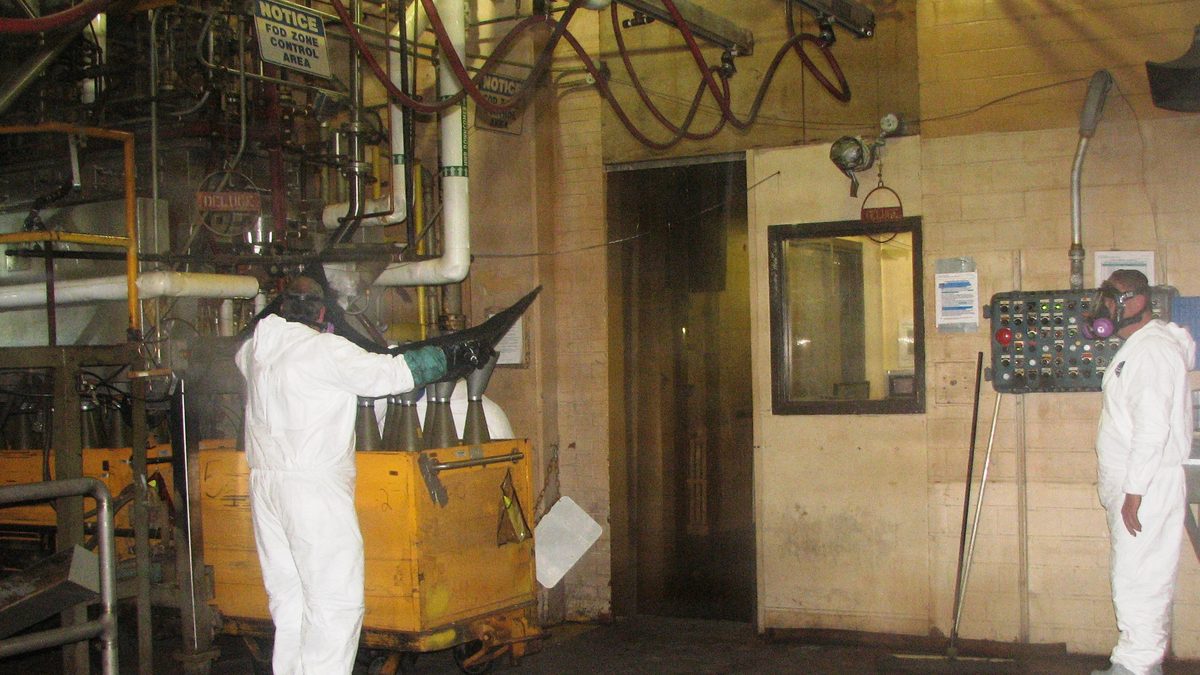
Contract employees prepare 155 mm M795 projectile cases at the Iowa Army Ammunition Plant. US Army photo by Dori Whipple (DVIDS, public domain). Appearance of US Department of Defense visual information does not imply DoD endorsement.
US Army Breaks Ground on 155 mm Future Artillery Complex in Iowa as CSG Deepens Its American Footprint
On 15 July 2026, CSG's US subsidiary MSM North America broke ground on the Future Artillery Complex at the Iowa Army Ammunition Plant, a facility built under a contract of around $635 million. Designed for up to 36,000 loaded 155 mm projectiles a month from 2029, it replaces a line more than fifty years old and anchors the US Army's push toward 100,000 shells a month.
Technical Summary
CSG (Czechoslovak Group), through its United States subsidiary MSM North America, held the groundbreaking ceremony for the Future Artillery Complex (FAC) at the Iowa Army Ammunition Plant (IAAP) on 15 July 2026. The event follows a United States Army contract awarded to MSM Group North America in 2025 to design, build and commission the facility. The US Army puts the value at $635 million on a fixed-price-with-economic-price-adjustment basis, executed as a sole-source undefinitized contract action under Title 10 United States Code section 3204(a)(7); CSG describes the value as up to $632 million. The new government-owned, contractor-operated (GOCO) plant will replace an ageing production line that has served the US Army for more than five decades. It is designed to load, assemble and pack up to 36,000 155 mm artillery projectiles a month, which CSG describes as the world's most modern explosive loading facility for 155 mm ammunition.
The FAC is a load-assemble-pack (LAP) facility rather than a metal-parts or energetics plant: its function is to fill and finish artillery projectiles using lean manufacturing, robotics, automation and integrated supervisory control and data acquisition (SCADA) systems, with the flexibility to transition between products and to run economically at either peak capacity or a Minimum Sustaining Rate. Construction is expected to take roughly 40 months, with full commissioning and First Article Acceptance Testing within 48 months of award and entry into operation in 2029. The Joint Program Executive Office Armaments and Ammunition (JPEO A&A) at Picatinny Arsenal frames the plant as one node in an Army goal of producing 100,000 155 mm rounds a month, funded from a roughly $5 billion Congressional allocation to modernise the organic industrial base. For CSG the project deepens a US footprint that already includes The Kinetic Group in small-calibre ammunition and CSG Land Systems North America.
Designed for up to 36,000 loaded 155 mm projectiles a month, the Future Artillery Complex will supply roughly a third of the US Army's stated goal of 100,000 rounds a month from a single Iowa node when it enters operation in 2029. ISC Defence Intelligence assessment, drawn from JPEO A&A statements
Analysis of Effects
The WOME significance of a LAP facility lies in what it fills and how much energetic material it holds at once. The standard US 155 mm high-explosive projectile, the M795 shown in the Army's own imagery of the plant, carries a burster of approximately 10.8 kg (23.8 lb) of TNT, though modern production increasingly loads insensitive fills such as IMX-101 to meet insensitive-munitions requirements under Standardization Agreement (STANAG) 4439. A filled and fuzed HE projectile classifies as United Nations serial UN 0168, Hazard Division (HD) 1.1 Compatibility Group (CG) D, and the associated propelling charges as UN 0242 or UN 0279 at HD 1.3 CG C. A plant running at 36,000 rounds a month, some 432,000 a year, therefore holds and moves a large mass of HD 1.1 material through its melt-pour or press-load bays, which sets its quantity-distance footprint and its insensitive-munitions posture as the two defining engineering constraints.
In industrial-base terms the FAC is one of the clearest signals yet of how the United States intends to reach a sustained 100,000 rounds a month: not by expanding one WW2-era plant but by adding modern, automated nodes with surge headroom. That the prime is MSM North America, the US arm of the Czech-owned CSG, is itself notable. CSG reports annualised in-house large-calibre artillery and tank ammunition capacity above 800,000 rounds at the end of the first quarter of 2026, rising toward 850,000 during the year, and is drawing engineering support from its European facilities. A European ammunition group building and operating a sovereign US load line is the mirror image of the France and FN Herstal arrangement, and a marker of how integrated the transatlantic energetics base has become.
A fill plant is only one link in the chain, and it is not currently the weakest. A July 2026 Department of Defense Inspector General evaluation found that projectile metal-part production, not loading, is the limiting factor on the 100,000-a-month goal: as of March 2026 the organic industrial base was producing roughly 36,000 rounds a month, and a new metal-parts facility at Mesquite, Texas, built at a cost of about $469 million, had yet to deliver any parts meeting contract specification. The Future Artillery Complex raises the ceiling on filled-round output, but that ceiling only binds once forged shell bodies and modular propellant charges arrive in matching volume, so Iowa should be read as one necessary node rather than the single fix for the 155 mm shortfall.
Personnel and Safety Considerations
An explosive LAP facility is among the higher-hazard nodes in the ammunition chain because it concentrates bulk high explosive and filled HD 1.1 projectiles in the same building. Melt-pour and press-load operations for TNT or IMX-101 demand blast-resistant bay construction, remote and automated handling, and internal quantity-distance separation sized to the maximum credible event, all governed in the US context by Department of Defense explosives-safety standards and, for NATO-interoperable siting, by Allied Ammunition Storage and Transport Publication (AASTP) 1 Edition C. The Army's emphasis on robotics and automation is presented as a productivity gain, but its first-order benefit is operator safety: removing people from the fill bays is the surest way to reduce exposure in exactly the operations where an initiation would be most severe.
Data Gaps
Several details are not yet in the public record. It is unclear whether the FAC will load conventional TNT, insensitive IMX-101, or both, and in what product mix between the M795 and newer insensitive-munitions variants. The precise net explosive quantity licensing and quantity-distance siting for the new bays are not published. The $635 million Army figure and CSG's up to $632 million figure are not fully reconciled in open sources. The source of the energetic fill, and whether it draws on US or allied TNT and IMX production, is unstated, as is the split of the plant's output between war-reserve replenishment and allied resupply.
Key Questions
What is the Future Artillery Complex at the Iowa Army Ammunition Plant?
The Future Artillery Complex is a new load-assemble-pack facility for 155 mm artillery ammunition at the Iowa Army Ammunition Plant, built by MSM North America under a US Army contract of around $635 million. It replaces a fifty-year-old line and is designed for up to 36,000 loaded projectiles a month from 2029.
How does the plant fit the US Army's 155 mm production goals?
The US Army wants to reach 100,000 155 mm rounds a month across its modernised industrial base, funded by roughly $5 billion from Congress. At up to 36,000 loaded projectiles a month, the Iowa Future Artillery Complex would supply about a third of that target from a single automated node once it is fully operational.
Who is building and operating the facility?
The prime contractor is MSM North America, the US subsidiary of the Czech-owned CSG (Czechoslovak Group), drawing on engineering support from CSG's European ammunition plants. It is a government-owned, contractor-operated facility overseen by the Joint Program Executive Office Armaments and Ammunition at Picatinny Arsenal, and is expected to create about 70 skilled jobs.
References
Source-evaluated under NATO STANAG 2022 (Reliability A–F / Accuracy 1–6). Tier 1 = government primary source; Tier 2 = quality news / specialist defence media; Tier 3 = authoritative aggregator / encyclopaedia.
- T1US Army (army.mil) – Army invests $635M in cutting-edge artillery ammunition production facility, 20 August 2025. (Reliability A / Accuracy 1)
- T2CSG / GlobeNewswire – CSG breaks ground on Future Artillery Complex in Iowa, marking a new milestone in its long-term expansion in the United States, 15 July 2026. (Reliability B / Accuracy 2)
- T2Defence Industry Europe – CSG breaks ground on Future Artillery Complex in Iowa to expand US Army 155mm ammunition production, July 2026. (Reliability B / Accuracy 2)
- T2KILJ Radio – Defense Department Awards $635 Million Contract for Expansion at Iowa Army Ammunition Plant, July 2026. (Reliability B / Accuracy 2)
- T3Axios – Army kickstarts plans for huge artillery ammo factory in Iowa, 20 August 2025. (Reliability C / Accuracy 3)
- T2Military Times – Manufacturing woes hamper US 155-mm ammo production (reporting the July 2026 Department of Defense Inspector General evaluation), 14 July 2026. (Reliability B / Accuracy 2)
Corrections & updates welcome. If you hold open-source data that refines or corrects any parameter in this article, please contact [email protected] citing the specific claim and your source. Verified corrections will be incorporated and credited in the revision history. AI-assisted technical assessment based on open-source material. Not a formal intelligence product.