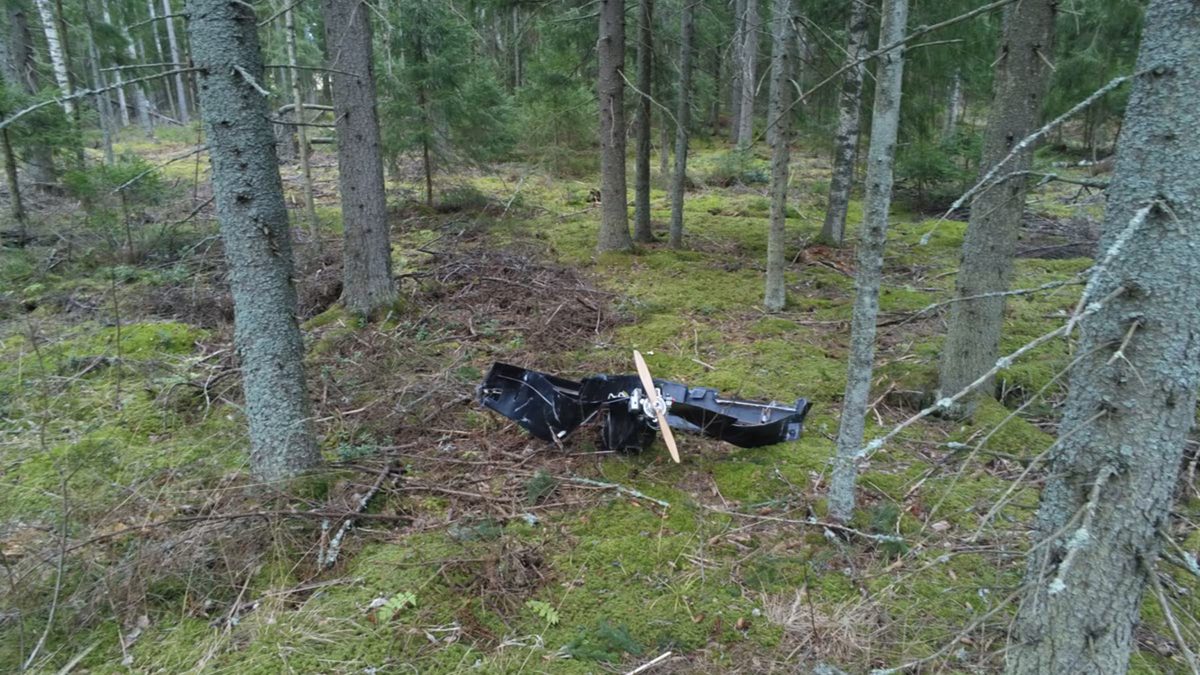
An An-196 Liutyi airframe recovered at Kouvola, Finland, shown for identification and not the missile-carrier variant. Police of Finland via Wikimedia Commons, public domain.
Ukraine Reworks the Liutyi Deep-Strike Drone Into a Stand-Off Missile Carrier
Ukraine has reconfigured its An-196 Liutyi deep-strike drone to carry four missiles rather than a single 50 to 75 kilogram warhead, a change shown publicly at the Farnborough International Airshow in July 2026. Each missile is reported to reach up to 200 kilometres at about 500 kilometres per hour, converting a one-way attack drone into a reusable stand-off launch platform.
Technical Summary
The An-196 Liutyi, developed by the Antonov design bureau under the state conglomerate Ukroboronprom, is one of Ukraine's principal long-range one-way attack (OWA) drones. Introduced in 2022 as a domestic answer to the Iranian-designed Shahed-136, it is a fixed-wing aircraft of 250 to 300 kilograms maximum take-off weight, powered by a piston engine in pusher configuration, with a 6.7 metre wingspan, a length of about 4.4 metres and a warhead of 50 to 75 kilograms. Cruising near 160 kilometres per hour, its reported reach runs from about 1,000 kilometres to strikes confirmed close to 1,700 kilometres, with some sources citing up to 2,000 kilometres. Guidance combines an inertial navigation system (INS), satellite positioning and an artificial-intelligence terminal stage, and unit cost is estimated near 200,000 US dollars. It is flown by the unit publicly known as Ukraine's 14th Separate Regiment of Unmanned Aerial Systems (UAS), since reorganised within the Unmanned Systems Forces.
The configuration shown this week is different in kind, not degree. Instead of a single internal warhead, the airframe was displayed on the Ukroboronprom stand carrying four external missiles under its wings. The Ukrainian outlet Oboronka reported the fit from the Farnborough International Airshow and put each missile's range at up to 200 kilometres and its speed at about 500 kilometres per hour, roughly Mach 0.4 and firmly subsonic. United24 Media and the specialist outlet TurDef corroborated the four-missile load, and Defence Blog carried the story in English. The munitions are described variously as compact air-launched cruise missiles or, by TurDef, as UAV-191 loitering munitions. No official designation has been confirmed, so the load-out is a display claim rather than a verified specification. Ukroboronprom presented the variant as a reusable launch platform rather than a pure one-way weapon.
Adding a 200 kilometre missile to a drone that already flies beyond 1,000 kilometres pushes the release point far outside a defended target's inner air-defence belt, and multiplies the aimpoints a single sortie can threaten. ISC open-source assessment, 21 July 2026
Analysis of Effects
The change matters because it moves the Liutyi from a terminal weapon to a launch platform. A conventional Liutyi sortie ends with one warhead of 50 to 75 kilograms arriving on one aimpoint. The exhibited variant instead releases its munitions before reaching the target and is presented as recoverable, so a single airframe could in principle deliver strikes across more than one sortie rather than expending itself once. Up to four smaller warheads can be spread across separate aimpoints or concentrated on one, arriving on divergent axes rather than a single predictable track. That complicates the intercept problem for an integrated air defence system (IADS), which must engage several small, low-signature munitions instead of one larger aircraft.
The trade is warhead mass for reach and dispersion. Net explosive quantity (NEQ) per missile is not disclosed, but each is necessarily smaller than the 50 to 75 kilogram charge it replaces, so single-point destructive effect falls while the number of objects a defender must stop rises. Composite reach is the other gain. A drone flying beyond 1,000 kilometres that then launches a 200 kilometre missile can strike from a release point outside the envelope at which many point-defence systems would otherwise engage the airframe. Carrying four external stores would cut the drone's own range and endurance through added mass and drag, so a launch-platform profile is likely shorter than the clean one-way configuration, and whether recovery works reliably in service is unproven.
Personnel and Safety Considerations
For explosive ordnance disposal (EOD) teams and ammunition technical officers (ATOs), a downed missile-carrier variant is a materially harder problem than a single-warhead Liutyi. A recovered airframe may hold up to four separate air-launched munitions, each with its own warhead, propulsion and fuzing, alongside the drone's own systems. Fuze states and arming logic for the missiles are not published, so every munition on a recovered airframe should be treated as live and armed until proven otherwise. Hazard division for storage and transport of these items would follow national assignment against the United Nations framework for the transport of dangerous goods. On current open information a mass-detonating assessment is prudent but not confirmed. This article does not address render-safe procedures.
Data Gaps
Several parameters remain unconfirmed on open sources. Four missiles are reported by multiple outlets and shown in the display imagery, but no official missile designation is confirmed, with the type described variously as a compact cruise missile or, by one outlet, as the UAV-191 loitering munition. Warhead mass, net explosive quantity, fuze type and guidance method for the missiles are not disclosed. The reusable-platform claim comes from the exhibitor and has not been demonstrated in service. The effect of the external load on the drone's own range and endurance is not stated. No Ukrainian government or manufacturer technical release confirms the configuration, which rests on specialist-media observation at a public airshow. These figures should be read as provisional exhibition claims, not validated specification.
Key Questions
What has Ukraine changed on the Liutyi drone?
Ukraine has shown its An-196 Liutyi long-range attack drone configured to carry four missiles instead of a single fixed warhead. Reported from the Farnborough International Airshow in July 2026, the change turns a one-way attack aircraft into a reusable aerial launch platform for stand-off munitions.
How far can the Liutyi-launched missiles reach?
Open-source reporting gives each missile a range of up to 200 kilometres and a speed of about 500 kilometres per hour. Added to the drone's own reach of more than 1,000 kilometres, the pairing lets Ukraine release munitions well outside a target's inner air-defence belt.
How many missiles does it carry, and what type?
Multiple outlets report four missiles, shown under the wings at the display. No official designation is confirmed. The munitions are described as compact cruise missiles or, by one outlet, as UAV-191 loitering munitions. Warhead mass and fuzing are not disclosed, so the figures should be treated as provisional.
References
Source-evaluated under NATO STANAG 2022 (Reliability A–F / Accuracy 1–6). Tier 1 = government primary source; Tier 2 = quality news / specialist defence media; Tier 3 = authoritative aggregator / encyclopaedia.
- T2Oboronka (Mezha.ua) – Liutyi drone shown with missiles at the Farnborough International Airshow, 20 July 2026. (Reliability B / Accuracy 2)
- T2United24 Media – Ukraine turns its suicide drone into a cruise missile carrier, 21 July 2026. (Reliability B / Accuracy 3)
- T3TurDef – Ukraine's Liutyi armed kamikaze UAV gets small helpers, 20 July 2026. (Reliability C / Accuracy 3)
- T2Defence Blog – Ukraine turns its signature kamikaze drone into a missile carrier, 21 July 2026. (Reliability B / Accuracy 3)
- T3Wikipedia – Liutyi (An-196): baseline airframe and warhead specification, accessed 21 July 2026. (Reliability C / Accuracy 3)
- T3Re:Russia – From Stings to Deterrence: Ukraine's long-range drone and missile arsenal, 2026. (Reliability C / Accuracy 3)
Corrections & updates welcome. If you hold open-source data that refines or corrects any parameter in this article, please contact [email protected] citing the specific claim and your source. Verified corrections will be incorporated and credited in the revision history. AI-assisted technical assessment based on open-source material. Not a formal intelligence product.