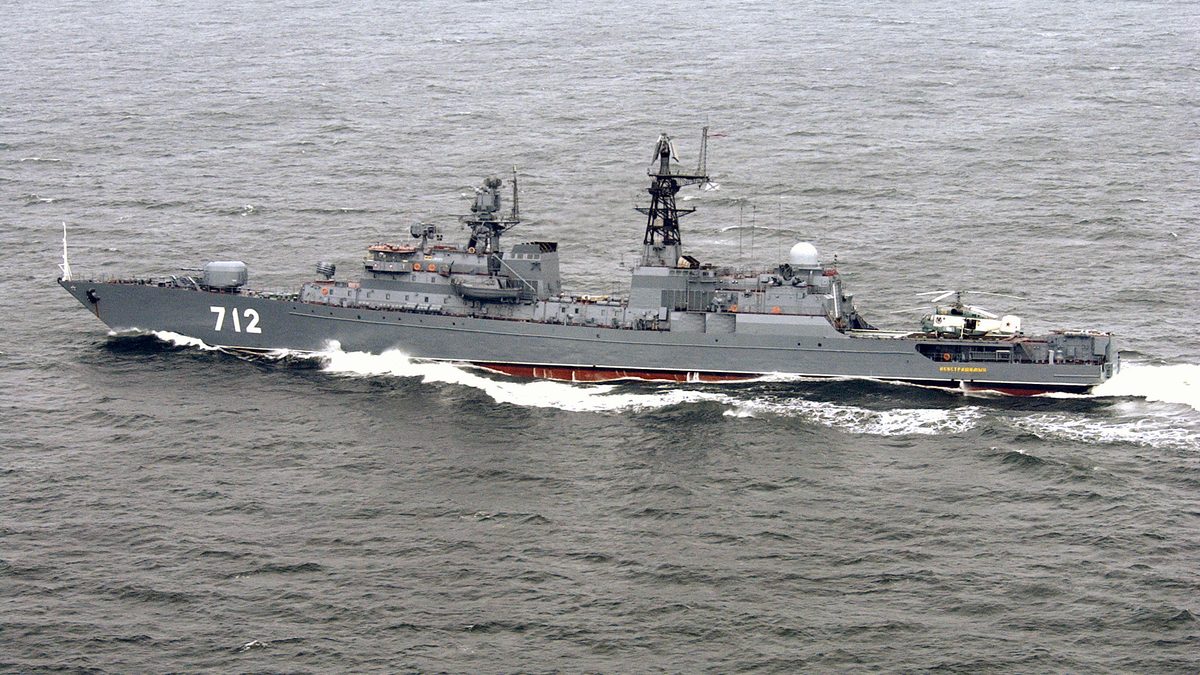
Portside view of the Russian frigate Neustrashimy (712). Photo: PH2 George Sisting, US Navy / US National Archives (public domain), via Wikimedia Commons.
Russian Frigate Neustrashimy Fires Live Naval Gunnery Serial Off Plymouth on Burnham's First Day
The Russian frigate Neustrashimy fired a 30-minute live naval gunnery serial in international waters about 40 nautical miles south of Plymouth on 20 July 2026, the day Andy Burnham became Prime Minister. HMS Tyne shadowed it throughout, and the Ministry of Defence said the Royal Navy tracked the exercise and stands ready to protect national security.
Technical Summary
The Russian Navy frigate Neustrashimy conducted a live-fire naval gunnery serial lasting about 30 minutes in international waters roughly 40 nautical miles (approximately 75 kilometres) south of Plymouth on the morning of Monday 20 July 2026. The firing coincided with the first day in office of Andy Burnham, who was appointed United Kingdom Prime Minister that day after Sir Keir Starmer stood down. The Offshore Patrol Vessel HMS Tyne shadowed the frigate throughout, and was asked by the Russian ship to open to a safer distance before firing began.
Neustrashimy is the lead ship of the Neustrashimy class, known in Russian service as Project 11540 Yastreb. She displaces about 4,250 tonnes at full load over a hull length near 130 metres. Her principal gun armament is a single 100 millimetre AK-100 automatic naval gun with a cyclic rate near 50 rounds per minute and an effective surface range beyond 20 kilometres, backed by two Kortik close-in weapon systems, each pairing twin 30 millimetre rotary cannon with short-range missiles. A notified 30-minute gunnery serial is consistent with main-gun firing, close-in weapon firing, or both, against a towed or virtual target inside a declared danger area.
A single 100 millimetre high-explosive round carries a bursting charge near 1.4 kilograms TNT equivalent, so the interest in this half-hour serial is its timing and location, not the modest energetic content committed. ISC Defence Intelligence assessment
Neustrashimy class (Project 11540 Yastreb): baseline (open sources)
| Full-load displacement | Approximately 4,250 tonnes |
| Length | Approximately 130 metres |
| Main gun | 1 x 100 millimetre AK-100, about 50 rounds per minute, effective range beyond 20 kilometres |
| Close-in weapons | 2 x Kortik (CADS-N-1), twin 30 millimetre rotary cannon with short-range missiles |
| Anti-ship missiles | Kh-35 Uran (SS-N-25), quoted range to about 130 kilometres |
| Air defence | Klinok (SA-N-9) vertical-launch surface-to-air missiles |
Analysis of Effects
Read as ordnance rather than as a diplomatic gesture, the event was a routine but noisy training serial conducted close to a busy traffic separation scheme. The natures most likely expended were 100 millimetre high-explosive fragmentation projectiles from the AK-100, with 30 millimetre rounds a possibility if the Kortik mounts were exercised. A single AK-100 F-1 high-explosive round carries a bursting charge on the order of 1.4 kilograms TNT equivalent, so the total energetic content committed across a half-hour serial is modest against the frigate's magazine capacity. The figure is an estimate drawn from published AK-100 ammunition data and has not been confirmed for this specific serial.
The safety-relevant parameter is not the charge weight but the danger area. Naval gunnery ranges extend well beyond the reposition distance reported here, and shell fall for a 100 millimetre gun at maximum elevation reaches out past 20 kilometres. The Russian ship managed the risk in the conventional way. It notified the shadowing Royal Navy vessel directly, requested that HMS Tyne open from roughly 2 to about 5 nautical miles, and a French maritime patrol aircraft made radio contact to confirm intentions. Firing live in international waters is lawful under the high-seas freedoms of the United Nations Convention on the Law of the Sea provided due regard is shown to other users and adequate safety warnings are issued. What draws attention is the short notice and the proximity to United Kingdom waters, not the legality.
Personnel and Safety Considerations
For the mariner and the watch-keeper, the practical points are conventional. A declared gunnery danger area should be treated as a live impact zone for the full arc of shell fall, not merely the stated bilateral separation to the shadowing warship. Unfused practice natures still arrive with lethal kinetic energy, and any high-explosive projectile that fails to function becomes unexploded ordnance on the seabed with an unknown fuze state. There is no indication that rounds came near HMS Tyne, the French aircraft, or civilian traffic, and the Royal Navy assessed the serial as controlled throughout. The Ministry of Defence confirmed it continues to track the vessel.
Data Gaps
Several technical parameters remain unconfirmed at the time of writing. The exact natures fired, the number of rounds expended, and whether only the 100 millimetre gun or also the 30 millimetre Kortik mounts were exercised are not stated in open reporting. The declared dimensions of the danger area, the target type, the fuze settings on any high-explosive natures, and whether any round failed to function are likewise unknown. The 40 nautical mile figure and the reposition distances are drawn from official briefings relayed through United Kingdom media rather than from a standalone published range order. Location was reported consistently as south of Plymouth by the local Member of Parliament and the majority of outlets, with one specialist source instead citing Portsmouth.
Key Questions
What did the Russian frigate Neustrashimy do off Plymouth?
Neustrashimy conducted a live-fire naval gunnery serial lasting about 30 minutes in international waters roughly 40 nautical miles south of Plymouth on 20 July 2026. HMS Tyne shadowed the frigate throughout and was asked to open to a safer distance before firing began.
Was the Russian live-fire exercise off the UK coast legal?
Yes. Firing live in international waters is lawful under the high-seas freedoms of the United Nations Convention on the Law of the Sea, provided due regard is shown to other users and safety warnings are given. The notable features were the short notice and the proximity to United Kingdom waters, not the legality.
Why did the timing on Andy Burnham's first day matter?
The firing coincided with Andy Burnham taking office as Prime Minister on 20 July 2026. Defence sources cited in United Kingdom reporting called the timing unusual, though the Ministry of Defence declined to link the serial explicitly to the change of government, noting heightened Russian naval activity near United Kingdom waters.
References
Source-evaluated under NATO STANAG 2022 (Reliability A–F / Accuracy 1–6). Tier 1 = government primary source; Tier 2 = quality news / specialist defence media; Tier 3 = authoritative aggregator / encyclopaedia.
- T1GOV.UK (Prime Minister's Office) – Andy Burnham's first speech as Prime Minister: 20 July 2026, 20 July 2026. (Reliability A / Accuracy 1)
- T2ITV News – Russian warship conducted weapon firing exercise off the coast of Plymouth, 21 July 2026. (Reliability B / Accuracy 2)
- T2CNN – Russian warship conducts live-fire exercise off UK as new PM Burnham reaffirms support for Kyiv, 21 July 2026. (Reliability B / Accuracy 2)
- T2The Maritime Executive – Russian Frigate Conducts Live-Fire Exercise Off UK Coast as Royal Navy Watches, 21 July 2026. (Reliability B / Accuracy 2)
- T3Yahoo News UK / PA Media – Russian warship carries out live-fire exercise 40 miles off UK coast, 21 July 2026. (Reliability C / Accuracy 3)
- T3Naval Technology – Neustrashimy Class (Type 11540) frigate specifications, reference profile. (Reliability C / Accuracy 3)
Corrections & updates welcome. If you hold open-source data that refines or corrects any parameter in this article, please contact [email protected] citing the specific claim and your source. Verified corrections will be incorporated and credited in the revision history. AI-assisted technical assessment based on open-source material. Not a formal intelligence product.