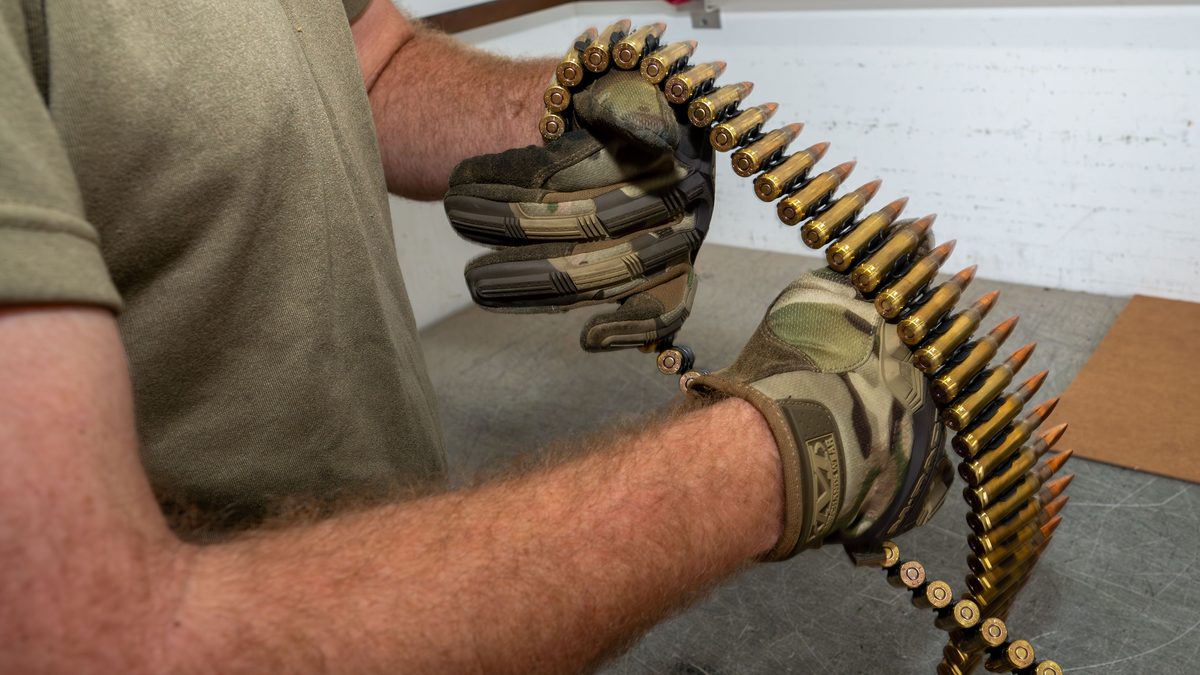
Munitions specialists conduct a roll test on 7.62 mm ammunition. US Air Force photo by Darius Sostre-Miroir (DVIDS, public domain); illustrative, not the DGA contract. Appearance of US Department of Defense visual information does not imply DoD endorsement.
France Turns to FN Herstal Consortium to Rebuild Sovereign 5.56 mm and 7.62 mm Ammunition Production
France's defence procurement agency, the Direction Generale de l'Armement (DGA), has selected a consortium led by Belgium's FN Herstal, with French firms Cheddite and NobelSport, to manufacture 5.56 mm and 7.62 mm NATO ammunition at a new plant in Clerieux, Drome. Production begins in 2029 at 75 million rounds a year, restoring a sovereign small-calibre capability France lost decades ago.
At a Glance
| Calibres | 5.56 by 45 mm NATO (STANAG 4172) and 7.62 by 51 mm NATO (STANAG 2310) |
| Natures | Ball and tracer |
| Design capacity | 75 million rounds a year from 2029 |
| Site | Clerieux, Drome, south-east France |
| Initial French scope | Propellant loading, primer, case and projectile assembly, stripper-clip and belt packaging |
| Later French scope | National propellants and primers |
| Consortium | FN Herstal (Belgium, lead), Cheddite (France), NobelSport (France) |
| European context | Feeds the EDA Small Arms Ammunition Technologies (SAAT) project |
Technical Summary
On 15 and 16 July 2026 the Direction Generale de l'Armement (DGA), the French defence procurement agency, announced the award of a small-calibre ammunition production contract to an industrial grouping led by FN Herstal of Belgium, with the French companies Cheddite and NobelSport as members. The contract covers 5.56 by 45 mm and 7.62 by 51 mm NATO-standard natures in ball and tracer configurations. A new sovereign production facility will be established at Clerieux in the Drome department of south-east France, with first output targeted for 2029 at an industrial rate of 75 million rounds a year. The DGA states that the award is the result of a European competition it opened in April 2025, and that formal signature of the contract is expected during the summer of 2026 once the requirements of the French public procurement code are met.
Initial activities on French soil will comprise propellant loading, assembly of the round components (primer, case and projectile) and packaging onto stripper clips and belted links. For resilience, the DGA intends to qualify European sources across the whole subcontracting chain, with national production later extended to sub-components, propellants and primers in particular. The consortium structure maps directly onto the four building blocks of a cartridge: FN Herstal provides small-calibre manufacturing lead and line integration, NobelSport supplies a French propellant and loading base, and Cheddite contributes primer and priming-component capacity. France has depended on imported small-calibre ammunition since the closure of its last military small-calibre line, the GIAT Industries plant at Le Mans, in 1999, so the award re-establishes indigenous supply of the two principal NATO infantry calibres. Cheddite already runs a civilian primer and case plant at Bourg-les-Valence in the same Drome department, giving the consortium an established French energetic-components anchor close to the new Clerieux site. FN Herstal also leads the European Defence Agency (EDA) Small Arms Ammunition Technologies (SAAT) project, and the Clerieux consortium feeds that same effort to widen the European small-calibre supplier base.
The Clerieux plant is scheduled to deliver 75 million rounds of 5.56 mm and 7.62 mm NATO ammunition a year from 2029, the first sovereign French small-calibre output since the GIAT Industries plant at Le Mans closed in 1999. ISC Defence Intelligence assessment, drawn from the DGA release
Analysis of Effects
From a Weapons, Ordnance, Munitions and Explosives (WOME) standpoint the technical centre of gravity is not the inert ball projectile but the two energetic operations the plant will run: propellant loading and primer assembly. Bulk smokeless propellant (single or double base nitrocellulose) is handled as United Nations serial UN 0160 or UN 0161, Hazard Division (HD) 1.3 Compatibility Group (CG) C, while primer compositions and percussion caps in bulk fall under UN 0044 or UN 0377 at HD 1.4 S or, for primary-explosive intermediates, HD 1.1 B. The finished cartridges themselves, cartridges for weapons with an inert projectile, classify as UN 0012 at HD 1.4 S, which is why palletised small-arms ammunition is comparatively benign to store. Co-locating a 1.3 propellant operation and a 1.1 B priming operation at a single new site therefore sets the quantity-distance and process-hazard envelope for the whole facility, and that envelope, not the round in the magazine, is what drives the site's safety case.
On capacity, 75 million rounds a year is a peacetime training and sustainment figure rather than a war-stock figure. It sits below credible French consumption at full mobilisation, and the DGA's own language about later localising propellants and primers signals an intent to grow the base rather than cap it here. Interoperability is assured through the governing standards: 5.56 by 45 mm is controlled by Standardization Agreement (STANAG) 4172 and 7.62 by 51 mm by STANAG 2310, so any French-produced nature must pass the interchangeability and proof regimes those agreements define before it can be fielded as a NATO-common round. Quality assurance will almost certainly be anchored on STANAG 4107 and the Allied Quality Assurance Publication (AQAP) 2110 series that French military ammunition procurement normally invokes, though the contract's specific quality clauses are not public.
Personnel and Safety Considerations
A new-build small-calibre plant is, in safety terms, a primary-explosive and propellant establishment first and a metalworking site second. Primer manufacture involves sensitive priming compositions whose handling is governed by strict quantity limits, conductive flooring, remote operation and blast separation; propellant loading carries deflagration-to-detonation and fire-load risks that set the internal quantity-distance layout. For a facility that may hold NATO-interoperable stocks, the relevant siting reference is Allied Ammunition Storage and Transport Publication (AASTP) 1 Edition C, applied alongside French pyrotechnic-establishment regulation. None of this is exotic for FN Herstal or NobelSport, both of which run established energetic operations, but it is the reason a small-calibre line takes years to stand up: the licensing, proofing and hazard-analysis path, not the machinery, is the long pole.
Data Gaps
Several parameters remain open at the time of writing. The full contract terms, total value, specification references and any AQAP or STANAG 4107 quality clauses are not published. The split between 5.56 mm and 7.62 mm output, and between ball and tracer natures, is unstated, as is whether the 75 million round figure includes any reserve or mobilisation stock or covers training consumption alone. The Hazard Division and Compatibility Group siting details for Clerieux, and whether the site will hold NATO-declared stockpiles, are not in the public record. The timeline for extending production to French-made propellants and primers is described only as a later phase without dates.
Key Questions
Why is France restarting domestic small-arms ammunition production?
France has relied on imported 5.56 mm and 7.62 mm ammunition since its last national small-calibre line, the GIAT Industries plant at Le Mans, closed in 1999, leaving it without sovereign small-calibre supply. Ukraine-driven stockpile depletion has made that dependence a strategic risk, so the DGA is rebuilding an indigenous line at Clerieux to secure both training and high-intensity conflict needs.
What will the Clerieux facility produce and when?
The Clerieux plant will make 5.56 by 45 mm and 7.62 by 51 mm NATO ammunition in ball and tracer natures, at up to 75 million rounds a year from 2029. Initial work covers propellant loading, assembly of primer, case and projectile, and packaging onto stripper clips and belts, with components later made in France.
Who is in the FN Herstal-led consortium and what does each partner provide?
The grouping is led by FN Herstal of Belgium, Europe's largest small-calibre manufacturer and lead of the EDA SAAT project, which brings line integration and manufacturing depth. NobelSport, a French firm, provides propellant and loading capacity, and Cheddite supplies primer and priming components, together covering two of the components France currently lacks.
References
Source-evaluated under NATO STANAG 2022 (Reliability A–F / Accuracy 1–6). Tier 1 = government primary source; Tier 2 = quality news / specialist defence media; Tier 3 = authoritative aggregator / encyclopaedia.
- T1Ministere des Armees (DGA) – La DGA attribue le marche de production de munitions de petit calibre en France, 16 July 2026. (Reliability A / Accuracy 1)
- T2Zone Militaire (Opex360) – Le ministere des Armees retient un groupement emmene par FN Herstal pour produire des munitions de petit calibre en France, 16 July 2026. (Reliability B / Accuracy 2)
- T2La Libre Belgique – FN Herstal decroche un contrat tres attendu avec l'armee francaise, 16 July 2026. (Reliability B / Accuracy 2)
- T2Army Recognition – France Selects Belgium's FN Herstal Consortium to Restore Domestic Military Ammunition Production, 15 July 2026. (Reliability B / Accuracy 2)
- T3Defense Mirror – French DGA Awards Contract to Procure 75 Million Rounds of Small Arms Ammunition, July 2026. (Reliability C / Accuracy 3)
Corrections & updates welcome. If you hold open-source data that refines or corrects any parameter in this article, please contact [email protected] citing the specific claim and your source. Verified corrections will be incorporated and credited in the revision history. AI-assisted technical assessment based on open-source material. Not a formal intelligence product.