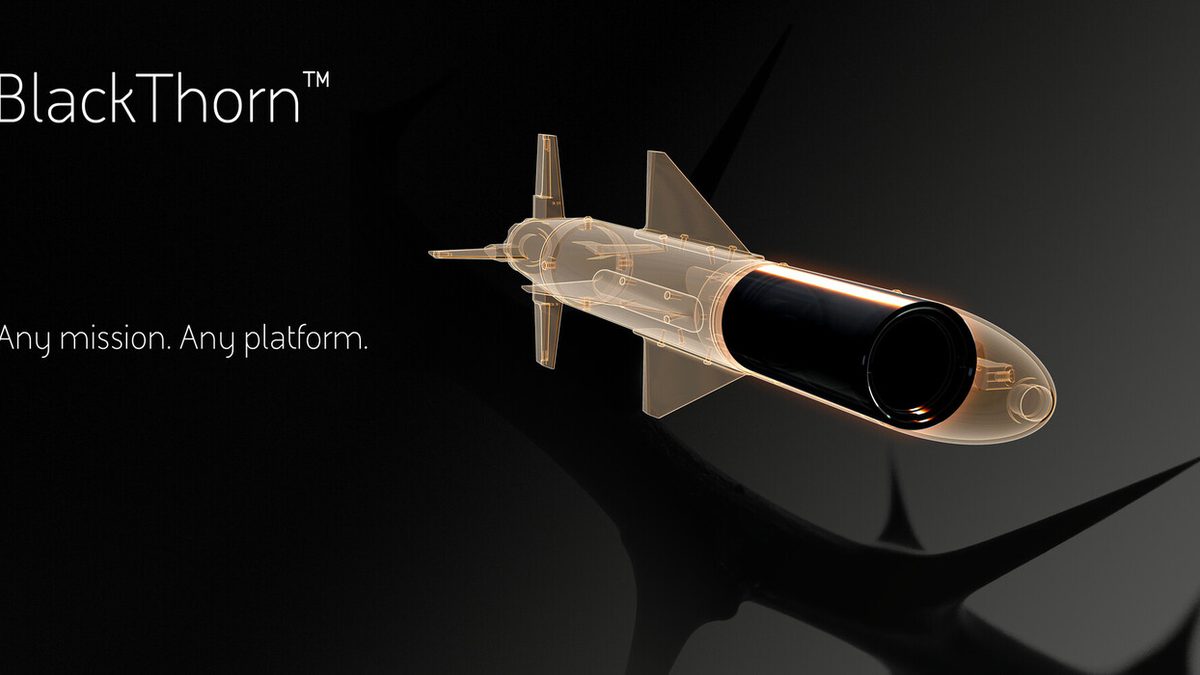
Image: BAE Systems (BlackThorn media briefing collateral). Used with permission for editorial purposes.
BAE Systems Unveils BlackThorn Modular Warhead, First Bound for Frankenburg’s Mark I Interceptor
BAE Systems unveiled BlackThorn on 21 July 2026, a modular warhead built in 40mm, 70mm and 120mm sizes with interchangeable blast, fragmentation, multi-purpose and anti-armour effect modules. It is designed for drones, one-way effectors, counter-drone systems, missiles and uncrewed ground vehicles, and has been selected as the first new-generation warhead for Frankenburg Technologies’ Mark I air defence missile.
Technical Summary
BlackThorn is a new family of Weapons, Ordnance, Munitions and Explosives (WOME) payloads aimed squarely at the low-cost, high-volume end of the modern battlefield. BAE Systems describes it as a multi-role, modular warhead for autonomous platforms, one-way effectors, counter-drone systems, missiles and Uncrewed Ground Vehicles (UGVs). The company frames the design around a single objective: an assured, agile munition that integrates quickly across many platforms and can be manufactured rapidly, at scale, and at low cost.
Three physical sizes have been announced, at 40mm, 70mm and 120mm. Each size draws on a common modular architecture that can be configured for blast, fragmentation, multi-purpose or anti-armour effects. That approach lets one warhead family cover several missions without fielding several separate weapon types. BAE Systems says BlackThorn was developed on a compressed timeline through heavy use of modelling, simulation and digital engineering, then validated through a wide programme of live testing. The most concrete near-term proof point is a customer: BlackThorn has been picked as the first new-generation warhead for the Mark I short-range air defence missile built by Frankenburg Technologies, following a memorandum of understanding (MoU) the two firms signed on 24 February 2026.
BlackThorn provides an advanced, affordable solution that meets the evolving needs of our customers and delivers multi-role warheads for the next generation of attritable platforms, missiles, autonomous platforms and counter drone capability, at pace. Scott Jamieson, Managing Director, BAE Systems Maritime and Land Defence Solutions
Frankenburg opens the world’s first affordable air defence missile mass-production facility in Riga. Riga is the first operational step in our plan to build annual capacity for 1,000,000 affordable guided air defence missiles. The Riga Weapon System & Missile Assembly Factory…
— Frankenburg Technologies (@FrankenburgTech) June 23, 2026
Analysis of Effects
The four named effect options map onto standard WOME output categories. A blast module optimises air-blast overpressure and impulse against soft and structural targets. A fragmentation module drives a controlled spray of fragments, which for a counter-air role usually means a proximity-initiated pattern rather than a contact hit. The multi-purpose option points to a combined shaped-charge and fragmentation design in the High-Explosive Dual-Purpose (HEDP) tradition, giving one round both a light armour-piercing jet and a useful fragmentation field. The anti-armour option implies a shaped-charge or Explosively Formed Projectile (EFP) liner tuned to defeat protected targets. Selecting between these is the engineering value of the modular architecture: the seeker, airframe and fuze train stay common, while the terminal effect changes with the mission.
Calibre points to role. The Frankenburg Mark I is a 60mm-diameter interceptor weighing under 2kg, so on physical grounds the integrated BlackThorn is most plausibly the 40mm or 70mm variant rather than the 120mm, which suits larger missiles and effectors. BAE Systems has not stated which calibre goes into the Mark I, so ISC treats the calibre-to-platform match as an assessment, not a confirmed fact. Context helps here: the Mark I as shown at Eurosatory and the World Defense Show in 2026 carried a 0.5kg high-explosive fragmentation warhead with a proximity fuze and a self-destruct function, against low, slow and massed drones out to a range of about 2km and an altitude near 1,500m. A fragmentation-configured BlackThorn in that class would sit in the same effect band while giving Frankenburg a warhead line it can scale alongside its missile production. Net Explosive Quantity (NEQ), explosive fill type, fragment mass and velocity, and fuze design have not been released for any BlackThorn variant.
Personnel and Safety Considerations
For ammunition technicians, storekeepers and safety-case authors, the load-bearing questions are the ones BAE Systems has not yet answered in public. A warhead described as assured and mass-manufacturable would normally be expected to use insensitive energetic fills qualified against the Insensitive Munitions (IM) response criteria in NATO Standardisation Agreement (STANAG) 4439 and Allied Ordnance Publication (AOP) 39, with hazard testing under AOP-7, but no IM status has been disclosed. Hazard Division (HD) and Compatibility Group (CG) have not been assigned in open sources, so storage and transport planning under United Kingdom governance in Defence Safety Authority publication DSA 03.OME cannot yet be scoped from the manufacturer data. One design feature does reduce residual risk: the Mark I baseline warhead carries a self-destruct function, which limits the unexploded ordnance and explosive remnants of war left behind by missed intercepts, a real consideration for a weapon meant to be fired in volume over friendly and civilian ground. Whether every BlackThorn configuration inherits that feature is not stated.
Data Gaps
Key technical parameters remain undisclosed and are recorded here rather than estimated. Missing items are: the NEQ and explosive fill type for each calibre; the fragmentation characterisation, meaning pre-formed or natural fragments, fragment mass and initial velocity; the fuze type and arming logic per effect module; the HD and CG assignment; the IM qualification status and governing standard; which BlackThorn calibre is being integrated into the Mark I; the qualification and proofing state of the warhead line; and unit cost. Confidence in the announced facts is high because they come from the manufacturer, but confidence in performance and safety characterisation is low pending release of qualification data or an independent technical datasheet.
Key Questions
What is BAE Systems’ BlackThorn warhead?
BlackThorn is a modular multi-role warhead that BAE Systems unveiled on 21 July 2026. It is offered in 40mm, 70mm and 120mm sizes with interchangeable blast, fragmentation, multi-purpose and anti-armour effect modules, and is designed for drones, one-way effectors, counter-drone systems, missiles and uncrewed ground vehicles, with rapid low-cost manufacture at scale.
Which missile will use the BlackThorn warhead first?
BlackThorn has been selected as the first new-generation warhead for Frankenburg Technologies’ Mark I short-range air defence and counter-drone missile. The choice follows a memorandum of understanding the two companies signed on 24 February 2026. The Mark I is a sub-2kg, 60mm interceptor with a range of about 2km.
How does BlackThorn’s modular design work?
BlackThorn uses one warhead family with interchangeable effect modules across three calibres, so a single design can deliver blast, fragmentation, multi-purpose or anti-armour effects without separate weapon systems. BAE Systems says it was developed on an accelerated timeline using modelling, simulation and digital engineering, then validated through a programme of live testing.
References
Source-evaluated under NATO STANAG 2022 (Reliability A–F / Accuracy 1–6). Tier 1 = government or primary manufacturer source; Tier 2 = quality news / specialist defence media; Tier 3 = authoritative aggregator / encyclopaedia.
- T1BAE Systems – Next generation of drone and missile warheads unveiled (BlackThorn, Ref 083/2026), 21 July 2026. (Reliability A / Accuracy 1)
- T1Frankenburg Technologies – Frankenburg Technologies and BAE Systems sign MoU, February 2026. (Reliability A / Accuracy 2)
- T1Frankenburg Technologies – Frankenburg Technologies (company website): Mark I missile systems and Riga production, 2026. (Reliability A / Accuracy 2)
- T2Aviation Week – BAE Systems, Frankenburg team on missile warhead development, February 2026. (Reliability B / Accuracy 2)
- T2EDR Magazine – Frankenburg Mark I ultra short-range air defence missile close to mass production, 2026. (Reliability B / Accuracy 2)
- T2Army Technology – Frankenburg try to shift the SHORAD market with Mark 1 missile, 2026. (Reliability B / Accuracy 2)
- T3Armada International – Mark I counter-drone missile approaching production, March 2026. (Reliability C / Accuracy 3)
Corrections & updates welcome. If you hold open-source data that refines or corrects any parameter in this article, please contact [email protected] citing the specific claim and your source. Verified corrections will be incorporated and credited in the revision history. AI-assisted technical assessment based on open-source material. Not a formal intelligence product.