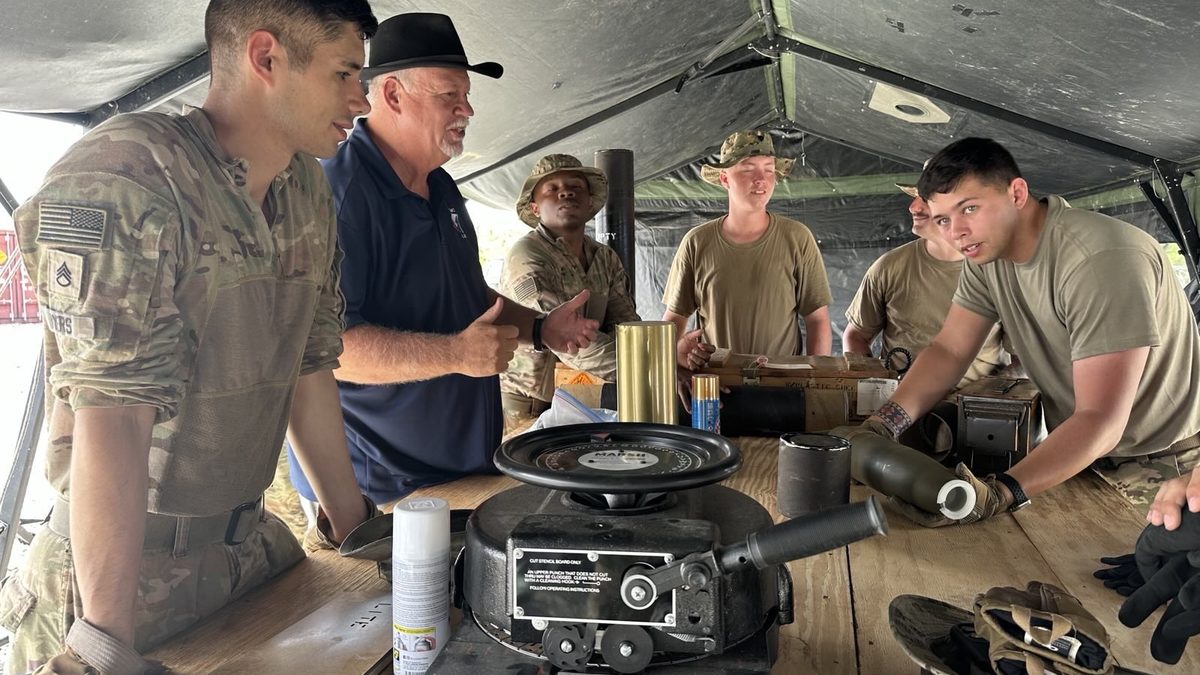
A US Army quality assurance specialist inspects munitions for through-life safety. Image: U.S. Army photo by Aaron DeCapua, released via DVIDS (public domain).
One Lifecycle, Four Rulebooks: Mapping WOME Safety Across NATO, the UK, US and Australia
MSIAC's Safety Assessment Software, now at Version 4.0, lets a user draw a munition's Manufacture to Target or Disposal Sequence and generates the design and assessment requirements that follow, defaulting to NATO standards with United States and United Kingdom overlays. That MTDS lifecycle is the shared spine beneath the UK CADMID cycle, US DESR 6055.09 and Australia's eDEOP 101.
Technical Summary
Four systems govern the safety of Weapons, Ordnance, Munitions and Explosives across NATO, the United Kingdom, the United States and Australia. They read very differently on the page, yet they track the same physical journey. A munition is made, stored, moved, handled, fired or expended, watched over in service, and finally disposed of or demilitarised. MSIAC, the Munitions Safety Information Analysis Centre, models that journey directly. Its Safety Assessment Software asks the user to lay out each step as a node in a flow diagram, then attaches the safety requirements that each step triggers.
This review takes the MSIAC Manufacture to Target or Disposal Sequence, known as the MTDS, as the neutral backbone and maps the national frameworks onto it. The aim was set plainly: find the parts that are the same, mark the parts that differ, and name the standards that hold each structure in place. Every load-bearing fact here is drawn from official public sources and cross-checked. Where a figure could not be confirmed from a primary source, it is flagged as a data gap rather than asserted.
Draw the sequence once in SASO, and the tool returns a hyperlinked requirement set and a verification and validation matrix in spreadsheet form. The lifecycle is common to all four nations. The rulebooks bolted to each node are not. ISC assessment of MSIAC SASO Version 4.0, July 2026
The MSIAC backbone: SASO and the MTDS
The Safety Assessment Software is a browser based tool built for munition designers, procurement staff and safety specialists. The interface works like a drawing package. A user drags nodes onto a canvas, and each node stands for one lifecycle activity with its own parameters such as location, duration and configuration. From the finished diagram the tool produces two outputs. Design safety requirements flow from the munition's own design data. Assessment requirements flow from the activity types the user has placed in the sequence.
Each requirement carries a link to the standard behind it. The default set is NATO, and the user can switch specific requirements to United States or United Kingdom equivalents where those exist. The product is an assessment report that combines the sequence diagram, the requirement list and the linked standards, alongside a verification and validation matrix delivered as a spreadsheet with columns left open for compliance evidence. SASO also carries a searchable database of munition safety standards, which connects to the wider Munition Safety Standards repository that MSIAC holds behind its secure site.
Two points matter for anyone trying to build a single structure. First, the MTDS is not a document. It is a generated model, redrawn for each munition, that covers the whole life from factory to target or to disposal. Second, no other nation ships a public tool of this kind. The United Kingdom, the United States and Australia run their lifecycle safety through written regulation and national process rather than a shared requirement engine.
One lifecycle, four names
Set side by side, the four frameworks fold onto the same phase map. The table below shows the alignment. Read across a row and the wording changes. Read down a column and the safety intent holds.
| Lifecycle stage | NATO / MSIAC (MTDS) | United Kingdom (CADMID) | United States | Australia |
|---|---|---|---|---|
| Concept and design | MTDS design node; safety and suitability for service (S3) assessment begins | Concept, Assessment | DoDI 5000 acquisition; MIL-STD-882 system safety | Capability definition under Defence policy |
| Manufacture and acquisition | MTDS manufacture nodes | Demonstration, Manufacture | Development, test and production | Procurement under the eDEOP 101 regime |
| Storage, transport, handling | AASTP-1, AASTP-2 and AASTP-5 nodes | DSA 03.OME Part 2 (former JSP 482) | DESR 6055.09 volumes | eDEOP 101, aligned to AASTP |
| In service use and surveillance | MTDS in-service nodes; life assessment | In-Service; munitions life assessment | Service use; hazard tracking | In-service management; Explosive Ordnance Safety Regulator |
| Disposal and demilitarisation | MTDS disposal node | Disposal | Munitions response and demilitarisation | Disposal under eDEOP 101 |
The United Kingdom is the clearest case of two cycles running together. Its acquisition model is CADMID, standing for Concept, Assessment, Demonstration, Manufacture, In-Service and Disposal. Its ordnance safety regulation, DSA 03.OME Part 1, drives safety through that cycle and speaks the same manufacture to disposal language as the MTDS. The United States reaches the same coverage by a different route, joining the Department of Defense Instruction 5000 acquisition series to MIL-STD-882 system safety and to the explosives specific DESR 6055.09. Australia embeds the whole life inside one national manual, eDEOP 101, overseen by the Explosive Ordnance Safety Regulator.
The governing standards: NATO, UK, US and Australia
The request asked for the military specifications, NATO standards and Defence Standards that hold each structure in place. The set below lists the current documents. Superseded editions are named only to steer readers away from them.
| Safety domain | NATO baseline | United Kingdom | United States | Australia |
|---|---|---|---|---|
| Lifecycle safety regulation | MSIAC MTDS via SASO; AOP series | DSA 03.OME Parts 1 and 2 (replacing JSP 520 and JSP 482) | DESR 6055.09 Edition 1 Change 2; DoDI 5000 | eDEOP 101 |
| System safety method | AASTP-4 risk analysis | Def Stan 00-056 | MIL-STD-882E | National process aligned to NATO |
| Safety and suitability for service | AOP-15 / STANAG 4297 | Applied through DSA 03.OME | Service S3 processes | Applied through eDEOP 101 |
| Insensitive munitions | AOP-39 Edition 3 / STANAG 4439 | Adopted via DSA 03.OME | MIL-STD-2105E test sequence | NATO insensitive munitions standards adopted |
| Hazard classification | AASTP-3 / STANAG 4123 with UN model regulations | UK implementation of STANAG 4123 | Joint Hazard Classification System | eDEOP 101 classification |
| Storage and transport | AASTP-1 Edition C (STANAG 4440); AASTP-2; AASTP-5 (STANAG 4657) | DSA 03.OME Part 2 | DESR 6055.09 volumes | eDEOP 101, AASTP aligned |
Read together, the tables expose the real division. The lifecycle is shared and the technical baselines converge, because every nation either writes or ratifies the same NATO standards for insensitive munitions, safety and suitability for service, hazard classification, and storage. What differs is regulatory style. NATO issues consensus guidance that nations ratify through Standardization Agreements. The United Kingdom sets goals and demands a written safety case argued to a level that is broadly acceptable or tolerable and as low as reasonably practicable. The United States writes prescriptive volumes with detailed quantity distance tables and risk matrices. Australia consolidates the field into a single national publication that leans heavily on the NATO storage and transport series.
Where the structures genuinely diverge
Four differences are worth holding onto for anyone compiling a unified structure. Terminology is the first. The UK carries both CADMID and the MTDS vocabulary, NATO and MSIAC use the MTDS directly, the US frames the same work as systems engineering plus explosives regulation, and Australia keeps its language inside eDEOP 101. Regulatory philosophy is the second, splitting goal setting and safety cases in the UK from prescriptive tables in the US. Tooling is the third, and here MSIAC stands alone, since only SASO builds the sequence and generates the linked requirement set with multinational standard options. Test detail is the fourth. The US runs the MIL-STD-2105 hazard assessment sequence, while NATO, the UK and Australia work from AOP-39 and its supporting Standardization Agreements. None of these differences breaks interoperability, because the NATO standards sit underneath all four as the common reference.
Data gaps and access limits
Several elements sit behind access controls and are stated here only as far as public sources allow. The full contents of SASO Version 4.0, the internal logic that maps activities to requirements, and the complete Munition Safety Standards repository are held on the MSIAC secure site and are released by nationality. Individual NATO standards, including current editions of the AASTP series and the AOP publications, carry release statements and are not all public. UK Defence Standards and US military specifications are widely available through their national portals, yet some editions carry distribution limits. The exact change status of a given document can move between editions, so the numbers here reflect the latest confirmed public editions as at 20 July 2026 and should be re-checked against the issuing authority before use in a formal safety case. This article is an open source assessment and is not a substitute for the controlled documents themselves.
Key Questions
What is the MSIAC MTDS and how does SASO use it?
The Manufacture to Target or Disposal Sequence is MSIAC's model of a munition's whole life, from factory to target or disposal. In the Safety Assessment Software, now Version 4.0, a user draws the sequence as linked nodes. The tool then generates design and assessment requirements and links each to its governing standard.
How do the UK CADMID cycle and the MTDS relate?
CADMID is the UK acquisition cycle: Concept, Assessment, Demonstration, Manufacture, In-Service and Disposal. It maps almost directly onto the MTDS lifecycle. UK ordnance safety regulation, DSA 03.OME Part 1, which replaced JSP 520, drives safety through that cycle using the same manufacture to disposal framing as MSIAC.
Which standards govern munitions safety in the US and Australia?
The United States uses DESR 6055.09, now Edition 1 Change 2, with MIL-STD-882 for system safety and MIL-STD-2105 for hazard and insensitive munitions testing. Australia consolidates its rules in eDEOP 101, overseen by the Explosive Ordnance Safety Regulator and aligned to the NATO AASTP storage and transport series.
References
Source-evaluated under NATO STANAG 2022 (Reliability A–F / Accuracy 1–6). Tier 1 = government primary source; Tier 2 = quality news / specialist defence media; Tier 3 = authoritative aggregator / encyclopaedia.
- T1MSIAC (NATO Munitions Safety Information Analysis Centre) – Safety Assessment Software (SASO) tool page, accessed 20 July 2026. (Reliability A / Accuracy 1)
- T1UK Defence Safety Authority via GOV.UK – DSA03.OME Part 1: OME Acquisition (formerly JSP 520), 2021. (Reliability A / Accuracy 1)
- T1US Department of Defense, DDESB via DENIX – Defense Explosives Safety Regulation DESR 6055.09, Edition 1 Change 2, 8 December 2025. (Reliability A / Accuracy 1)
- T1Australian Government, Department of Defence – Defence Explosive Ordnance Publication 101 (eDEOP 101), accessed 20 July 2026. (Reliability A / Accuracy 2)
- T2IMEMG mirror of US DoD standard – MIL-STD-2105 Hazard Assessment Tests for Non-Nuclear Munitions (Rev D 2011; Rev E 2022), 2011 and 2022. (Reliability B / Accuracy 2)
- T2MSIAC (NATO) – Promulgation of AASTP-1 Edition C (STANAG 4440); related AOP-15 / STANAG 4297 and AOP-39 / STANAG 4439, accessed 20 July 2026. (Reliability B / Accuracy 2)
Corrections & updates welcome. If you hold open-source data that refines or corrects any parameter in this article, please contact [email protected] citing the specific claim and your source. Verified corrections will be incorporated and credited in the revision history. AI-assisted technical assessment based on open-source material. Not a formal intelligence product.