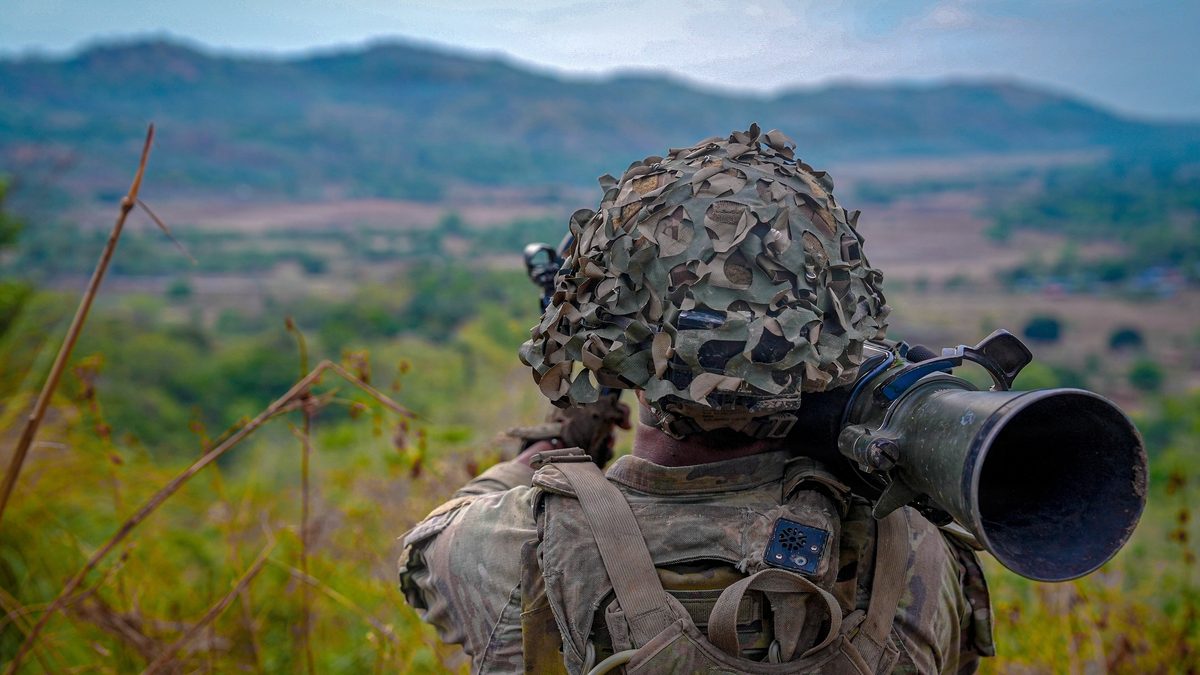
A U.S. Army soldier shoulders a Carl-Gustaf 84 mm recoilless rifle during Exercise Salaknib 2026, Philippines, 15 May 2026. U.S. Army photo by Spc. Christopher Moorehead, 25th Infantry Division, via DVIDS (public domain). Use does not imply endorsement. Illustrative of the launcher family, not the HE 448 round itself.
The Carl-Gustaf HE 448: What the M3 Fires, and What Only the M4 With FCD 558 Unlocks
Yes. The Saab HE 448 chambers and fires from any Carl-Gustaf, the M3 included, delivering its tungsten fragmentation in impact mode. Its programmable airburst, effective to 1,500 metres, works only when the launcher carries a fire control device, Saab's FCD 558 or the Aimpoint Fire Control System 13 Rate Estimator (FCS13-RE), which the M4 and its U.S.-service equivalent the M3A1 provide through Saab's Firebolt data link.
Technical Summary
The HE 448, also catalogued as FFV 448, is Saab's programmable High Explosive (HE) round for the 84 mm Carl-Gustaf recoilless rifle. Saab unveiled it in May 2022. The published figures are compact and telling: a round of about 2.7 kg, an effective range near 1,500 metres, and a warhead carrying some 4,000 tungsten pellets. It offers two fuze functions, impact for a point target and air-burst for troops behind cover. This is a Weapons, Ordnance, Munitions and Explosives (WOME) upgrade defined less by a bigger bang than by where and when the energy is released. Against the predecessor HE 441 the change is concrete: Saab records 800 steel balls giving way to some 4,000 smaller and harder tungsten pellets, a denser pattern that bites through body armour, and at about 0.5 kg lighter the round leaves the barrel faster, stretching accurate reach from roughly 1,300 metres to beyond 1,500.
The intelligence sits in the link, not the filler. Firebolt is Saab's two-way digital protocol between the round, the launcher and the sight. When a Firebolt round is chambered, it identifies itself to the Fire Control Device (FCD) 558 and reports its own propellant temperature, a real ballistic variable, since cooler propellant burns slightly slower and warmer propellant slightly faster. The gunner adds range. The FCD 558 then computes the firing solution, shifts the aim point and, for the airburst function, programmes the fuze. No one sets a timer by hand.
The datasheet is stark: roughly 4,000 tungsten pellets, a 2.7 kg round, a reach of 1,500 metres. That physics travels with the round into any launcher. The airburst that exploits it does not travel with the round. It lives in the sight. ISC open-source technical assessment
Analysis of Effects
Fired from an M3, the HE 448 is a capable direct-fire round and nothing more. It loads. It fires. It throws its tungsten in impact mode, and its improved range and fragmentation still apply against a point target. What it loses is the smart layer. There is no automatic exchange of round type or propellant temperature, no toggle to select airburst, no programmed fuze. A standard M3 can even carry the Aimpoint FCS13-RE, which adds laser ranging and a computed aim point, yet that buys ballistics, not programming: the airburst still needs the launcher-side Firebolt interface an M3 does not have, so the round stays impact-only. Backward compatibility is the design promise here, and Saab keeps it: the round is safe on the older weapon, just not clever on it.
Pair the same round with an M4, or its U.S.-service equivalent the M3A1, and it becomes what it was built to be. A point of naming matters here. The M3A1 is not an upgraded M3. It is the U.S. designation for a new-production lightweight launcher of the M4 generation, fielded alongside the older M3s rather than converted from them, and it carries the built-in Firebolt harness the M3 lacks. The FCD 558 that reads the round is a 1.2 kg unit, batteries included, that clamps to the Picatinny rail beside a normal day sight and holds ballistic tables for the whole legacy 84 mm family. It receives ammunition type and propellant temperature automatically, lets the gunner pick direct or airburst with a simple switch, takes a laser or manual range, and computes the trajectory against those variables. It then sets the fuze. The payoff is first-round hit probability and, with airburst, lethal effect on personnel in defilade who a point-detonating round would miss. Saab's philosophy is deliberate. Every 84 mm nature works in every launcher, protecting fielded stocks, while the high-end capability rides on the newest fire control. You buy the round to fill the tube. You buy the sight to unlock the round.
Personnel and Safety Considerations
The safety case turns on removing a human step. On a legacy crew, an assistant gunner sets fuzes and range under stress, and that is where timing errors and dud functions creep in. Firebolt takes the fuze setting out of the loop, and propellant temperature, a variable older systems could not read automatically, is fed straight into the solution. Backblast danger area, minimum arming range and handling drills for the round are unchanged, and the airburst function does not lower the usual As Low As Reasonably Practicable (ALARP) demands on the firing point. Two compatibility points matter for stockpile managers. Legacy non-Firebolt rounds still fire from an FCD 558, with the gunner selecting the type by hand. Firebolt rounds still fire from old launchers, but only in basic impact mode with no programming.
Data Gaps
Several parameters are not independently confirmed in open sources and are flagged rather than asserted. Saab does not publish the Net Explosive Quantity (NEQ) or the explosive fill of the HE 448, so no kilogram TNT-equivalent figure is offered here. Saab describes a higher muzzle velocity than the HE 441 but publishes no exact figure, and the precise pellet diameter varies across secondary reporting. On procurement, the United States is documented as programming the HE 441E through the Aimpoint FCS13-RE; a U.S. purchase of Saab's own FCD 558 is not confirmed in open sources. Firebolt is no longer confined to the HE 448: Saab launched the HEAT 758 tandem anti-armour round on 7 May 2026 as a second Firebolt nature that talks to the same M4 and FCD 558 (assessed separately by ISC), and Saab states the wider Carl-Gustaf portfolio is moving to Firebolt while keeping legacy backward compatibility, though the full timetable is not yet public.
Key Questions
Can the HE 448 be fired from an M3 Carl-Gustaf?
Yes. All 84 mm Carl-Gustaf ammunition is cross-compatible across the M1, M2, M3 and M4 launchers, so the HE 448 loads and fires safely from an M3 in impact mode and still delivers its tungsten fragmentation. What the M3 cannot do is programme the round's airburst, because it has no fire control interface to talk to the round.
What does the FCD 558 add that an M3 cannot provide?
The Fire Control Device 558 reads the round's type and propellant temperature over the Firebolt link, takes the gunner's range input, computes the trajectory and sets the fuze for airburst or impact. That removes manual fuze setting and lifts first-round hit probability, above all against troops in cover.
Has the United States bought the HE 448, and how does it programme it?
Yes. The U.S. Army designates the round HE 441E and has ordered it since 2023, including a USD 104.9 million AT4 and Carl-Gustaf order that September. U.S. forces programme it on the M3A1 launcher, the U.S. designation for the lightweight Carl-Gustaf M4 family, using the Aimpoint FCS13-RE fire control system rather than Saab's own FCD 558.
References
Source-evaluated under NATO STANAG 2022 (Reliability A–F / Accuracy 1–6). Tier 1 = government primary source; Tier 2 = quality news / specialist defence media; Tier 3 = authoritative aggregator / encyclopaedia.
- T1Saab AB – Saab firings showcase new programmable Carl-Gustaf munition (HE 448 and FCD 558 via Firebolt), 6 May 2022. (Reliability A / Accuracy 1)
- T2Saab AB – 84 mm HE 448 datasheet (2.7 kg, 1,500 m, some 4,000 tungsten pellets, impact and air-burst), accessed 20 July 2026. (Reliability B / Accuracy 2)
- T2Saab AB – Saab secures U.S. AT4 and Carl-Gustaf ammunition order (HE 448, U.S. HE 441E; USD 104.9 million; framework up to USD 422 million), 18 September 2023. (Reliability B / Accuracy 2)
- T2Saab AB (U.S. newsroom) – Saab receives order for latest Carl-Gustaf ammunition type from the U.S. Army (about USD 10 million, deliveries 2024), April 2023. (Reliability B / Accuracy 2)
- T3Task & Purpose – US Army stocking up on programmable Carl Gustaf ammunition (HE 441E on the M3A1 with Aimpoint FCS13-RE), 2023. (Reliability C / Accuracy 3)
- T1Saab AB – Saab launches new Carl-Gustaf anti-tank round (HEAT 758; uses Firebolt to communicate with the M4 and FCD 558), 7 May 2026. (Reliability A / Accuracy 1)
- T1Saab AB – Accuracy meets simplicity (predecessor HE 441 held 800 steel balls; HE 448 holds some 4,000 tungsten pellets, about 0.5 kg lighter, range beyond 1,500 m), May 2022. (Reliability A / Accuracy 1)
Corrections & updates welcome. If you hold open-source data that refines or corrects any parameter in this article, please contact [email protected] citing the specific claim and your source. Verified corrections will be incorporated and credited in the revision history. AI-assisted technical assessment based on open-source material. Not a formal intelligence product.