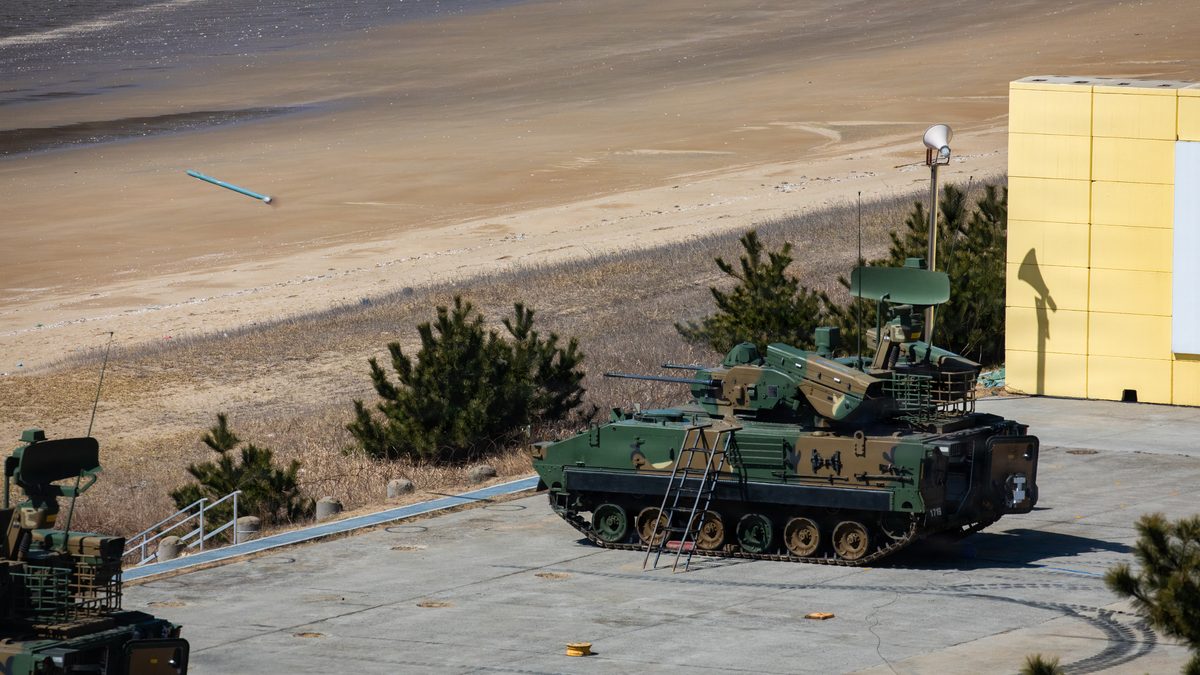
Air Defense Stinger Live Fire. U.S. Army photo by Staff Sgt. Tarako Braswell via DVIDS (U.S. Department of Defense imagery, public domain). Illustrative; ISC did not commission this image.
Raytheon NGSRI Scores Guided Intercepts as the US Army Moves to Replace the Stinger MANPADS
On 15 July 2026 Raytheon, an RTX business, reported that its Next Generation Short Range Interceptor (NGSRI) launched multiple guided missiles from a soldier-portable Command Launch Assembly and destroyed simulated aerial targets with direct hits. NGSRI is the US Army programme intended to replace the FIM-92 Stinger man-portable air-defence missile from a shoulder or vehicle mount.
Technical Summary
The Next Generation Short Range Interceptor (NGSRI) is a guided surface-to-air missile the United States Army is developing to succeed the FIM-92 Stinger, the shoulder-fired man-portable air-defence system (MANPADS) in service since 1981. In the demonstration reported on 15 July 2026, Raytheon fired several rounds from its Command Launch Assembly (CLA), a reusable soldier-portable launcher, and stated that each round detected, tracked and defeated an Army-simulated aerial threat through a direct hit. The company said the interceptor can be launched from either a shoulder mount or a vehicle mount, and that it is working to keep the round interoperable with existing and new mounted platforms.
Two subsystems define the round. The first is a precision electro-optical seeker in the missile, paired with optics in the launcher, giving the target acquisition and tracking that Raytheon says exceed the Stinger. The second is a highly loaded grain solid rocket motor supplied by Northrop Grumman, a propellant charge configured to extend powered flight and therefore engagement range beyond the current system. Raytheon has run several company-funded firings over the past year and completed two incremental demonstrations under Army contract. The company frames NGSRI as a shoulder-launched air defence missile for both the Army and the US Marine Corps, built with modular design and automated manufacturing to shorten production timelines.
Raytheon reported that each shot in the July 2026 demonstration detected, tracked and defeated an Army-simulated aerial threat, and that a highly loaded grain solid rocket motor extends engagement range beyond the Stinger the round is intended to replace. ISC assessment of RTX (Raytheon) demonstration reporting, 15 July 2026
NGSRI is a competitive programme. The US Army placed parallel development contracts in 2023 with Raytheon and Lockheed Martin and expects to down-select to a single provider around 2028, so these guided firings position the Raytheon candidate ahead of that decision (Army Recognition, AUSA 2025).
For reference, the legacy FIM-92 Stinger it is designed to replace reaches about 4.8 km in range and 3.8 km in altitude and carries a roughly 3 kg warhead with a 1.02 kg HTA-3 explosive fill; NGSRI targets improved range, accuracy and lethality against that baseline (FIM-92 public data).
Analysis of Effects
For the weapons technical reader the significant variables are range, seeker mode and warhead, and only one of the three is characterised in open sources. Raytheon claims greater range than the Stinger without publishing a figure. The FIM-92 has an engagement envelope of roughly 4,800 m in slant range and about 3,800 m in altitude, so a material improvement implies a larger or more efficient rocket motor grain and a heavier all-up round. The reference to a highly loaded grain motor is consistent with that reading. A longer reach against uncrewed aircraft and rotary-wing targets would let a dismounted team engage before a threat closes to its own weapon-release range.
The warhead and fuzing are the key data gaps. The Stinger uses an annular blast fragmentation warhead of about 3 kg with an impact-fuzed terminal sequence. Raytheon has not disclosed whether NGSRI retains a fragmentation warhead, adds a proximity fuze for smaller uncrewed targets, or moves toward a hit-to-kill kinetic approach. Net explosive quantity (NEQ) therefore cannot be stated. The single largest energetic component is likely the solid rocket motor rather than the warhead, which places motor propellant hazard classification at the centre of any storage and transport assessment. On present evidence NGSRI is a technology demonstration that has fired guided rounds, not yet a type-classified munition in production.
Personnel and Safety Considerations
MANPADS are a proliferation-sensitive category. Their small size, low weight and self-contained guidance make them attractive to non-state actors, which is why national custody, serialised accounting and secure storage are treated as security controls rather than routine logistics. A modernised interceptor does not change that risk profile. From an explosive-safety standpoint the round combines a solid propellant rocket motor, most plausibly United Nations Hazard Division 1.3 (mass fire) in its packaged configuration, with a warhead of undisclosed net explosive quantity. Compatibility group and quantity-distance treatment cannot be finalised until the warhead fill and motor propellant mass are published. Launcher backblast danger-area handling will follow the pattern established for Stinger until manufacturer data states otherwise.
Data Gaps
Open sources do not yet establish: the NGSRI maximum effective range and altitude envelope (Raytheon claims an improvement over Stinger but gives no figure); the warhead type, mass and net explosive quantity; the fuzing approach, whether impact, proximity or hit-to-kill; the solid rocket motor propellant type, mass and hazard division; the seeker wavebands and counter-countermeasure features; the schedule to type classification and first unit fielding; and unit cost. These parameters are estimated or unstated and are not independently verified.
Key Questions
What is the NGSRI and what does it replace?
The Next Generation Short Range Interceptor is a US Army guided surface-to-air missile being developed by Raytheon to replace the FIM-92 Stinger, the shoulder-fired man-portable air-defence missile in service since 1981. It can be fired from a shoulder mount or a vehicle mount and is aimed at both the Army and the Marine Corps.
What happened in the July 2026 NGSRI demonstration?
On 15 July 2026 Raytheon reported that NGSRI launched multiple guided missiles from its soldier-portable Command Launch Assembly and destroyed Army-simulated aerial targets with direct hits. The firm said the event proved the interceptor could detect, track and defeat threats, and marked a key milestone under its Army development contract.
How is NGSRI different from the Stinger?
Raytheon says NGSRI offers greater range, accuracy and lethality than the Stinger, driven by precision optics in the launcher and missile seeker and a highly loaded grain solid rocket motor from Northrop Grumman. Exact range, warhead and fuzing figures have not been released, so the improvement is not yet quantified in open sources.
References
Source-evaluated under NATO STANAG 2022 (Reliability A–F / Accuracy 1–6). Tier 1 = government primary source; Tier 2 = quality news / specialist defence media; Tier 3 = authoritative aggregator / encyclopaedia.
- T1U.S. Army Office of the Assistant Secretary of the Army (Financial Management & Comptroller) – FY2027 President's Budget: Research, Development, Test & Evaluation justification (short-range air defence programme elements), 2026. (Reliability A / Accuracy 1)
- T2RTX (Raytheon) – RTX's Raytheon completes key milestone for U.S. Army's Next Generation Short Range Interceptor, 15 July 2026. (Reliability B / Accuracy 2)
- T2Defence Industry Europe – Raytheon's NGSRI missile demonstration marks key step in U.S. Army effort to replace Stinger air defence system, 15 July 2026. (Reliability B / Accuracy 2)
- T2RTX (Raytheon) – NGSRI: Next Generation Short Range Interceptor (programme page), accessed 19 July 2026. (Reliability B / Accuracy 2)
- T3Wikipedia – FIM-92 Stinger, accessed 19 July 2026. (Reliability C / Accuracy 3)
Corrections & updates welcome. If you hold open-source data that refines or corrects any parameter in this article, please contact [email protected] citing the specific claim and your source. Verified corrections will be incorporated and credited in the revision history. AI-assisted technical assessment based on open-source material. Not a formal intelligence product.