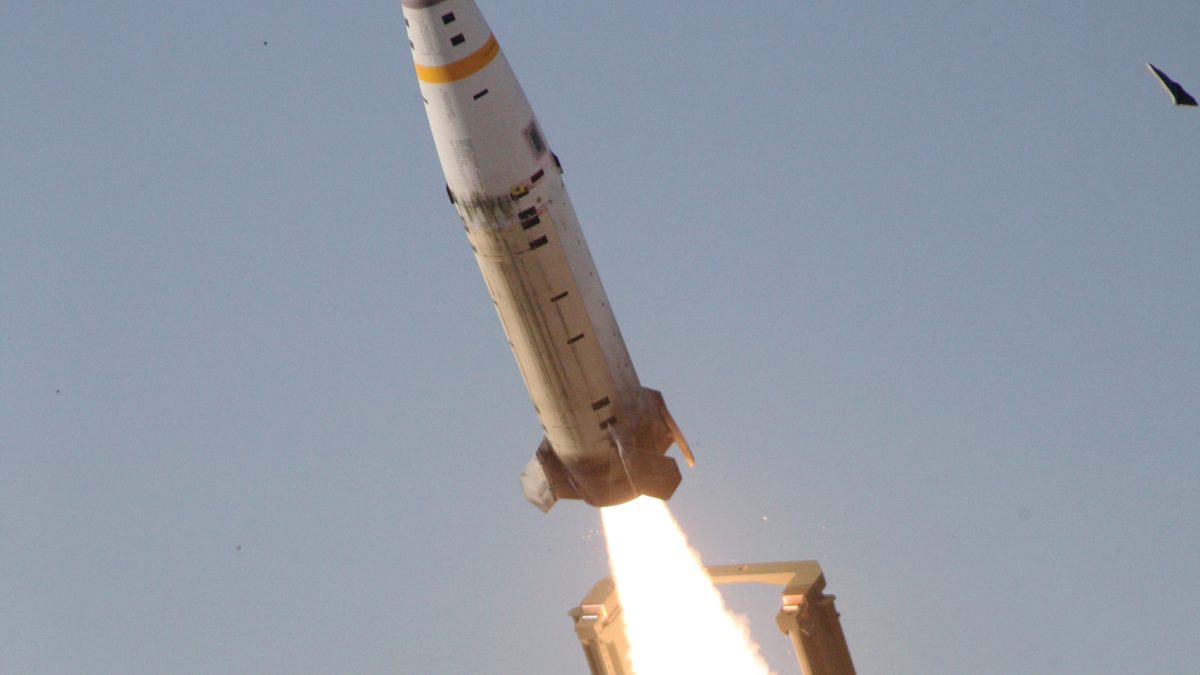
An M57A1 Army Tactical Missile System (ATACMS) missile is fired over the cab of an M142 High Mobility Artillery Rocket System (HIMARS) launcher. U.S. Army photo / U.S. Army Acquisition Support Center / DVIDS (public domain). Use does not imply endorsement.
Taiwan Deepens Its Missile Magazine: $439m ATACMS Award Lands as the Production Line Sunsets
On 15 July 2026 the US Army placed a 439.4 million dollar undefinitized contract with Lockheed Martin for Army Tactical Missile System (ATACMS) guided missiles and launch assemblies, funded entirely by Foreign Military Sales to Taiwan. The award, against a cumulative ceiling of 896.7 million dollars, extends a production line the Precision Strike Missile is set to replace.
Technical Summary
The Army Tactical Missile System (ATACMS) is a solid-propellant, surface-to-surface guided missile in the MGM-140 family, fired one round per pod from the M270 Multiple Launch Rocket System (MLRS) and the M142 High Mobility Artillery Rocket System (HIMARS). The 15 July 2026 US Department of War contract announcement records a 439,387,261 dollar undefinitized contract action to Lockheed Martin of Grand Prairie, Texas, for the ATACMS guided missile and launching assembly, against a total cumulative ceiling of 896,708,696 dollars, with the sum obligated from fiscal year 2026 Foreign Military Sales (Taiwan) funds. One bid was solicited and one received; work completes by 28 February 2031 under contract W31P4Q-26-C-0019, awarded by Army Contracting Command, Redstone Arsenal.
Current-production ATACMS rounds carry a single unitary WDU-18/B blast and fragmentation warhead in the 227 kilogram (500 pound) class, superseding the earlier M39-series submunition payloads of M74 anti-personnel and anti-materiel bomblets now being withdrawn under wider cluster-munition pressure. Range for the unitary M57 variant is commonly cited at up to 300 kilometres. An undefinitized contract action authorises production before final price and terms are settled, a mechanism reserved for schedule-driven work; here it signals that Taipei's magazine is being filled at pace even as the ATACMS line approaches the end of its service life.
An undefinitized contract action lets the line cut metal before the price is fixed. That the US Army is willing to do so for a Taiwan-bound missile it is itself retiring says as much about deterrence timing as about industrial economics. ISC open-source assessment
Analysis of Effects
Read against the Taiwan Strait, ATACMS gives Taipei a roughly 300 kilometre reach that covers Chinese coastal marshalling areas, ports and airfields opposite the island, complementing the shorter-ranged Guided Multiple Launch Rocket System (GMLRS) and the land-attack and coastal-defence missiles already contracted. Each ATACMS occupies a full launch pod that would otherwise hold six GMLRS rockets, so magazine depth, not launcher count, becomes the binding constraint for the HIMARS launchers Taiwan has received since 2024. The value of this award, set beside Taiwan's 2020 Foreign Military Sales case, points to a meaningful expansion of that depth rather than a token top-up.
The industrial signal is just as important. Lockheed Martin's ATACMS line is being superseded in US service by the Precision Strike Missile (PrSM), which fits two rounds per pod and reaches further. Export orders such as this one keep the older line warm through its sunset and let allied stocks be built while unit costs and tooling still exist. For Taiwan the calculation is straightforward: a proven missile available now is worth more than a superior one available later, particularly when the deterrence clock is the variable that matters most.
Personnel and Safety Considerations
As an assembled round the ATACMS missile is a Hazard Division 1.1 mass-detonating store; its solid rocket motor and unitary high-explosive warhead drive the quantity-distance and storage-licensing requirements at any holding site, and the net explosive quantity of the warhead fill is the figure that governs those calculations. Open sources do not disclose the warhead fill type or its net explosive quantity for the current export configuration, so magazine planners should treat published figures as indicative until confirmed against the delivered technical data package. Transport and storage fall under the applicable national and NATO ammunition regulations, including AASTP-1 Edition C for storage and the relevant modal dangerous-goods codes for movement.
Data Gaps
The contract states dollars, not quantities: the number of missiles, the specific M57 variant, and the delivery schedule to Taiwan are not disclosed. The warhead fill type and net explosive quantity, the rocket motor propellant formulation, and whether the launching assembly is the launch pod container alone or includes launcher hardware are also unstated. The undefinitized status means final price and full scope remain to be settled, so the cumulative ceiling of 896.7 million dollars, rather than the 439.4 million dollar obligation, is the better guide to eventual programme size.
Key Questions
What did the US Army buy for Taiwan in July 2026?
On 15 July 2026 the US Army awarded Lockheed Martin a 439.4 million dollar undefinitized contract for Army Tactical Missile System (ATACMS) guided missiles and launch assemblies, funded entirely by Foreign Military Sales to Taiwan, against a cumulative ceiling of 896.7 million dollars.
How far can ATACMS reach and what warhead does it carry?
The current unitary ATACMS variant reaches up to about 300 kilometres and carries a single WDU-18/B blast and fragmentation warhead in the 227 kilogram class, replacing the older M74 submunition payloads now being withdrawn under cluster-munition pressure.
Why order ATACMS when the Precision Strike Missile is replacing it?
Because a proven missile available now supports deterrence better than a superior one available later. Export orders also keep Lockheed Martin's ATACMS line warm through its sunset, letting allied stocks be built while the tooling and unit costs still exist.
References
Source-evaluated under NATO STANAG 2022 (Reliability A–F / Accuracy 1–6). Tier 1 = government primary source; Tier 2 = quality news / specialist defence media; Tier 3 = authoritative aggregator / encyclopaedia.
- T1US Department of War – Contracts for July 15, 2026, 15 July 2026. (Reliability A / Accuracy 1)
- T2US Defense Security Cooperation Agency – Major Arms Sales, accessed 18 July 2026. (Reliability B / Accuracy 2)
- T2Lockheed Martin – Army Tactical Missile System (ATACMS) product page, accessed 18 July 2026. (Reliability B / Accuracy 2)
- T2CSIS Missile Threat – ATACMS (MGM-140) missile profile, accessed 18 July 2026. (Reliability B / Accuracy 2)
- T3Wikipedia – MGM-140 ATACMS, accessed 18 July 2026. (Reliability C / Accuracy 3)
Corrections & updates welcome. If you hold open-source data that refines or corrects any parameter in this article, please contact [email protected] citing the specific claim and your source. Verified corrections will be incorporated and credited in the revision history. AI-assisted technical assessment based on open-source material. Not a formal intelligence product.