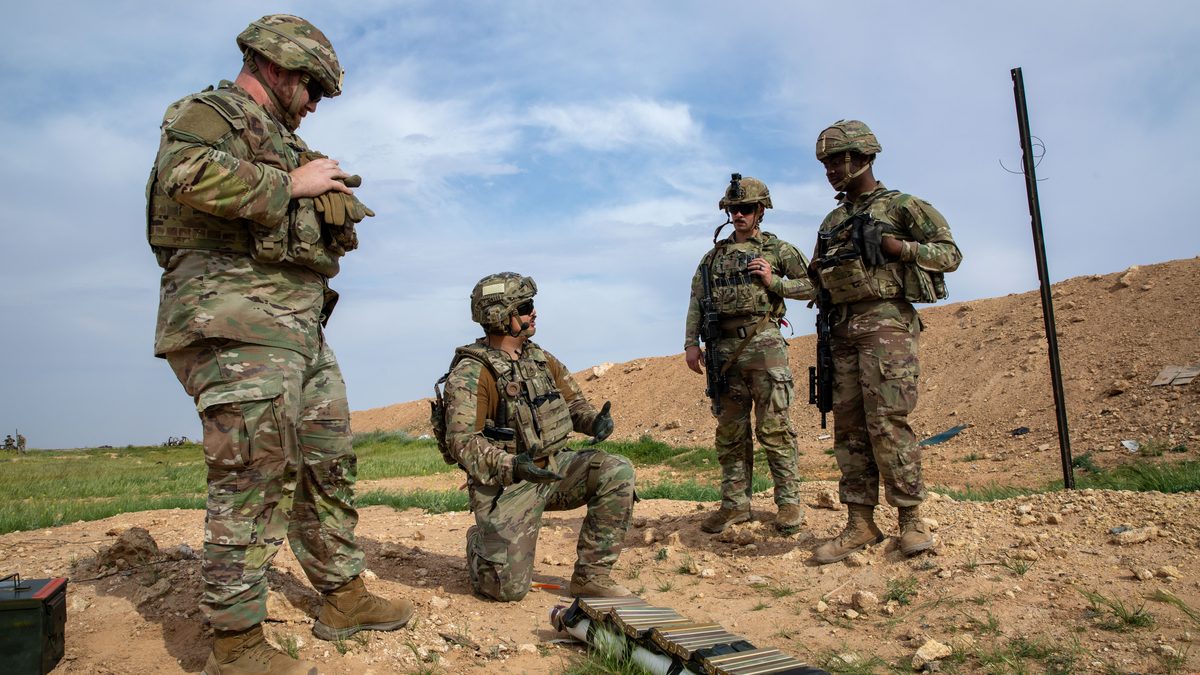
A U.S. Army Explosive Ordnance Disposal technician briefs a controlled-detonation demolition range during coalition EOD training. U.S. Army photo by Sgt. Ryan Ahmed / DVIDS (public domain). Use does not imply endorsement.
Explosive Harvesting: The US Funds Regional EOD and Counter-IED Training After the Iran Conflict
On 14 July 2026 the US State Department's Bureau of Counterterrorism opened a cooperative agreement worth up to 3.95 million dollars for explosive ordnance disposal, counter-improvised-explosive-device and post-blast investigation training and equipment across Iraq, Lebanon and the six Gulf Cooperation Council states, driven by the unexploded-ordnance legacy of the 2026 Iran conflict.
Technical Summary
The Bureau of Counterterrorism (CT) of the US Department of State posted funding opportunity DFOP0018683 on 14 July 2026, an open competition under Assistance Listing 19.701 (Global Counterterrorism Programs) for a single cooperative agreement with a ceiling of 3,946,719 dollars and no cost-share requirement. The award funds explosive ordnance disposal (EOD), counter-improvised-explosive-device (C-IED) and post-blast investigation training and equipment for security forces in Iraq, Lebanon and the Gulf Cooperation Council (GCC) states of Bahrain, Kuwait, Oman, Qatar, Saudi Arabia and the United Arab Emirates.
The stated driver is the residue of the 2026 conflict, in which Iran's widespread use of ballistic missiles and uncrewed aerial systems (UAS) left a persistent unexploded-ordnance (UXO) hazard. The notice names the specific risk of explosive harvesting: malign actors recovering energetic material or intact sub-components from failed munitions to build new improvised explosive devices. Named beneficiaries include the Iraqi security forces, the Lebanese Armed Forces (LAF), the Lebanese Internal Security Forces (ISF) and GCC security services, with the programme also intended to strengthen post-blast forensic and weapons technical intelligence (WTI) capability for attribution and prosecution.
Explosive harvesting turns a failed strike into a magazine. Every ballistic-missile warhead or loitering-munition charge that lands without functioning is a stock of energetic material waiting for someone with intent. ISC open-source assessment
Analysis of Effects
The technical problem behind the money is the character of the ordnance left on the ground. Iranian ballistic missiles carry unitary high-explosive warheads in the several-hundred-kilogram class, while Shahed-pattern loitering munitions carry warheads in the tens of kilograms; a failure to function leaves an armed or partially armed store whose fuzing state is unknown and whose energetic fill may be sensitised by impact, heat or age. Rendering such items safe is a specialist EOD task, and clearing them at scale across contested urban terrain is precisely the capability the programme is trying to seed in partner forces.
Post-blast investigation is the second, quieter half of the requirement. Recovering fuze fragments, casing materials and explosive residues from a functioned device supports weapons technical intelligence and, through it, attribution: matching a device to a supply chain or a builder. That the Bureau of Counterterrorism, rather than a security-assistance office, owns this opportunity signals that Washington reads the UXO problem less as a humanitarian clearance task and more as a counterterrorism and interdiction one, aimed at denying material to networks before it is reused.
Personnel and Safety Considerations
Unexploded ballistic-missile warheads and loitering-munition charges are Hazard Division 1.1 items until proven otherwise, and degraded or sensitised energetics raise the render-safe hazard well above that of a factory-fresh store. Recognised practice frames this work under the International Mine Action Standards, in particular IMAS 09.30 for explosive ordnance disposal, and the International Ammunition Technical Guidelines (IATG) for storage and disposal of recovered items; controlled disposal by demolition in place with a donor charge remains the default for items that cannot be safely moved. Training that does not embed these standards, alongside disciplined post-blast forensic handling, risks trading one hazard for another.
Data Gaps
The notice states a ceiling but no floor and names no incumbent or expected implementer. The specific EOD equipment sets, the balance between training and hardware, and the split of effort across the eight named countries are unstated. The listed closing date of 15 July 2026, one day after posting, is almost certainly a data-portal artefact rather than a genuine 24-hour window, and should be confirmed against the full solicitation on Grants.gov. No estimate of the UXO burden across the affected states is given, so the scale of the underlying problem the award addresses cannot be sized from the notice alone.
Key Questions
What is the US State Department funding for EOD in the Near East?
The Bureau of Counterterrorism opened a cooperative agreement on 14 July 2026 worth up to 3.95 million dollars for explosive ordnance disposal, counter-improvised-explosive-device and post-blast investigation training and equipment for security forces in Iraq, Lebanon and the six Gulf Cooperation Council states.
What is explosive harvesting and why does it matter?
Explosive harvesting is the recovery of energetic material or intact components from unexploded ordnance to build new improvised explosive devices. It matters because the 2026 Iran conflict left large numbers of failed ballistic-missile warheads and loitering-munition charges that malign actors could reuse against soft targets.
Which forces and countries does the programme cover?
The programme names the Iraqi security forces, the Lebanese Armed Forces, the Lebanese Internal Security Forces and Gulf Cooperation Council security services, covering Iraq, Lebanon, Bahrain, Kuwait, Oman, Qatar, Saudi Arabia and the United Arab Emirates.
References
Source-evaluated under NATO STANAG 2022 (Reliability A–F / Accuracy 1–6). Tier 1 = government primary source; Tier 2 = quality news / specialist defence media; Tier 3 = authoritative aggregator / encyclopaedia.
- T1Grants.gov (Simpler.Grants.gov) – Regional Explosive Ordnance Disposal Operations in the Near East (DFOP0018683), 14 July 2026. (Reliability A / Accuracy 1)
- T2US Department of State – Bureau of Counterterrorism, accessed 18 July 2026. (Reliability B / Accuracy 2)
- T2International Mine Action Standards – IMAS 09.30 Explosive ordnance disposal, accessed 18 July 2026. (Reliability B / Accuracy 2)
- T2UN SaferGuard – International Ammunition Technical Guidelines (IATG), accessed 18 July 2026. (Reliability B / Accuracy 2)
- T3Wikipedia – Bomb disposal (explosive ordnance disposal), accessed 18 July 2026. (Reliability C / Accuracy 3)
Corrections & updates welcome. If you hold open-source data that refines or corrects any parameter in this article, please contact [email protected] citing the specific claim and your source. Verified corrections will be incorporated and credited in the revision history. AI-assisted technical assessment based on open-source material. Not a formal intelligence product.