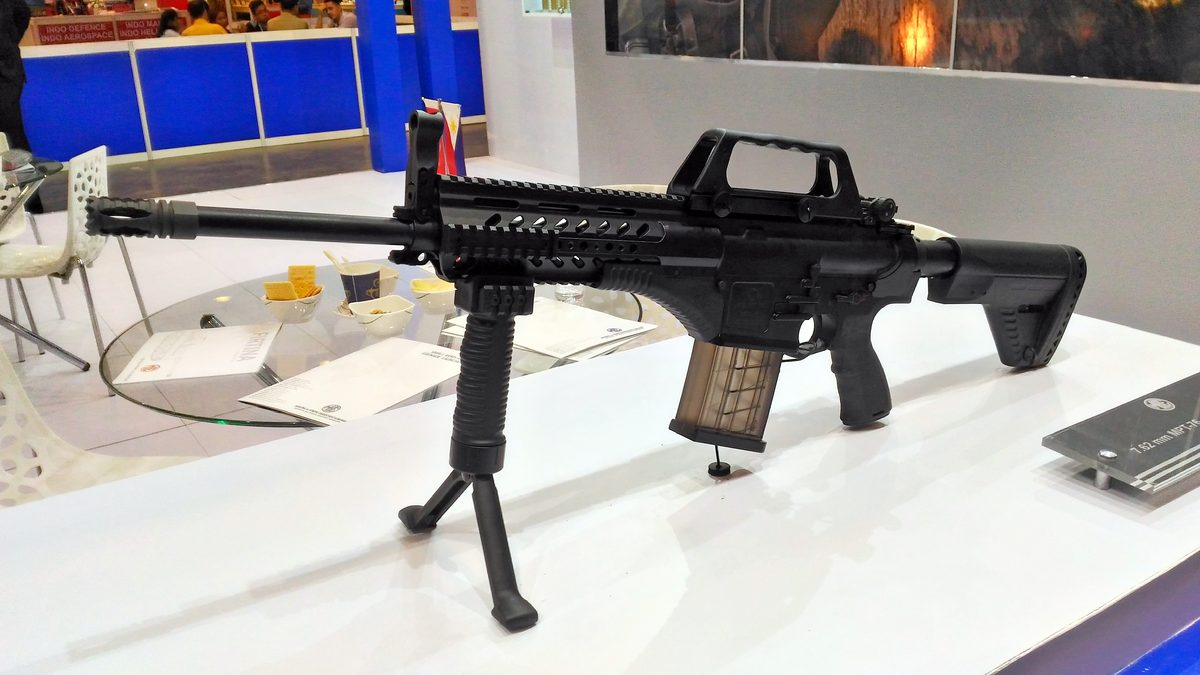
MKE MPT-76, base variant of the newly delivered MPT-76 MH. Photo: Rhk111 via Wikimedia Commons, licensed CC BY-SA 4.0.
Türkiye Fields the Lightweight MPT-76 MH as MKE Completes Serial Production
Yes. On 18 July 2026 Türkiye's state manufacturer MKE announced it had completed serial production of the MPT-76 MH, the lightweight version of the national infantry rifle, and delivered a large batch to the Turkish Land Forces Command. The 7.62 x 51 mm NATO rifle weighs about 3.75 kg, roughly 0.45 kg less than the base MPT-76.
Technical Summary
The MPT-76 MH is the lightweight member of Türkiye's MPT-76 family (Millî Piyade Tüfeği, the national infantry rifle). It is chambered in 7.62 x 51 mm NATO and uses a gas-operated, short-stroke piston system with a rotating bolt, the same operating principle as the base MPT-76. Makina ve Kimya Endüstrisi A.S. (MKE), the Turkish state ordnance manufacturer, builds the rifle at its Kırıkkale Firearms Factory. The MH revision trims empty weight to roughly 3.75 kg, against about 4.2 kg for the standard MPT-76, a reduction of the order of 0.45 kg. Open sources quote an effective range of up to 600 m and a cyclic rate reported at between 650 and 750 rounds per minute, with the spread reflecting differences between older and current manufacturer figures.
On 18 July 2026 MKE announced that serial production of the MPT-76 MH was complete and that a large batch had been shipped into the inventory of the Turkish Land Forces Command (Kara Kuvvetleri Komutanlığı). MKE states the design cleared 58 qualification tests in total: 42 aligned to NATO test standards, covering conditions such as cold, heat, sand, rain and mud, and 16 to Turkish national standards. The manufacturer claims the MPT-76 MH is the only rifle in its calibre class to have passed the full set. The exact number of rifles in the delivered batch and the contract value were not disclosed. For programme context, cumulative deliveries across the wider MPT-76 family had already exceeded 40,000 rifles in earlier reporting, with production shared historically between MKE, Sarsılmaz and Kalekalıp.
MKE says the MPT-76 MH cleared 58 separate qualification tests, 42 to NATO standards and 16 to Turkish national standards, and claims it is the only rifle in its calibre class to have passed the full set. ISC assessment of MKE and Turkish state-media statements, 18 July 2026
MPT-76 MH: baseline specification (open sources)
| Designation | MPT-76 MH (Millî Piyade Tüfeği, lightweight) |
| Calibre | 7.62 x 51 mm NATO |
| Operating system | Gas-operated, short-stroke piston, rotating bolt |
| Empty weight | approx 3.75 kg (base MPT-76: approx 4.2 kg) |
| Effective range | up to 600 m |
| Cyclic rate | 650 to 750 rounds/min (source variance) |
| Barrel life | up to approx 12,000 rounds (manufacturer) |
| Operating temperature | minus 40 C to plus 65 C (manufacturer) |
| Manufacture | MKE Kırıkkale Firearms Factory, Türkiye |
| Qualification | 58 tests (42 NATO-standard, 16 Turkish national) |
Analysis of Effects
The engineering headline is weight, but the procurement signal is control. By closing out serial production of a lightweight 7.62 x 51 mm rifle it owns end to end, Türkiye continues to retire the Heckler and Koch G3 legacy fleet with a platform it can build, modify and sustain without an external licensor. Because the cartridge is standard NATO 7.62 x 51 mm, the rifle stays inside allied ammunition logistics: it draws on the same ball, tracer and linked natures held across NATO stockpiles, which matters for coalition operations and for export customers who value that interchangeability.
Lightening the infantry rifle by roughly 0.45 kg reads as marginal in isolation, yet it compounds across a soldier's full combat load and across a force of hundreds of thousands. The MH revision folds in field feedback on ergonomics and handling, which is the normal maturation path for a service rifle several years into issue. The harder question is industrial: whether the MH now supersedes the base MPT-76 on the line or runs alongside it, and how MKE apportions work against Sarsılmaz and Kalekalıp. MKE frames the NATO-standard test pass as an export argument, positioning the rifle for allied and partner buyers rather than the home army alone.

Personnel and Safety Considerations
As a service weapon rather than a bulk-energetic store, the MPT-76 MH carries the conventional small-arms hazard profile: it is the cartridge, not the rifle, that is the energetic item. The rifle feeds standard 7.62 x 51 mm NATO ammunition, so unit-level storage, transport and accounting of ball and tracer natures follow the same national and NATO small-arms ammunition rules already in force, with no new explosive licensing implication from the rifle itself. The qualification claim, operation across a minus 40 C to plus 65 C envelope and through sand, mud and immersion, speaks to reliability rather than terminal effect; ISC has not independently verified the individual test results. Transition training should account for the full-power 7.62 x 51 mm recoil impulse relative to intermediate-calibre carbines, and for any handling differences introduced by the lighter furniture.
Data Gaps
Several load-bearing specifics remain unconfirmed in open sources and are flagged rather than asserted. The exact number of MPT-76 MH rifles in the delivered batch is not disclosed. Neither the contract value nor the order and delivery schedule is published. The stated weight reduction varies across sources, from roughly 0.4 kg to as much as 0.75 kg, so the figure of about 0.45 kg used here is an open-source central estimate, not a confirmed manufacturer datum. The cyclic rate is quoted at both 650 and 750 rounds per minute in different reports. No MKE or Turkish Land Forces officials are named in the coverage, the breakdown of the 42 NATO-standard tests is not published, and MKE's claim to be the only rifle in its class to pass the full set cannot be independently corroborated.
Key Questions
What is the MPT-76 MH?
The MPT-76 MH is the lightweight version of Türkiye's MPT-76 national infantry rifle, chambered in 7.62 x 51 mm NATO. Built by the state manufacturer MKE, it weighs about 3.75 kg, roughly 0.45 kg less than the standard MPT-76, and has been delivered to the Turkish Land Forces Command.
How many MPT-76 MH rifles has MKE delivered?
MKE announced a large-scale delivery to the Turkish Land Forces Command on 18 July 2026 and said serial production is complete, but it did not publish the exact number in the batch or the contract value. Cumulative deliveries across the wider MPT-76 family had already passed 40,000 in earlier reporting.
Is the MPT-76 MH compatible with NATO ammunition?
Yes. The rifle fires the standard 7.62 x 51 mm NATO cartridge, so it uses the same ammunition logistics as other NATO 7.62 weapons. MKE says the design passed 42 tests to NATO standards alongside 16 Turkish national tests.
References
Source-evaluated under NATO STANAG 2022 (Reliability A–F / Accuracy 1–6). Tier 1 = government primary source; Tier 2 = quality news / specialist defence media; Tier 3 = authoritative aggregator / encyclopaedia.
- T1MKE (Makina ve Kimya Endüstrisi A.S.) – MKE Small Arms Catalogue, MPT series, accessed 18 July 2026. (Reliability A / Accuracy 1)
- T2TRT Haber – Hafifletilmis MPT-76 MH'lar Mehmetcigin emrinde, 18 July 2026. (Reliability B / Accuracy 2)
- T2Defence Türkiye Magazine – Lighter Version of the National Infantry Rifle MPT-76 Ready for Duty, 2026. (Reliability B / Accuracy 2)
- T2Demiroren Haber Ajansi (DHA) – MKE silah ve muhimmat teslimatlarini surdurdu, 2026. (Reliability B / Accuracy 2)
- T3Wikipedia – MKE MPT, accessed 18 July 2026. (Reliability C / Accuracy 3)
- T4Defence Turk (@Defence_Turk_EN) – MKE completes large-scale delivery of MPT-76MH rifles to the Turkish Land Forces Command, 18 July 2026. (Reliability D / Accuracy 3)
Corrections & updates welcome. If you hold open-source data that refines or corrects any parameter in this article, please contact [email protected] citing the specific claim and your source. Verified corrections will be incorporated and credited in the revision history. AI-assisted technical assessment based on open-source material. Not a formal intelligence product.