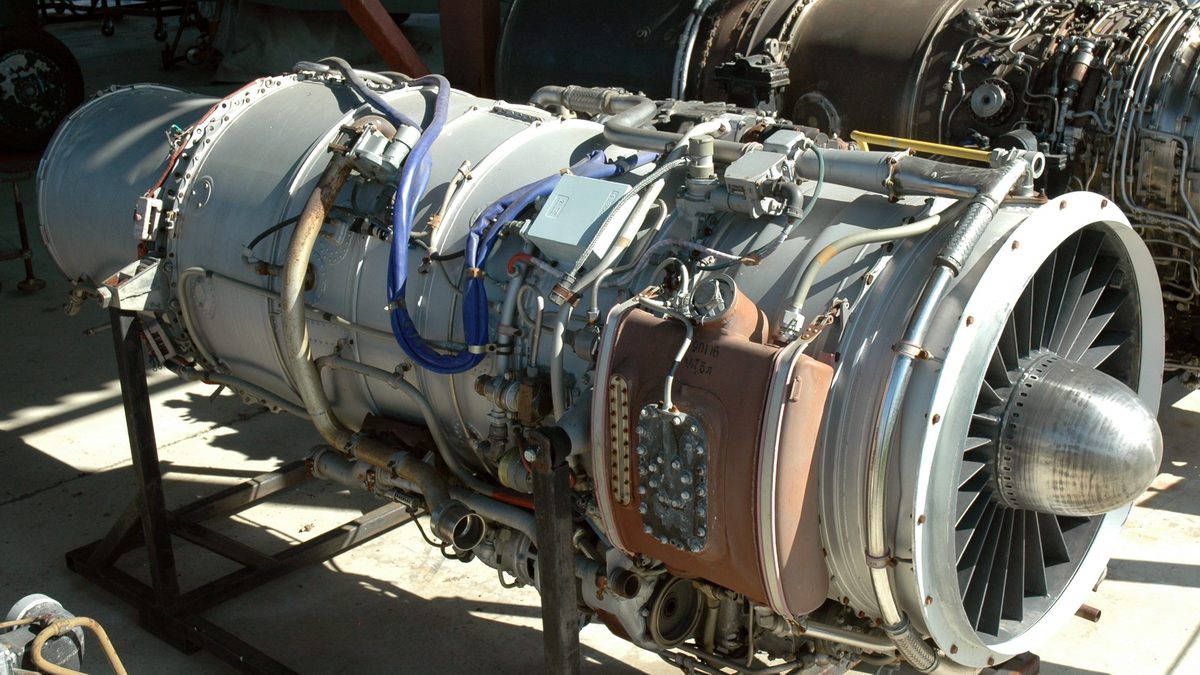
An Ivchenko AI-25 turbofan, the Soviet-era Aero L-39 trainer engine of the type Fire Point salvages and refurbishes to power the FP-5 Flamingo. Photo: VargaA / Wikimedia Commons, CC BY-SA 4.0. Shown as illustrative of the engine class, not a Fire Point unit.
The Important Number Is Not 3,000 km. It Is Three Per Day.
Fire Point, a Ukrainian manufacturer, says it now builds up to three FP-5 Flamingo cruise missiles and roughly 200 long-range strike drones every day. The reach that draws the headlines is the Flamingo’s 3,000 kilometre range. The number that matters is the daily output. A production line this cheap and this dispersed is harder to defeat than any single missile.
Technical Summary
The FP-5 Flamingo is a truck-launched cruise missile developed by Fire Point, a Ukrainian defence company. Open sources put its range at up to 3,000 kilometres and its warhead at a gross mass of 1,150 kilograms. It cruises at roughly 700 to 900 kilometres per hour at low level. Guidance is satellite based, using the Global Navigation Satellite System (GNSS) with an inertial navigation system (INS) as backup, and reported accuracy sits near 14 metres circular error probable (CEP). There is no terrain-contour matching of the kind carried by a Tomahawk.
The economics sit in the engine. Fire Point powers the Flamingo with the Ivchenko AI-25, a Soviet-era medium-bypass turbofan built in its thousands for the Aero L-39 Albatros trainer. Salvaged examples are cheap and plentiful, and a one-way weapon does not need the service life an aircraft demands. The airframe is wound from carbon fibre on an automated line. Fire Point says a Flamingo costs about half of a Tomahawk. Open-source estimates place the Flamingo unit price between 500,000 dollars and just under one million. Recent and widely reported United States figures put a Tomahawk at roughly two million dollars or more per missile, depending on the variant and the size of the order, so on price the Ukrainian weapon looks cheaper still. In engine class and satellite-plus-inertial guidance the Flamingo sits in the same broad family as older turbofan cruise missiles such as the Soviet Kh-55 and its Kh-101 successor, though it is built for volume rather than a long shelf life.
Range, payload and unit price do not measure accuracy, reliability, survivability, or the probability of penetrating a defended target. The Flamingo is not simply a cheaper Ukrainian Tomahawk. It is a different design philosophy. ISC open-source assessment, 18 July 2026

Analysis of Effects
Range, payload and unit price are the figures that travel well. None of them measure accuracy, reliability, survivability, the mission-planning burden, or the probability of getting through a defended target. The 1,150 kilogram figure describes gross warhead mass, not net explosive quantity (NEQ), which Fire Point has not disclosed. Terminal effect depends on the NEQ, the fill type and the fuzing, none of which are in the public record. A bigger case does not by itself mean a bigger blast.
The strike logic is not about one exceptional weapon. At a reported 55,000 dollars, the FP-1 one-way attack drone provides cheap volume, and it forces an air defence network to spend interceptors worth far more than the target. The Flamingo adds a heavy warhead and long reach on top. Run together, the cheap drones saturate the approach routes and drain the interceptor magazine, while the cruise missiles threaten the targets that need real destructive power. The defender has to be strong everywhere at once. That is expensive.
FP-5 Flamingo: open-source parameters
| Type | Truck-launched, jet-powered cruise missile |
| Range | Up to 3,000 km (reported) |
| Warhead (gross) | 1,150 kg; net explosive quantity not disclosed |
| Cruise speed | 700 to 900 km/h |
| Guidance | GNSS with INS backup; approx. 14 m CEP; no terrain matching |
| Powerplant | Ivchenko AI-25 turbofan, salvaged and refurbished |
| Unit cost | ~USD 0.5m to under 1m (est.); Fire Point says about half a Tomahawk |
| Claimed output | Up to 3 Flamingos and ~200 strike drones per day (unaudited) |
Personnel and Safety Considerations
For explosive ordnance disposal (EOD) and weapons intelligence staff, the salient point is variety, not a single signature. A dispersed inventory that mixes carbon-fibre cruise missiles, one-way attack drones and refurbished Soviet engines produces a wide range of impact and failure states. Unexploded or partially functioned airframes may carry undisclosed net explosive quantities, unfamiliar fuze trains and residual fuel. Any recovered wreckage should be treated as potentially armed until the fuze state and fill are established. Handling should follow current UK Defence Safety Authority (DSA) guidance under DSA 03.OME principles, not assumptions imported from Western munitions of known configuration.
Data Gaps
Several load-bearing figures rest on the manufacturer’s own statements and are not independently audited. The daily production claim of three Flamingos and 200 drones has not been verified by a third party. Net explosive quantity, warhead fill and fuzing are undisclosed. Guidance performance against jamming, and the true circular error probable in combat conditions, are not established. The gap between rated production capacity and combat-ready delivery, meaning missiles fuelled, checked and actually launched, is unknown. Stockpiling, testing and reserve holdings could all sit between a factory figure and a launch rate.
Key Questions
How many Flamingo missiles and drones can Fire Point make each day?
Fire Point says it can now build up to three FP-5 Flamingo cruise missiles and about 200 long-range strike drones a day, a figure its chief designer Denys Shtilerman gave in March 2026. The company says output could double or triple. None of it is independently audited.
Is the Flamingo just a cheaper Ukrainian Tomahawk?
No. The Flamingo carries a heavier warhead and flies further than a Tomahawk, but it uses satellite and inertial guidance with roughly 14 metre accuracy and no terrain matching. It is a single-mission weapon built from salvaged Soviet engines, not a decades-of-inventory precision system.
Why does the production rate matter more than the range?
Range, payload and price do not measure accuracy, survivability or how many targets an enemy must defend. Building three missiles and 200 drones a day lets Ukraine present more aim points than an air defence network can cover economically. The line, not any single missile, is the asset.
References
Source-evaluated under NATO STANAG 2022 (Reliability A–F / Accuracy 1–6). Tier 1 = government primary source; Tier 2 = quality news / specialist defence media; Tier 3 = authoritative aggregator / encyclopaedia.
- T1US Navy – Tomahawk Cruise Missile fact file, accessed 18 July 2026. (Reliability A / Accuracy 1)
- T2The Atlantic – Profile of Fire Point and Denys Shtilerman on Ukraine’s drone and missile output, July 2026. (Reliability B / Accuracy 2)
- T2United24 Media – Ukraine is producing 200 long-range strike drones a day and says output can triple, March 2026. (Reliability B / Accuracy 2)
- T1Fire Point – FP-5 Flamingo system page (manufacturer, self-reported specifications), accessed 18 July 2026. (Reliability B / Accuracy 3)
- T2Ukrainska Pravda – Ukraine’s long-range strike programme, 9 May 2026. (Reliability B / Accuracy 2)
- T3Wikipedia – FP-5 Flamingo (consolidated specifications, engine, cost and production timeline), accessed 18 July 2026. (Reliability C / Accuracy 3)
Corrections & updates welcome. If you hold open-source data that refines or corrects any parameter in this article, please contact [email protected] citing the specific claim and your source. Verified corrections will be incorporated and credited in the revision history. AI-assisted technical assessment based on open-source material. Not a formal intelligence product.