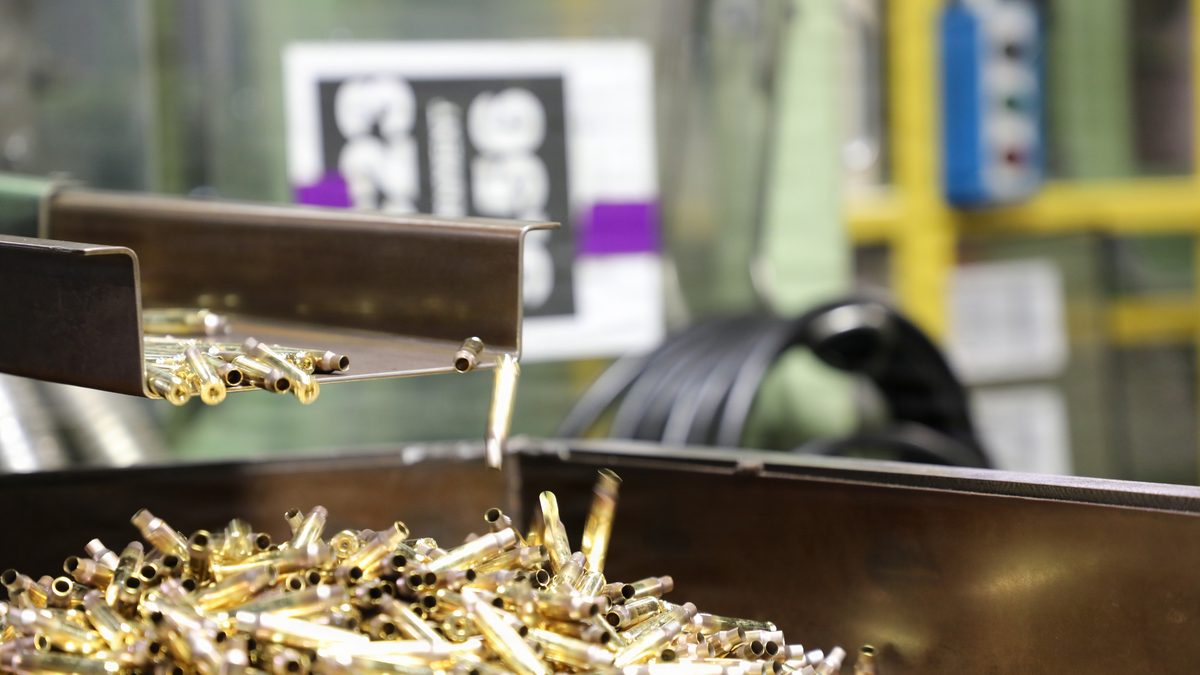
Small calibre ammunition production on the SCAMP line at Lake City Army Ammunition Plant. U.S. Army photo by Dori Whipple, Joint Munitions Command (public domain, via DVIDS).
A live 5.56mm NATO IDIQ on SAM.gov: the US keeps buying the legacy round as it fields 6.8mm
A request for proposal for a 5.56mm NATO and .223 Remington indefinite delivery, indefinite quantity (IDIQ) contract is live on SAM.gov as of 17 July 2026. It confirms the United States is still buying the legacy rifle round, funded at 128.283 million dollars for 245.566 million cartridges in the FY2026 budget, even as it fields the 6.8mm Next Generation Squad Weapon.
Technical Summary
The System for Award Management, SAM.gov, is the single public portal through which the US federal government advertises contract opportunities. Listed on it now is an opportunity titled "RFP - 5.56 NATO/223 Remington Ammunition IDIQ". A request for proposal (RFP) is the formal step at which the government invites priced offers. An indefinite delivery, indefinite quantity (IDIQ) vehicle is the contracting form that suits ammunition sustainment well: it fixes the terms, the unit pricing and a ceiling quantity, then lets the government place delivery orders over a multi-year period as war reserve, training and export demand actually materialises, rather than committing every round up front.
The round itself is the 5.56x45mm NATO cartridge, standardised across the Alliance under STANAG 4172, with the commercial .223 Remington as its close parent case. This is small arms ammunition, and its hazard character matters for how it is stored and moved rather than for any battlefield novelty. Packaged service small arms cartridges are classified UN Hazard Division 1.4, compatibility group S (HD 1.4 S): the recognised meaning is that any initiation in transit or store stays confined to the package, with no mass detonation and no significant hazard beyond the immediate vicinity. That classification, not terminal ballistics, is the WOME thread through a procurement story of this kind.
What an IDIQ actually buys
An IDIQ contract is not a single fixed order. It qualifies one or more suppliers, sets agreed pricing and a maximum ceiling, then draws individual delivery orders against that ceiling as requirements arise. For a commodity like 5.56mm ball and tracer, this lets the government keep production lines warm and surge on demand without forecasting every cartridge years ahead. It is the standard mechanism for sustaining a mature munition whose annual demand is steady but not perfectly predictable.
The FY2026 budget funds 245.566 million 5.56mm cartridges at 128.283 million dollars, up from 84.090 million dollars a year earlier, while 6.8mm Next Generation Squad Weapon ammunition draws 426.177 million dollars. FY2026 Procurement of Ammunition, Army
Analysis of Effects
Read as a procurement signal, a live 5.56mm IDIQ is evidence of sustainment, not reversal. The 6.8mm Next Generation Squad Weapon re-equips close combat formations with the M7 rifle and the M250 automatic rifle, and it is funded generously, at 426.177 million dollars in FY2026 against 194.889 million dollars the year before. That fielding does not empty the 5.56mm requirement. The installed base of M4 carbines and M249 squad automatic weapons runs into the millions across active, reserve and allied hands. Training consumption, the Title 10 war reserve backing approved Combatant Commander operational plans, test and evaluation lots, and Foreign Military Sales to partners who standardise on the same NATO cartridge all keep the demand line firmly above zero. The FY2026 justification is explicit that its 5.56mm buy supports war reserve, training for both Active and Reserve Component forces, and test requirements.
The industrial picture reinforces the point. The FY2026 budget maintains minimum sustaining rates at both Lake City Army Ammunition Plant, operated by Olin Winchester, and a second source facility at Oxford, Mississippi. Keeping two qualified sources warm is a deliberate resilience choice: it protects against a single point of failure and preserves the skilled workforce and tooling that a surge would need. Lake City is simultaneously the centre of the 6.8mm build-out, where a new 450,000 square foot cartridge facility is under construction with equipment installation expected from 2028, so the two calibres are being produced side by side rather than one simply replacing the other. A fresh 5.56mm IDIQ competed now, potentially widening the supplier base, fits that logic precisely.
Personnel and Safety Considerations
For ammunition technicians and storekeepers, the relevance of a contract like this is inventory and classification management rather than any handling novelty. Service 5.56mm ball and tracer are among the most routinely handled natures in any inventory, but they still carry a real fire hazard and must be stored and transported under the HD 1.4 S rules and the relevant modal regulations, including ADR for road and the IMDG Code for sea. Where tracer natures are included in a delivery, the pyrotechnic composition raises the fire risk relative to plain ball, and mixed pallets should be segregated and marked accordingly. None of this is exotic, and there is no explosive ordnance disposal dimension to a factory-fresh, correctly configured commercial and military round. The professional discipline is simply to treat a new supply stream as new stock: verify lot documentation, confirm hazard classification on receipt, and fold it into the existing stock rotation.
Data Gaps
The full opportunity sits behind SAM.gov registration, so several load-bearing parameters cannot be independently confirmed from open sources at the time of writing. Not verified here: the solicitation number, the issuing agency and contracting office, the NAICS and product service codes, any small business set-aside status, the IDIQ ceiling value and ordering period, the funded quantities and delivery schedule under this specific vehicle, the exact projectile configurations sought (for example M855, M855A1 enhanced performance round, or M856 tracer), the offer due date, and the place of performance. It is also not confirmed whether this RFP establishes a new second source, recompetes an existing vehicle, or supplements Lake City capacity. The FY2026 dollar and quantity figures cited above are the Army procurement request for the 5.56mm line as a whole, not the ceiling of this individual IDIQ. Readers with SAM.gov access can resolve these gaps directly from the listing.
Key Questions
What is the 5.56mm IDIQ listed on SAM.gov?
It is a request for proposal for a 5.56mm NATO and .223 Remington indefinite delivery, indefinite quantity contract, listed on SAM.gov, the US federal contract portal. An IDIQ sets terms and a ceiling, then lets the government place orders as demand arises. Full detail requires SAM.gov registration.
Why is the US still buying 5.56mm while fielding 6.8mm?
The 6.8mm Next Generation Squad Weapon re-equips close combat units only. The vast M4 and M249 fleet, reserve and training use, the Title 10 war reserve, and allied forces on the 5.56x45mm NATO standard keep demand high. FY2026 funds 245.566 million 5.56mm cartridges.
Who manufactures US 5.56mm ammunition?
Lake City Army Ammunition Plant in Missouri, operated by Olin Winchester, is the primary producer, alongside a second source facility in Oxford, Mississippi. The FY2026 budget funds minimum sustaining rates at both sites to keep the small calibre industrial base warm.
References
Source-evaluated under NATO STANAG 2022 (Reliability A–F / Accuracy 1–6). Tier 1 = government primary source; Tier 2 = quality news / specialist defence media; Tier 3 = authoritative aggregator / encyclopaedia.
- T1SAM.gov, US System for Award Management – RFP - 5.56 NATO/223 Remington Ammunition IDIQ, accessed 17 July 2026 (full detail requires registration). (Reliability A / Accuracy 1)
- T1Assistant Secretary of the Army (Financial Management and Comptroller) – FY2026 Procurement of Ammunition, Army: CTG 5.56MM All Types and Next Generation Squad Weapon Ammunition, 2025. (Reliability A / Accuracy 1)
- T1U.S. Army – Delivering tomorrow's small caliber ammunition lethality today, April 2026. (Reliability A / Accuracy 1)
- T2Army Recognition – U.S. Army Accelerates Fielding of M7 Assault Rifles and M250 Light Machine Guns in FY2026, 2025. (Reliability B / Accuracy 2)
- T3Wikipedia – Lake City Army Ammunition Plant, accessed 17 July 2026. (Reliability C / Accuracy 3)
Corrections & updates welcome. If you hold open-source data that refines or corrects any parameter in this article, please contact [email protected] citing the specific claim and your source. Verified corrections will be incorporated and credited in the revision history. AI-assisted technical assessment based on open-source material. Not a formal intelligence product.