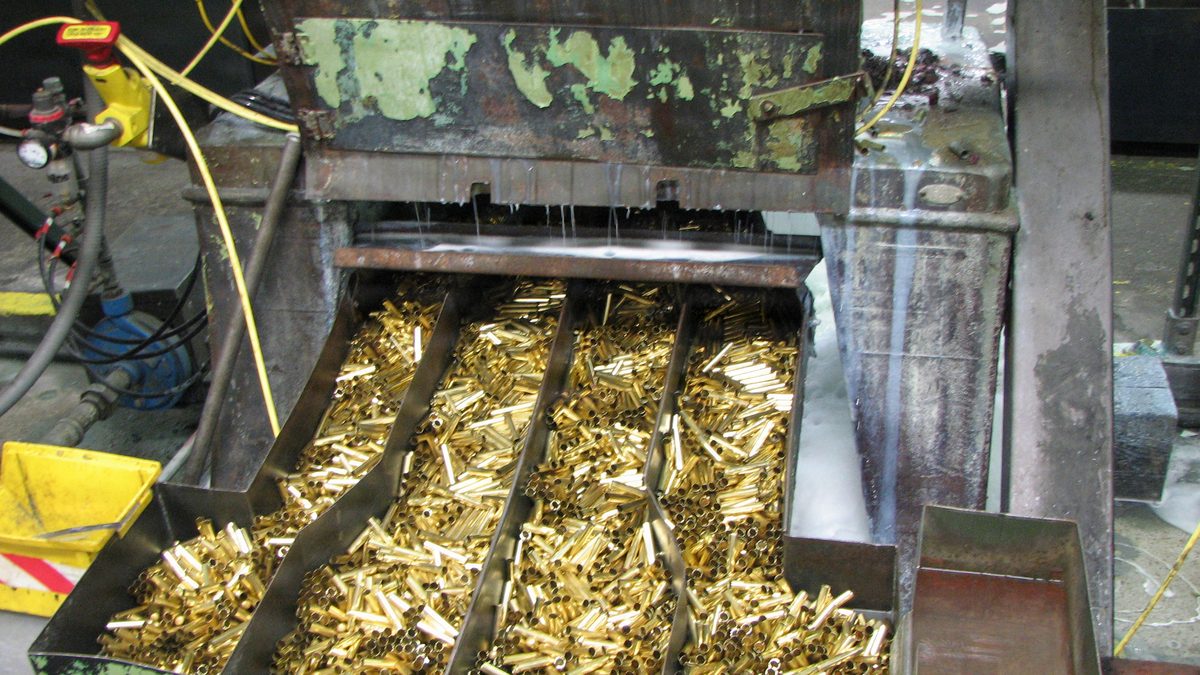
Illustrative image: a small-calibre ammunition production line (Lake City Army Ammunition Plant). Photo by Dori Whipple, U.S. Army, public domain, via DVIDS. Used to illustrate small-arms ammunition manufacture; not the Ketech Asia plant.
Malaysia Locks In Sovereign Small-Arms Ammunition Supply With RM150 Million Ketech Asia Central Contract
Malaysia's Ministry of Defence has appointed Ketech Asia to a RM150 million (about US$32 million) three-year central contract supplying 9mm and 5.56mm small-arms ammunition to the Armed Forces and government security agencies. The award routes demand through a single Finance Ministry mechanism to rebuild depleted stocks and cut reliance on imported cartridges.
Technical Summary
The contract covers two small-calibre natures: the 9x19mm Parabellum pistol and submachine-gun cartridge, and the 5.56x45mm NATO rifle cartridge governed by Standardization Agreement (STANAG) 4172. Both are brass-cased, primed, full-metal-jacket ball rounds rather than energetic-filled ordnance, so Net Explosive Quantity (NEQ) applies only to the propellant charge and primer composition, not to an explosive projectile fill. For transport and storage, packaged service cartridges of this class are United Nations Hazard Division 1.4, Compatibility Group S (HD 1.4 S), the least hazardous energetic category, reflecting their confinement within cartridge cases and packaging.
Ketech Asia manufactures at a plant in Lipis, Pahang, rated at up to 120 million rounds of 9mm and 5.56mm ammunition per year, and the company states an intention to add 7.62x51mm NATO (STANAG 2310) and 12.7x99mm NATO natures. Open-source product listings put the 9mm output in the two standard military ball weights, 115-grain and 124-grain, and the 5.56mm output in both the 55-grain M193 and the 62-grain SS109/M855 constructions, the heavier round being the current NATO-preferred penetrator nature. The National Defence Research and Development Institute (STRIDE) provides testing and evaluation to confirm each lot meets the specifications set by the Armed Forces. The RM150 million ceiling runs over three years, though the parliamentary reply did not break out annual quantities, projectile construction, proof pressures or lot-acceptance criteria.
The Lipis plant is rated at up to 120 million rounds of 9mm and 5.56mm ammunition a year, with 7.62mm and 12.7mm natures planned, giving Malaysia a domestic base across the full small-arms calibre span. ISC open-source technical assessment
Analysis of Effects
The strategic significance is supply resilience rather than a new capability. The written reply was prompted by a question on a significant ammunition shortage within the Armed Forces, and the Central Contract mechanism, coordinated by the Finance Ministry, aggregates demand from the military and other security agencies into one instrument. Consolidating buyers reduces price fragmentation and gives a single domestic producer the order visibility needed to sustain a production line, the same logic NATO applies through its framework and Ammunition Support Partnership contracts.
Choosing the 9mm, 5.56mm, 7.62mm and 12.7mm family keeps Malaysia inside the Western small-arms interoperability set even though it is not a NATO member, which matters for coalition exercises and for weapons already in service sourced through Foreign Military Sales. It also revives a domestic capability that had rested with Malaysian Explosive Ordnance (SMEO), the previous supplier of 5.56mm, 7.62mm, 9mm and 12-bore shotgun ammunition. The National Defence Industry Policy (DIPN) frames the award as a step toward producing critical ammunition components locally and reducing dependence on external sources.
Personnel and Safety Considerations
For ammunition technicians and storekeepers the practical implications are conventional. HD 1.4 S small-arms cartridges attract the lightest quantity-distance and mixing constraints, but primers and propellant remain sensitive to heat and impact, and lots from a new production source require careful marking and segregation for traceability, particularly as small-arms ball ammunition properly stored cool and dry holds a serviceable life measured in decades rather than years, so early lots will remain in the inventory long after the current shortage is cleared. The controlling factor for a producer standing up capacity is quality assurance: consistent chamber pressure, case metallurgy and primer sensitivity determine whether rounds meet proof and function standards. STRIDE testing is the stated gate, but the reply does not confirm whether acceptance is aligned to a NATO Electronic Pressure, Velocity and Action Time (EPVAT) regime or to a national standard.
Data Gaps
Several parameters remain unstated in open sources. The reply gives no annual quantity under the RM150 million ceiling as distinct from plant capacity, no projectile construction (for example an SS109 or M855-class 5.56mm bullet versus an M193-class round), no propellant type, primer composition or proof-pressure specification, and no delivery schedule or lot-acceptance criteria. Whether STRIDE evaluation maps to STANAG 4172 EPVAT methodology or a national proof standard is not disclosed, and the currency conversion of RM150 million is approximate and sensitive to the mid-2026 exchange rate. Timing for the planned 7.62mm and 12.7mm lines is also unconfirmed.
Key Questions
What did Malaysia's ammunition contract with Ketech Asia cover?
Malaysia's Ministry of Defence appointed Ketech Asia to a RM150 million central contract, running three years, to supply 9mm and 5.56mm small-arms ammunition to the Armed Forces and other government security agencies nationwide. The company plans to add 7.62mm and 12.7mm calibre production at its Lipis, Pahang plant.
Why does the Malaysian small-arms ammunition deal matter?
It addresses a stated ammunition shortage in the Armed Forces and rebuilds a sovereign supply chain. By aggregating demand through one Finance Ministry mechanism and a domestic producer, Malaysia aims to cut reliance on imported cartridges while keeping to the 9mm, 5.56mm, 7.62mm and 12.7mm calibres common to Western forces.
How is small-arms ammunition classified for storage and transport?
Packaged service small-arms cartridges such as 9mm and 5.56mm ball are United Nations Hazard Division 1.4, Compatibility Group S (HD 1.4 S), the least hazardous energetic category. Net Explosive Quantity applies only to the propellant and primer, since these are inert-projectile rounds rather than explosive-filled ordnance.
References
Source-evaluated under NATO STANAG 2022 (Reliability A–F / Accuracy 1–6). Tier 1 = government primary source; Tier 2 = quality news / specialist defence media; Tier 3 = authoritative aggregator / encyclopaedia.
- T1The Star (Malaysia), quoting Ministry of Defence written parliamentary reply – RM150mil contract awarded to Ketech Asia to secure armed forces’ ammo supply, 14 July 2026. (Reliability A / Accuracy 1)
- T2The Star (Malaysia) – ‘Malaysia remains a neutral country for defence procurement’, 15 July 2026. (Reliability B / Accuracy 2)
- T2NATO Standardization Office – STANAG 4172 (5.56×45mm) and STANAG 2310 (7.62×51mm) small-arms standards, 2026. (Reliability B / Accuracy 2)
- T2United Nations Economic Commission for Europe (UNECE) – Recommendations on the Transport of Dangerous Goods: Model Regulations (HD 1.4 S small-arms cartridges), 2025. (Reliability B / Accuracy 2)
- T3Wikipedia – 5.56×45mm NATO, accessed July 2026. (Reliability C / Accuracy 3)
Corrections & updates welcome. If you hold open-source data that refines or corrects any parameter in this article, please contact [email protected] citing the specific claim and your source. Verified corrections will be incorporated and credited in the revision history. AI-assisted technical assessment based on open-source material. Not a formal intelligence product.