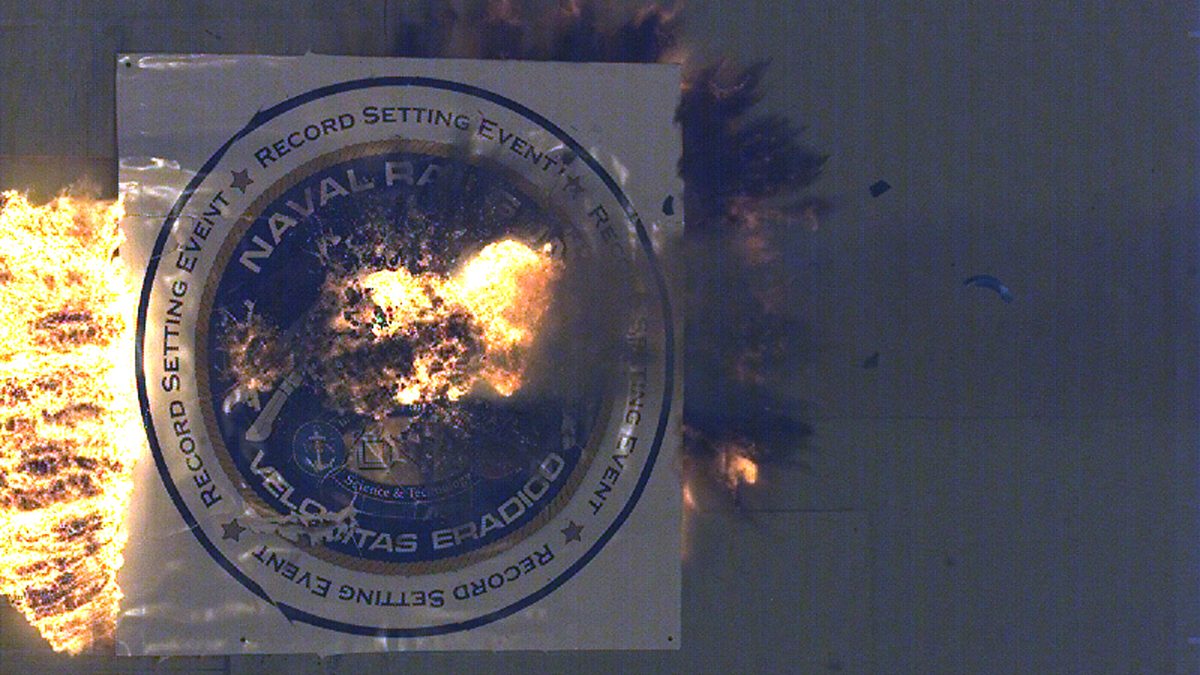
Illustrative: a US Navy electromagnetic railgun fires at 10.64 MJ during a record-setting test at Naval Surface Warfare Center Dahlgren, 31 January 2008. Public domain, US Navy photo by John Williams (DVIDS). Shown to illustrate railgun launch physics; this is not the ISL Baldersheim shot.
Europe’s Railgun Leaves the Laboratory: ISL Fires First Open-Range Kinetic Shot
The French-German Research Institute of Saint-Louis (ISL) fired its electromagnetic railgun in the open air for the first time on 29 June 2026 at Baldersheim, launching a 25mm kinetic-energy projectile beyond Mach 5 with no chemical propellant. The shot opened ISL’s Railgun Free Flight Facility and marks Europe’s step from laboratory rail-launch research toward a counter-hypersonic weapon.
Technical Summary
A railgun is an electromagnetic launcher. A pulsed direct current of the order of two million amperes passes down two parallel rails and through a conducting armature behind the projectile, and the resulting Lorentz force accelerates the round. There is no gun propellant, no cartridge case and no chemical energetic in the launch, so Net Explosive Quantity (NEQ) is not applicable to the firing package. ISL reported that the 29 June shot drove a 25mm projectile to a velocity in excess of Mach 5 under a peak acceleration exceeding 100,000 g, with the launch energy in the one-megajoule (MJ) class.
ISL has not publicly named the launcher used at Baldersheim. The reported parameters, a 25mm bore and roughly one-MJ launch energy, align with ISL’s RAFIRA rapid-fire rail launcher rather than the larger Pegasus demonstrator, which uses a 40 by 40 millimetre square bore and a 10 MJ distributed energy supply. RAFIRA has previously driven projectiles of around 100 grams beyond 2,400 metres per second and can fire short salvos, a design point aimed at the repeated shots a counter-air role would demand. A 100-gram projectile at 2,400 metres per second carries roughly 288 kilojoules of kinetic energy (calculated), delivered entirely as hit-to-kill effect with no explosive fill.
| Parameter | Value |
|---|---|
| Calibre | 25 mm bore |
| Launch energy | One-megajoule (MJ) class |
| Muzzle velocity | Greater than Mach 5 |
| Peak acceleration | Exceeding 100,000 g |
| Chemical propellant | None; Net Explosive Quantity (NEQ) not applicable to the firing package |
| Projectile mass | Not released (RAFIRA-class prior lab work: around 100 g) |
| Inferred launcher | RAFIRA rapid-fire class (not confirmed by ISL) |
| Cited applications | Counter-hypersonic air-and-missile defence; long-range surface fires; naval gunnery |
The 29 June shot drove a 25mm projectile beyond Mach 5 at a peak acceleration exceeding 100,000 g, with the launch energy in the one-megajoule class and not a gram of chemical propellant behind it. ISC assessment of ISL open-source disclosure, July 2026
Analysis of Effects
The military value of a railgun lies in what it removes as much as what it adds. Replacing the propelling charge with stored electrical energy takes the largest single fire-and-explosion hazard out of the weapon and out of the magazine. A warship or land battery holding inert kinetic rounds and a pulsed-power plant no longer stows tonnes of gun propellant, which lowers the magazine hazard classification and, in principle, allows a deeper magazine at lower stored-explosive risk. The cost migrates to the electrical plant: multi-megajoule capacitor banks, mega-ampere switching, and the thermal and structural loads those impose on the rails.
The stated motivation is counter-hypersonic and wider air-and-missile defence. A launcher that pushes a small projectile to very high velocity offers a magazine of low-cost interceptors against manoeuvring threats that make current missile interceptors expensive and finite. ISL frames the open-range shot as the start of that path rather than the arrival: the near-term work is scaling energy across successive shots, tracking the projectile in free flight, and developing projectiles and guidance built specifically for electromagnetic launch. Long-range surface fires and naval gunnery are the other cited applications. None is a fielded system, and the institute is explicit that years of scaling and qualification remain.
International Context
ISL’s open-range shot lands in a field that other navies have found unforgiving. The United States Navy spent roughly 500 million US dollars on its electromagnetic railgun before pausing the programme in July 2021, citing barrel life, a low rate of fire and the competing pull of hypersonic missiles for the same money. Its rails needed replacement after somewhere between 100 and 400 shots, against the thousands of rounds a conventional 5-inch (127mm) gun barrel sustains, and that wear problem was never closed out.
Asia has since pushed ahead at sea. Japan’s Acquisition, Technology and Logistics Agency (ATLA), working with the Japan Maritime Self-Defense Force, mounted a railgun on the test ship JS Asuka and in September 2025 struck a target vessel for the first time. That launcher drives a 40mm, 320-gram steel projectile to roughly Mach 6.5 to 7.35. Measured against those efforts ISL’s 25mm, one-MJ shot is smaller in both calibre and energy, yet it is a live European rail-launch capability firing in the open, which is the claim the institute is staking. The persistent barrier across all three programmes is the same: rail erosion and armature wear under mega-ampere currents, and the pulsed-power plant needed to feed them, not the physics of the launch itself.
Naval News, among the first outlets to report the trial, summarised the milestone on its own channel:
The French-German Research Institute of Saint-Louis (ISL) has successfully conducted the first outdoor, free-flight test of its domestically designed electromagnetic railgun. The milestone test took place on June 29, 2026, at the institute’s proving ground in Baldersheim, marking a critical transition for the European defense technology from laboratory research to open-range validation 🇫🇷🇩🇪⚡
— Naval News (@navalnewscom) July 9, 2026
Personnel and Safety Considerations
The hazards of this technology are electrical and kinetic rather than explosive. The firing package carries no energetic fill, so the familiar Hazard Division (HD) and Compatibility Group (CG) framework for gun propellant and filled projectiles does not apply to the round itself. The dominant risks are instead the multi-megajoule pulsed-power store, currents of the order of two million amperes, rail erosion and armature debris, and the down-range kinetic hazard of a hypervelocity projectile and any sabot or armature that separates in flight. Open-range firing exists precisely to characterise that external ballistic sequence, including whether the projectile stays inside the designated safety corridor. Any future weaponised round that added a payload or guidance section would reintroduce an energetics safety case that the current inert demonstrator does not carry.
Data Gaps
Several parameters remain unconfirmed in open sources. ISL published the shot as a milestone rather than a data release. The exact muzzle velocity is given only as greater than Mach 5, and the projectile mass, construction and sabot design are not stated. The launcher identity is inferred as the RAFIRA class rather than confirmed by ISL. Also unstated are the rail length and bore geometry, the electrical-to-kinetic conversion efficiency achieved on this shot, the rate of fire demonstrated outdoors, and the per-shot rail wear. The 25mm calibre, the one-MJ launch-energy class and the 100,000 g figure are as reported by ISL and specialist coverage and are not independently measured here. The demonstrator round is assessed as inert.
Key Questions
What did ISL’s railgun test on 29 June 2026 actually achieve?
It was the first time ISL fired its electromagnetic railgun outdoors in free flight rather than inside a laboratory. The shot launched a 25mm kinetic-energy projectile beyond Mach 5 with no chemical propellant, and it opened ISL’s new Railgun Free Flight Facility at Baldersheim. ISL describes it as commissioning a new test capability, not fielding a weapon.
How is a railgun different from a conventional gun in weapons and munitions terms?
A conventional gun burns a chemical propelling charge to push a shell; a railgun uses a pulsed electrical current and magnetic force. That means no gun propellant, no cartridge case and no energetic fill in the launch, so Net Explosive Quantity does not apply. The projectile defeats its target by kinetic energy alone rather than by blast or fragmentation.
What is the ISL railgun intended to be used for?
ISL cites counter-hypersonic air-and-missile defence as the leading motivation, alongside long-range surface fires and naval gunnery. The appeal is a deep magazine of low-cost kinetic interceptors against manoeuvring threats that strain expensive missile stocks. None of these is a fielded system; ISL is explicit that further scaling, guidance development and qualification are still required.
References
Source-evaluated under NATO STANAG 2022 (Reliability A–F / Accuracy 1–6). Tier 1 = government primary source; Tier 2 = quality news / specialist defence media; Tier 3 = authoritative aggregator / encyclopaedia.
- T1ISL (Institut franco-allemand de recherches de Saint-Louis) – ISL Marks Major Milestone in Railgun Development with First Open-Range Shot, July 2026. (Reliability A / Accuracy 1)
- T2Naval News – ISL Conducts First Free-Flight Test of European Electromagnetic Railgun, 9 July 2026. (Reliability B / Accuracy 2)
- T2Army Recognition – French-German institute ISL tests railgun outdoors for first time to advance hypersonic defense, 14 July 2026. (Reliability B / Accuracy 2)
- T2The Defense Post – Europe Just Fired an Electromagnetic Railgun Into Open Air, 14 July 2026. (Reliability B / Accuracy 2)
- T3Interesting Engineering – Scientists fire next-gen electromagnetic railgun in first open-range trial, July 2026. (Reliability C / Accuracy 3)
- T2Naval News – Japan Successfully Fires Ship-Mounted Railgun at Target Vessel for First Time, September 2025. (Reliability B / Accuracy 2)
- T2Military.com – The Navy Finally Pulls the Plug on the Railgun, July 2021. (Reliability B / Accuracy 2)
Corrections & updates welcome. If you hold open-source data that refines or corrects any parameter in this article, please contact [email protected] citing the specific claim and your source. Verified corrections will be incorporated and credited in the revision history. AI-assisted technical assessment based on open-source material. Not a formal intelligence product.