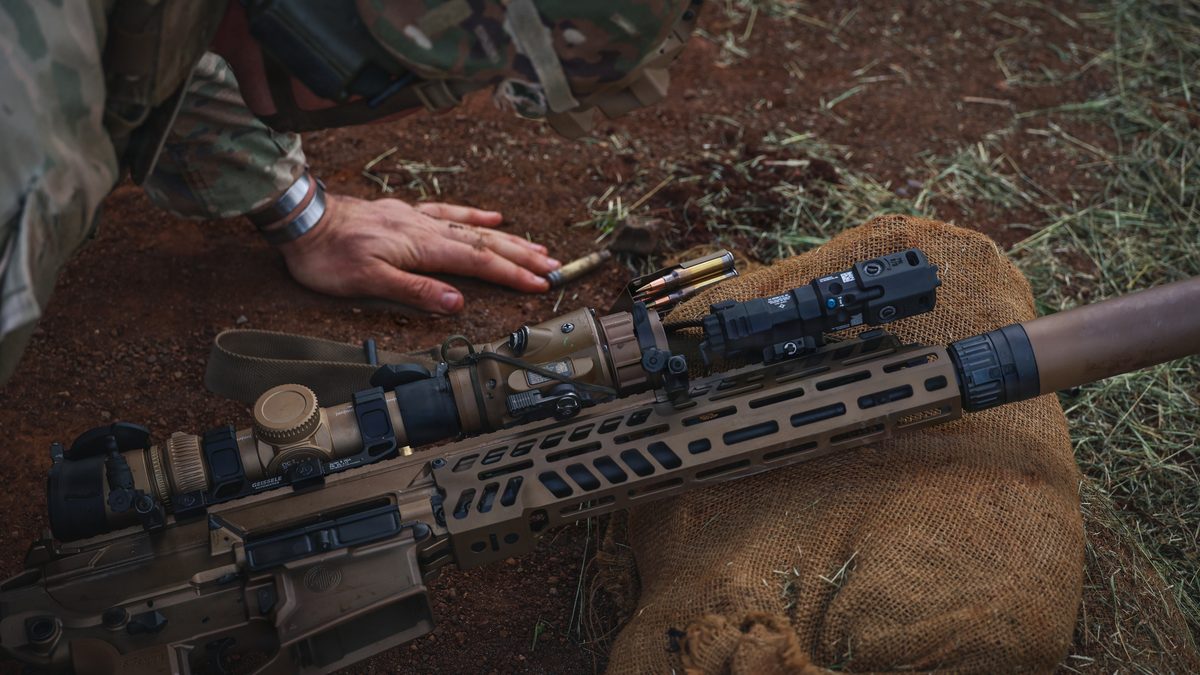
U.S. Army photo by Sergeant Austin Paredes / DVIDS (VIRIN 260206-A-PT086-2513). A soldier of 2nd Battalion, 21st Infantry Regiment, 25th Infantry Division qualifies with the M7 rifle, the Next Generation Squad Weapon the FY27 budget stops buying in favour of the XM8 carbine. Public-domain U.S. Government work; use does not imply endorsement.
The FY27 Budget Ends M7 Rifle Buys and Bets the Close Fight on the XM8
The US Army's Federal Fiscal Year 2027 (FY27) budget request, released on 1 July 2026, asks for no M7 rifles at all. It funds 14,944 XM8 carbines, 2,795 M250 automatic rifles and 20,402 M157 optics, a 38,141-unit Next Generation Squad Weapon buy worth about 382.3 million US dollars. The close-combat force now standardises on SIG Sauer's 6.8x51mm round.
Technical Summary
The shift is small in words and large in intent. The Army's FY27 request buys not one more M7 rifle. Every dollar in the Next Generation Squad Weapon (NGSW) rifle line now goes to the XM8, a shorter carbine cut from the same SIG Sauer design that produced the M7. The programme keeps buying the M250 automatic rifle and the M157 Small Arms Fire Control optic, so the weapon family stays intact. What changes is the rifle in the close-combat soldier's hands.
Numbers frame the decision. The request funds 14,944 XM8 carbines, 2,795 M250 automatic rifles and 20,402 M157 optics. The Army's own FY27 budget highlights list 38,141 NGSW units, which is exactly that three-part sum. The weapon-system procurement line reads about 382.3 million dollars, up from roughly 372.2 million in Federal Fiscal Year 2026. The XM8 is not a new programme. It is the M7 made shorter and lighter, and the budget has now made it the priority.
The FY27 request buys 14,944 XM8 carbines and zero M7 rifles. The close-combat calibre question is settled: 6.8x51mm stays, and 5.56mm does not come back. ISC assessment of the US Army FY27 budget request
XM8 carbine, baseline specification (open sources)
| Barrel length | 11 in (279 mm), against 13 in (330 mm) on the M7 rifle |
| Overall length | About 3.5 in (89 mm) shorter than the M7 |
| Weight | A little over 1 lb (0.45 kg) lighter than the M7; close to M4A1 carry weight |
| Cartridge | 6.8x51mm Common Cartridge (.277 SIG Fury), shared with the M7 and M250 |
| Fire control | M157 optic (Vortex); suppressor-ready |
| Action | Short-stroke gas piston, select-fire, magazine-fed |
| FY27 line item | Quantity requested | Status and role |
|---|---|---|
| XM8 Carbine | 14,944 | In production Close-combat rifle, replaces the M4A1 |
| M7 Rifle | 0 | No new buy Already fielded; not requested in FY27 |
| M250 Automatic Rifle | 2,795 | In production Replaces the M249 Squad Automatic Weapon |
| M157 Fire Control | 20,402 | In production Optic across the family (Vortex) |
Analysis of Effects
Two inches of barrel is not a rounding error. The XM8 trims the M7's 13-inch barrel to 11 inches. That cut costs some muzzle velocity, because a shorter barrel gives the burning propellant less time to push the bullet. The 6.8x51mm round was built with headroom for exactly this trade. Its hybrid case, a stainless-steel base joined to a brass body, holds a chamber pressure near 80,000 pounds per square inch (psi). Conventional brass-cased 5.56mm and 7.62mm rounds run closer to 55,000 to 62,000 psi. The extra pressure buys velocity and armour-defeat margin, so the carbine can shed two inches of barrel and still strike harder at range than the 5.56mm weapon it displaces.
The signal to allies is louder than the dollar figure. The United States has now tied its close-combat rifle to a calibre that sits outside NATO's standard family. The 5.56mm round is covered by Standardization Agreement (STANAG) 4172. The 7.62mm round is covered by STANAG 2310. The 6.8x51mm round is neither. By zeroing the M7 and funding the XM8 in its place, the Army has not softened that commitment. It has hardened it. The close fight is moving to 6.8mm and staying there.
Personnel and Safety Considerations
Soldier feedback drove this. Troops carrying the M7 found it heavy against the M4A1 they knew, and weight in the close fight is paid in mobility, fatigue and hit rate. The XM8 answers that complaint head-on. It restores something near M4A1 handling while keeping the 6.8mm terminal effect and the M157 optic. Higher chamber pressure and a shorter barrel do raise questions about felt recoil, muzzle blast and suppressor wear. The round's heat and pressure demand disciplined barrel and suppressor maintenance. Those are training and sustainment issues rather than show-stoppers, but they travel with the weapon.
Data Gaps
Several figures are not yet in the public record. The Army has not published a per-unit XM8 price, so the split of the 382.3 million dollar line across carbines, automatic rifles and optics is inferred, not stated. The muzzle-velocity loss from the two-inch barrel reduction is not disclosed. Whether the M7 line is closed for good or simply paused after early fielding is not spelled out; the FY27 request shows a zero, not a cancellation. Earlier test reporting flagged concerns over M157 zero retention and ammunition supply, and the current status of those issues is not confirmed here. Ammunition procurement quantities sit in a separate budget line and are not covered by the weapon figures above.
Key Questions
Is the US Army cancelling the M7 rifle?
Not formally. The Federal Fiscal Year 2027 budget requests zero new M7 rifles and shifts the rifle buy to the XM8 carbine, but the M7 is already fielded and is not stated as cancelled. The request signals a priority change, not a programme termination.
What is the difference between the XM8 and the M7?
The XM8 is a shorter, lighter carbine version of the SIG Sauer M7. It uses an 11-inch barrel against the M7's 13 inches, runs about 3.5 inches shorter and over a pound lighter, and fires the same 6.8x51mm round with the same M157 optic.
Does the XM8 decision affect NATO calibre standards?
Indirectly, yes. The 6.8x51mm round is not a NATO-standard calibre; 5.56mm sits under STANAG 4172 and 7.62mm under STANAG 2310. By funding the XM8 and no M7, the US Army confirms a long-term move to a non-standard close-combat calibre, which allies such as the UK weigh under Project GRAYBURN.
References
Source-evaluated under NATO STANAG 2022 (Reliability A–F / Accuracy 1–6). Tier 1 = government primary source; Tier 2 = quality news / specialist defence media; Tier 3 = authoritative aggregator / encyclopaedia.
- T1US Army Office of the Assistant Secretary (Financial Management & Comptroller) – Army FY 2027 Budget Highlights, July 2026. (Reliability A / Accuracy 1)
- T2Guns.com – Army Switches Gears from M7 Rifle to XM8 Carbine in Budget Request, 1 July 2026. (Reliability B / Accuracy 2)
- T2Military Times – Army receives first batch of XM8 carbines set to replace M4A1s, 7 April 2026. (Reliability B / Accuracy 2)
- T2National Defense Magazine – Army Introduces New XM8 Carbine For Close Combat Ops, 11 June 2026. (Reliability B / Accuracy 2)
- T1UK Ministry of Defence / Find a Tender – Project GRAYBURN: Defence replacement of SA80 family of rifles (Concept Stage), notice 002873-2026, January 2026. (Reliability A / Accuracy 2)
- T3Wikipedia – .277 Fury (6.8x51mm) cartridge data, accessed 14 July 2026. (Reliability C / Accuracy 3)
Corrections & updates welcome. If you hold open-source data that refines or corrects any parameter in this article, please contact [email protected] citing the specific claim and your source. Verified corrections will be incorporated and credited in the revision history. AI-assisted technical assessment based on open-source material. Not a formal intelligence product.