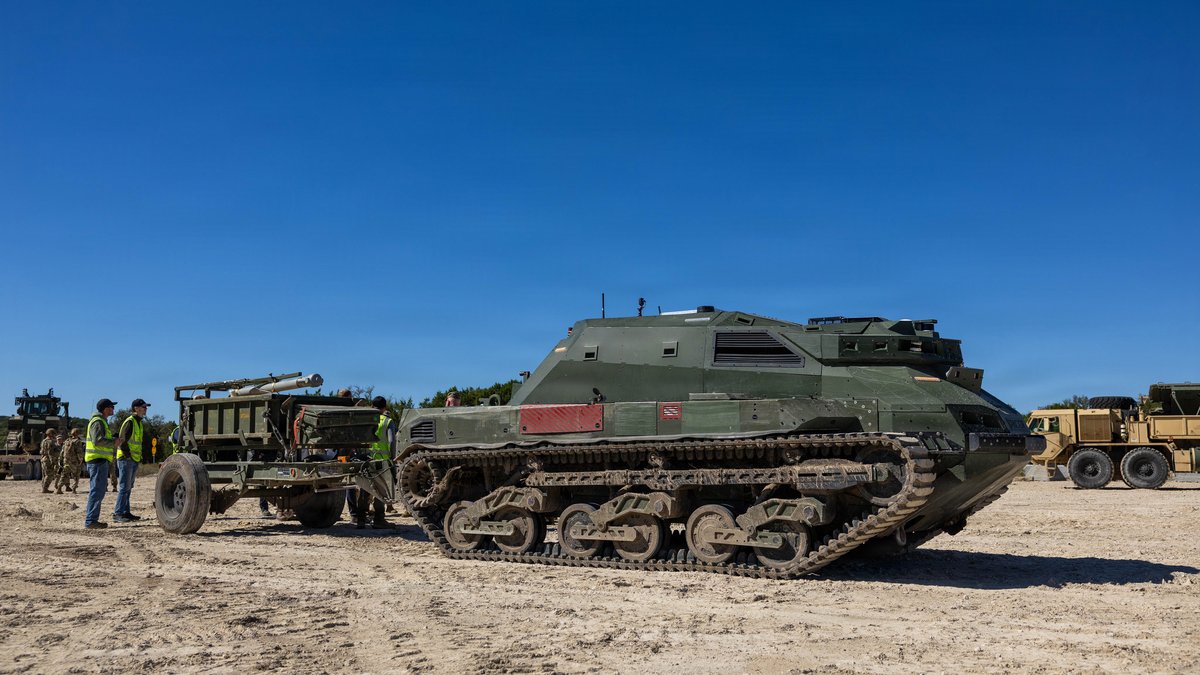
A RACER (Robotic Autonomy in Complex Environments with Resiliency) Heavy Platform tows an M58 Mine Clearing Line Charge. Photo: Thomas Sakell, U.S. Army / DVIDS (public domain). Illustrative of uncrewed breaching; not the EABC prototypes.
US Army Picks Four Firms to Prototype Autonomous Minefield Breaching Under Fire
The U.S. Army selected Caterpillar, Forterra, IDV USA and Overland AI on 8 July 2026 for its Engineer Autonomous Breaching Capability, a prototype effort to open lanes through obstacle belts and minefields under direct fire using uncrewed vehicles. A unit assessment is planned for early 2027 ahead of a production decision.
Technical Summary
The Army's Capability Program Executive for Mission Autonomy announced the four-company down-select on 10 July 2026 from Detroit Arsenal, Michigan. The Engineer Autonomous Breaching Capability, or EABC, asks industry to prototype robotic systems that clear complex obstacles and minefields under direct observation and fire. The four firms are Caterpillar of Irving, Texas, Forterra of Clarksburg, Maryland, IDV USA of York, Pennsylvania, and Overland AI of Seattle. Each brings a different starting point. Some propose autonomised commercial plant. Others offer purpose-built robots. All carry modular payloads, and formal awards, value undisclosed, follow in the coming weeks.
Breaching under fire is an ordnance problem before it is an autonomy problem. A deliberate breach of a mined obstacle belt is normally opened with explosive line charges rather than by driving through and hoping. The current U.S. tool is the M58 Mine Clearing Line Charge, a rocket-projected line that, by long-standing open-source accounts, runs about 350 feet and carries roughly 1,750 pounds of C-4, at some five pounds per foot. It detonates to cut a lane about eight metres wide and a hundred metres long through conventionally fuzed anti-tank mines. For dismounted lanes, the Anti-Personnel Obstacle Breaching System projects a grenade-studded line to clear a footpath through wire and anti-personnel mines. EABC does not replace these charges. It changes the platform that carries and fires them.
The platform that carries these charges today is the M1150 Assault Breacher Vehicle, an Abrams-based engineer tank crewed by two and fitted with a pair of M58 launchers and a full-width mine plough. Its crew rides at the head of the breach. That is the seat EABC wants to empty. The Army is already funding a remote-control fit for the M1150 itself, so the legacy platform and the new prototypes point the same way.
A deliberate breach is opened with explosive line charges, and the M58 MICLIC alone carries a line charge of roughly 1,750 pounds of C-4. EABC does not remove that ordnance from the fight. It removes the crew from the vehicle that delivers it. ISC open-source assessment, 14 July 2026
Analysis of Effects
The driver is survivability. Breaching a defended obstacle belt is among the most lethal tasks an army performs, because the breach lane is a known point that the defender has ranged with direct fire, artillery and, increasingly, first-person-view drones. Ukraine has shown what happens to armour and engineers stacked at a single crossing point. Taking the crew out of the lead breaching vehicle removes people from the exact spot the enemy is trying to kill them. That is the whole case for EABC, and it explains why the Army wants systems controlled beyond line of sight.
The procurement path is deliberately short. After formal award, the prototypes move into demonstrations and a Transformation in Contact unit assessment in early 2027, feeding a production decision. EABC does not sit alone. In the same week the Army publicised trials of autonomous mass minelaying, and it has been testing the SLICE autonomous mine-breaching rig. Both ends of the obstacle fight, laying and clearing, are being de-crewed at once. For NATO engineer branches watching mobility and counter-mobility, that is the signal worth reading.
Personnel and Safety Considerations
The energetics are the hard part. A MICLIC-class line charge is a large net explosive quantity, and current doctrine assumes a trained crew arms and fires it with the human as the final safety authority. Move that charge onto an uncrewed platform and the arming decision, the fault modes and the command-detonation assurance all have to be re-engineered. U.S. explosive safety sits under DESR 6055.09 Change 2, with NATO storage and transport under AASTP-1 Edition C, and neither was written for a robot carrying a primed line charge into a killing area. There is also the residue. Explosive breaching can leave dud charge segments and bypassed mines, so any cleared lane still needs proofing and follow-on Explosive Ordnance Disposal.
Data Gaps
Several parameters are not yet public. The Army has not stated which breaching charges each contractor will integrate, so no net explosive quantity can be assessed for the prototypes. Award values are undisclosed. The arming-authority model and the fail-safe design for an uncrewed charge are unstated, as is any concept for proofing and marking cleared lanes or for the EOD follow-up the residue implies. These gaps matter more than the robotics, and ISC will track them as the awards firm up.
Key Questions
Which companies won the US Army autonomous breaching contracts?
The Army selected four firms on 8 July 2026 for the Engineer Autonomous Breaching Capability: Caterpillar, Forterra, IDV USA and Overland AI. Their approaches range from autonomised commercial equipment to purpose-built robots. Formal awards, at an undisclosed value, are expected within weeks.
What is the Engineer Autonomous Breaching Capability (EABC)?
EABC is a US Army prototype programme to build uncrewed vehicles that breach obstacle belts and minefields under direct observation and fire. The aim is to keep engineers out of the most exposed part of a breach. A unit assessment is planned for early 2027 ahead of a production decision.
Why does autonomous breaching matter for ordnance and EOD?
Breaching a minefield uses explosive line charges such as the M58 MICLIC. Putting that ordnance on an uncrewed platform moves arming and firing away from a human, and any dud or partial detonation leaves explosive remnants that EOD teams must locate and render safe.
References
Source-evaluated under NATO STANAG 2022 (Reliability A–F / Accuracy 1–6). Tier 1 = government primary source; Tier 2 = quality news / specialist defence media; Tier 3 = authoritative aggregator / encyclopaedia.
- T1U.S. Army, Capability Program Executive (Mission Autonomy) – Official EABC contractor-selection release (Detroit Arsenal, Mich.), reproduced by Soldier Systems Daily, 10 July 2026. (Reliability A / Accuracy 1)
- T2Breaking Defense – Army selects four companies for new autonomous breaching program, 8 July 2026. (Reliability B / Accuracy 2)
- T2Army Recognition – U.S. Army Selects Four Companies to Build Autonomous Minefield Breaching Vehicle Prototypes, 13 July 2026. (Reliability B / Accuracy 2)
- T2Military Times – US Army tests autonomous mass mine-laying, 7 July 2026. (Reliability B / Accuracy 2)
- T2Army Recognition – U.S. Army tests autonomous SLICE mine-breaching system to keep soldiers out of danger, 2026. (Reliability B / Accuracy 2)
- T3GlobalSecurity.org – M58 Mine Clearing Line Charge (MICLIC) reference, accessed 14 July 2026. (Reliability C / Accuracy 3)
- T3Army Technology – M1150 Assault Breacher Vehicle, accessed 14 July 2026. (Reliability C / Accuracy 3)
- T2Army Recognition – US Army boosts M1150 Assault Breacher Vehicle funding for future remote-controlled operations, 2026. (Reliability B / Accuracy 2)
Corrections & updates welcome. If you hold open-source data that refines or corrects any parameter in this article, please contact [email protected] citing the specific claim and your source. Verified corrections will be incorporated and credited in the revision history. AI-assisted technical assessment based on open-source material. Not a formal intelligence product.