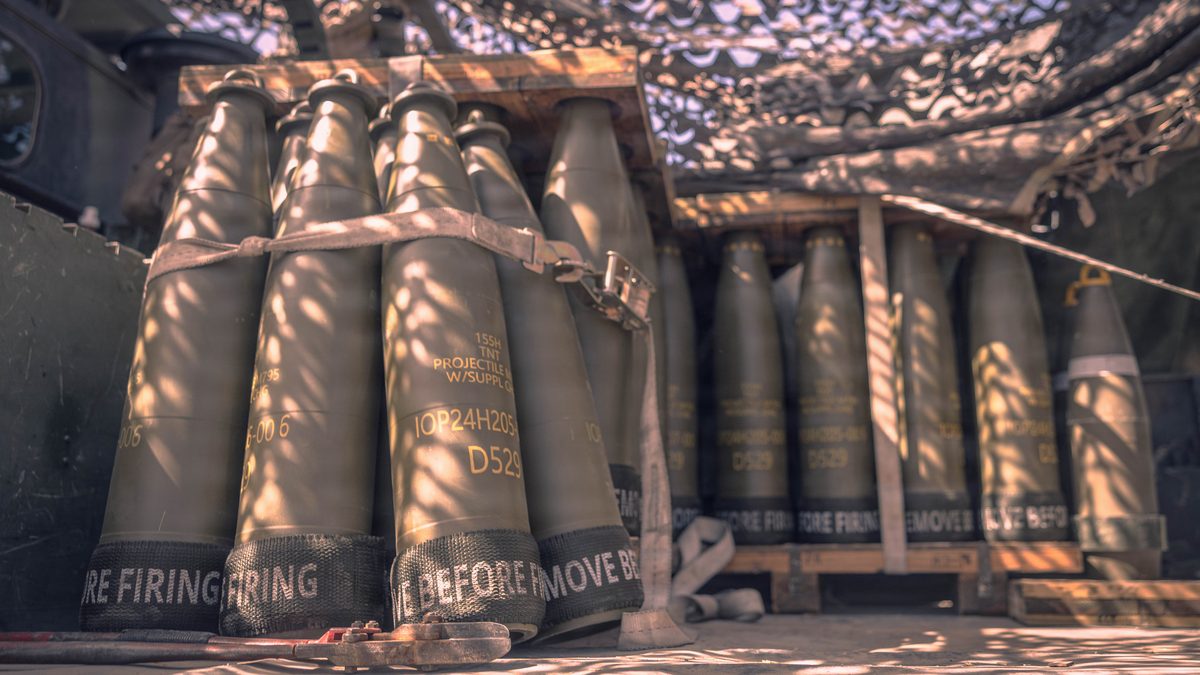
U.S. Marine Corps photo by Lance Cpl. Parker Peichel via DVIDS (public domain). Illustrative: a NATO-standard 155mm howitzer on a live-fire range, not the Vulcano round itself.
NSPA Buys Vulcano 155mm Guided Rounds for 27 Allies, First Deliveries in 2027
The NATO Support and Procurement Agency (NSPA) has awarded Diehl Defence a contract for Vulcano 155mm guided artillery ammunition, announced at the NATO Summit Defence Industry Forum in Ankara on 7 July 2026. The buy runs through the 27-nation Ammunition Support Partnership. First deliveries are expected in 2027, giving allied howitzers a precision round that reaches about 70 kilometres.
Technical Summary
Vulcano is a family of 155mm artillery projectiles built by Diehl Defence and Leonardo. Leonardo holds design authority for the guidance, fuze and warhead. Diehl supplies the terminal seekers, handles integration and runs series manufacturing. The family splits into two lines. The Ballistic Extended Range (BER) round flies unguided, though it carries a multifunctional fuze that a gunner can set for an airburst on the altimeter, for impact or delayed impact, or for a timed burst. The Guided Long Range (GLR) round adds satellite and inertial guidance, and it is the GLR that carries the precision the NSPA contract is buying.
The round is sub-calibre and fin-stabilised. Deployable fins let it glide, so it stretches range without a rocket motor. Fired from a 52-calibre gun such as the PzH 2000, the GLR reaches up to 70 kilometres. From a shorter 39-calibre barrel it reaches about 55 kilometres. Guidance combines an autonomous Inertial Measurement Unit (IMU) with Global Positioning System (GPS) updates through the mid-course phase, and an optional Semi-Active Laser (SAL) or Infrared (IR) seeker takes over for terminal homing. Circular Error Probable (CEP), the radius within which half the rounds land, sits at 5 metres or better on a coordinate, and it drops to 3 metres or better when the laser seeker steers the shell onto a designated target.
One barrel, two very different rounds. The guided Vulcano reaches 70 kilometres and lands inside a 5-metre circle, where a conventional high-explosive shell tops out near 30 kilometres and scatters across a far wider area. ISC open-source assessment
Vulcano 155 GLR: key parameters (open sources)
| Calibre | 155mm, sub-calibre, fin-stabilised, gliding (no rocket motor) |
| Range, 52-cal gun | Up to 70 km (GLR) / up to 50 km (BER, unguided) |
| Range, 39-cal gun | Up to 55 km (GLR) / up to 36 km (BER, unguided) |
| Guidance | Autonomous IMU + GPS mid-course; optional SAL or IR terminal seeker |
| Accuracy (CEP) | 5 m or better on coordinate; 3 m or better with SAL homing |
| Warhead | Notched high-explosive, pre-formed tungsten rings, insensitive-munition fill |
| Host guns | PzH 2000, CAESAR, Archer, K9 Thunder and other 39/52-cal 155mm howitzers |
| Status | Qualified and fielded by Germany and Italy; naval 127mm and 76mm variants exist |
The #VULCANO 155mm ammunition gives the 155/52 caliber and 155/39 caliber Howitzers the capability to extend their operative range and precision beyond the actual limits, minimizing engagement costs and collateral damages. Learn more at #GDA2017 #Leonardo https://t.co/4LQF7wy4zz
— Leonardo (@Leonardo_live) December 13, 2017
Analysis of Effects
The NSPA buy sits inside a wider shift in how NATO thinks about artillery. For two years the war in Ukraine has drained 155mm stocks and exposed how thin European magazines had become. The Ammunition Support Partnership, a multinational body that dates back to 1993, aggregates demand from 27 member nations and places contracts on their behalf. Buying as a block lifts order volumes, which tends to pull unit prices down and gives industry the confidence to open extra production lines. It also drives standardisation, so a round bought by one ally can be fired and supported by another. NSPA General Manager Stacy Cummings said the contract “underscores our unwavering commitment to modernising ammunition stockpiles and strengthening collective defence through multinational cooperation.”
Precision changes the arithmetic of a fire mission. A battery firing unguided shells may need dozens of rounds to be sure of hitting a moving launcher or a hardened command post. A single Vulcano, landing within a few metres, can do the same work. That matters when every shell is scarce and expensive. The warhead is smaller than a standard shell, a notched high-explosive charge wrapped in pre-formed tungsten rings and filled with an insensitive explosive, and the design trades raw blast for accuracy. Against a radar, a command vehicle or an artillery piece, that trade favours the guided round. NSPA frames the purchase as replenishing what it calls Land Battle Decisive Munition stockpiles, the small set of natures judged able to shape the outcome of a land engagement.
The award did not appear from nowhere. NSPA first published a notice of planned sole-source award, reference 25LBS062, on 17 June 2025, naming Diehl Defence and Leonardo as the only firms judged able to meet the requirement. The agency justified going sole-source on the uniqueness of the design and the round’s key performances in a ready-for-deployment configuration for NATO 155mm systems. The formal contract followed just over a year later at the Ankara summit forum. That gap is a data point in itself. The requirement was fixed and the supplier settled in mid-2025, and the year since went on negotiation and the multinational order rather than on any competition.
Fielding the round takes more than the shell. Each gun needs a Vulcano programming and fire-command kit, built around a fire-command computer, a Global Positioning System (GPS) receiver and a GPS Key-storage Interface Device (GPS-KID) that loads the encryption keys, plus a programming device that sets the fuze and mission data moments before firing. The kit works through the NATO Armaments Ballistic Kernel (NABK) and stays compatible with the Joint Ballistics Memorandum of Understanding (JBMoU), so a crew trained on one NATO fire-control system can programme and fire the round without a bespoke workflow. For a 27-nation buy, that interoperability is the point.
| Variant | 52-calibre gun | 39-calibre gun |
|---|---|---|
| Guided Long Range (GLR) | Up to 70 km | Up to 55 km |
| Ballistic Extended Range (BER), unguided | Up to 50 km | Up to 36 km |
| Standard HE shell (reference) | ~30 km | ~24 km |
Personnel and Safety Considerations
The insensitive explosive fill is not only about the target. A round that resists cook-off, shaped-charge attack and bullet impact is safer to store, move and handle, which is the property NATO wants as it rebuilds deep magazines. Conventional 155mm high-explosive projectiles are handled as United Nations Hazard Division 1.1, the mass-detonation class, and a qualified insensitive-munition fill can support a less severe in-storage categorisation under national policy. The Vulcano-specific hazard classification and Net Explosive Quantity (NEQ) are not stated in the open-source release, so magazine planners will work from the national qualification data rather than the contract announcement. The precision seeker also cuts the number of rounds fired to achieve an effect, which lowers the volume of energetic material moving through the supply chain in the first place.
What NSPA Is Buying: The Stock Numbers
The notice does more than name a supplier. It lists the exact stock numbers NSPA plans to buy, and the breakdown shows how a modern precision round reaches the gun line as a complete logistic package. The list runs to ten NATO Stock Numbers (NSNs), split between Italian-coded projectile natures and German-coded primers, handling equipment and containers. The first four digits of each NSN give the Federal Supply Class (FSC); the next two give the NATO codification country, where 15 is Italy and 12 is Germany.
| NATO Stock Number | Supply class (FSC) | Origin | Item |
|---|---|---|---|
| 1320-15-018-0458 | 1320 Ammunition, over 125mm | Italy | 155mm projectile nature (Leonardo) |
| 1320-15-018-0459 | 1320 Ammunition, over 125mm | Italy | 155mm projectile nature (Leonardo) |
| 1320-15-018-0460 | 1320 Ammunition, over 125mm | Italy | 155mm projectile nature (Leonardo) |
| 1320-15-018-0463 | 1320 Ammunition, over 125mm | Italy | 155mm projectile nature (Leonardo) |
| 1320-12-364-3419 | 1320 Ammunition, over 125mm | Germany | 155mm ammunition item |
| 1390-12-149-7543 | 1390 Fuzes and primers | Germany | DM191A1 percussion primer (RUAG Ammotec / RWS) |
| 1398-12-411-0437 | 1398 Specialised ammunition handling and servicing equipment | Germany | Handling and servicing equipment |
| 8140-12-338-0096 | 8140 Ammunition boxes, packages and containers | Germany | Packaging or container |
| 8140-12-410-4227 | 8140 Ammunition boxes, packages and containers | Germany | Packaging or container |
| 8140-12-411-0438 | 8140 Ammunition boxes, packages and containers | Germany | Packaging or container |
Two designations stand out. The primer is the DM191A1, a percussion primer made by RUAG Ammotec (RWS) at Fuerth in Germany. The specified propelling charge is the DM92 modular charge, a Rheinmetall product. Charges of that family are bought through a separate NSPA 155mm framework, so the DM92 sits alongside this guided-projectile award rather than inside it. A Vulcano round on the gun line is therefore the sum of three procurement threads: the projectile from Diehl Defence and Leonardo, the modular charge from Rheinmetall, and the primer from RUAG.
Data Gaps
Several figures a buyer would want are absent from the announcement. The contract value has not been disclosed. The number of rounds and the delivery cadence are not stated. NSPA has not named which of the 27 partner nations receive the first deliveries, nor whether the buy covers the guided GLR round, the unguided BER round or both. The Vulcano-specific hazard classification, Net Explosive Quantity per round and unit price remain outside the public record. Where this article gives performance figures, they are the manufacturer's published parameters for the Vulcano 155 family, not contract-verified quantities. Treat the range and accuracy numbers as design values pending independent test data. The notice lists the stock numbers but not which projectile nature each Italian NSN denotes, so the split between the laser, infrared and ballistic variants across those four numbers is not established here.
Key Questions
What did NSPA buy from Diehl Defence?
The NATO Support and Procurement Agency awarded Diehl Defence a contract for Vulcano 155mm guided artillery ammunition. It was announced at the NATO Summit Defence Industry Forum in Ankara on 7 July 2026 and runs through the Ammunition Support Partnership, which aggregates demand from 27 nations. First deliveries are expected in 2027.
How far does the Vulcano 155mm round reach?
Fired from a 52-calibre howitzer such as the PzH 2000, the guided Vulcano reaches up to 70 kilometres. From a 39-calibre barrel it reaches about 55 kilometres. The unguided Ballistic Extended Range version travels up to 50 kilometres from a 52-calibre gun. The round glides on deployable fins rather than using a rocket motor.
How accurate is Vulcano, and how is it guided?
The Guided Long Range round uses an inertial measurement unit and GPS for mid-course flight, with an optional semi-active laser or infrared seeker for the final approach. Circular Error Probable is 5 metres or better on a coordinate, tightening to 3 metres or better with laser terminal homing. That precision suits high-value targets such as radars and command posts.
References
Source-evaluated under NATO STANAG 2022 (Reliability A–F / Accuracy 1–6). Tier 1 = government primary source; Tier 2 = quality news / specialist defence media; Tier 3 = authoritative aggregator / encyclopaedia.
- T1NATO – Tens of billions in new procurements revealed at the NATO Summit Defence Industry Forum in Ankara, 7 July 2026. (Reliability A / Accuracy 1)
- T2defence-industry.eu – NSPA awards Diehl Defence contract for Vulcano 155mm guided ammunition, 11 July 2026. (Reliability B / Accuracy 2)
- T2GlobalSecurity.org – NATO Summit: Contract signed for 155 mm guided ammunition under NSPO's Ammunition Support Partnership, 7 July 2026. (Reliability B / Accuracy 2)
- T2Leonardo – Diehl Defence, Leonardo and General Dynamics celebrate Extended Range Artillery Projectile award based on Vulcano 155mm GLR, 16 June 2026. (Reliability B / Accuracy 2)
- T3Leonardo Electronics – Vulcano 155mm guided ammunition family (product data), accessed 13 July 2026. (Reliability C / Accuracy 3)
- T1NSPA – Notice of Planned Sole Source Award No. 25LBS062, Vulcano Long Range Precision Guided ammunition (Diehl Defence and Leonardo), 17 June 2025. (Reliability A / Accuracy 1)
- T2Rheinmetall – 155mm Artillery Modular Charge System (DM72/DM92 family), accessed 13 July 2026. (Reliability B / Accuracy 2)
- T3NATO Codification – Federal Supply Classification groups and classes (FSC 1320, 1390, 1398, 8140), accessed 13 July 2026. (Reliability C / Accuracy 3)
Corrections & updates welcome. If you hold open-source data that refines or corrects any parameter in this article, please contact [email protected] citing the specific claim and your source. Verified corrections will be incorporated and credited in the revision history. AI-assisted technical assessment based on open-source material. Not a formal intelligence product.