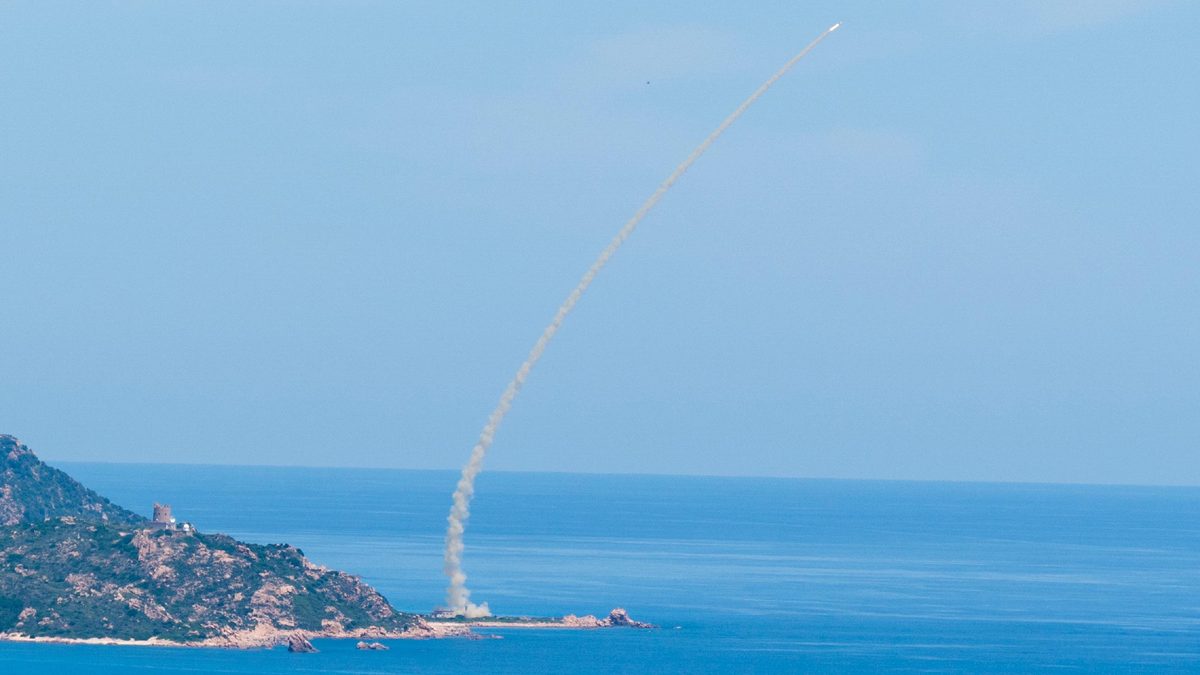
Aster 30 interceptor launched from a SAMP/T launcher during a 2025 exercise, Italian Army 4th Anti-Aircraft Artillery Regiment "Peschiera". Photo: Italian Army (Esercito Italiano) via Wikimedia Commons, licensed under CC BY 2.5.
SAMP/T: Why Faster Availability Means Interceptors, Not New Batteries
Faster SAMP/T availability for Ukraine in 2026 depends on Aster 30 interceptors, not on building new launchers. France and Italy can move quickest by releasing existing missile stocks, reprioritising the 218-missile Aster order of March 2025, and expanding repair throughput. New SAMP/T New Generation batteries, and a Ukraine-dedicated production lot, are realistically 2027 to 2028 outcomes.
Technical Summary
The Franco-Italian SAMP/T (Sol-Air Moyenne Portee/Terrestre, surface-to-air medium-range land system) is Europe's sovereign long-range ground-based air defence. It fires the Aster 30 interceptor built by the MBDA missile group. Ukraine wants more of it, fast. The honest answer is uncomfortable. Faster availability is mostly a question of interceptors, and only partly a question of launchers. A battery without missiles is a radar and a lorry.
Ukraine has received at least two SAMP/T systems. Public reporting keeps naming the same limiting factor, and it is not the count of launchers. It is the supply of Aster 30 rounds. A third battery is expected in October 2026, which sharpens the problem rather than solving it, because a launcher with an empty magazine defends nothing.
The Aster 30 carries roughly 40,000 components. Doubling output in 2026 lifts a low baseline. It does not conjure an emergency stockpile, and it will not by itself refill Ukraine's magazines this year. ISC open-source assessment, 13 July 2026
Analysis of Effects
Six levers can move availability inside 2026, and only some of them are quick. The fastest is releasing Aster 30 rounds from existing French, Italian or naval stocks, which restores combat endurance in weeks when governments accept the risk elsewhere. The Aster family is shared. It arms SAMP/T batteries, French, Italian and British warships, and forces deployed across Europe and the Middle East, so every round sent to Ukraine is a round pulled from another commitment. Italy has said it will not strip the SAMP/T capability now protecting Ukraine to meet other regional demands, a signal that Rome treats the deployed system as ring-fenced.
Repair and recertification is the quieter lever. Returning missiles, radars, launchers and command vehicles to service faster raises the availability of what Ukraine already fields, and OCCAR (the Organisation for Joint Armament Co-operation) already holds multi-year SAMP/T support packages that can be widened. Production is the slowest lever of all. MBDA plans to double Aster output during 2026 and to lift total missile production by about 40 percent, after cutting order-to-delivery time from roughly 42 months before 2022 toward about 18 months. That is real progress. It is not an emergency tap, because output must still be divided across France, Italy, the United Kingdom, Denmark and naval users.
| Acceleration option | Speed | Realistic effect and constraint |
|---|---|---|
| Release existing Aster 30 stock | Weeks to months | Most direct way to restore combat endurance. Limited by shared naval and national inventories. |
| Transfer another legacy SAMP/T battery | Months | Immediate operational value. Leaves the donor with a capability gap until a New Generation system replaces it. |
| Forward repair and sustainment hub | Months | Raises availability of fielded batteries and rounds. Needs secure sites, test equipment and specialist staff. |
| Reprioritise 2026 Aster deliveries | Months | Uses the existing 218-missile contract to move Ukraine up the delivery queue. |
| Early access to SAMP/T NG evaluation systems | Late 2026 to 2027 | Adds radar and anti-ballistic performance. Diverts systems needed for French and Italian evaluation. |
| New Ukraine-dedicated production lot | 18 months or more | Sustainable long-term supply. Not an emergency solution. |
The contractual mechanism to reprioritise already exists. France, Italy and the United Kingdom ordered 218 additional Aster missiles in March 2025 and accelerated 134 rounds from earlier orders for delivery across 2025 and 2026. Governments can therefore change delivery sequencing, favour the land-based Aster 30, and place early production with Ukraine, without waiting for a wholly new line. That is the most realistic single source of extra missile availability this year.
| Period | Most credible acceleration measure |
|---|---|
| 0 to 3 months | Release existing Aster stock, redistribute rounds, accelerate repair, train crews, push spares forward. |
| 3 to 9 months | Reprioritised 2026 production, a dedicated sustainment hub, extra launcher and radar support. |
| 6 to 18 months | Higher Aster output, first evaluation-standard SAMP/T NG systems, expanded repair capacity. |
| 18 to 30 months | Dedicated production lots, more serial SAMP/T NG batteries, wider export production. |
| 2028 onward | Larger multinational fleet, Denmark deliveries, possible Turkish participation, mature Aster 30 B1 NT (Block 1 New Technology) rounds. |
Personnel and Safety Considerations
Sustaining an interceptor is not a clerical task. The Aster 30 rocket motor and warhead are energetic items, so recertification, repair and battle-damage work demand qualified facilities, trained munitions staff, and storage that meets NATO explosive-safety rules under AASTP-1 (Allied Ammunition Storage and Transport Publication 1). A forward hub in France, Italy, Poland or Romania could pool spares and recertify rounds closer to the front. It would still need secure sites, test equipment, transport arrangements, and people who take time to train. Skilled labour is itself a bottleneck, alongside rocket motors, seekers, and the new-generation radars: the Thales Ground Fire 300 for France and the Leonardo Kronos Grand Mobile High Power for Italy. Radar production, calibration and acceptance can throttle the programme independently of missile output.
Data Gaps
Several figures cannot be confirmed from open sources, and each is flagged as an estimate or an open question rather than a fact. Ukraine's current Aster 30 holding is not public. The exact split of 2026 Aster output between land and naval users is not public either. The line between an evaluation-standard SAMP/T NG system and a fully operational one is stated differently by the manufacturer and by the French Ministry of Armed Forces, with delivery for evaluation in 2026 and a first operational national system indicated for late 2027. The outcome of the renewed France, Italy and Turkey talks on SAMP/T is not yet settled, and any Turkish industrial role would be a medium to long-term matter, not an immediate uplift.
Key Questions
What is really slowing SAMP/T down in Ukraine?
Interceptors, not launchers. Ukraine has received at least two SAMP/T systems, and reporting consistently identifies a shortage of Aster 30 missiles as the constraint. A third battery expected in October 2026 adds a launcher, but its usefulness still depends on how many rounds France, Italy and MBDA can free up.
Can France and Italy just send more complete SAMP/T batteries?
They can, but slowly and at a cost. Transferring another legacy battery is possible within months, yet it opens a capability gap for the donor until a SAMP/T New Generation system replaces it. Releasing and repairing Aster 30 rounds is the faster and more militarily useful short-term measure.
When will SAMP/T New Generation actually add capacity?
Evaluation-standard systems are due in 2026, with a first fully operational national system indicated for late 2027. A wider multinational fleet builds from 2028, when Denmark takes its first delivery. Export success does not speed Ukrainian supply unless governments deliberately place Ukraine first.
References
Source-evaluated under NATO STANAG 2022 (Reliability A–F / Accuracy 1–6). Tier 1 = government or manufacturer primary source; Tier 2 = quality news / specialist defence media; Tier 3 = authoritative aggregator / encyclopaedia.
- T1French Ministry for the Armed Forces – Additional Aster missiles: France, Italy, United Kingdom to deepen air-defence missile stock, 14 March 2025. (Reliability A / Accuracy 1)
- T2Naval News – France, Italy and the UK order more than 200 additional Aster missiles from MBDA, March 2025. (Reliability B / Accuracy 2)
- T2Defense News – MBDA to double Aster air-defense missile output in 2026, 26 March 2026. (Reliability B / Accuracy 2)
- T2Defense Express – Ukraine to receive third SAMP/T battery in October, but will there be enough missiles to use it?, 2026. (Reliability B / Accuracy 2)
- T1Thales Group – Denmark has selected the European SAMP/T NG (first delivery 2028), April 2026. (Reliability A / Accuracy 2)
- T3Wikipedia – SAMP/T, accessed 13 July 2026. (Reliability C / Accuracy 3)
Corrections & updates welcome. If you hold open-source data that refines or corrects any parameter in this article, please contact [email protected] citing the specific claim and your source. Verified corrections will be incorporated and credited in the revision history. AI-assisted technical assessment based on open-source material. Not a formal intelligence product.