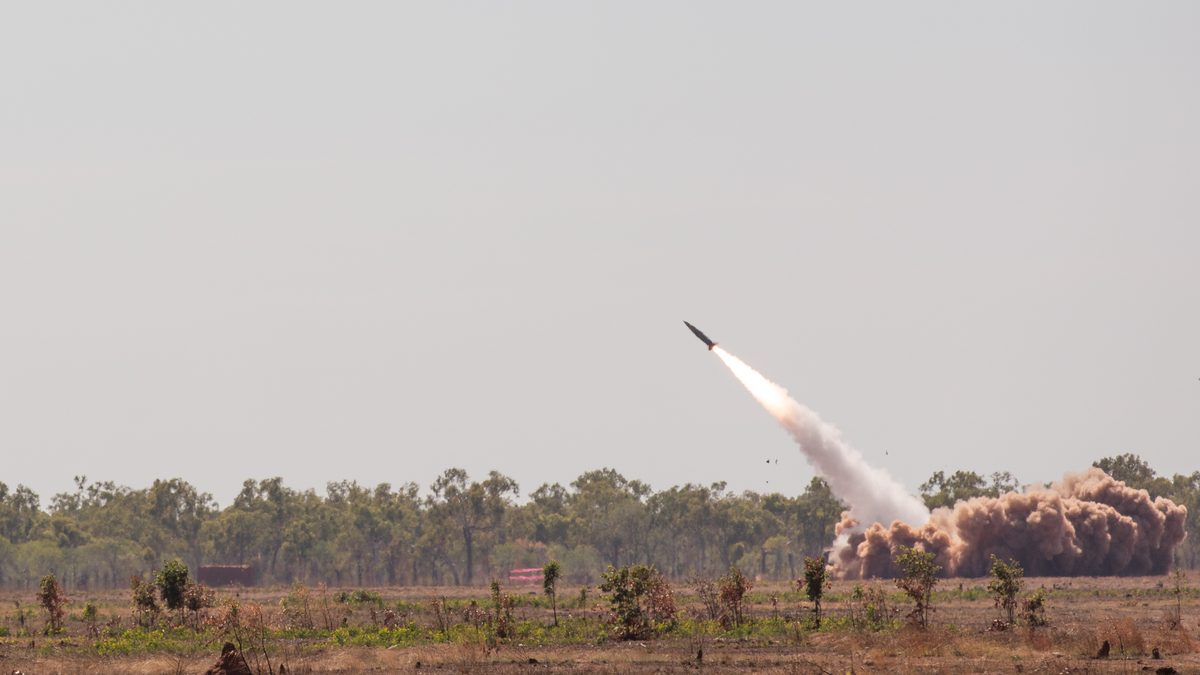
U.S. Army photo by Sgt. 1st Class Andrew Dickson (DVIDS, public domain). Illustrative: an Army Tactical Missile System (ATACMS) launch during a multinational exercise, 2023.
From Pledge to Contract: NATO's Ankara Summit and the WOME Order Book
NATO's Ankara Defence Industry Forum on 7 July 2026 turned spending pledges into signed orders. The weapons, ordnance, munitions and explosives portfolio led the day. Allies committed to buy 700 PAC-2 and 200 PAC-3 interceptors, co-produce the Army Tactical Missile System at Rheinmetall's German plant, back a six-nation deep precision strike project that sits inside a wider United Kingdom-led coalition pledging about 50 billion US dollars over a decade, and prototype a nine-nation interchangeable 155 mm round.
Technical Summary
The North Atlantic Treaty Organization (NATO) met in Ankara on 7 and 8 July 2026. The Defence Industry Forum on the first day did the practical work. Secretary General Mark Rutte framed the outcome in a single line, that the alliance now delivers rather than sets targets, with members already spending close to 4 percent of Gross Domestic Product (GDP) one year into a ten-year march toward the 5 percent pledge for 2035. Behind that headline sat roughly 50 billion euros of fresh procurement announced at the Forum, and the sharp end of it was WOME, meaning Weapons, Ordnance, Munitions and Explosives.
Seven industrial programmes carried the coverage out of Ankara. Three are platforms and enablers. Eleven allies agreed to buy the Saab GlobalEye Airborne Early Warning and Control (AEW&C) aircraft to replace the ageing E-3 fleet. Denmark, Finland, Germany and Norway will take up to five Northrop Grumman MQ-4C Triton maritime surveillance drones. Airbus gained a seven-nation A400M airlift pool and a tenth aircraft for the Multi-Role Tanker Transport (MRTT) fleet as Finland joined as its ninth member. The other four programmes are munitions and strike. They reshape the ammunition and long-range fires base, and they are where this round-up spends its time.
| Programme | Lead / participants | WOME weight | Maturity |
|---|---|---|---|
| ATACMS co-production | Lockheed Martin + Rheinmetall (Germany) | High | MoU, JV planned |
| Deep precision strike | 6-nation NATO core; wider UK-led | High | ~50bn USD / decade |
| PAC-2 / PAC-3 buy + sustainment | NSPA; US, DE, NL, PL, SE | High | 700 + 200 missiles |
| GENIFR interchangeable 155 mm | 9 allies | High | Prototype |
| GlobalEye AEW&C | 11 allies | Low | Joint buy |
| MQ-4C Triton | DK, FI, DE, NO | Low | Up to 5 |
| A400M pool / A330 MRTT | 7 allies / MRTT fleet | Low | 10th aircraft |
A six-nation NATO project sits inside a wider, United Kingdom-led deep precision strike coalition that has pledged about 50 billion dollars over a decade, with a ground-based missile reported at around 1,250 miles of reach. ISC assessment of NATO and UPI reporting, Ankara Summit, 8 July 2026
Analysis of Effects
Start with the missile that matters most for Europe's industrial map. Lockheed Martin and Rheinmetall signed a Memorandum of Understanding (MoU) to co-produce the Army Tactical Missile System (ATACMS) at Rheinmetall's Unterluess site in Lower Saxony, with a joint venture to follow. ATACMS is a surface-to-surface ballistic missile with a published reach in the region of 300 kilometres, and until now it has only ever been built in the United States. Rocket motor and guided-component work is planned to begin as early as 2027. Armin Papperger, Rheinmetall's chief executive, cast the deal as strengthening the defence of Germany and Europe. The strategic point is plainer than the corporate language. A European ATACMS line means allied deep fires stop depending on a single production site an ocean away.
The second strike move looks further out. NATO opened a six-nation Ground-Based Precision Strike project with Denmark, France, Italy, Norway, Turkey and the United Kingdom, aimed at new launchers and missiles. British Prime Minister Keir Starmer used Ankara to launch a wider, United Kingdom-led strike coalition that reporting put at up to twelve nations and around 50 billion US dollars over the coming decade, with the flagship ground-based weapon reported at roughly 1,250 miles of range. Air and missile defence stocks moved in parallel. The NATO Support and Procurement Agency (NSPA) will acquire 700 Patriot Advanced Capability-2 (PAC-2) and 200 PAC-3 interceptors, and the United States, Germany, the Netherlands, Poland and Sweden agreed to explore a dedicated PAC-3 Missile Segment Enhancement (MSE) maintenance facility on European soil. On the gun line, nine allies opened the Generic NATO Indirect Fire Round (GENIFR) to prototype a fully interchangeable 155 mm munition. NSPA then layered framework contracts for extra 155 mm shells and loitering munitions on top, including a Diehl Defence Vulcano guided-round award with first deliveries due in 2027.
Personnel and Safety Considerations
Every one of these WOME lines carries an explosive-safety and quality tail that rarely reaches the summit photographs. Co-producing rocket motors at Unterluess brings energetic-material handling, net explosive quantity limits and quantity-distance rules under Allied Ammunition Storage and Transport Publication (AASTP)-1 into a plant, and it brings Allied Quality Assurance Publication (AQAP) conformity obligations with them. An interchangeable 155 mm round only works if the propellant, projectile and fuze all meet a common qualification and interface standard, so GENIFR is as much a standards and safety-case project as a manufacturing one. Sustaining PAC-3 interceptors in Europe adds a storage, surveillance and shelf-life burden, which is exactly why a dedicated maintenance facility is on the table. None of this is glamorous. All of it decides whether the headline numbers survive contact with a real magazine and a real safety regulator.
Data Gaps
Several figures remain soft. The 50 billion dollar deep strike total sits with the wider United Kingdom-led coalition rather than the six-nation NATO project alone, and both that figure and the 1,250-mile range come from trade reporting rather than a signed programme document. The coalition has published no in-service date. Neither NSPA nor Lockheed Martin disclosed a contract value or a build schedule for the 700 PAC-2 and 200 PAC-3 buy. The ATACMS joint venture has an intent and a start year but no announced annual output. The Vulcano award value and the recipient nations were not named. Read the direction of travel as firm and the precise money and timelines as provisional.
Key Questions
What did NATO's Ankara summit actually order for munitions and air defence?
At the 7 July 2026 Defence Industry Forum the alliance moved from targets to contracts. The headline munitions and air-defence actions were buys of 700 PAC-2 and 200 PAC-3 interceptors, ATACMS co-production in Germany, a six-nation deep precision strike coalition, and a nine-nation interchangeable 155 mm round.
Where will ATACMS missiles be built in Europe?
Lockheed Martin and Rheinmetall signed a Memorandum of Understanding to co-produce the Army Tactical Missile System at Rheinmetall's Unterluess site in Germany. Rocket motor and guided-component work is planned to start as early as 2027, with a joint venture to follow. It is the first ATACMS production outside the United States.
How big is the European deep precision strike plan?
A six-nation NATO project (Denmark, France, Italy, Norway, Turkey and the United Kingdom) forms the core, sitting inside a wider United Kingdom-led coalition that reporting put at around 50 billion US dollars over a decade. The flagship ground-based weapon is reported at roughly 1,250 miles of range.
References
Source-evaluated under NATO STANAG 2022 (Reliability A–F / Accuracy 1–6). Tier 1 = government primary source; Tier 2 = quality news / specialist defence media; Tier 3 = authoritative aggregator / trade site.
- T1NATO – Tens of billions in new procurements revealed at the NATO Summit Defence Industry Forum in Ankara, 7 July 2026. (Reliability A / Accuracy 1)
- T1NATO – Allies meet strike capability requirements with multinational initiatives, 7 July 2026. (Reliability A / Accuracy 1)
- T1NATO – Secretary General on the Ankara Summit: NATO delivers, 8 July 2026. (Reliability A / Accuracy 1)
- T2Rheinmetall AG – Rheinmetall and Lockheed Martin plan to produce ATACMS, 7 July 2026. (Reliability B / Accuracy 2)
- T2Lockheed Martin – Lockheed Martin and NATO Allies Accelerate PAC-3 Sustainment Across Europe, 7 July 2026. (Reliability B / Accuracy 2)
- T2United Press International – Turkey, NATO unveil new long-range missile program, 8 July 2026. (Reliability B / Accuracy 2)
- T2Defense News – Germany set to become first international site for ATACMS missile production, 7 July 2026. (Reliability B / Accuracy 2)
- T2Defence Industry Europe – NSPA awards Diehl Defence contract for Vulcano 155mm guided ammunition, July 2026. (Reliability B / Accuracy 2)
- T3GovCon Executive – NATO Unveils Space, Strike & Air Defense Initiatives at Ankara Industry Forum, July 2026. (Reliability C / Accuracy 3)
Corrections & updates welcome. If you hold open-source data that refines or corrects any parameter in this article, please contact [email protected] citing the specific claim and your source. Verified corrections will be incorporated and credited in the revision history. AI-assisted technical assessment based on open-source material. Not a formal intelligence product.