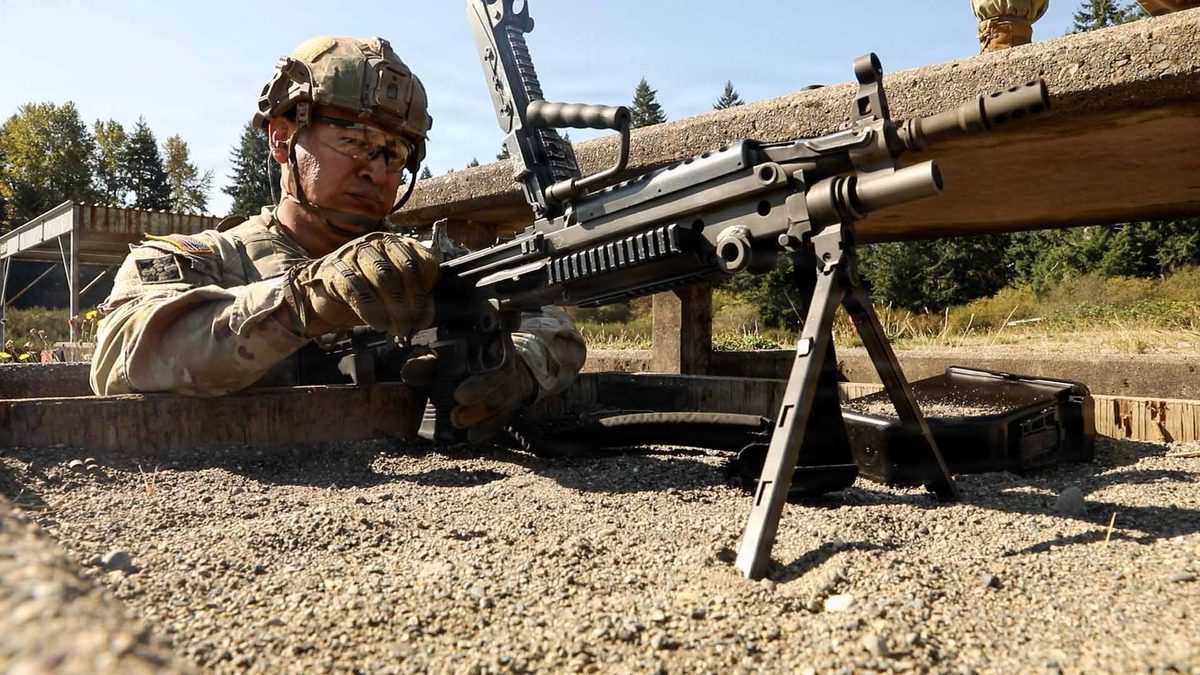
U.S. Army photo by Sgt. Brandon Bruer, 16th Combat Aviation Brigade / DVIDS. Public domain. Soldiers train with the M249 Squad Automatic Weapon, the 5.56mm light machine gun the SS109 round was optimised around.
The 5.56x45mm NATO Cartridge in 2026: A Compromise Asked to Do Too Much
The 5.56x45mm NATO cartridge, standardised under STANAG 4172 on 28 October 1980, was built as a compromise for two jobs: the individual rifle and the squad light machine gun. In 2026 the United States is fielding a 6.8x51mm replacement for its close combat force, while most of NATO keeps 5.56mm. The round is not obsolete, but it is being asked to do more than it was designed to do.
The requirement that built the cartridge
The 5.56mm story starts with a study, not a battle. After Korea, United States Army analysts looked hard at where infantry actually fired and hit. Most engagements happened well inside 300 metres. The 7.62x51mm NATO battle rifle round was accurate and powerful, yet it was heavy, and its recoil made automatic fire difficult to control. A soldier could carry only so many rounds of it.
In 1957 the Continental Army Command (CONARC) opened the Small Calibre High Velocity (SCHV) programme. The requirements were exact and demanding. A .22 calibre bullet had to stay supersonic to 500 yards (457 metres). It had to punch through one side of a United States steel helmet and 0.135 inches (3.4mm) of steel plate at that range. The rifle was to weigh about six pounds loaded and fire on full automatic. Eugene Stoner scaled his 7.62mm ArmaLite AR-10 down into the AR-15, and Remington stretched the commercial .222 varmint case into what became the .223 Remington. Loaded with a 55-grain bullet at roughly 3,250 feet per second (991 metres per second), it met the brief. The United States adopted it in the early 1960s as the M16 rifle and the Cartridge, 5.56mm Ball, M193.
M193 baseline specification (open sources)
| Case type | Rimless, bottlenecked, centrefire |
| Bullet weight | 55 grains (3.56 g), full metal jacket |
| Muzzle velocity | about 3,250 fps (991 m/s), 20-inch barrel |
| Chamber pressure | about 52,000 psi |
| Rifling twist | 1 turn in 12 inches (original M16) |
| Design intent | Flat trajectory and reliable fragmentation at close and medium range |
Standardisation: SS109 and STANAG 4172
M193 was a national round, not a NATO standard. That changed through a long competition. Between 1977 and 1980 NATO ran trials to pick a second, smaller service cartridge to sit beside the 7.62mm. Four contenders went forward: the United States 5.56mm entry, the Belgian SS109 from FN Herstal, a British 4.85x49mm design, and a German 4.7x33mm caseless round. The Belgian entry won.
SS109 was a different animal to M193. It carried a heavier 62-grain bullet with a mild steel penetrator tip ahead of a lead core, and a reshaped nose for steadier flight and better penetration at distance. NATO standardised it on 28 October 1980 under STANAG 4172, the Standardization Agreement that fixes the technical interchangeability of 5.56x45mm ammunition across the Alliance. The United States adopted the same load as the M855, the green tip, and issued it with the improved M16A2. The heavier bullet needed a faster spin to stabilise, so barrels moved from the old one turn in twelve inches to one in seven or one in nine.
| Parameter | M193 (1960s) | SS109 / M855 (STANAG 4172, 1980) |
|---|---|---|
| Bullet weight | 55 grains | 62 grains |
| Construction | Lead core, full metal jacket | Lead core with a mild steel penetrator tip |
| Muzzle velocity (20 in) | about 3,250 fps (991 m/s) | about 3,025 fps (922 m/s) |
| Optimised for | Short-range fragmentation | Penetration to 500 to 600 m, light machine gun |
| Twist required | 1:12 | 1:7 or 1:9 |
The change from M193 to SS109 traded short-range fragmentation for long-range penetration. The cartridge was quietly re-optimised around the light machine gun, and the rifleman inherited a compromise he never asked for. ISC open-source assessment
Did it work? The improvement trail
Partly. SS109 gave NATO the helmet and steel penetration it wanted for the FN Minimi light machine gun at 500 to 600 metres. It gave that up at the other end. The heavier, slower bullet fragments less reliably than M193, and 5.56mm bullets only fragment well above about 2,500 fps (760 m/s). Out of the short barrel of an M4 carbine, velocity falls away fast, and past 150 to 200 metres wounding can turn inconsistent. Soldiers noticed. So did armourers. What followed was thirty years of patches rather than a clean redesign.
The main attempts to fix the round, and the reason behind each, are set out below.
| Improvement | When | Why |
|---|---|---|
| SS109 / M855 green tip | 1980 | Helmet and steel penetration to about 600 m for the light machine gun |
| Faster twist, heavier barrels (1:7) | 1980s | Stabilise the heavier ball and the tracer bullet |
| Mk262 77-grain open tip match | 2000s | Accuracy and a heavier bullet for designated marksman use |
| Mk318 SOST 62-grain open tip match | 2010 | Consistent terminal effect and barrier performance from the 14-inch M4 barrel |
| M855A1 Enhanced Performance Round | 2010 | Copper core with an exposed hardened steel penetrator, better armour and barrier defeat from short barrels, lead free |
| Frangible anti-drone loads (USMC L-variant, GGG) | 2024 to 2026 | Engage small uncrewed aircraft, a role never in the original design |
One cartridge, how many jobs?
Here is the honest answer to the design question. 5.56mm SS109 was never meant to be a single do-all round. It was built as a two-role compromise. It had to serve the individual rifle, where close-range fragmentation matters most, and the squad automatic weapon, where reach and penetration matter most. Those two jobs pull the design in opposite directions. The 62-grain steel-tipped bullet and the fast twist were chosen for the machine gun and the 600-metre helmet shot. The rifleman inherited that choice.
The marksman role came later and was always a stretch. Designated marksmen wanted a heavier, more accurate bullet, so US Special Operations reached for the 77-grain Mk262 open tip match load. It works, within limits, but it is a workaround and not what the cartridge was built for. Now a fourth job has arrived. Small drones. Frangible anti-drone 5.56mm loads are in service or in trial, from the US Marine Corps L-variant to the Lithuanian GGG frangible round. One case, four missions, and none of them the same.
Fit for purpose in 2026?
The clearest verdict comes from the country that wrote the original requirement. In 2022 the US Army chose the 6.8x51mm Common Cartridge, the SIG Sauer .277 Fury, for its Next Generation Squad Weapon (NGSW) programme. The reason was blunt. Modern rifle-plate body armour, of the kind Russian and Chinese forces field, blunts 5.56mm at range. The 6.8mm round runs at a maximum chamber pressure of 80,000 pounds per square inch (550 megapascals), well above the roughly 62,000 psi of 5.56mm NATO, and it drives a heavier bullet hard enough to beat that armour.
The rifle that fires it, the M7, was type classified in May 2025 and is going to the close combat force first. It is heavier than the M4, by about two pounds, and a soldier carries roughly 70 fewer rounds for the same load weight. That weight became a complaint. By April 2026 the Army had accepted first deliveries of a shorter, lighter carbine, the XM8, in the same 6.8mm calibre, and it is set to replace the M7 in production. For the American front-line rifleman, the direction is clear: 5.56mm is on the way out.
NATO has not followed. The 6.8mm cartridge is a United States national choice, not a NATO standard. STANAG 4172 still governs 5.56x45mm, and it stays the standard individual weapon round for the great majority of the Alliance. Britain, France, Germany and most others still issue 5.56mm and are improving it, not retiring it. That gap is the real 2026 problem. It is not that 5.56mm suddenly stopped working. It is that the Alliance may be drifting toward two calibres for the same job, and toward the interoperability cost that split would carry.
Interoperability and safety notes
Two practical points sit underneath the strategy. First, interchangeability is not automatic. STANAG 4172, backed by the NATO Manual of Proof and Inspection (MOPI) held under the Alliance armaments structure, sets the dimensional and pressure limits that let one nation's 5.56mm feed another nation's weapon safely. That is not the same as saying every 5.56mm load performs alike. Second, the commercial .223 Remington and the military 5.56mm NATO are not the same specification. The NATO chamber has a longer throat and a higher pressure rating, so firing 5.56mm in a .223 chamber can drive pressures past safe limits. Twist rate matters too. The old one turn in twelve inch barrels will not stabilise the heavy match and tracer bullets the modern round depends on.
Data gaps
Several figures here carry the usual caveats. Muzzle velocities move with barrel length, lot and temperature, so the numbers quoted are nominal 20-inch barrel values from open sources. The exact edition and change state of STANAG 4172 in force in 2026 is not published openly and is treated here as the standing agreement rather than a dated revision. Armour-defeat and terminal performance for both 5.56mm and 6.8mm depends on the specific projectile and the target set, and much of the comparative test data is not public. Where a claim could not be confirmed against a primary source it is flagged here rather than asserted as fact.
Key Questions
Is the 5.56mm NATO cartridge obsolete in 2026?
No. The 5.56x45mm NATO round, standardised under STANAG 4172, is still the standard individual weapon cartridge for most of NATO in 2026. The United States is replacing it for its close combat force with a 6.8x51mm round, but Britain, France, Germany and others still issue and improve 5.56mm rather than retire it.
Why did NATO change from the M193 to the SS109 round?
NATO wanted better long-range performance for the FN Minimi light machine gun, including penetration of a steel helmet at 500 to 600 metres. The heavier 62-grain SS109 bullet with a steel penetrator tip delivered that reach, standardised as STANAG 4172 in 1980, at the cost of the short-range fragmentation the lighter 55-grain M193 gave.
Was the 5.56mm round meant to be a rifle, machine gun and marksman cartridge at once?
It was designed as a two-role compromise for the individual rifle and the squad automatic weapon, not a true do-all round. The designated marksman role, using heavier 77-grain match loads, and the newer anti-drone role were added later and were never part of the original SS109 design intent.
References
Source-evaluated under NATO STANAG 2022 (Reliability A–F / Accuracy 1–6). Tier 1 = government primary source; Tier 2 = quality news / specialist defence media; Tier 3 = authoritative aggregator / encyclopaedia.
- T1NATO Standardization Office – STANAG 4172: Technical performance specification for the interchangeability of 5.56 mm x 45 ammunition, standing agreement. (Reliability A / Accuracy 1)
- T1U.S. Army – Army moving forward with Next Generation Squad Weapon program, 2022. (Reliability A / Accuracy 1)
- T2Army Recognition – U.S. Army officially deploys M7 6.8mm rifle to replace M4A1 in combat units, 2026. (Reliability B / Accuracy 2)
- T2RECOIL – What Is .277 Fury: Basics, Ballistics and Army Adoption, 2023. (Reliability B / Accuracy 2)
- T3Wikipedia – 5.56x45mm NATO, accessed 13 July 2026. (Reliability C / Accuracy 3)
- T3Wikipedia – Next Generation Squad Weapon, accessed 13 July 2026. (Reliability C / Accuracy 3)
Corrections & updates welcome. If you hold open-source data that refines or corrects any parameter in this article, please contact [email protected] citing the specific claim and your source. Verified corrections will be incorporated and credited in the revision history. AI-assisted technical assessment based on open-source material. Not a formal intelligence product.