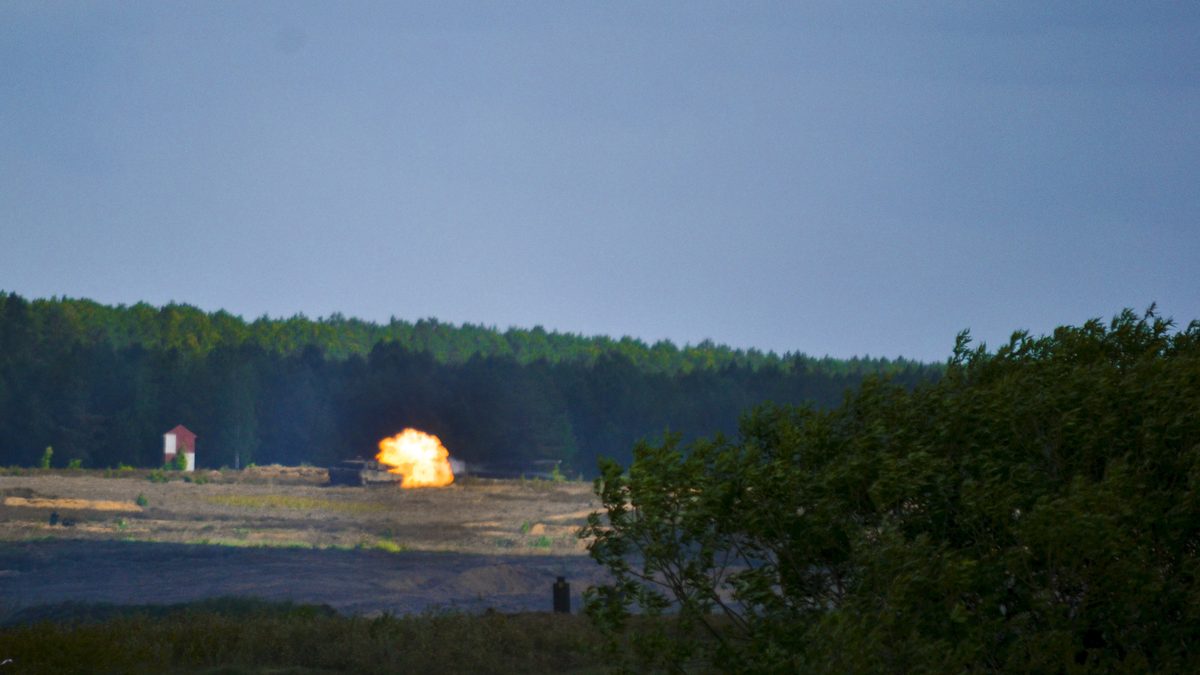
A Polish Army Leopard 2PL of the 10th Armoured Cavalry Brigade fires during the Defender Europe 22 live-fire exercise at Drawsko Pomorskie, Poland, 27 May 2022. U.S. Army photo by Capt. Tobias Cukale (DVIDS), public domain; cropped by ISC.
Poland Relaunches Its 7.62mm and .338 Lapua Magnum Ammunition Tender After April Cancellation
Poland's Agencja Uzbrojenia relaunched its small-calibre ammunition and smoke-grenade tender on 6 July 2026 under TED notice 463399-2026, after cancelling the original September 2025 procedure on 27 April 2026 so the purchase could be refitted for European Union SAFE funding rules. The three lots cover 280,000 linked 7.62x51mm DA165 rounds, 45,000 rounds of .338 Lapua Magnum and 11,604 76mm smoke grenades; requests to participate close on 10 August 2026.
Technical Summary
The North Atlantic Treaty Organization (NATO) member's procurement authority, the Agencja Uzbrojenia (Armament Agency), has split the requirement into three lots. Part I is 280,000 rounds of linked 7.62x51mm NATO carrying the DA165 projectile, a 165 grain (about 10.7 gram) bullet, for the Dillon Aero M134D, a six-barrel rotary machine gun (minigun), deliverable by 31 October 2029. Part II is 11,604 76mm smoke grenades for the Wegmann dischargers fitted to Leopard 2A4, 2A5, 2PL and 2PLM1 main battle tanks, due by the same date. Part III is 45,000 rounds of 8.6x70mm (.338 Lapua Magnum) carrying a 19.4 gram (about 300 grain) Lock Base projectile, on the shortest deadline of the three, 29 October 2027. Each lot admits a qualified equivalent to the named nature, and deliveries run to the military depots at Mosty, Szeroki Bór (Pisz) and Duninów (Chocianów).
| Lot | Nature | Quantity | Key specification | Primary platform(s) | Delivery deadline |
|---|---|---|---|---|---|
| Part I | 7.62x51mm NATO, linked | 280,000 rounds | DA165 projectile (165 grain / approx. 10.7 g), or equivalent | Dillon Aero M134D minigun (GROM; Special Operations air component) | 31 October 2029 |
| Part II | 76mm smoke grenade | 11,604 grenades | Wegmann-type discharger compatibility, or equivalent | Leopard 2A4 / 2A5 / 2PL / 2PLM1 | 31 October 2029 |
| Part III | 8.6x70mm (.338 Lapua Magnum) | 45,000 rounds | 19.4 g (approx. 300 grain) Lock Base projectile, or equivalent | AWM-F, Mini-Hecate .338 and TRG M10 precision rifles | 29 October 2027 |
This is the second attempt at the combined purchase, recorded as contract notice 463399-2026 in the European Union's Tenders Electronic Daily (TED). The original tender opened on 1 September 2025 and was cancelled on 27 April 2026. The cancellation notice gave no reason. Polish defence reporting at the time tied the decision to financing: the expenditure was to move wholly or partly onto the European Union's Security Action for Europe (SAFE) instrument, and a procedure already running under the old footing could not meet the competition and transparency conditions that EU funding attaches, so the Agency cancelled and reformatted. Poland has already routed a PLN 13.5 billion 155mm artillery ammunition order through SAFE, covered in ISC's earlier assessment. For the .338 Lapua Magnum element this is in fact the third attempt, after a standalone 45,000-round tender opened on 14 October 2024 was cancelled on 6 June 2025.
The relaunch is a restricted competitive procedure, a two-stage process in which candidates first submit requests to participate and only shortlisted firms are then invited to tender. The MILMAG headline figure of about 330,000 items aggregates the two ammunition lots (325,000 rounds) with the 11,604 grenades. No contract value was published.
The relaunched requirement covers 280,000 rounds of 7.62x51mm NATO for M134D miniguns and 45,000 rounds of .338 Lapua Magnum for precision rifles, a dual-calibre package now competing for the same finite European small-calibre production capacity the United Kingdom is booking for its own replenishment. ISC open-source assessment, 12 July 2026
Analysis of Effects
Ammunition for a rotary minigun is not interchangeable in practice with rifle-grade ball simply because both are 7.62x51mm NATO. The M134D fires at a fixed 3,000 rounds per minute, 50 rounds a second, so cartridge case hardness, primer sensitivity, projectile crimp and belt-link tolerance must all be held tightly to avoid stoppages and out-of-battery events at that rate. Dillon Aero quotes a system life beyond 1.5 million rounds, a figure that assumes ammunition certified for link-fed quality at volume. The DA165 nature named in the notice is therefore a meaningful specification, not a formality. It is also an established one: Poland has procured DA165 for these guns before, including a December 2021 tender for 189,000 rounds of the same nature.
The .338 Lapua Magnum lot addresses the extended-range precision role. In Polish service the calibre feeds the Accuracy International AWM-F, the folding-stock Arctic Warfare Magnum carried by Special Forces, the PGM Precision Mini-Hecate .338 and the SAKO TRG M10, the last delivered from 2017 under the Kij programme that gave the Territorial Defence Forces 150 rifles; Land Forces marksmen use the calibre as well. The 19.4 gram Lock Base is a solid-base full-metal-jacket design of about 300 grains favoured for consistent long-range behaviour, and the cartridge holds supersonic flight far enough for an effective range around 1,500 metres, roughly double a 7.62x51mm sniper nature. Lock Base is a Lapua design, and Lapua sits inside the Nammo group, so the or-equivalent wording is the clause that opens the lot to qualified producers beyond the originator's group. The award will draw on the same European precision-ammunition base that the United Kingdom is courting for Project Shamer, and the 29 October 2027 deadline runs this lot two full years ahead of the volume lots.
The smoke-grenade lot completes the package. Leopard 2 turrets mount banks of Wegmann 76mm dischargers fired electrically, singly or in salvos of four, to throw an instant screen between the tank and an observer or seeker. The high-performance natures in this calibre are red phosphorus (RP) based and increasingly multispectral. The mechanism repays attention: an air-bursting element blooms the screen instantly while ground-burning canisters sustain it, and burning phosphorus defeats thermal sensors twice, first by over-radiating them, then because the phosphorus pentoxide it produces hydrates in air into an aerosol that absorbs infrared as well as scattering visible light. Australian Defence Science and Technology Organisation trial work on RP natures of this family, reported by Smit, Lee and Burridge at the PARARI symposium in 2007, put a 12-round salvo at full visual obscuration of a main battle tank within 3 seconds, a screen frontage beyond 100 metres, duration over 60 seconds, and long-wave infrared obscuration building inside the same 3 seconds.
European industry sells that performance off the shelf, which is what gives the or-equivalent clause its teeth. Rheinmetall Waffe Munition's 76mm MASKE is a bi-modular multispectral grenade pairing a rapid-reaction jamming module, which over-radiates seekers using decoy technology, with a long-duration visual and infrared screening module. The manufacturer's datasheet quotes effect within 2 seconds of burst and a 30 to 50 metre screen holding 35 seconds in the visual band and more than 30 seconds in the infrared, from a 1.35 kilogram, 178 millimetre grenade carried as UN 0303, Hazard Division 1.4G, nontoxic to STANAG 4588, in service and combat proven. Wescom Defence in the United Kingdom fields a parallel 76mm family: the V731 builds its screen from twin ground-burning red phosphorus canisters with a nominal 30 second burn; the multispectral V741 ejects three payloads up to 45 metres so an air-burst element screens instantly in visual and infrared while the ground-burn element holds past 30 seconds, and it is qualified electromagnetically safe to MIL-STD-464 for handling around emitting platforms; the V745 is its sister nature, combining the same air-burst and ground-burn red phosphorus elements. Poland's December 2021 tender bought 12,000 German DM35 76mm grenades for the same dischargers, and the 11,604 now sought replenish the fleet across the 2A4, 2A5, 2PL and 2PLM1 variants.
| Nature | Producer | Concept | Screen build and duration | Key data (manufacturer) |
|---|---|---|---|---|
| 76mm MASKE | Rheinmetall Waffe Munition | Bi-modular multispectral: over-radiation jamming module plus long-duration visual and IR smoke | Effective within 2 s; VIS 35 s, IR over 30 s | 1.35 kg, 178 mm; screen 30 to 50 m wide; UN 0303, HD 1.4G; NSN 1330-12-367-2456 |
| V731 | Wescom Defence | Twin ground-burning red phosphorus canisters, visual screening | Instant salvo screen, no window-hole effect; 30 s nominal burn | Mission-selectable: camouflage, concealment, deception |
| V741 | Wescom Defence | Multispectral: three payloads ejected to 45 m, air-burst plus ground-burn red phosphorus | Instant visual and IR bloom; ground burn over 30 s | HERO-safe to MIL-STD-464 |
| V745 | Wescom Defence | Multispectral: air-burst element plus ground-burn element, visual and IR | Instant bloom; sustained ground burn | Sister nature to the V741 |
Personnel and Safety Considerations
The two ball natures are inert-projectile cartridges whose only energetic content is propellant and primer, so Net Explosive Quantity (NEQ) is not a governing figure for them individually. Packaged small-arms ammunition of this kind is normally assigned Hazard Division 1.4, Compatibility Group S, and bulk storage is still managed under recognised explosives-storage rules such as Allied Ammunition Storage and Transport Publication AASTP-1 (Edition C) and the national equivalent. The 76mm smoke grenades are the energetic item of interest: each carries a pyrotechnic obscurant fill and an expelling or bursting charge, so a Hazard Division (HD) and Compatibility Group (CG) must be confirmed for transport and storage; for calibration, Rheinmetall lists its in-service 76mm MASKE at UN 0303, HD 1.4G. The combustion products of the screening composition, for red phosphorus fills the phosphorus pentoxide aerosol and the acids it forms with atmospheric moisture, carry the usual inhalation and confined-space considerations. Transport falls under the European Agreement concerning the International Carriage of Dangerous Goods by Road (ADR).
Data Gaps
Several parameters are not in the open-source record and should be treated as gaps. The exact construction of the 7.62mm DA165 projectile is not confirmed beyond the designation and its 165 grain mass. The precise Lock Base loading for the .338 Lapua Magnum lot is not stated beyond the 19.4 gram projectile mass, and equivalents are admitted. The screening composition, Hazard Division and Compatibility Group of the 76mm smoke grenade are not published, and the notice does not say whether a single-band or multispectral nature is required, though European producers offer both. No total or per-lot contract value is disclosed. The cancellation notice for the first tender gave no reason; the SAFE financing explanation rests on Polish press reporting and is not confirmed in the notice text itself. Whether the Polish state producer participates is not indicated in the public record.
Key Questions
What is Poland buying in the relaunched ammunition tender?
The Armament Agency is buying, for 2027 to 2029, 280,000 linked rounds of 7.62x51mm NATO (DA165) for Dillon Aero M134D miniguns, 45,000 rounds of 8.6x70mm .338 Lapua Magnum (19.4 gram Lock Base) for precision rifles, and 11,604 76mm smoke grenades for Leopard 2 dischargers.
Why did Poland relaunch the tender?
The original combined tender, opened on 1 September 2025, was cancelled on 27 April 2026. The cancellation notice gave no reason, but Polish defence reporting tied it to refinancing under the European Union's SAFE instrument, which requires EU-compliant competitive procedures. The Agencja Uzbrojenia reissued the requirement on 6 July 2026 as a restricted two-stage procedure, with requests to participate closing on 10 August 2026.
Which rifles use Poland's .338 Lapua Magnum ammunition?
Polish Special Forces field the Accuracy International AWM-F, PGM Precision Mini-Hecate .338 and SAKO TRG M10 in 8.6x70mm, alongside Land Forces and Territorial Defence Forces marksmen; the Territorial Defence Forces took 150 TRG M10 under the Kij programme from 2017. The calibre is the principal NATO extended-range precision anti-personnel nature, effective to roughly 1,500 metres.
References
Source-evaluated under NATO STANAG 2022 (Reliability A–F / Accuracy 1–6). Tier 1 = government primary source; Tier 2 = quality news / specialist defence media; Tier 3 = authoritative aggregator / encyclopaedia.
- T1Tenders Electronic Daily (TED) – Contract notice 463399-2026 (Agencja Uzbrojenia): delivery of ammunition and smoke grenades 2027 to 2029, Parts I to III, 6 July 2026. (Reliability A / Accuracy 1)
- T2MILMAG – Polish Armament Agency relaunches tender for 330,000 rounds of ammunition and grenades, 6 July 2026. (Reliability B / Accuracy 2)
- T2Defence24 – Wstrzymane zakupy amunicji dla wojska: decyzja Agencji Uzbrojenia (ammunition tenders halted for SAFE refinancing), 28 April 2026. (Reliability B / Accuracy 2)
- T2Defence24 – Polish Armed Forces procure minigun ammunition (DA165, 165 grain, for the M134D), 1 April 2020. (Reliability B / Accuracy 2)
- T2Defence24 – Wojsko kupuje naboje do minigunów i granaty dymne (the 2021 DA165 and DM35 procurement), 31 December 2021. (Reliability B / Accuracy 2)
- T2Dillon Aero – M134D (7.62x51mm rotary machine gun), technical overview, accessed 12 July 2026. (Reliability B / Accuracy 2)
- T2Rheinmetall Waffe Munition – MASKE Smoke Grenade 76mm, technical datasheet D217e05.22 (smoke protection systems for land vehicles), 2022 edition, accessed 12 July 2026. (Reliability B / Accuracy 2)
- T2Wescom Defence – 76mm vehicle-launched grenade RP (V731); 76mm multi-spectral (V741); 76mm multi-spectral (V745), accessed 12 July 2026. (Reliability B / Accuracy 2)
- T2Smit, K.J., Lee, A. and Burridge, M., Defence Science and Technology Organisation (Australia) – Multispectral Smoke Obscurants for M1A1 Abrams Tank and M88A2 Hercules Recovery Vehicle, PARARI 2007 (8th Australian Explosive Ordnance Symposium). Conference paper, copy held by ISC. (Reliability B / Accuracy 2)
- T3Wikipedia – .338 Lapua Magnum (8.6x70mm) cartridge and Accuracy International AWM references, accessed 12 July 2026. (Reliability C / Accuracy 3)
- T3Grokipedia – PGM 338 (PGM Precision Mini-Hecate .338, 8.6x70mm precision rifle) reference, accessed 12 July 2026. (Reliability C / Accuracy 3)
Corrections & updates welcome. If you hold open-source data that refines or corrects any parameter in this article, please contact [email protected] citing the specific claim and your source. Verified corrections will be incorporated and credited in the revision history. AI-assisted technical assessment based on open-source material. Not a formal intelligence product.