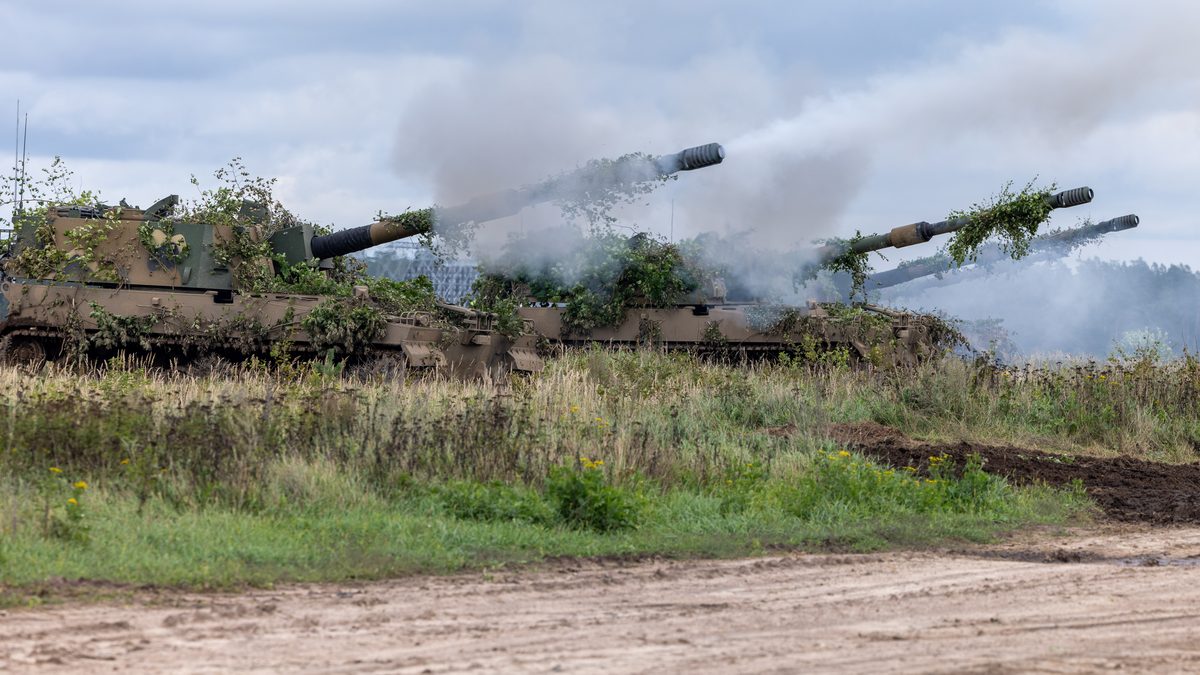
Polish Land Forces AHS Krab 155mm self-propelled howitzers fire during exercise Iron Defender-25, Orzysz Training Area, Poland, September 2025. Photo: Pfc. Andre Gremillion Jr, U.S. Army (DVIDS, public domain). Illustrative of the KRAB platform used for the WITU certification firing; not the MESKO propellant line.
Czechoslovak Group Transfers 155mm Propellant Technology to Poland's MESKO for Modular Artillery Charges
Technical Summary
Czechoslovak Group (CSG), the Central European defence holding led by Michal Strnad, has completed the transfer of gun propellant production technology to MESKO S.A., a company within Poland's state defence group Polska Grupa Zbrojeniowa (PGZ). The propellant is manufactured into modular propellant charges (MPC) for 155mm artillery ammunition, and a first production batch has already been fired from KRAB 155mm self-propelled howitzers. CSG confirmed completion of the transfer on 8 July 2026, with MESKO issuing a parallel statement the same day.
The transfer is one element of the December 2023 executive agreement between Poland's Armament Agency (Agencja Uzbrojenia) and the PGZ-Amunicja consortium for nearly 300,000 rounds of 155mm artillery ammunition, worth about 11 billion zloty, with deliveries running from 2024 to 2029 under the National Ammunition Reserve programme. CSG supplied the technical documentation, supported the commissioning of a new propellant line, and assisted with the first trial batch. That batch passed laboratory characterisation and a certification firing conducted by Poland's Military Institute of Armament Technology (WITU), clearing the propellant for series production at MESKO's plant in Pionki. The new propellant capability sits within MESKO's wider Project 400 programme at Pionki, a modernisation effort running since 2019 with a budget of around 466.7 million zloty, under which multi-base propellant production is being brought on line in 2026.
The propellant already produced by MESKO has successfully completed both laboratory testing and live-fire trials using KRAB self-propelled howitzers, confirming the successful transfer of the technology. Wojciech Grzonka, CEO of CSG Polska and Vice President Sales, CSG
Analysis of Effects
For a modern 155mm 52-calibre system such as KRAB, the propelling charge is the decisive variable behind muzzle velocity, achievable range and barrel wear. Modular charge architectures replace fixed bagged charges with interchangeable combustible-cased increments that gunners combine to select a firing zone, giving a single inventory that spans short-range high-angle fire to maximum-range shoots. Sovereign manufacture of the propellant grain and the modular increment is therefore not a peripheral component: it is the item that sets the ballistic performance of every round MESKO assembles.
Neither CSG nor MESKO disclosed the propellant chemistry, grain geometry, increment mass or the number of charge zones qualified, and the specific CSG subsidiary that owns the transferred technology was not named. What both parties did confirm is a complete qualification path, from technical data package through new-line commissioning to a certified trial batch proven under proving-ground conditions in a KRAB gun. Certification firing by WITU against defined requirements points to a mature qualification programme rather than a laboratory demonstrator, and it is the step that lets the Pionki line move from trial to series output.
Public reference data for NATO-standard 155mm modular charge systems indicates the ballistic envelope such a propellant governs, although none of these figures describe the undisclosed MESKO product. Rheinmetall's qualified 155mm modular charge system, developed for NATO 39-calibre and 52-calibre guns under the Joint Ballistic Memorandum of Understanding (JBMOU) and listed as compatible with KRAB, records a mean muzzle velocity of 945 metres per second from a 52-calibre barrel firing a six-module top charge with an L15A1 projectile at 21 degrees Celsius, with an upper pressure limit at propellant proof of 391 megapascals at 63 degrees Celsius. That reference system is bi-modular, pairing a low-zone module with a high-zone module so a single family of increments covers the firing range from short high-angle shoots to extended-range fire. The parameters MESKO has qualified for its own charge are not public, but this is the class of performance a sovereign modular-charge line is built to deliver.
Domestic propellant is only one half of a modular charge. This transfer runs alongside a separate Eurenco and MESKO project at Pionki, where an assembly line for Eurenco's Bi-Modular Charge System reached operational readiness in July 2025 with a stated capacity of up to 100,000 charge systems per year. Read together, sovereign propellant manufacture and local charge assembly move Poland toward end-to-end national production of complete 155mm modular charges rather than final assembly from imported energetics.
Thanks to our cooperation with CSG, we have increased our level of independence from external suppliers and strengthened the supply chain within Polska Grupa Zbrojeniowa. Renata Gruszczyńska, President of the Management Board, MESKO S.A.
Personnel and Safety Considerations
Gun propellant and assembled modular charges are energetic stores in their own right. On the balance of open-source evidence and typical practice, bulk propellant and propelling charges of this class are assigned Hazard Division (HD) 1.3, Compatibility Group (CG) C, the mass-fire rather than mass-detonation category, although neither company published a hazard classification and this figure is an ISC assessment rather than a sourced parameter. Series manufacture of nitrocellulose-based propellant at Pionki, and the storage and transport of finished charges, fall under the NATO AASTP-1 (Edition C) storage principles and the United Nations Recommendations on the Transport of Dangerous Goods as reflected in ADR for road movement. Qualification of the energetic material for military service is governed by NATO STANAG 4170 and its associated Allied Ordnance Publication AOP-7 test protocols.
Data Gaps
Several technical parameters are absent from the open-source record: the propellant chemistry (single, double or triple base) and grain geometry; the modular charge designation, increment mass and number of qualified zones; the Hazard Division and Compatibility Group assigned to the finished charge; the net explosive quantity per charge and per packaged unit; the identity of the CSG subsidiary that owns the transferred technology; and the planned annual output and delivery schedule from the Pionki line. These gaps limit assessment of throughput and of the storage and transport burden the new capacity will place on Polish sites.
Key Questions
What did Czechoslovak Group transfer to MESKO?
CSG transferred gun propellant production technology to MESKO S.A., part of Poland's PGZ group. It supplied technical documentation, helped commission a new propellant line, and supported a first trial batch. The propellant is used in modular charges for 155mm artillery ammunition and is now cleared for series production at Pionki.
How was the new Polish propellant proven?
The first batch produced by MESKO passed laboratory characterisation and a certification trial firing conducted by Poland's Military Institute of Armament Technology. The firing used a KRAB 155mm self-propelled howitzer under proving-ground conditions, confirming the propellant met defined requirements before series production was authorised at Pionki.
Why does the transfer matter for NATO's eastern flank?
Poland is building sovereign capacity to produce complete 155mm ammunition rather than depend on imported components. Domestic propellant manufacture reduces reliance on external suppliers, strengthens the PGZ supply chain, and supports the December 2023 Armament Agency contract, adding resilient artillery-ammunition output on NATO's eastern flank.
References
Source-evaluated under NATO STANAG 2022 (Reliability A–F / Accuracy 1–6). Tier 1 = government primary source; Tier 2 = quality news / specialist defence media; Tier 3 = authoritative aggregator / encyclopaedia.
- T1Czechoslovak Group (CSG) – CSG transfers key propellant technology to MESKO, strengthening Poland's ammunition production, 8 July 2026. (Reliability A / Accuracy 1)
- T1MESKO S.A. (Polska Grupa Zbrojeniowa) – CSG transfers key propellant technology to MESKO, strengthening Poland's ammunition production, 8 July 2026. (Reliability A / Accuracy 1)
- T2GlobeNewswire (CSG wire distribution) – CSG transfers key propellant technology to MESKO, strengthening Poland's ammunition production, 9 July 2026. (Reliability B / Accuracy 2)
- T2EDR Magazine – CSG transfers key propellant technology to MESKO, strengthening Poland's ammunition production, 8 July 2026. (Reliability B / Accuracy 2)
- T3ASDNews (syndicated MESKO release) – CSG Transfers Key Propellant Technology to Mesko, Strengthening Poland's Ammunition Production, 8 July 2026. (Reliability C / Accuracy 3)
- T2Rheinmetall – 155mm Artillery Modular Charge System (product datasheet, JBMOU 39/52-calibre reference figures, KRAB compatibility). (Reliability B / Accuracy 2)
- T2MILMAG – Mesko finalizes Project 400 and Project 44.7 – key investments in Poland's defense industry. (Reliability B / Accuracy 3)
- T2Defence Industry Europe – EURENCO and MESKO launch new assembly line for 155mm modular charges in Poland (Bi-Modular Charge System line at Pionki, operational July 2025). (Reliability B / Accuracy 2)
- T1Dezamet (PGZ-Amunicja consortium member) – Record contract for 155 mm ammunition for the Polish army (Dec 2023 executive agreement, ~300,000 rounds, deliveries 2024–2029). (Reliability A / Accuracy 2)
Corrections & updates welcome. If you hold open-source data that refines or corrects any parameter in this article, please contact [email protected] citing the specific claim and your source. Verified corrections will be incorporated and credited in the revision history. AI-assisted technical assessment based on open-source material. Not a formal intelligence product.